
用 Identity Server 4 (JWKS 端点和 RS256 算法) 来保护 Python web api
[新添加] 本文对应的源码 (多个flow, clients, 调用python api): https://github.com/solenovex/Identity-Server-4-Python-Hug-Api-Jwks
目前正在使用asp.net core 2.0 (主要是web api)做一个项目, 其中一部分功能需要使用js客户端调用python的pandas, 所以需要建立一个python 的 rest api, 我暂时选用了hug, 官网在这: http://www.hug.rest/.
目前项目使用的是identity server 4, 还有一些web api和js client.
项目的早期后台源码: https://github.com/solenovex/asp.net-core-2.0-web-api-boilerplate
下面开始配置identity server 4, 我使用的是windows.
添加ApiResource:
在 authorization server项目中的配置文件添加红色部分, 这部分就是python hug 的 api:
public static IEnumerable<ApiResource> GetApiResources()

        {

            return new List<ApiResource>

            {

                new ApiResource(SalesApiSettings.ApiName, SalesApiSettings.ApiDisplayName) {

                    UserClaims = { JwtClaimTypes.Name, JwtClaimTypes.PreferredUserName, JwtClaimTypes.Email }

                },

                new ApiResource("purchaseapi", "采购和原料库API") {

                    UserClaims = { JwtClaimTypes.Name, JwtClaimTypes.PreferredUserName, JwtClaimTypes.Email }

                },

                new ApiResource("hugapi", "Hug API") {

                    UserClaims = { JwtClaimTypes.Name, JwtClaimTypes.PreferredUserName, JwtClaimTypes.Email }

                }

            };

        }
修改js Client的配置:
// Sales JavaScript Client

                new Client

                {

                    ClientId = SalesApiSettings.ClientId,

                    ClientName = SalesApiSettings.ClientName,

                    AllowedGrantTypes = GrantTypes.Implicit,

                    AllowAccessTokensViaBrowser = true,

                    AccessTokenLifetime =  * ,

                    AllowOfflineAccess = true,

                    RedirectUris =           { $"{Startup.Configuration["MLH:SalesApi:ClientBase"]}/login-callback", $"{Startup.Configuration["MLH:SalesApi:ClientBase"]}/silent-renew.html" },

                    PostLogoutRedirectUris = { Startup.Configuration["MLH:SalesApi:ClientBase"] },

                    AllowedCorsOrigins =     { Startup.Configuration["MLH:SalesApi:ClientBase"] },

                    AlwaysIncludeUserClaimsInIdToken = true,

                    AllowedScopes =

                    {

                        IdentityServerConstants.StandardScopes.OpenId,

                        IdentityServerConstants.StandardScopes.Profile,

                        IdentityServerConstants.StandardScopes.Email,

                        SalesApiSettings.ApiName,

                        "hugapi"

                    }

                }
修改js客户端的oidc client配置选项:
添加 hugapi, 与authorization server配置对应.
{

        authority: 'http://localhost:5000',

        client_id: 'sales',

        redirect_uri: 'http://localhost:4200/login-callback',

        response_type: 'id_token token',

        scope: 'openid profile salesapi hugapi email',

        post_logout_redirect_uri: 'http://localhost:4200',

        silent_redirect_uri: 'http://localhost:4200/silent-renew.html',

        automaticSilentRenew: true,

        accessTokenExpiringNotificationTime: 4,

        // silentRequestTimeout:10000,

        userStore: new WebStorageStateStore({ store: window.localStorage })

    }
建立Python Hug api
(可选) 安装virtualenv:
pip install virtualenv
然后在某个地方建立一个目录:
mkdir hugapi && cd hugapi
建立虚拟环境:
virtualenv venv
激活虚拟环境:
venv\Scripts\activate
然后大约这样显示:

安装hug:
pip install hug
这时, 参考一下hug的文档. 然后建立一个简单的api. 建立文件main.py:
import hug

@hug.get('/home')

def root():

    return 'Welcome home!'
运行:
hug -f main.py
结果好用:

然后还需要安装这些:
pip install cryptography pyjwt hug_middleware_cors
其中pyjwt是一个可以encode和decode JWT的库, 如果使用RS256算法的话, 还需要安装cryptography.
而hug_middleware_cors是hug的一个跨域访问中间件(因为js客户端和这个api不是在同一个域名下).
添加需要的引用:
import hug

import jwt

import json

import urllib.request

from jwt.algorithms import get_default_algorithms

from hug_middleware_cors import CORSMiddleware
然后正确的做法是通过Authorization Server的discovery endpoint来找到jwks_uri,
identity server 4 的discovery endpoint的地址是:
http://localhost:5000/.well-known/openid-configuration, 里面能找到各种节点和信息:
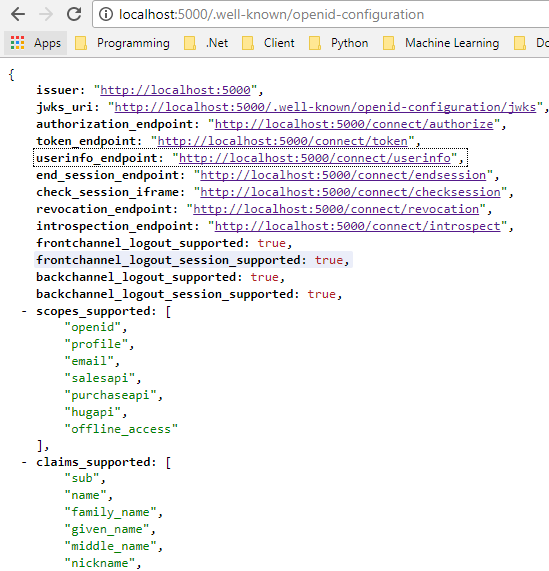
但我还是直接写死这个jwks_uri吧:
response = urllib.request.urlopen('http://localhost:5000/.well-known/openid-configuration/jwks')

still_json = json.dumps(json.loads(response.read())['keys'][0])
identity server 4的jwks_uri, 里面是public key, 它的结构是这样的:
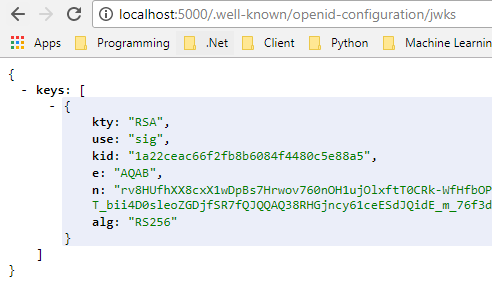
而我使用jwt库, 的参数只能传入一个证书的json, 也可就是keys[0].
所以上面的最后一行代码显得有点.......
如果使用python-jose这个库会更简单一些, 但是在我windows电脑上总是安装失败, 所以还是凑合用pyjwt吧.
然后让hug api使用cors中间件:
api = hug.API(__name__)

api.http.add_middleware(CORSMiddleware(api))
然后是hug的authentication部分:
def token_verify(token):

    token = token.replace('Bearer ', '')

    rsa = get_default_algorithms()['RS256']

    cert = rsa.from_jwk(still_json)

    try:

        result = jwt.decode(token, cert, algorithms=['RS256'], audience='hugapi')

        print(result)

        return result

    except jwt.DecodeError:

        return False

token_key_authentication = hug.authentication.token(token_verify)
通过rsa.from_jwk(json) 就会得到key (certificate), 然后通过jwt.decode方法可以把token进行验证并decode, 算法是RS256, 这个方法要求如果token里面包含了aud, 那么方法就需要要指定audience, 也就是hugapi.
最后修改api 方法, 加上验证:
@hug.get('/home', requires=token_key_authentication)

def root():

    return 'Welcome home!'
最后运行 hug api:
hug -f main.py
端口应该是8000.
运行js客户端,登陆, 并调用这个hug api http://localhost:8000/home:
(我的js客户端是angular5的, 这个没法开源, 公司财产, 不过配置oidc-client还是很简单的, 使用)
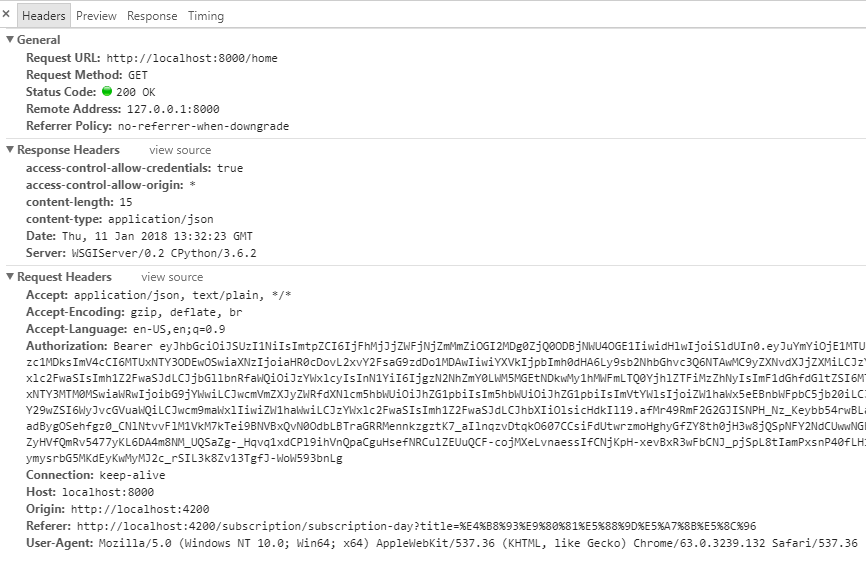
返回200, 内容是:

看一下hug的log:

token被正确验证并解析了. 所以可以进入root方法了.
其他的python api框架, 都是同样的道理.
[新添加] 本文对应的源码 (多个flow, clients, 调用python api): https://github.com/solenovex/Identity-Server-4-Python-Hug-Api-Jwks
可以使用这个例子自行搭建 https://github.com/IdentityServer/IdentityServer4.Samples/tree/release/Quickstarts/7_JavaScriptClient
官方还有一个nodejs api的例子: https://github.com/lyphtec/idsvr4-node-jwks
今日修改后的代码:
import json

import hug

import jwt

import requests

from jwt.algorithms import get_default_algorithms

from hug_middleware_cors import CORSMiddleware

api = hug.API(__name__)

api.http.add_middleware(CORSMiddleware(api))

def token_verify(token):

    access_token = token.replace('Bearer ', '')

    token_header = jwt.get_unverified_header(access_token)

    res = requests.get(

        'http://localhost:5000/.well-known/openid-configuration')

    jwk_uri = res.json()['jwks_uri']

    res = requests.get(jwk_uri)

    jwk_keys = res.json()

    rsa = get_default_algorithms()['RS256']

    key = json.dumps(jwk_keys['keys'][0])

    public_key = rsa.from_jwk(key)

    try:

        result = jwt.decode(access_token, public_key, algorithms=[

                            token_header['alg']], audience='api1')

        return result

    except jwt.DecodeError:

        return False

token_key_authentication = hug.authentication.token(token_verify)

@hug.get('/identity', requires=token_key_authentication)

def root(user: hug.directives.user):

    print(user)

    return user
我的博客即将搬运同步至腾讯云+社区,邀请大家一同入驻:https://cloud.tencent.com/developer/support-plan
用 Identity Server 4 (JWKS 端点和 RS256 算法) 来保护 Python web api的更多相关文章
- Identity Server 4 从入门到落地(四)—— 创建Web Api
前面的部分: Identity Server 4 从入门到落地(一)-- 从IdentityServer4.Admin开始 Identity Server 4 从入门到落地(二)-- 理解授权码模式 ...
- Identity Server 4 从入门到落地(三)—— 创建Web客户端
书接上回,我们已经搭建好了基于Identity Server 4的认证服务和管理应用(如果还没有搭建,参看本系列前两部分,相关代码可以从github下载:https://github.com/zhen ...
- 使用PostMan Canary测试受Identity Server 4保护的Web Api
在<Asp.Net Core: Swagger 与 Identity Server 4>一文中介绍了如何生成受保护的Web Api的Swagger文档,本文介绍使用PostMan Cana ...
- 第17章 社区快速入门和模板 - Identity Server 4 中文文档(v1.0.0)
IdentityServer组织不维护这些示例.IdentityServer组织愉快地链接到社区模板,但不能对模板做出任何保证.请直接与作者联系. 17.1 各种ASP.NET核心安全样本 https ...
- Identity Server 4 从入门到落地(五)—— 使用Ajax访问Web Api
前面的部分: Identity Server 4 从入门到落地(一)-- 从IdentityServer4.Admin开始 Identity Server 4 从入门到落地(二)-- 理解授权码模式 ...
- Identity Server 4 从入门到落地(六)—— 简单的单页面客户端
前面的部分: Identity Server 4 从入门到落地(一)-- 从IdentityServer4.Admin开始 Identity Server 4 从入门到落地(二)-- 理解授权码模式 ...
- Identity Server 4 从入门到落地(七)—— 控制台客户端
前面的部分: Identity Server 4 从入门到落地(一)-- 从IdentityServer4.Admin开始 Identity Server 4 从入门到落地(二)-- 理解授权码模式 ...
- Identity Server 4 从入门到落地(八)—— .Net Framework 客户端
前面的部分: Identity Server 4 从入门到落地(一)-- 从IdentityServer4.Admin开始 Identity Server 4 从入门到落地(二)-- 理解授权码模式 ...
- Identity Server 4 从入门到落地(九)—— 客户端User和Role的解析
前面的部分: Identity Server 4 从入门到落地(一)-- 从IdentityServer4.Admin开始 Identity Server 4 从入门到落地(二)-- 理解授权码模式 ...
随机推荐
- 如何用shell脚本取出服务器图片
一 ,SHELL 是什么 (1)shell是一种命令行解释器. (2)是用户和Linux内核之间沟通的桥梁,属于中间件.见下图 (3)交互流程:shell接受用户输入的指令 =>将指令传达给Li ...
- 错误代码: 1054 Unknown column 't.createUsrId' in 'group statement'
1.错误描写叙述 1 queries executed, 0 success, 1 errors, 0 warnings 查询:select count(t.id),t.`createUserId` ...
- LeetCode(24) Swap Nodes in Pairs
题目 Given a linked list, swap every two adjacent nodes and return its head. For example, Given 1-> ...
- 关于Oracle处理DDL和DML语句的事务管理
SQL主要程序设计语言 数据定义语言DDL(Data Definition Language) 如 create.alter.drop, 数据操作语言DML(Data Munipulation Lan ...
- 在Intellij里使用Erlang依赖库
这里以protobuffs为例,记录一下环境的配置,发现这种东西中文的资料真的不多,无论是分享还是记录都是很好的 1.创建一个文件夹名use_proto, 配置rebar.config文件如下: {d ...
- SSM框架开发web项目系列(四) MyBatis之快速掌握动态SQL
前言 通过前面的MyBatis部分学习,已经可以使用MyBatis独立构建一个数据库程序,基本的增删查改/关联查询等等都可以实现了.简单的单表操作和关联查询在实际开的业务流程中一定会有,但是可能只会占 ...
- Django项目创建02
Django项目创建(ubuntu环境) 1. 创建项目目录,我是在root下创建了一个workspace文件夹:mkdir workspace 然后cd到该目录下 命令:django-adm ...
- MVC+EF 入门教程(二)
一.前沿 为了使以后项目分开,所以我会添加3个类库.用于存储 实体.数据库迁移.服务.这种思路是源于我使用的一个框架 ABP.有兴趣的您,可以去研究和使用这个框架. 二.修改本地连接 在项目中,找到 ...
- 微信小程序教学第二章:小程序中级实战教程之预备篇 - 项目结构设计 |基于最新版1.0开发者工具
iKcamp官网:http://www.ikcamp.com 访问官网更快阅读全部免费分享课程:<iKcamp出品|全网最新|微信小程序|基于最新版1.0开发者工具之初中级培训教程分享>. ...
- mac配置java和maven环境变量
1.打开终端: 2.输入命令:sudo vi ~/.bash_profile进入编辑模式: 3.输入开机密码并按两次enter键进入编辑选择项: 4.输入i键进入文件插入模式输入配置信息: 5.按es ...