
New Garbage Collector http://wiki.luajit.org/New-Garbage-Collector
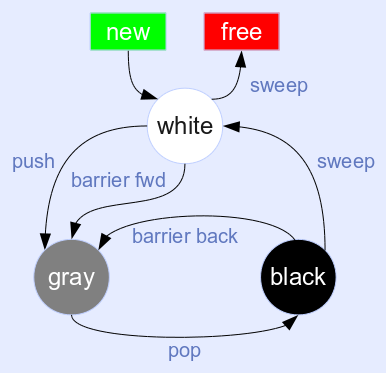
New Garbage Collector http://wiki.luajit.org/New-Garbage-Collector
GC Algorithms
This is a short overview of the different GC algorithms used in Lua 5.x and LuaJIT 1.x/2.0 as well as the proposed new GC in LuaJIT 3.0.
All of these implementations use a tracing garbage collector (#) with two basic phases:
- The mark phase starts at the GC roots (e.g. the main thread) and iteratively marks all reachable (live) objects. Any objects that remain are considered unreachable, i.e. dead.
- The sweep phase frees all unreachable (dead) objects.
Any practical GC implementation has a couple more phases (e.g. an atomic phase), but this is not relevant to the following discussion. To avoid a recursive algorithm, a mark stack or mark list can be used to keep track of objects that need to be traversed.
Note that most of the following is just describing well-established techniques. Please refer to the literature on garbage collection for details.
(#) 'Tracing' in this context means it's tracing through the live object graph, as opposed to a reference counting garbage collector, which manages reference counts for each object. The terminology is not related to the concept of a trace compiler.
New Garbage Collector http://wiki.luajit.org/New-Garbage-Collector的更多相关文章
- The The Garbage-First (G1) collector since Oracle JDK 7 update 4 and later releases
Refer to http://www.oracle.com/technetwork/tutorials/tutorials-1876574.html for detail. 一些内容复制到这儿 Th ...
- How Garbage Collection Really Works
Java Memory Management, with its built-in garbage collection, is one of the language's finest achiev ...
- Java Garbage Collection Basics--转载
原文地址:http://www.oracle.com/webfolder/technetwork/tutorials/obe/java/gc01/index.html Overview Purpose ...
- Garbage Collectors – Serial vs. Parallel vs. CMS vs. G1 (and what’s new in Java 8)
转自:http://blog.takipi.com/garbage-collectors-serial-vs-parallel-vs-cms-vs-the-g1-and-whats-new-in-ja ...
- Garbage Collectors - Serial vs. Parallel vs. CMS vs. G1 (and what's new in Java 8)--转
The 4 Java Garbage Collectors - How the Wrong Choice Dramatically Impacts Performance The year is 20 ...
- luajit官方性能优化指南和注解
luajit是目前最快的脚本语言之一,不过深入使用就很快会发现,要把这个语言用到像宣称那样高性能,并不是那么容易.实际使用的时候往往会发现,刚开始写的一些小test case性能非常好,经常毫秒级就算 ...
- 用好lua+unity,让性能飞起来——luajit集成篇/平台相关篇
luajit集成篇 大家都知道luajit比原生lua快,快在jit这三个字上. 但实际情况是,luajit的行为十分复杂.尤其jit并不是一个简单的把代码翻译成机器码的机制,背后有很多会影响性能的因 ...
- Fundamentals of Garbage Collection
[Fundamentals of Garbage Collection] 1.Reclaims objects that are no longer being used, clears their ...
- uva 10755 - Garbage Heap
http://uva.onlinejudge.org/index.php?option=com_onlinejudge&Itemid=8&page=show_problem&p ...
随机推荐
- 【转】IIS日志-网站运维的好帮手
对于一个需要长期维护的网站来说,如何让网站长久稳定运行是件很有意义的事情. 有些在开发阶段没有暴露的问题很有可能就在运维阶段出现了,这也是很正常的. 还有些时候,我们希望不断地优化网站,让网站更快速的 ...
- 【Java面试题】39 Set里的元素是不能重复的,那么用什么方法来区分重复与否呢? 是用==还是equals()? 它们有何区别?
1.什么是Set?(what) Set是Collection容器的一个子接口,它不允许出现重复元素,当然也只允许有一个null对象. 2.如何来区分重复与否呢?(how) “ 用 iterator() ...
- Linux /proc/loadavg(平均负载)
from : http://hi.baidu.com/mengyun8/blog/item/bd424531451b98e71a4cffc0.html 一.什么是系统平均负载(Load average ...
- gradle教程 [原创](eclipse/ADT下 非插件 非Android Studio/AS)纯手打 第三篇:gradle完整的实战
上两篇的地址 安装配置 http://www.cnblogs.com/uncle2000/p/4276833.html 简单实战 http://www.cnblogs.com/uncle2000/p/ ...
- Facebook开源技术识别网购评论
1.自然语言处理2.情感分析3.监督学习模型4.词向量 5.fasttext 汉藏语系,是语言系属分类(Language family)的一种,分为汉语族和藏缅语族,是用汉语和藏语的名称概括与其有亲属 ...
- 如何通过XAMPP来实现单个服务器上建多个网站
xampp 是一个非常方便的本地 apache + php + mysql 的调试环境,在本地安装测试 WordPress 等各种博客.论坛程序非常方便.今天我们来给大家介绍一下,如何使用 XAMPP ...
- SVN目录权限配置
1.如果要使用SVN,需要有一个项目的保存目录,例如把该目录设为“C:\MyPro”文件夹 2.把该目录发布为SVN项目目录,则需要通过以下命令行 svnadmin create c:\mypro ...
- ModelState.AddModelError使用
后台: ModelState.AddModelError("userPwd", "请输入密码!"); ModelState是一个字典类型,这句话的作用是向Mod ...
- 关于ArrayList和List的区别
ArrayList可以存放不同类型的数据,第一个可以是int,第二个可以是double等等 而List存放的是单一的数据类型的数据用法如下: List<GameObject> xx = n ...
- ExtJS6的中sencha cmd中自动创建案例项目代码分析
在之前的博文中,我们按照sencha cmd的指点,在自己win7虚拟机上创建了一个案例项目,相当于创建了一个固定格式的文档目录结构,然后里面自动创建了一系列js代码.这是使用sencha cmd自动 ...