
Architecture and design 洋葱 中间件 装饰器
Go kit - Frequently asked questions https://gokit.io/faq/
Architecture and design
Introduction — Understanding Go kit key concepts
If you’re coming from Symfony (PHP), Rails (Ruby), Django (Python), or one of the many popular MVC-style frameworks out there, the first thing you should know is that Go kit is not an MVC framework. Instead, Go kit services are laid out in three layers:
- Transport layer
- Endpoint layer
- Service layer
Requests enter the service at layer 1, flow down to layer 3, and responses take the reverse course.
This may be a bit of an adjustment, but once you grok the concepts, you should see that the Go kit design is well-suited for modern software design: both microservices and so-called elegantmonoliths.
Transports — What are Go kit transports?
The transport domain is bound to concrete transports like HTTP or gRPC. In a world where microservices may support one or more transports, this is very powerful; you can support a legacy HTTP API and a newer RPC service, all in a single microservice.
When implementing a REST-ish HTTP API, your routing is defined within a HTTP transport. It’s most common to see routes defined in a HTTP Router function like this:
r.Methods("POST").Path("/profiles/").Handler(httptransport.NewServer(

		e.PostProfileEndpoint,

		decodePostProfileRequest,

		encodeResponse,

		options...,

))
Endpoints — What are Go kit endpoints?
An endpoint is like an action/handler on a controller; it’s where safety and antifragile logic lives. If you implement two transports (HTTP and gRPC), you might have two methods of sending requests to the same endpoint.
Services — What is a Go kit service?
Services are where all of the business logic is implemented. A service usually glues together multiple endpoints. In Go kit, services are typically modeled as interfaces, and implementations of those interfaces contain the business logic. Go kit services should strive to abide the Clean Architecture or the Hexagonal Architecture. That is, the business logic should have no knowledge of endpoint- or especially transport-domain concepts: your service shouldn’t know anything about HTTP headers, or gRPC error codes.
Middlewares — What are middlewares, in Go kit?
Go kit tries to enforce a strict separation of concerns through use of the middleware (or decorator) pattern. Middlewares can wrap endpoints or services to add functionality, such as logging, rate limiting, load balancing, or distributed tracing. It’s common to chain multiple middlewares around an endpoint or service.
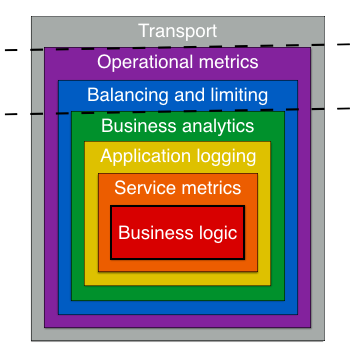
Putting all these concepts together, we see that Go kit microservices are modeled like an onion, with many layers. The layers can be grouped into our three domains. The innermost service domain is where everything is based on your specific service definition, and where all of the business logic is implemented. The middle endpoint domain is where each method of your service is abstracted to the generic endpoint.Endpoint, and where safety and antifragile logic is implemented. Finally, the outermost transport domain is where endpoints are bound to concrete transports like HTTP or gRPC.
You implement the core business logic by defining an interface for your service and providing a concrete implementation. Then, you write service middlewares to provide additional functionality, like logging, analytics, instrumentation — anything that needs knowledge of your business domain.
Go kit provides endpoint and transport domain middlewares, for functionality like rate limiting, circuit breaking, load balancing, and distributed tracing — all of which are generally agnostic to your business domain.
In short, Go kit tries to enforce strict separation of concerns through studious use of the middleware (or decorator) pattern.
Architecture and design 洋葱 中间件 装饰器的更多相关文章
- Fastify 系列教程二 (中间件、钩子函数和装饰器)
Fastify 系列教程: Fastify 系列教程一 (路由和日志) Fastify 系列教程二 (中间件.钩子函数和装饰器) 中间件 Fastify 提供了与 Express 和 Restify ...
- 装饰器模式以及Laravel框架下的中间件应用
Laravel框架的中间件使用:从请求进来到响应返回,经过中间件的层层包装,这种场景很适合用到一种设计模式---装饰器模式. 装饰器模式的作用,多种外界因素改变对象的行为.使用继承的方式改变行为不太被 ...
- Fastify 系列教程二 (中间件、钩子函数和装饰器)
Fastify 系列教程: Fastify 系列教程一 (路由和日志) Fastify 系列教程二 (中间件.钩子函数和装饰器) Fastify 系列教程三 (验证.序列化和生命周期) Fastify ...
- 001-ant design pro 页面加载原理及过程,@connect 装饰器
一.概述 以列表页中的标准列表为主 Ant Design Pro 默认通过只需浏览器单方面就可处理的 HashHistory 来完成路由.如果要切换为 BrowserHistory,那在 src/in ...
- CBV加装饰器解决登录注册问题和 <<中间件>>
文本目录 CBV加装饰器解决登录注册问题 一:什么是中间件 二:中间件有什么用 三:自定义中间件 四:中间件应用场景 五:SCRF TOKEN跨站请求伪造 六: 其他操作 CBV加装饰器解决登录注册问 ...
- 浅谈Django的中间件与Python的装饰器
浅谈Django的中间件 与Python的装饰器 一.原理 1.装饰器是Python的一种语法应用,利用闭包的原理去更改一个函数的功能,即让一个函数执行之前先到另外一个函数中执行其他需求语句,在执行该 ...
- Flask(2)- 装饰器的坑及解决办法、flask中的路由/实例化配置/对象配置/蓝图/特殊装饰器(中间件、重定义错误页面)
一.装饰器的坑以及解决方法 1.使用装饰器装饰两个视图函数,代码如下 from flask import Flask, redirect, render_template, request, sess ...
- Django day15 (一) cbv装饰器 , 中间件
一: 装饰器 二: 中间件
- cbv装饰器 中间件 跨站请求伪造
给cbv下面的函数加装饰器 写一个验证用户登录的程序 前端页面 # 写一个装饰器验证session def login_auth(func): def inner(request,*args,**kw ...
随机推荐
- ASP.NET Core 3.1 IOC容器以及默认DI以及替换Autofac生命周期
IOC 就是我们需要一个对象 以前我们是去 new 现在我们是直接向 IOC容器 要我们需要的那个对象. 使用一个IOC容器(autofac)通过依赖注入控制各个组件的耦合.也就是说你写好了组件,不需 ...
- 登录&单点登录介绍
COOKIE & SESSION & TOKEN 主要用来跟踪会话,识别用户所用.cookie 是客户端,session 是服务端的. 因为 http 是无状态协议,每一次的访问都不知 ...
- JS实现JSON数组合并和去重
var a=[{"id":"1001","name":"张三","age":"18&quo ...
- [LeetCode]234. Palindrome Linked List判断回文链表
重点是: 1.快慢指针找到链表的中点.快指针一次走两步,慢指针一次走一步,分清奇偶数情况. 2.反转链表.pre代表已经反转好的,每次将当前节点指向pre /* 快慢指针得到链表中间,然后用206题方 ...
- JDK,JRE,JVM三者之间的关系和作用
1,定义: JDK: Java Develpment Kit java 开发工具 bin:最主要的是编译器(javac.exe) include:java和JVM交互用的头文件 lib:类库 JRE: ...
- redis 作为 mysql的缓存服务器(读写分离)
redis 作为 mysql的缓存服务器(读写分离) 一.redis简介 Redis是一个key-value存储系统.和Memcached类似,为了保证效率,数据都是缓存在内存中.区别的是redis会 ...
- 使用Modbus4J进行RTU模式串口通信
Modus协议是由MODICON(现为施耐德电气公司的一个品牌)在1979年开发的,是全球第一个真正用于工业现场的总线协议,应用非常广泛,可谓大名鼎鼎. 理论性的东西就不多介绍了,推荐一本书<M ...
- 改进你的c#代码的5个技巧(二)
在本文中,我将向你展示c#编程的5个最佳实践.我从日常编程经验中学到了这些实践.我在release模式下测试了所有的代码,并在开发环境稳定后进行了截屏.我想你会喜欢这些建议的. 在使用数据类型之前选择 ...
- GitHub基础使用指南
引言: 只要进行了一段时间的软件或者编程相关知识的学习,相信大家或多或少都会见过这只"猫猫",这可不是什么宠物店铺的商标,身为即将成为程序猿/媛的你,或者已经是一位程序猿/媛的你, ...
- NOIP初赛篇——02计算机系统的基本结构
引言 计算机系统由硬件和软件两部分组成,硬件系统是计算机的"躯干",是物质基础.而软件系统则是建立在这个"躯干"上的"灵魂". 计算机硬件 ...