
Architecture and design 洋葱 中间件 装饰器
Go kit - Frequently asked questions https://gokit.io/faq/
Architecture and design
Introduction — Understanding Go kit key concepts
If you’re coming from Symfony (PHP), Rails (Ruby), Django (Python), or one of the many popular MVC-style frameworks out there, the first thing you should know is that Go kit is not an MVC framework. Instead, Go kit services are laid out in three layers:
- Transport layer
- Endpoint layer
- Service layer
Requests enter the service at layer 1, flow down to layer 3, and responses take the reverse course.
This may be a bit of an adjustment, but once you grok the concepts, you should see that the Go kit design is well-suited for modern software design: both microservices and so-called elegantmonoliths.
Transports — What are Go kit transports?
The transport domain is bound to concrete transports like HTTP or gRPC. In a world where microservices may support one or more transports, this is very powerful; you can support a legacy HTTP API and a newer RPC service, all in a single microservice.
When implementing a REST-ish HTTP API, your routing is defined within a HTTP transport. It’s most common to see routes defined in a HTTP Router function like this:
r.Methods("POST").Path("/profiles/").Handler(httptransport.NewServer(

		e.PostProfileEndpoint,

		decodePostProfileRequest,

		encodeResponse,

		options...,

))
Endpoints — What are Go kit endpoints?
An endpoint is like an action/handler on a controller; it’s where safety and antifragile logic lives. If you implement two transports (HTTP and gRPC), you might have two methods of sending requests to the same endpoint.
Services — What is a Go kit service?
Services are where all of the business logic is implemented. A service usually glues together multiple endpoints. In Go kit, services are typically modeled as interfaces, and implementations of those interfaces contain the business logic. Go kit services should strive to abide the Clean Architecture or the Hexagonal Architecture. That is, the business logic should have no knowledge of endpoint- or especially transport-domain concepts: your service shouldn’t know anything about HTTP headers, or gRPC error codes.
Middlewares — What are middlewares, in Go kit?
Go kit tries to enforce a strict separation of concerns through use of the middleware (or decorator) pattern. Middlewares can wrap endpoints or services to add functionality, such as logging, rate limiting, load balancing, or distributed tracing. It’s common to chain multiple middlewares around an endpoint or service.
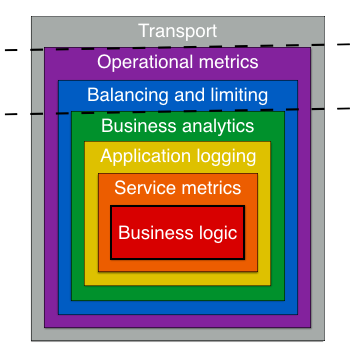
Putting all these concepts together, we see that Go kit microservices are modeled like an onion, with many layers. The layers can be grouped into our three domains. The innermost service domain is where everything is based on your specific service definition, and where all of the business logic is implemented. The middle endpoint domain is where each method of your service is abstracted to the generic endpoint.Endpoint, and where safety and antifragile logic is implemented. Finally, the outermost transport domain is where endpoints are bound to concrete transports like HTTP or gRPC.
You implement the core business logic by defining an interface for your service and providing a concrete implementation. Then, you write service middlewares to provide additional functionality, like logging, analytics, instrumentation — anything that needs knowledge of your business domain.
Go kit provides endpoint and transport domain middlewares, for functionality like rate limiting, circuit breaking, load balancing, and distributed tracing — all of which are generally agnostic to your business domain.
In short, Go kit tries to enforce strict separation of concerns through studious use of the middleware (or decorator) pattern.
Architecture and design 洋葱 中间件 装饰器的更多相关文章
- Fastify 系列教程二 (中间件、钩子函数和装饰器)
Fastify 系列教程: Fastify 系列教程一 (路由和日志) Fastify 系列教程二 (中间件.钩子函数和装饰器) 中间件 Fastify 提供了与 Express 和 Restify ...
- 装饰器模式以及Laravel框架下的中间件应用
Laravel框架的中间件使用:从请求进来到响应返回,经过中间件的层层包装,这种场景很适合用到一种设计模式---装饰器模式. 装饰器模式的作用,多种外界因素改变对象的行为.使用继承的方式改变行为不太被 ...
- Fastify 系列教程二 (中间件、钩子函数和装饰器)
Fastify 系列教程: Fastify 系列教程一 (路由和日志) Fastify 系列教程二 (中间件.钩子函数和装饰器) Fastify 系列教程三 (验证.序列化和生命周期) Fastify ...
- 001-ant design pro 页面加载原理及过程,@connect 装饰器
一.概述 以列表页中的标准列表为主 Ant Design Pro 默认通过只需浏览器单方面就可处理的 HashHistory 来完成路由.如果要切换为 BrowserHistory,那在 src/in ...
- CBV加装饰器解决登录注册问题和 <<中间件>>
文本目录 CBV加装饰器解决登录注册问题 一:什么是中间件 二:中间件有什么用 三:自定义中间件 四:中间件应用场景 五:SCRF TOKEN跨站请求伪造 六: 其他操作 CBV加装饰器解决登录注册问 ...
- 浅谈Django的中间件与Python的装饰器
浅谈Django的中间件 与Python的装饰器 一.原理 1.装饰器是Python的一种语法应用,利用闭包的原理去更改一个函数的功能,即让一个函数执行之前先到另外一个函数中执行其他需求语句,在执行该 ...
- Flask(2)- 装饰器的坑及解决办法、flask中的路由/实例化配置/对象配置/蓝图/特殊装饰器(中间件、重定义错误页面)
一.装饰器的坑以及解决方法 1.使用装饰器装饰两个视图函数,代码如下 from flask import Flask, redirect, render_template, request, sess ...
- Django day15 (一) cbv装饰器 , 中间件
一: 装饰器 二: 中间件
- cbv装饰器 中间件 跨站请求伪造
给cbv下面的函数加装饰器 写一个验证用户登录的程序 前端页面 # 写一个装饰器验证session def login_auth(func): def inner(request,*args,**kw ...
随机推荐
- 跳表(SkipList)设计与实现(Java)
微信搜一搜「bigsai」关注这个有趣的程序员 文章已收录在 我的Github bigsai-algorithm 欢迎star 前言 跳表是面试常问的一种数据结构,它在很多中间件和语言中得到应用,我们 ...
- 深入浅出JVM(一):你写得.java文件是如何被加载到内存中执行的
众所周知,.java文件需要经过编译生成.class文件才能被JVM执行. 其中,JVM是如何加载.class文件,又做了些什么呢? .class文件通过 加载->验证->准备->解 ...
- springcloud执行流程理解图
执行流程图
- MybatisPlus学习(四)条件构造器Wrapper方法详解
文章目录 1.条件构造器 2.QueryWrapper 2.1.eq.ne 2.2.gt.ge.lt.le 2.3.between.notBetween 2.4.like.notLike.likeLe ...
- 决胜面试之---SQL经典面试题
在SQL面试部分,一般会考核多表连接查询能力,精选了一些SQL面试题记录下: 四张表(学生表,教师表,课程表,成绩表) 以下是表的创建和添加SQL语句 学生 ...
- python之scrapy篇(一)
一.首先创建工程(cmd中进行) scrapy startproject xxx 二.编写Item文件 添加要字段 # -*- coding: utf-8 -*- # Define here the ...
- Daphile 安装手册 -- 官方文档译文 [原创]
Daphile 安装手册(Daphile Installation) 英文原文:https://www.daphile.com/download/DaphileInstallation.pdf 采集日 ...
- .NET 云原生架构师训练营(模块二 基础巩固 MongoDB 更新和删除)--学习笔记
2.5.4 MongoDB -- 更新和删除 整体更新 更新字段 字段操作 数组操作 删除 https://docs.mongodb.com/manual/reference/operator/upd ...
- Elastisearch在kibana下常用命令总结
1.获取所有数据 GET /_search 2.创建一个Document PUT /ecommerce/product/1 { "name" : "gaolujie ya ...
- ethernet
OSI参考模型 简化相关网络操作:提供不同厂商之间的互联 应用层 为应用程序提供服务 HTTP Telnet 表示层 数据格式化,加密.解密 ASCII EBCDIC JPEG 会话层 建立.维护.管 ...