
Stanford coursera Andrew Ng 机器学习课程第四周总结(附Exercise 3)
Introduction
Neural NetWork的由来
先考虑一个非线性分类,当特征数很少时,逻辑回归就可以完成了,但是当特征数变大时,高阶项将呈指数性增长,复杂度可想而知。如下图:对房屋进行高低档的分类,当特征值只有x1,x2,x3时,我们可以对它进行处理,分类。但是当特征数增长为x1,x2....x100时,分类器的效率就会很低了。
Neural NetWork模型
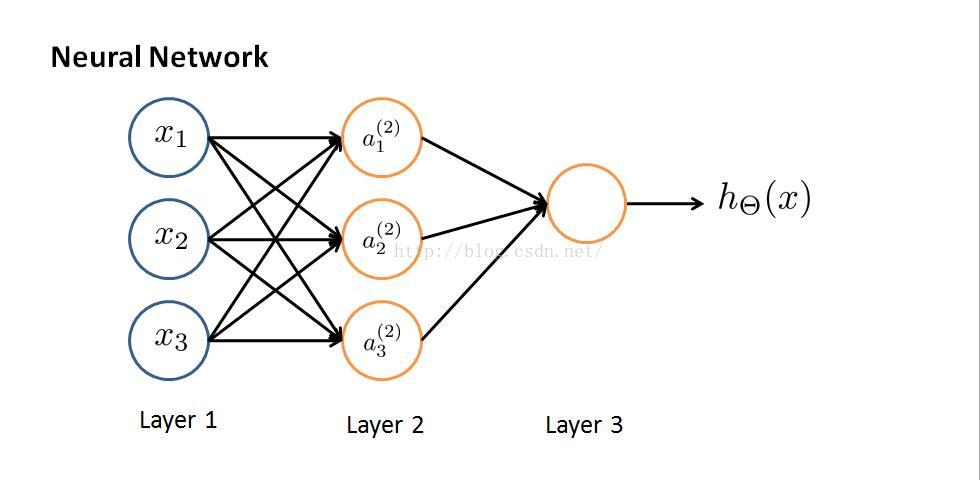
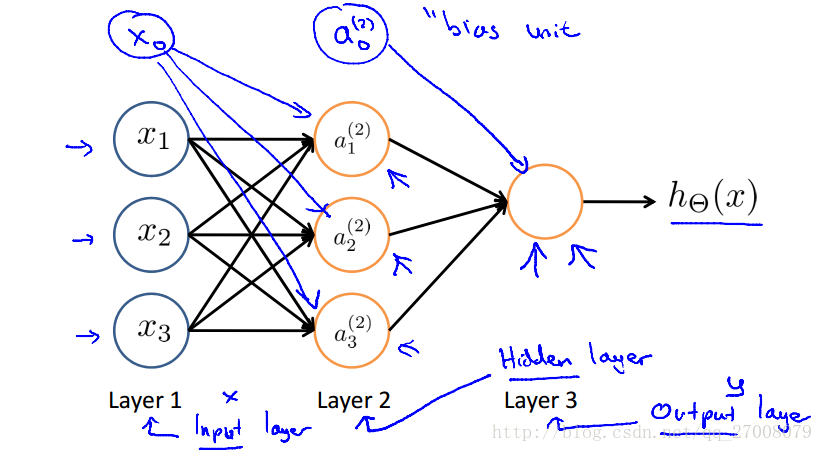
该图是最简单的神经网络,共有3层,输入层Layer1;隐藏层Layer2;输出层Layer3,每层都有多个激励函数ai(j).通过层与层之间的传递参数Θ得到最终的假设函数hΘ(x)。我们的目的是通过大量的输入样本x(作为第一层),训练层与层之间的传递参数(经常称为权重),使得假设函数尽可能的与实际输出值接近h(x)≈y(代价函数J尽可能的小)。
逻辑回归模型
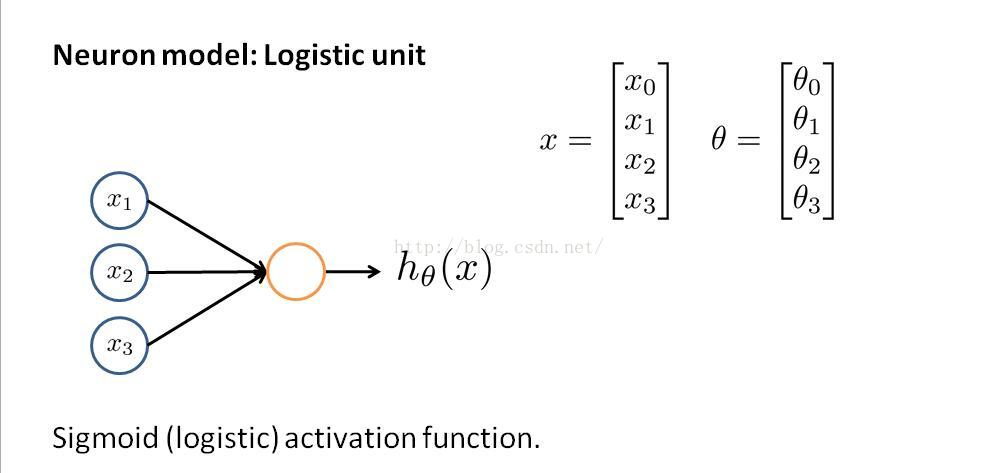
很容易看出,逻辑回归是没有隐藏层的神经网络,层与层之间的传递函数就是θ。
Neural NetWork
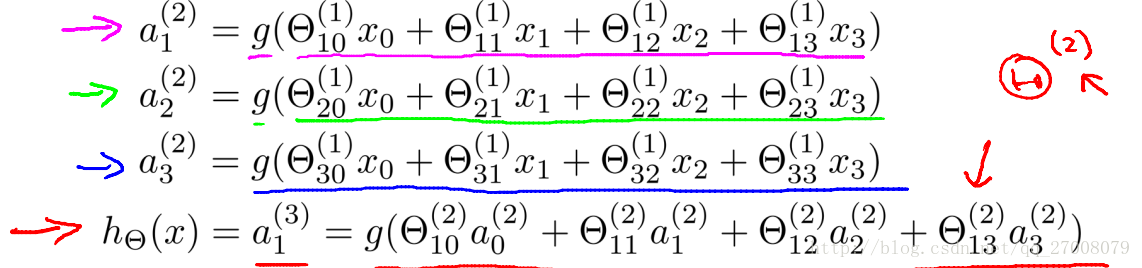
神经网络模型---正向传播
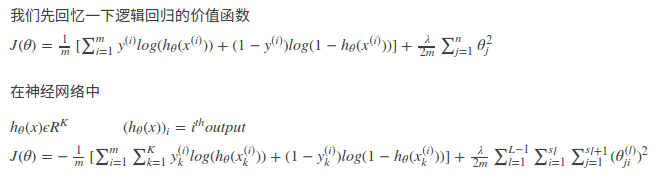
Cost function(代价函数)
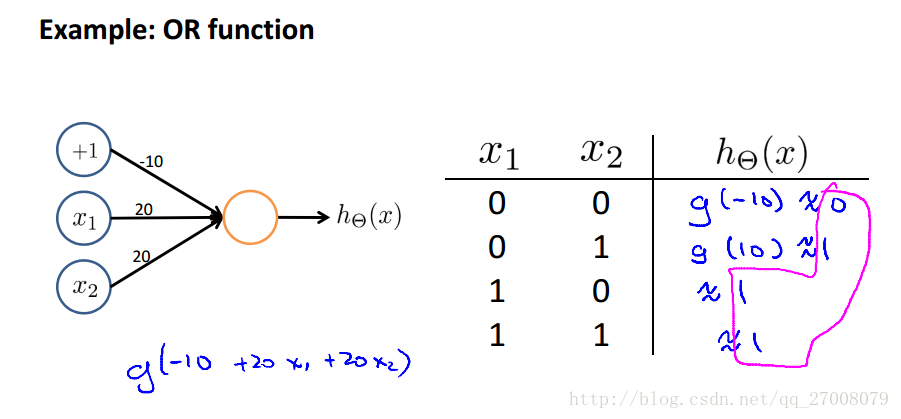
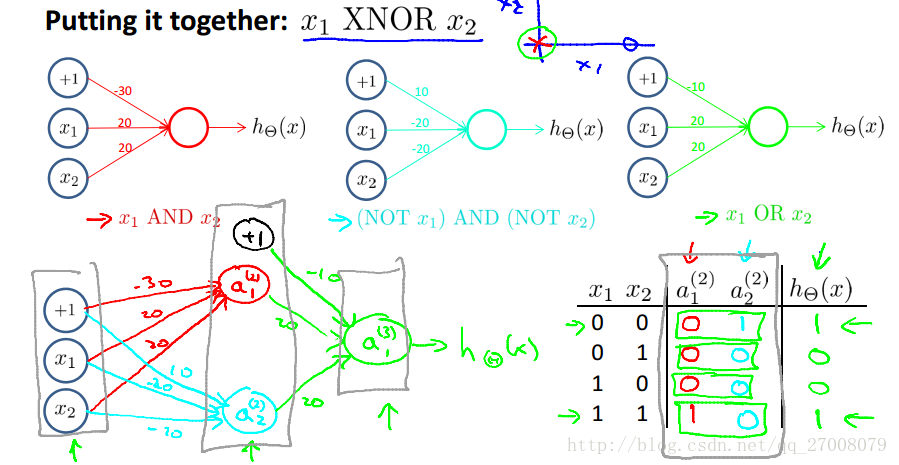
Examples and intuitions

Multi-class classification
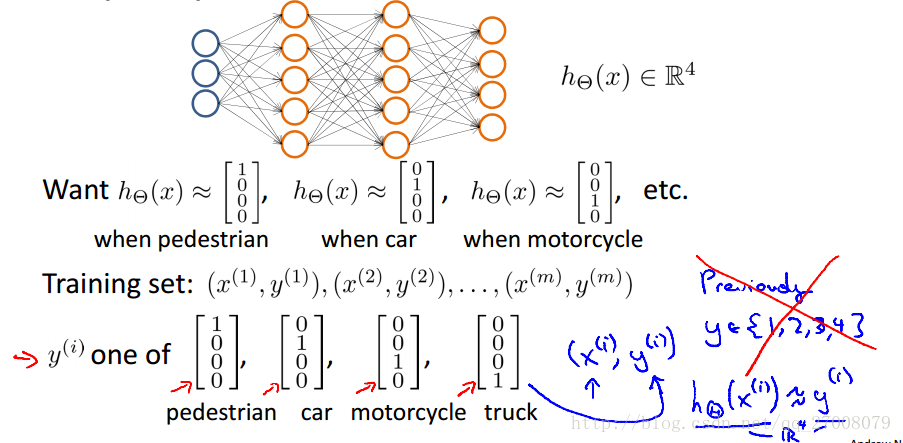
对于多分类问题,我们可以通过设置多个输出值来实现。
编程作业就是一个多分类问题——手写数字识别
输入的是手写的照片(数字0-9),5000组样本、每个像素点用20×20的点阵表示成一行,输入向量为5000×400的矩阵X,经过神经网络传递后,输出一个假设函数(列向量),取最大值所在的行号即为假设值(0-9中的一个)。也就是输出值y = 1,2,3,4,5.....10又有可能,为了方便数值运算,我们用10×1的列向量表示,譬如 y = 5,有

Exercises
这次的作业是用逻辑回归和神经网络来实现手写数字识别,比较下两者的准确性。
Logistic Regression
lrCostFunction.m
function [J, grad] = lrCostFunction(theta, X, y, lambda)

%LRCOSTFUNCTION Compute cost and gradient for logistic regression with

%regularization

%   J = LRCOSTFUNCTION(theta, X, y, lambda) computes the cost of using

%   theta as the parameter for regularized logistic regression and the

%   gradient of the cost w.r.t. to the parameters.

% Initialize some useful values

m = length(y); % number of training examples

% You need to return the following variables correctly

J = 0;

grad = zeros(size(theta));

% ====================== YOUR CODE HERE ======================

% Instructions: Compute the cost of a particular choice of theta.

%               You should set J to the cost.

%               Compute the partial derivatives and set grad to the partial

%               derivatives of the cost w.r.t. each parameter in theta

%

% Hint: The computation of the cost function and gradients can be

%       efficiently vectorized. For example, consider the computation

%

%           sigmoid(X * theta)

%

%       Each row of the resulting matrix will contain the value of the

%       prediction for that example. You can make use of this to vectorize

%       the cost function and gradient computations.

%

% Hint: When computing the gradient of the regularized cost function,

%       there're many possible vectorized solutions, but one solution

%       looks like:

%           grad = (unregularized gradient for logistic regression)

%           temp = theta;

%           temp(1) = 0;   % because we don't add anything for j = 0

%           grad = grad + YOUR_CODE_HERE (using the temp variable)

%

theta_reg=[0;theta(2:size(theta))];

J = (-y'*log(sigmoid(X*theta))-(1-y)'*log(1-sigmoid(X*theta)))/m + lambda/(2*m)*(theta_reg')*theta_reg;

grad = X'*(sigmoid(X*theta)-y)/m + lambda/m*theta_reg;

% =============================================================

grad = grad(:);

end
oneVsAll.m
function [all_theta] = oneVsAll(X, y, num_labels, lambda)

%ONEVSALL trains multiple logistic regression classifiers and returns all

%the classifiers in a matrix all_theta, where the i-th row of all_theta

%corresponds to the classifier for label i

%   [all_theta] = ONEVSALL(X, y, num_labels, lambda) trains num_labels

%   logistic regression classifiers and returns each of these classifiers

%   in a matrix all_theta, where the i-th row of all_theta corresponds

%   to the classifier for label i

% Some useful variables

m = size(X, 1);

n = size(X, 2);

% You need to return the following variables correctly

all_theta = zeros(num_labels, n + 1);

% Add ones to the X data matrix

X = [ones(m, 1) X];

% ====================== YOUR CODE HERE ======================

% Instructions: You should complete the following code to train num_labels

%               logistic regression classifiers with regularization

%               parameter lambda.

%

% Hint: theta(:) will return a column vector.

%

% Hint: You can use y == c to obtain a vector of 1's and 0's that tell you

%       whether the ground truth is true/false for this class.

%

% Note: For this assignment, we recommend using fmincg to optimize the cost

%       function. It is okay to use a for-loop (for c = 1:num_labels) to

%       loop over the different classes.

%

%       fmincg works similarly to fminunc, but is more efficient when we

%       are dealing with large number of parameters.

%

% Example Code for fmincg:

%

%     % Set Initial theta

%     initial_theta = zeros(n + 1, 1);

%

%     % Set options for fminunc

%     options = optimset('GradObj', 'on', 'MaxIter', 50);

%

%     % Run fmincg to obtain the optimal theta

%     % This function will return theta and the cost

%     [theta] = ...

%         fmincg (@(t)(lrCostFunction(t, X, (y == c), lambda)), ...

%                 initial_theta, options);

%

 initial_theta = zeros(n + 1, 1);

 options = optimset('GradObj', 'on', 'MaxIter', 50);

 for c = 1:num_labels

    all_theta(c,:) = fmincg (@(t)(lrCostFunction(t, X, (y == c), lambda)), initial_theta, options);

 end

% =========================================================================

end
predictOneVsAll.m
function p = predictOneVsAll(all_theta, X)

%PREDICT Predict the label for a trained one-vs-all classifier. The labels

%are in the range 1..K, where K = size(all_theta, 1).

%  p = PREDICTONEVSALL(all_theta, X) will return a vector of predictions

%  for each example in the matrix X. Note that X contains the examples in

%  rows. all_theta is a matrix where the i-th row is a trained logistic

%  regression theta vector for the i-th class. You should set p to a vector

%  of values from 1..K (e.g., p = [1; 3; 1; 2] predicts classes 1, 3, 1, 2

%  for 4 examples)

m = size(X, 1);

num_labels = size(all_theta, 1);

% You need to return the following variables correctly

p = zeros(size(X, 1), 1);

% Add ones to the X data matrix

X = [ones(m, 1) X];

% ====================== YOUR CODE HERE ======================

% Instructions: Complete the following code to make predictions using

%               your learned logistic regression parameters (one-vs-all).

%               You should set p to a vector of predictions (from 1 to

%               num_labels).

%

% Hint: This code can be done all vectorized using the max function.

%       In particular, the max function can also return the index of the

%       max element, for more information see 'help max'. If your examples

%       are in rows, then, you can use max(A, [], 2) to obtain the max

%       for each row.

%

[maxx, p]=max(X*all_theta',[],2);

% =========================================================================

end
Training Set Accuracy: 95.100000
下面是以三层bp神经网络处理的手写数字识别,其中权重矩阵已给出。
predict.m
function p = predict(Theta1, Theta2, X)

%PREDICT Predict the label of an input given a trained neural network

%   p = PREDICT(Theta1, Theta2, X) outputs the predicted label of X given the

%   trained weights of a neural network (Theta1, Theta2)

% Useful values

m = size(X, 1);

num_labels = size(Theta2, 1);

% You need to return the following variables correctly

p = zeros(size(X, 1), 1);

% ====================== YOUR CODE HERE ======================

% Instructions: Complete the following code to make predictions using

%               your learned neural network. You should set p to a

%               vector containing labels between 1 to num_labels.

%

% Hint: The max function might come in useful. In particular, the max

%       function can also return the index of the max element, for more

%       information see 'help max'. If your examples are in rows, then, you

%       can use max(A, [], 2) to obtain the max for each row.

%

X = [ones(m, 1) X];

temp=sigmoid(X*Theta1');

temp = [ones(m, 1) temp];

temp2=sigmoid(temp*Theta2');

[maxx, p]=max(temp2, [], 2);

% =========================================================================

end
Training Set Accuracy: 97.520000
注意事项
1.X = [ones(m, 1) X];是确保矩阵维度一致。X0就是一行1
2.正则化时theta0要用0替代,处理如theta_reg=[0;theta(2:size(theta))];
Stanford coursera Andrew Ng 机器学习课程第四周总结(附Exercise 3)的更多相关文章
- Stanford coursera Andrew Ng 机器学习课程编程作业(Exercise 2)及总结
Exercise 1:Linear Regression---实现一个线性回归 关于如何实现一个线性回归,请参考:http://www.cnblogs.com/hapjin/p/6079012.htm ...
- Stanford coursera Andrew Ng 机器学习课程第二周总结(附Exercise 1)
Exercise 1:Linear Regression---实现一个线性回归 重要公式 1.h(θ)函数 2.J(θ)函数 思考一下,在matlab里面怎么表达?如下: 原理如下:(如果你懂了这道作 ...
- Stanford coursera Andrew Ng 机器学习课程编程作业(Exercise 1)
Exercise 1:Linear Regression---实现一个线性回归 在本次练习中,需要实现一个单变量的线性回归.假设有一组历史数据<城市人口,开店利润>,现需要预测在哪个城市中 ...
- 【原】Coursera—Andrew Ng机器学习—课程笔记 Lecture 15—Anomaly Detection异常检测
Lecture 15 Anomaly Detection 异常检测 15.1 异常检测问题的动机 Problem Motivation 异常检测(Anomaly detection)问题是机器学习算法 ...
- 【原】Coursera—Andrew Ng机器学习—课程笔记 Lecture 1_Introduction and Basic Concepts 介绍和基本概念
目录 1.1 欢迎1.2 机器学习是什么 1.2.1 机器学习定义 1.2.2 机器学习算法 - Supervised learning 监督学习 - Unsupervised learning 无 ...
- 【原】Coursera—Andrew Ng机器学习—课程笔记 Lecture 17—Large Scale Machine Learning 大规模机器学习
Lecture17 Large Scale Machine Learning大规模机器学习 17.1 大型数据集的学习 Learning With Large Datasets 如果有一个低方差的模型 ...
- 【原】Coursera—Andrew Ng机器学习—课程笔记 Lecture 16—Recommender Systems 推荐系统
Lecture 16 Recommender Systems 推荐系统 16.1 问题形式化 Problem Formulation 在机器学习领域,对于一些问题存在一些算法, 能试图自动地替你学习到 ...
- 【原】Coursera—Andrew Ng机器学习—课程笔记 Lecture 14—Dimensionality Reduction 降维
Lecture 14 Dimensionality Reduction 降维 14.1 降维的动机一:数据压缩 Data Compression 现在讨论第二种无监督学习问题:降维. 降维的一个作用是 ...
- 【原】Coursera—Andrew Ng机器学习—课程笔记 Lecture 12—Support Vector Machines 支持向量机
Lecture 12 支持向量机 Support Vector Machines 12.1 优化目标 Optimization Objective 支持向量机(Support Vector Machi ...
随机推荐
- “取出数据表中第10条到第20条记录”的sql语句+select top 使用方法
1.首先.select top使用方法: 參考问题 select top n * from和select * from的差别 select * from table -- 取全部数据.返回无序集合 ...
- [DevExpress]GridControl分页的实现
加入两个组件:BindingNavigator和BindingSource 代码: using System; using System.Collections.Generic; using Syst ...
- Codeforces Round #320 (Div. 2) [Bayan Thanks-Round] C C Problem about Polyline 数学
C. A Problem about Polyline ...
- TQ210--UBOOT移植笔记--添加自己的单板【学习笔记】
在uboot的源码的根目录下的readme中有介绍如何在uboot中添加自己的单板: 一.在boards.cfg中添加自己的单板的信息,可以模仿smdkc100去添加自己的单板的信息 二.复制单板的配 ...
- oracle基本建表语句
oracle基本建表语句 2010-09-20 10:37:33| 分类: 数据库 | 标签:数据库 oracle |字号 订阅 --创建用户create user han identifie ...
- ubuntu中 python升级 (转载)
转自:http://blog.csdn.net/menglin8908/article/details/16822171 在ubuntu12.04中内置的python版本为2.7.3,最近想把pyth ...
- 微信H5页面 - 调酒
这是微信H5的一款小游戏(一款酒的推广活动),主要游戏页面如下: 游戏规则: 点击选择2个元素(圈圈图片),放入瓶中,使它们与瓶中已有的三个元素碰撞,调配佳酿. 只有选择正确的2个元素搭配,才可以调配 ...
- xposed源码编译与集成
xposed installer3.0版本之后,传统的xposed框架的使用方法是从官网上下载xposed installer.apk以及xposed-arm-sdk22.zip包.然后具体的使用方法 ...
- MongoDB一些常用指令与他的JavaScript的对应表
- 使用wkwebview后,页面返回不刷新的问题
onpageshow 事件在用户浏览网页时触发. onpageshow 事件类似于 onload 事件,onload 事件在页面第一次加载时触发, onpageshow 事件在每次加载页面时触发,即 ...