
[Unity算法]A星寻路(一):基础版本
参考链接:
https://www.cnblogs.com/yangyxd/articles/5447889.html
一.原理
1.将场景简化,分割为一个个正方形格子,这些格子称之为节点(node),从一个节点到另一个节点的距离称之为代价(cost)。一个节点与水平/垂直方向的相邻节点的代价是1,与对角节点的代价是1.4。这里引用公式f = g + h,f表示该节点的总代价,g表示该节点与上一路径节点的代价,h表示该节点与目标节点的代价。
2.需要两个列表,开启列表(openList)和关闭列表(closeList)。开启列表用来记录需要考虑的节点,关闭列表用来记录不会再考虑的节点。
3.在开启列表中添加起始节点。
4.在开启列表中找到总代价最低的节点,然后从开启列表中移除该节点,从关闭列表中添加该节点,把与该节点相邻的可通行的节点添加到开启列表,并且更新这些节点的代价。
5.循环第四步,如果当前节点等于目标节点,则退出循环。
二.实现
FindWayNode.cs
 using UnityEngine;

 public class FindWayNode {

     public bool isObstacle;//是否是障碍物

     public Vector3 scenePos;//场景位置

     public int x, y;//坐标

     public int gCost;//与起始点的距离

     public int hCost;//与目标点的距离

     public int fCost {

         get { return gCost + hCost; }

     }//总距离

     public FindWayNode parentNode;//父节点

     public FindWayNode(bool isObstacle, Vector3 scenePos, int x, int y)

     {

         this.isObstacle = isObstacle;

         this.scenePos = scenePos;

         this.x = x;

         this.y = y;

     }

 }
FindWayGrid.cs
 using System.Collections.Generic;

 using UnityEngine;

 public class FindWayGrid {

     public int width;//格子水平方向个数

     public int height;//格子垂直方向个数

     public float nodeLength;//格子长度

     private FindWayNode[,] findWayNodes;//格子数组

     private float halfNodeLength;//格子长度的一半

     private Vector3 startPos;//场景坐标起点

     public FindWayGrid(int width, int height, float nodeLength = 1f)

     {

         this.width = width;

         this.height = height;

         this.nodeLength = nodeLength;

         findWayNodes = new FindWayNode[width, height];

         halfNodeLength = nodeLength / ;

         startPos = new Vector3(-width /  * nodeLength + halfNodeLength, , -height /  * nodeLength + halfNodeLength);

         for (int x = ; x < width; x++)

         {

             for (int y = ; y < height; y++)

             {

                 Vector3 pos = CoordinateToScenePos(x, y);

                 findWayNodes[x, y] = new FindWayNode(false, pos, x, y);

             }

         }

     }

     //坐标转场景坐标

     public Vector3 CoordinateToScenePos(int x, int y)

     {

         Vector3 pos = new Vector3(startPos.x + x * nodeLength, startPos.y, startPos.z + y * nodeLength);

         return pos;

     }

     //根据场景坐标获取节点

     public FindWayNode GetNode(Vector3 pos)

     {

         int x = (int)(Mathf.RoundToInt(pos.x - startPos.x) / nodeLength);

         int y = (int)(Mathf.RoundToInt(pos.z - startPos.z) / nodeLength);

         x = Mathf.Clamp(x, , width - );

         y = Mathf.Clamp(y, , height - );

         return GetNode(x, y);

     }

     //根据坐标获取节点

     public FindWayNode GetNode(int x, int y)

     {

         return findWayNodes[x, y];

     }

     //获取相邻节点列表

     public List<FindWayNode> GetNearbyNodeList(FindWayNode node)

     {

         List<FindWayNode> list = new List<FindWayNode>();

         for (int i = -; i <= ; i++)

         {

             for (int j = -; j <= ; j++)

             {

                 if (i ==  && j == )

                 {

                     continue;

                 }

                 int x = node.x + i;

                 int y = node.y + j;

                 if (x >=  && x < width && y >=  && y < height)

                 {

                     list.Add(findWayNodes[x, y]);

                 }

             }

         }

         return list;

     }

     //获取两个节点之间的距离

     int GetDistance(FindWayNode nodeA, FindWayNode nodeB)

     {

         int countX = Mathf.Abs(nodeA.x - nodeB.x);

         int countY = Mathf.Abs(nodeA.y - nodeB.y);

         if (countX > countY)

         {

             return  * countY +  * (countX - countY);

         }

         else

         {

             return  * countX +  * (countY - countX);

         }

     }

     //找出起点到终点的最短路径

     public List<FindWayNode> FindWay(Vector3 startPos, Vector3 endPos)

     {

         FindWayNode startNode = GetNode(startPos);

         FindWayNode endNode = GetNode(endPos);

         List<FindWayNode> openList = new List<FindWayNode>();

         List<FindWayNode> closeList = new List<FindWayNode>();

         openList.Add(startNode);

         while (openList.Count > )

         {

             FindWayNode nowNode = openList[];

             //选择花费最低的

             for (int i = ; i < openList.Count; i++)

             {

                 if (openList[i].fCost <= nowNode.fCost &&

                     openList[i].hCost < nowNode.hCost)

                 {

                     nowNode = openList[i];

                 }

             }

             openList.Remove(nowNode);

             closeList.Add(nowNode);

             //找到目标节点

             if (nowNode == endNode)

             {

                 return GeneratePath(startNode, endNode);

             }

             List<FindWayNode> nearbyNodeList = GetNearbyNodeList(nowNode);

             for (int i = ; i < nearbyNodeList.Count; i++)

             {

                 FindWayNode node = nearbyNodeList[i];

                 //如果是墙或者已经在关闭列表中

                 if (node.isObstacle || closeList.Contains(node))

                 {

                     continue;

                 }

                 //计算当前相邻节点与开始节点的距离

                 int gCost = nowNode.gCost + GetDistance(nowNode, node);

                 //如果距离更小,或者原来不在打开列表

                 if (gCost < node.gCost || !openList.Contains(node))

                 {

                     //更新与开始节点的距离

                     node.gCost = gCost;

                     //更新与结束节点的距离

                     node.hCost = GetDistance(node, endNode);

                     //更新父节点为当前选定的节点

                     node.parentNode = nowNode;

                     //加入到打开列表

                     if (!openList.Contains(node))

                     {

                         openList.Add(node);

                     }

                 }

             }

         }

         return null;

     }

     //生成路径

     public List<FindWayNode> GeneratePath(FindWayNode startNode, FindWayNode endNode)

     {

         List<FindWayNode> nodeList = new List<FindWayNode>();

         if (endNode != null)

         {

             FindWayNode tempNode = endNode;

             while (tempNode != startNode)

             {

                 nodeList.Add(tempNode);

                 tempNode = tempNode.parentNode;

             }

             nodeList.Reverse();//反转路径

         }

         return nodeList;

     }

 }
TestFindWay.cs
 using UnityEngine;

 using System.Collections;

 using System.Collections.Generic;

 public class TestFindWay : MonoBehaviour {

     public Transform startTra;//起点tra

     public Transform endTra;//终点tra

     public Transform floorTra;//地板tra

     public GameObject obstacleGridPrefab;//障碍物格子

     public GameObject pathGridPrefab;//路径格子

     public LayerMask obstacleLayer;//障碍物所在的层

     private FindWayGrid findWayGrid;

     private GameObject obstacleRootGo;//障碍物格子的父go

     private GameObject pathRootGo;//路径格子的父go

     private List<GameObject> pathGridGoList;//路径格子go列表

     void Start ()

     {

         MeshFilter meshFilter = floorTra.GetComponent<MeshFilter>();

         int width = Mathf.CeilToInt(meshFilter.mesh.bounds.size.x) * (int)floorTra.localScale.x;

         int height = Mathf.CeilToInt(meshFilter.mesh.bounds.size.z) * (int)floorTra.localScale.z;

         findWayGrid = new FindWayGrid(width, height);

         obstacleRootGo = new GameObject("ObstacleRoot");

         pathRootGo = new GameObject("PathRoot");

         pathGridGoList = new List<GameObject>();

         ShowObstacle();

     }

     void Update ()

     {

         List<FindWayNode> nodeList = findWayGrid.FindWay(startTra.position, endTra.position);

         if (nodeList != null)

         {

             ShowPath(nodeList);

         }

     }

     //展示路径

     public void ShowPath(List<FindWayNode> list)

     {

         for (int i = ; i < list.Count; i++)

         {

             if (i < pathGridGoList.Count)

             {

                 pathGridGoList[i].transform.position = list[i].scenePos;

                 pathGridGoList[i].SetActive(true);

             }

             else

             {

                 GameObject go = Instantiate(pathGridPrefab);

                 go.transform.SetParent(pathRootGo.transform);

                 go.transform.position = list[i].scenePos;

                 pathGridGoList.Add(go);

             }

         }

         for (int i = list.Count; i < pathGridGoList.Count; i++)

         {

             pathGridGoList[i].SetActive(false);

         }

     }

     //展示障碍物

     public void ShowObstacle()

     {

         int width = findWayGrid.width;

         int height = findWayGrid.height;

         float halfNodeLength = findWayGrid.nodeLength / ;

         for (int x = ; x < width; x++)

         {

             for (int y = ; y < height; y++)

             {

                 FindWayNode node = findWayGrid.GetNode(x, y);

                 bool isObstacle = Physics.CheckSphere(node.scenePos, halfNodeLength, obstacleLayer);

                 if (isObstacle)

                 {

                     GameObject go = GameObject.Instantiate(obstacleGridPrefab, node.scenePos, Quaternion.identity) as GameObject;

                     go.transform.SetParent(obstacleRootGo.transform);

                 }

                 node.isObstacle = isObstacle;

             }

         }

     }

 }
三.使用
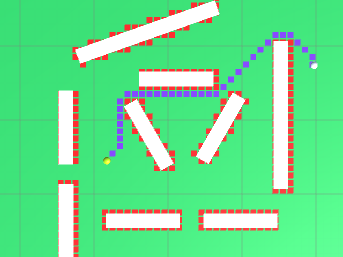
把TestFindWay.cs挂上,然后对public变量进行拖拽赋值即可。效果如下:
[Unity算法]A星寻路(一):基础版本的更多相关文章
- 基于Unity的A星寻路算法(绝对简单完整版本)
前言 在上一篇文章,介绍了网格地图的实现方式,基于该文章,我们来实现一个A星寻路的算法,最终实现的效果为: 项目源码已上传Github:AStarNavigate 在阅读本篇文章,如果你对于里面提到的 ...
- A星寻路算法入门(Unity实现)
最近简单学习了一下A星寻路算法,来记录一下.还是个萌新,如果写的不好,请谅解.Unity版本:2018.3.2f1 A星寻路算法是什么 游戏开发中往往有这样的需求,让玩家控制的角色自动寻路到目标地点, ...
- A星寻路算法介绍
你是否在做一款游戏的时候想创造一些怪兽或者游戏主角,让它们移动到特定的位置,避开墙壁和障碍物呢? 如果是的话,请看这篇教程,我们会展示如何使用A星寻路算法来实现它! 在网上已经有很多篇关于A星寻路算法 ...
- 用简单直白的方式讲解A星寻路算法原理
很多游戏特别是rts,rpg类游戏,都需要用到寻路.寻路算法有深度优先搜索(DFS),广度优先搜索(BFS),A星算法等,而A星算法是一种具备启发性策略的算法,效率是几种算法中最高的,因此也成为游戏中 ...
- A星寻路算法
A星寻路算法 1.准备一个close关闭列表(存放已被检索的点),一个open开启列表(存放未被检索的点),一个当前点的对象cur 2.将cur设成开始点 3.从cur起,将cur点放入close表中 ...
- cocos2d-x学习日志(13) --A星寻路算法demo
你是否在做一款游戏的时候想创造一些怪兽或者游戏主角,让它们移动到特定的位置,避开墙壁和障碍物呢?如果是的话,请看这篇教程,我们会展示如何使用A星寻路算法来实现它! A星算法简介: A*搜寻算法俗称A星 ...
- 无递归 A星寻路算法
整理硬盘的时候,发现我早些年写的A星寻路算法.特放上来,待有缘人拿去,无递归噢,性能那是杠杠的. 码上伺候 public class Node { public int X { get; set; } ...
- A星寻路算法(A* Search Algorithm)
你是否在做一款游戏的时候想创造一些怪兽或者游戏主角,让它们移动到特定的位置,避开墙壁和障碍物呢? 如果是的话,请看这篇教程,我们会展示如何使用A星寻路算法来实现它! 在网上已经有很多篇关于A星寻路算法 ...
- A星寻路算法-Mind&Hand(C++)
//注1:Mind & Hand,MIT校训,这里指的理解与实现(动脑也动手) //注2:博文分为两部分:(1)理解部分,为参考其他优秀博文的摘要梳理:(2)代码部分,是C++代码实现的,源码 ...
随机推荐
- 基于openresty的https配置实践
最近机器人项目的子项目,由于和BAT中的一家进行合作,人家要求用HTTPS连接,于是乎,我们要改造我们的nginx的配置,加添HTTPS的支持. 当然了,HTTPS需要的证书,必须是认证机构颁发的,这 ...
- Delphi代码模拟“显示桌面”的功能
今天有人问我:“用shell打开文件(显示桌面.scf)的方式还是用模拟键盘(Win+D)显示桌面”这应该有更好的方法,就搜了搜,关键字定位“ToggleDesktop”因为显示桌面.scf的内容是: ...
- git 克隆指定分支
git clone -b v2.8.1 https://git.oschina.net/oschina/android-app.git
- windows服务命令 转载
OnCustomCommand executes when the Service Control Manager (SCM) passes a custom command to the servi ...
- idea下的调试配置
react和ts的整合 https://github.com/Microsoft/TypeScript-React-Starter vue的 https://github.com/ducksoupde ...
- QT使用SQLite
在QT的widget中用tableview显示sqlite数据库表中的内容. 用QTcreator创建一个基于Widget类的窗口,再拖一个tableview到widget中,保存. 1.在widge ...
- 【springBoot】之快速构建一个web项目
基于maven,首先看pom文件 <parent> <groupId>org.springframework.boot</groupId> <artifact ...
- LeetCode——15. 3Sum
一.题目链接:https://leetcode.com/problems/3sum/ 二.题目大意: 3和问题是一个比较经典的问题,它可以看做是由2和问题(见http://www.cnblogs.co ...
- WhereHows前后端配置文件
前端: # This is the main configuration file for the application. # ~~~~~ # Secret key # ~~~~~ # The se ...
- 问题解决:SettingWithCopyWarning: A value is trying to be set on a copy of a slice from a DataFrame
转载:y小川 SettingWithCopyWarning 解决方案 问题场景:我在读取csv文件之后,因为要新增一个特征列并根据已有特征修改新增列的值,结果在修改的时候就碰到了SettingWith ...