
【POJ】1222 EXTENDED LIGHTS OUT(高斯消元)
http://poj.org/problem?id=1222
竟然我理解了两天。。。。。
首先先来了解异或方程组(或者说mod2方程组,modk的话貌似可以这样拓展出来)
对于一些我们需要求出的变量a[1~n],我们现在知道n个方程组(有解的情况下),每个方程均是类似原版消元那样带了个系数的,只不过这个系数只有0和1,那么我们第i个方程用x[i, 1~n]表示a[1~n]的系数,然后x[n+1]为这个方程的右式
那么这些方程组是这样的
(x[1,1]*a[1])^(x[1,2]*a[2])^...^(x[1,n]*a[n])=x[1, n+1]
(x[2,1]*a[1])^(x[2,2]*a[2])^...^(x[2,n]*a[n])=x[2, n+1]
...
(x[n,1]*a[1])^(x[n,2]*a[2])^...^(x[n,n]*a[n])=x[n, n+1]
而我们知道,异或操作有交换律、结合律。那么对于有一个相同的项,我们要消掉这个项,得到一个相同的方程,我们直接方程异或消掉即可。也就是说,例如两个方程
(x[1,1]*a[1])^(x[1,2]*a[2])^...^(x[1,n]*a[n])=x[1, n+1]
(x[2,1]*a[1])^(x[2,2]*a[2])^...^(x[2,n]*a[n])=x[2, n+1]
当x[1, 1]=x[2, 1]=1时,我们要消掉x[2, 1],那么我们将这两个式子的所有项都异或就行了,原理就是a=c, b=d, a^b=c^d
然后就能得出个倒三角,最后回代就行了(因为前边的系数都是1了,所以不需要对A[i][i]进行操作)
在找每一列的矩阵时,我们注意只需要找到某一个方程的这一列的系数是1就行了,不需要最大(本来就没有最大),就能消掉所有这一列=1的方程。
然后注意回代的时候系数不是1的就不要异或了(因为本来就没用这个元素啊)
然后记住每次清空矩阵啊!!!我一直以为是我的思路错了,调试了好久,原来是数组没清。。。。
#include <cstdio>

#include <cstring>

#include <cmath>

#include <string>

#include <iostream>

#include <algorithm>

#include <queue>

using namespace std;

#define rep(i, n) for(int i=0; i<(n); ++i)

#define for1(i,a,n) for(int i=(a);i<=(n);++i)

#define for2(i,a,n) for(int i=(a);i<(n);++i)

#define for3(i,a,n) for(int i=(a);i>=(n);--i)

#define for4(i,a,n) for(int i=(a);i>(n);--i)

#define CC(i,a) memset(i,a,sizeof(i))

#define read(a) a=getint()

#define print(a) printf("%d", a)

#define dbg(x) cout << (#x) << " = " << (x) << endl

#define printarr2(a, b, c) for1(_, 1, b) { for1(__, 1, c) cout << a[_][__]; cout << endl; }

#define printarr1(a, b) for1(_, 1, b) cout << a[_] << '\t'; cout << endl

inline const int getint() { int r=0, k=1; char c=getchar(); for(; c<'0'||c>'9'; c=getchar()) if(c=='-') k=-1; for(; c>='0'&&c<='9'; c=getchar()) r=r*10+c-'0'; return k*r; }

inline const int max(const int &a, const int &b) { return a>b?a:b; }

inline const int min(const int &a, const int &b) { return a<b?a:b; }

const int N=35;

typedef int mtx[N][N];

mtx a;

void gauss(mtx A, int n) {

	for1(i, 1, n) {

		int now=i;

		while(!A[now][i] && now<=n) ++now;

		for1(j, 1, n+1) swap(A[now][j], A[i][j]);

		for1(j, i+1, n) if(A[j][i])

			for1(k, i, n+1) A[j][k]^=A[i][k];

	}

	for3(i, n, 1)

		for1(j, i+1, n) if(A[i][j]) A[i][n+1]^=A[j][n+1];

}

int main() {

	int cs=getint();

	for1(ttt, 1, cs) {

		CC(a, 0);

		for1(i, 1, 30) {

			read(a[i][31]);

			a[i][i]=1;

			if(i%6!=1) a[i][i-1]=1;

			if(i%6!=0) a[i][i+1]=1;

			if(i>6) a[i][i-6]=1;

			if(i<25) a[i][i+6]=1;

		}

		gauss(a, 30);

		printf("PUZZLE #%d\n", ttt);

		for1(i, 1, 30) {

			printf("%d ", a[i][31]); if(i%6==0) puts("");

		}

	}

	return 0;

}
|
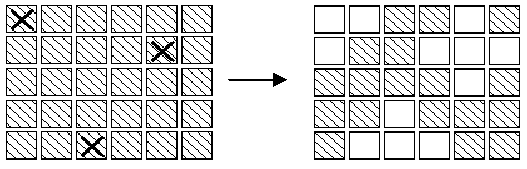
Description In an extended version of the game Lights Out, is a puzzle with 5 rows of 6 buttons each (the actual puzzle has 5 rows of 5 buttons each). Each button has a light. When a button is pressed, that button and each of its (up to four) neighbors above, below, right and left, has the state of its light reversed. (If on, the light is turned off; if off, the light is turned on.) Buttons in the corners change the state of 3 buttons; buttons on an edge change the state of 4 buttons and other buttons change the state of 5. For example, if the buttons marked X on the left below were to be pressed,the display would change to the image on the right.
 The aim of the game is, starting from any initial set of lights on in the display, to press buttons to get the display to a state where all lights are off. When adjacent buttons are pressed, the action of one button can undo the effect of another. For instance, in the display below, pressing buttons marked X in the left display results in the right display.Note that the buttons in row 2 column 3 and row 2 column 5 both change the state of the button in row 2 column 4,so that, in the end, its state is unchanged. 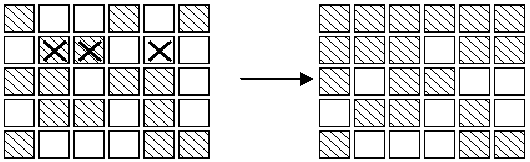 Note: 1. It does not matter what order the buttons are pressed. 2. If a button is pressed a second time, it exactly cancels the effect of the first press, so no button ever need be pressed more than once. 3. As illustrated in the second diagram, all the lights in the first row may be turned off, by pressing the corresponding buttons in the second row. By repeating this process in each row, all the lights in the first four rows may be turned out. Similarly, by pressing buttons in columns 2, 3 ?, all lights in the first 5 columns may be turned off. Write a program to solve the puzzle. Input The first line of the input is a positive integer n which is the number of puzzles that follow. Each puzzle will be five lines, each of which has six 0 or 1 separated by one or more spaces. A 0 indicates that the light is off, while a 1 indicates that the light is on initially.
Output For each puzzle, the output consists of a line with the string: "PUZZLE #m", where m is the index of the puzzle in the input file. Following that line, is a puzzle-like display (in the same format as the input) . In this case, 1's indicate buttons that must be pressed to solve the puzzle, while 0 indicate buttons, which are not pressed. There should be exactly one space between each 0 or 1 in the output puzzle-like display.
Sample Input 2 Sample Output PUZZLE #1 Source |
【POJ】1222 EXTENDED LIGHTS OUT(高斯消元)的更多相关文章
- POJ 1222 EXTENDED LIGHTS OUT (高斯消元)
题目链接 题意:5*6矩阵中有30个灯,操作一个灯,周围的上下左右四个灯会发生相应变化 即由灭变亮,由亮变灭,如何操作使灯全灭? 题解:这个问题是很经典的高斯消元问题.同一个按钮最多只能被按一次,因为 ...
- POJ 1222 EXTENDED LIGHTS OUT [高斯消元XOR]
题意: $5*6$网格里有一些灯告诉你一开始开关状态,按一盏灯会改变它及其上下左右的状态,问最后全熄灭需要按那些灯,保证有解 经典问题 一盏灯最多会被按一次,并且有很明显的异或性质 一个灯作为一个方程 ...
- poj1222 EXTENDED LIGHTS OUT 高斯消元||枚举
Time Limit: 1000MS Memory Limit: 10000K Total Submissions: 8481 Accepted: 5479 Description In an ...
- POJ1222 EXTENDED LIGHTS OUT 高斯消元 XOR方程组
http://poj.org/problem?id=1222 在学校oj用搜索写了一次,这次写高斯消元,haoi现场裸xor方程消元没写出来,真实zz. #include<iostream> ...
- POJ 1222【异或高斯消元|二进制状态枚举】
题目链接:[http://poj.org/problem?id=1222] 题意:Light Out,给出一个5 * 6的0,1矩阵,0表示灯熄灭,反之为灯亮.输出一种方案,使得所有的等都被熄灭. 题 ...
- POJ 1222 熄灯问题【高斯消元】
<题目链接> 题目大意: 有一个5*6的矩阵,每一位是0或者1. 没翻转一位,它的上下左右的数字也为改变.(0变成1,1变成0).要把矩阵中所有的数都变成0.求最少翻转次数的方案,输出矩阵 ...
- [poj1222]EXTENDED LIGHTS OUT(高斯消元)
题意:每个灯开启会使自身和周围的灯反转,要使全图的灯灭掉,判断灯开的位置. 解题关键:二进制高斯消元模板题. 复杂度:$O({n^3})$ #include<cstdio> #includ ...
- EXTENDED LIGHTS OUT (高斯消元)
In an extended version of the game Lights Out, is a puzzle with 5 rows of 6 buttons each (the actual ...
- POJ 1681---Painter's Problem(高斯消元)
POJ 1681---Painter's Problem(高斯消元) Description There is a square wall which is made of n*n small s ...
- POJ 1222 EXTENDED LIGHTS OUT(翻转+二维开关问题)
POJ 1222 EXTENDED LIGHTS OUT 今天真是完美的一天,这是我在poj上的100A,留个纪念,马上就要期中考试了,可能后面几周刷题就没这么快了,不管怎样,为下一个200A奋斗, ...
随机推荐
- Alpha 冲刺(2/10)
队名 火箭少男100 组长博客 林燊大哥 作业博客 Alpha 冲鸭鸭! 成员冲刺阶段情况 林燊(组长) 过去两天完成了哪些任务 协调各成员之间的工作 协助前端界面的开发 搭建测试用服务器的环境 完成 ...
- lol人物模型提取(五)
修改了发过去后,那边说吊坠的绳子太细了,厚度至少1mm,推荐是2mm,需要我自己加粗,没办法又得用3ds max一根一根线地缩放了. 修改好后问报价,高精度树脂打印需要730元,还不带上色的, ...
- Maven jeetsite项目 搭建
, 一直没有系统的总结一下Maven的知识,今天,想从网上找一个Maven的项目,练练手,顺便学习一下maven的原理 和布局. 官网:http://www.jeesite.com/ 没想到,上来就给 ...
- Delphi SQL语句字符串拼接
单引号必须成对出现,最外层的单引号表示其内部符号为字符:除最外层以外的单引号,每两个单引号代表一个'字符.加号:+用于字符串之间的连接.字符串常量用四个单引号,例如 ' select * from T ...
- IO复用、多进程和多线程三种并发编程模型
I/O复用模型 I/O复用原理:让应用程序可以同时对多个I/O端口进行监控以判断其上的操作是否可以进行,达到时间复用的目的.在书上看到一个例子来解释I/O的原理,我觉得很形象,如果用监控来自10根不同 ...
- Visual Stdio 2015打包安装项目的方法(使用Visual Studio Installer)
首先在官网下载VS2015的Visual Studio Installer 1.创建安装项目 里面最左侧的框框有三个文件夹 1.“应用程序文件夹”即"Application Folder&q ...
- Elasticsearch 更新索引settings
1.更新索引设置:将副本减至0,修改索引分析器为ik_max_word和检索分词器为ik_smart 2.需要先将索引关闭,然后再PUT setings POST user/_close PUT us ...
- Html CSS学习(五)position定位 原
Html CSS学习(五)position定位 position用来对元素进行定位,其值有以下几种: static:无特殊定位,对象遵循正常文档流,top,right,bottom,left等属性不会 ...
- POJ3068:"Shortest" pair of paths——题解
http://poj.org/problem?id=3068 题目大意: 从0-n-1找到两条边和点都不相同(除了0和n-1外)的最小费用路径. ——————————————————————————— ...
- HDU 2083(排序+绝对值+中间值求和)
简易版之最短距离 点我跳转到HDOJ Time Limit: 1000/1000 MS (Java/Others) Memory Limit: 32768/32768 K (Java/Others) ...