
《GPU高性能编程CUDA实战》第十章 流
▶ 本章介绍了页锁定内存和流的使用方法,给出了测试内存拷贝、(单 / 双)流控制下的内存拷贝的例子。
● 测试内存拷贝
 #include <stdio.h>

 #include "cuda_runtime.h"

 #include "device_launch_parameters.h"

 #include "D:\Code\CUDA\book\common\book.h"

 #define SIZE        (64*1024*1024)

 #define TEST_TIMES  (100)

 float cuda_malloc_test(int size, bool up)

 {

     cudaEvent_t     start, stop;

     int             *a, *dev_a;

     float           elapsedTime;

     cudaEventCreate(&start);

     cudaEventCreate(&stop);

     a = (int*)malloc(size * sizeof(int));

     cudaMalloc((void**)&dev_a,size * sizeof(*dev_a));

     cudaEventRecord(start, );

     if (up)

     {

         for (int i = ; i < TEST_TIMES; i++)

             cudaMemcpy(dev_a, a, size * sizeof(*dev_a), cudaMemcpyHostToDevice);

     }

     else

     {

         for (int i = ; i < TEST_TIMES; i++)

             cudaMemcpy(a, dev_a, size * sizeof(*dev_a), cudaMemcpyDeviceToHost);

     }

     cudaEventRecord(stop, );

     cudaEventSynchronize(stop);

     cudaEventElapsedTime(&elapsedTime, start, stop);

     free(a);

     cudaFree(dev_a);

     cudaEventDestroy(start);

     cudaEventDestroy(stop);

     return elapsedTime;

 }

 float cuda_host_alloc_test(int size, bool up)

 {

     cudaEvent_t     start, stop;

     int             *a, *dev_a;

     float           elapsedTime;

     cudaEventCreate(&start);

     cudaEventCreate(&stop);

     cudaHostAlloc((void**)&a, size * sizeof(int), cudaHostAllocDefault);

     cudaMalloc((void**)&dev_a, size * sizeof(int));

     cudaEventRecord(start, );

     if (up)

     {

         for (int i = ; i < TEST_TIMES; i++)

             cudaMemcpy(dev_a, a, size * sizeof(int), cudaMemcpyHostToDevice);

     }

     else

     {

         for (int i = ; i < TEST_TIMES; i++)

             cudaMemcpy(a, dev_a, size * sizeof(int), cudaMemcpyDeviceToHost);

     }

     cudaEventRecord(stop, );

     cudaEventSynchronize(stop);

     cudaEventElapsedTime(&elapsedTime, start, stop);

     cudaFreeHost(a);

     cudaFree(dev_a);

     cudaEventDestroy(start);

     cudaEventDestroy(stop);

     return elapsedTime;

 }

 int main(void)

 {

     float elapsedTime;

     float testSizeByte = (float)SIZE * sizeof(int) * TEST_TIMES /  / ;

     elapsedTime = cuda_malloc_test(SIZE, true);

     printf("\n\tcudaMalloc Upwards:\t\t%3.1f ms\t%3.1f MB/s",elapsedTime, testSizeByte / (elapsedTime / ));

     elapsedTime = cuda_malloc_test(SIZE, false);

     printf("\n\tcudaMalloc Downwards:\t\t%3.1f ms\t%3.1f MB/s", elapsedTime, testSizeByte / (elapsedTime / ));

     elapsedTime = cuda_host_alloc_test(SIZE, true);

     printf("\n\tcudaHostAlloc Upwards:\t\t%3.1f ms\t%3.1f MB/s", elapsedTime, testSizeByte / (elapsedTime / ));

     elapsedTime = cuda_host_alloc_test(SIZE, false);

     printf("\n\tcudaHostAlloc Downwards:\t%3.1f ms\t%3.1f MB/s", elapsedTime, testSizeByte / (elapsedTime / ));

     getchar();

     return;

 }
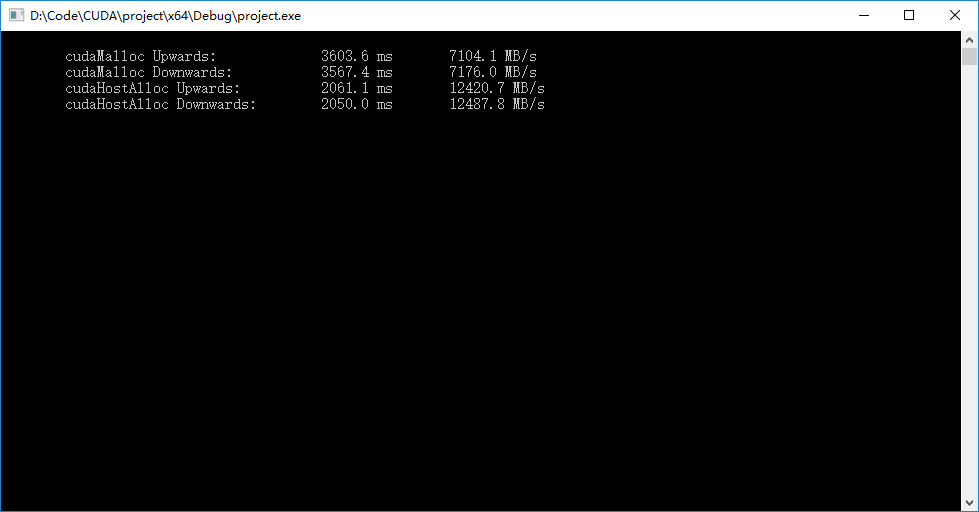
● 程序输出如下图,可见页锁定内存的读取速度要比内存快一些。
● 页锁定内存的使用方法
 int *a, *dev_a, size;

 cudaHostAlloc((void**)&a, sizeof(int) * size, cudaHostAllocDefault);// 申请页锁定内存

 cudaMalloc((void**)&dev_a, sizeof(int) * size);

 cudaMemcpy(dev_a, a, sizeof(int) * size, cudaMemcpyHostToDevice);// 使用普通的内存拷贝

 cudaMemcpy(a, dev_a, sizeof(int) * size, cudaMemcpyDeviceToHost);

 cudaFreeHost(a);// 释放内存

 cudaFree(dev_a);
● 单流内存拷贝
 #include <stdio.h>

 #include "cuda_runtime.h"

 #include "device_launch_parameters.h"

 #include "D:\Code\CUDA\book\common\book.h"

 #define N              (1024*1024)

 #define LOOP_TIMES     (100)

 __global__ void kernel(int *a, int *b, int *c)

 {

     int idx = threadIdx.x + blockIdx.x * blockDim.x;

     if (idx < N)

     {

         int idx1 = (idx + ) % ;

         int idx2 = (idx + ) % ;

         float   as = (a[idx] + a[idx1] + a[idx2]) / 3.0f;

         float   bs = (b[idx] + b[idx1] + b[idx2]) / 3.0f;

         c[idx] = (as + bs) / ;

     }

 }

 int main(void)

 {

     cudaEvent_t     start, stop;

     float           elapsedTime;

     cudaStream_t    stream;

     int *host_a, *host_b, *host_c;

     int *dev_a, *dev_b, *dev_c;

     cudaEventCreate(&start);

     cudaEventCreate(&stop);

     cudaStreamCreate(&stream);

     cudaMalloc((void**)&dev_a, N * sizeof(int));

     cudaMalloc((void**)&dev_b, N * sizeof(int));

     cudaMalloc((void**)&dev_c, N * sizeof(int));

     cudaHostAlloc((void**)&host_a, N * LOOP_TIMES * sizeof(int), cudaHostAllocDefault);

     cudaHostAlloc((void**)&host_b, N * LOOP_TIMES * sizeof(int), cudaHostAllocDefault);

     cudaHostAlloc((void**)&host_c, N * LOOP_TIMES * sizeof(int), cudaHostAllocDefault);

     for (int i = ; i < N * LOOP_TIMES; i++)

     {

         host_a[i] = rand();

         host_b[i] = rand();

     }

     cudaEventRecord(start, );

     for (int i = ; i < N * LOOP_TIMES; i += N)

     {

         cudaMemcpyAsync(dev_a, host_a + i, N * sizeof(int), cudaMemcpyHostToDevice, stream);

         cudaMemcpyAsync(dev_b, host_b + i, N * sizeof(int), cudaMemcpyHostToDevice, stream);

         kernel << <N / , , , stream >> >(dev_a, dev_b, dev_c);

         cudaMemcpyAsync(host_c + i, dev_c, N * sizeof(int), cudaMemcpyDeviceToHost, stream);

     }

     cudaStreamSynchronize(stream);

     cudaEventRecord(stop, );

     cudaEventSynchronize(stop);

     cudaEventElapsedTime(&elapsedTime, start, stop);

     printf("\n\tTest %d times, spending time:\t%3.1f ms\n", LOOP_TIMES, elapsedTime);

     cudaFree(dev_a);

     cudaFree(dev_b);

     cudaFree(dev_c);

     cudaFreeHost(host_a);

     cudaFreeHost(host_b);

     cudaFreeHost(host_c);

     cudaStreamDestroy(stream);

     cudaEventDestroy(start);

     cudaEventDestroy(stop);

     getchar();

     return ;

 }
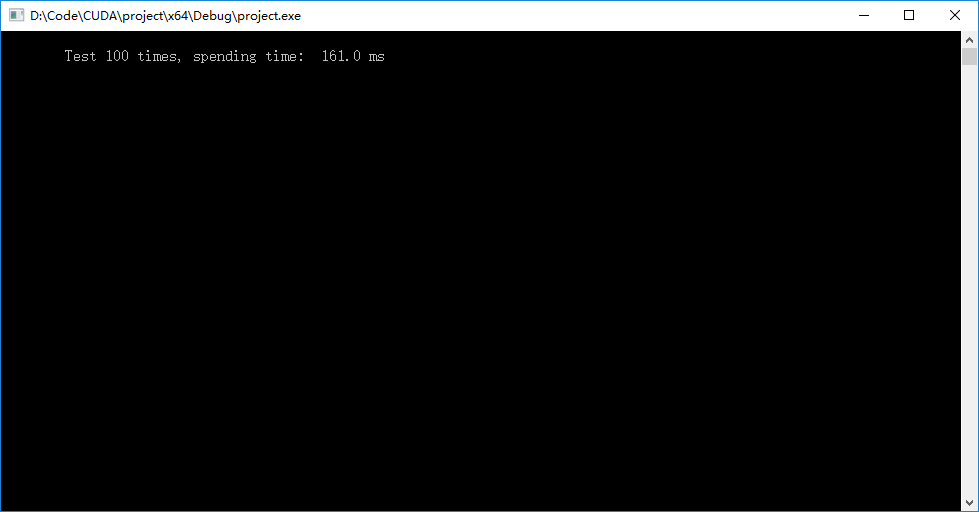
● 程序输出
● 限定流作为内存拷贝工作时要使用函数cudaMemcpyAsync(),其简单声明和使用为:
 cudaError_t cudaMemcpyAsync(void *dst, const void *src, size_t count, enum cudaMemcpyKind kind, cudaStream_t stream __dv());

 cudaMemcpyAsync(dev_a, host_a, size, cudaMemcpyHostToDevice, stream);

 cudaMemcpyAsync(host_a, dev_a, size, cudaMemcpyDeviceToHost, stream);
● 使用流的基本过程
 cudaStream_t stream;// 创建流变量

 int *host_a;

 int *dev_a;

 host_a = (int *)malloc(sizeof(int)*N);

 cudaMalloc((void**)&dev_a, N * sizeof(int));

 cudaMemcpyAsync(dev_a, host_a + i, N * sizeof(int), cudaMemcpyHostToDevice, stream);// 采用异步内存拷贝

 kernel << <blocksize, threadsize, stream >> > (dev_a);// 执行核函数,注意标记流编号

 cudaMemcpyAsync(host_c + i, dev_c, N * sizeof(int), cudaMemcpyDeviceToHost, stream);/

 cudaStreamSynchronize(stream);// 流同步,保证该留内的工作全部完成

 free(a);// 释放内存和销毁流变量

 cudaFree(dev_a);

 cudaStreamDestroy(stream);
● 双流内存拷贝
 #include <stdio.h>

 #include "cuda_runtime.h"

 #include "device_launch_parameters.h"

 #include "D:\Code\CUDA\book\common\book.h"

 #define N           (1024*1024)

 #define LOOP_TIMES  (100)

 #define NAIVE true

 __global__ void kernel(int *a, int *b, int *c)

 {

     int idx = threadIdx.x + blockIdx.x * blockDim.x;

     if (idx < N)

     {

         int idx1 = (idx + ) % ;

         int idx2 = (idx + ) % ;

         float   as = (a[idx] + a[idx1] + a[idx2]) / 3.0f;

         float   bs = (b[idx] + b[idx1] + b[idx2]) / 3.0f;

         c[idx] = (as + bs) / ;

     }

 }

 int main(void)

 {

     cudaEvent_t     start, stop;

     float           elapsedTime;

     cudaStream_t    stream0, stream1;

     int *host_a, *host_b, *host_c;

     int *dev_a0, *dev_b0, *dev_c0;

     int *dev_a1, *dev_b1, *dev_c1;

     cudaEventCreate(&start);

     cudaEventCreate(&stop);

     cudaStreamCreate(&stream0);

     cudaStreamCreate(&stream1);

     cudaMalloc((void**)&dev_a0,N * sizeof(int));

     cudaMalloc((void**)&dev_b0,N * sizeof(int));

     cudaMalloc((void**)&dev_c0,N * sizeof(int));

     cudaMalloc((void**)&dev_a1,N * sizeof(int));

     cudaMalloc((void**)&dev_b1,N * sizeof(int));

     cudaMalloc((void**)&dev_c1,N * sizeof(int));

     cudaHostAlloc((void**)&host_a, N * LOOP_TIMES * sizeof(int),cudaHostAllocDefault);

     cudaHostAlloc((void**)&host_b, N * LOOP_TIMES * sizeof(int),cudaHostAllocDefault);

     cudaHostAlloc((void**)&host_c, N * LOOP_TIMES * sizeof(int),cudaHostAllocDefault);

     for (int i = ; i < N * LOOP_TIMES; i++)

     {

         host_a[i] = rand();

         host_b[i] = rand();

     }

     printf("\n\tArray initialized!");

     cudaEventRecord(start, );

     for (int i = ; i < N * LOOP_TIMES; i += N * )// 每次吃两个N的长度

     {

 #if NAIVE

         cudaMemcpyAsync(dev_a0, host_a + i, N * sizeof(int),cudaMemcpyHostToDevice,stream0);// 前半段给dev_a0和dev_b0

         cudaMemcpyAsync(dev_b0, host_b + i, N * sizeof(int),cudaMemcpyHostToDevice,stream0);

         kernel << <N / , , , stream0 >> >(dev_a0, dev_b0, dev_c0);

         cudaMemcpyAsync(host_c + i, dev_c0, N * sizeof(int),cudaMemcpyDeviceToHost,stream0);

         cudaMemcpyAsync(dev_a1, host_a + i + N,N * sizeof(int),cudaMemcpyHostToDevice,stream1);//后半段给dev_a1和dev_b1

         cudaMemcpyAsync(dev_b1, host_b + i + N,N * sizeof(int),cudaMemcpyHostToDevice,stream1);

         kernel << <N / , , , stream1 >> >(dev_a1, dev_b1, dev_c1);

         cudaMemcpyAsync(host_c + i + N, dev_c1, N * sizeof(int),cudaMemcpyDeviceToHost,stream1);

 #else

         cudaMemcpyAsync(dev_a0, host_a + i, N * sizeof(int), cudaMemcpyHostToDevice, stream0);// 两个半段拷贝任务

         cudaMemcpyAsync(dev_a1, host_a + i + N, N * sizeof(int), cudaMemcpyHostToDevice, stream1);

         cudaMemcpyAsync(dev_b0, host_b + i, N * sizeof(int), cudaMemcpyHostToDevice, stream0);// 两个半段拷贝任务

         cudaMemcpyAsync(dev_b1, host_b + i + N, N * sizeof(int), cudaMemcpyHostToDevice, stream1);

         kernel << <N / , , , stream0 >> >(dev_a0, dev_b0, dev_c0);// 两个计算执行

         kernel << <N / , , , stream1 >> >(dev_a1, dev_b1, dev_c1);

         cudaMemcpyAsync(host_c + i, dev_c0, N * sizeof(int), cudaMemcpyDeviceToHost, stream0);// 两个半段拷贝任务

         cudaMemcpyAsync(host_c + i + N, dev_c1, N * sizeof(int), cudaMemcpyDeviceToHost, stream1);

 #endif

     }

     cudaStreamSynchronize(stream0);

     cudaStreamSynchronize(stream1);

     cudaEventRecord(stop, );

     cudaEventSynchronize(stop);

     cudaEventElapsedTime(&elapsedTime,start, stop);

     printf("\n\tTest %d times, spending time:\t%3.1f ms\n", LOOP_TIMES, elapsedTime);

     cudaFree(dev_a0);

     cudaFree(dev_b0);

     cudaFree(dev_c0);

     cudaFree(dev_a1);

     cudaFree(dev_b1);

     cudaFree(dev_c1);

     cudaFreeHost(host_a);

     cudaFreeHost(host_b);

     cudaFreeHost(host_c);

     cudaStreamDestroy(stream0);

     cudaStreamDestroy(stream1);

     getchar();

     return ;

 }
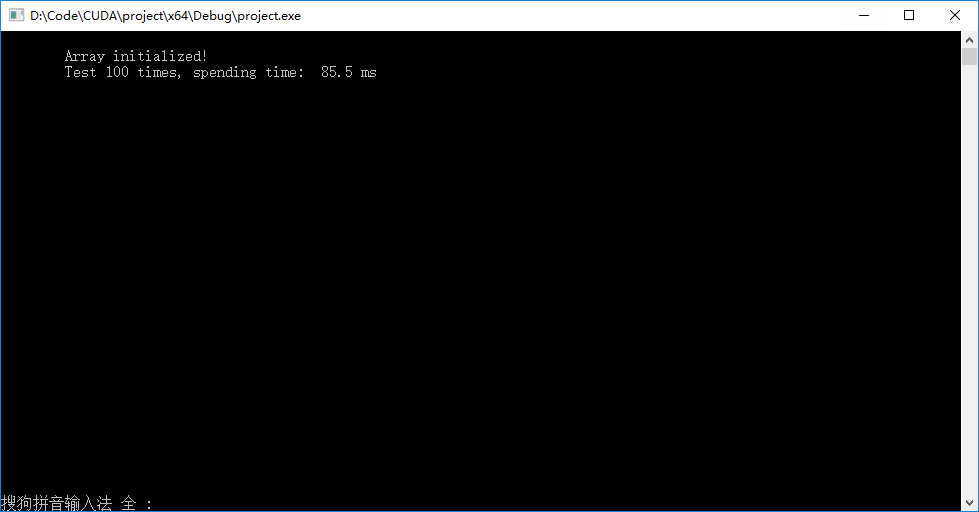
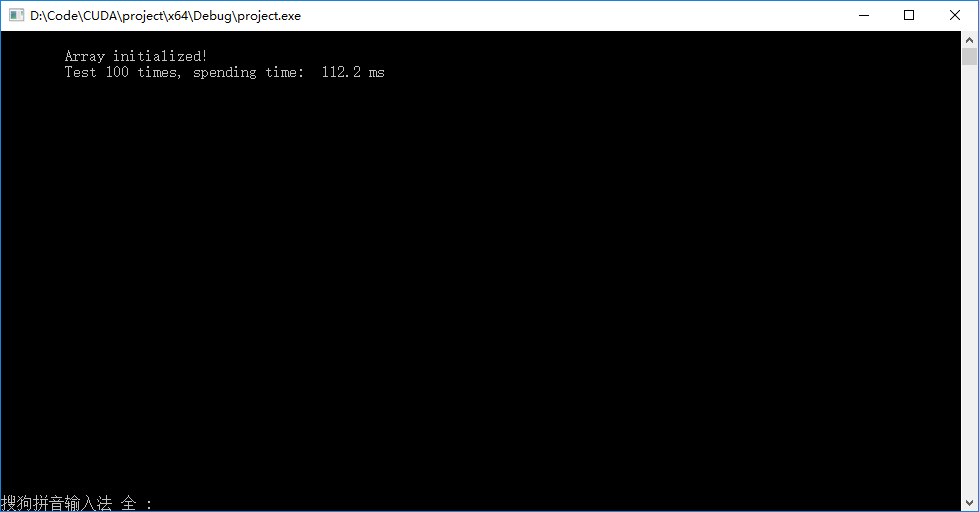
● 书上简单双流版本输出结果如下左图,异步双流版本输出结果如下右图。发现异步以后速度反而下降了。
《GPU高性能编程CUDA实战》第十章 流的更多相关文章
- [问题解决]《GPU高性能编程CUDA实战》中第4章Julia实例“显示器驱动已停止响应,并且已恢复”问题的解决方法
以下问题的出现及解决都基于"WIN7+CUDA7.5". 问题描述:当我编译运行<GPU高性能编程CUDA实战>中第4章所给Julia实例代码时,出现了显示器闪动的现象 ...
- 《GPU高性能编程CUDA实战》第十一章 多GPU系统的CUDA C
▶ 本章介绍了多设备胸膛下的 CUDA 编程,以及一些特殊存储类型对计算速度的影响 ● 显存和零拷贝内存的拷贝与计算对比 #include <stdio.h> #include " ...
- 《GPU高性能编程CUDA实战》第五章 线程并行
▶ 本章介绍了线程并行,并给出四个例子.长向量加法.波纹效果.点积和显示位图. ● 长向量加法(线程块并行 + 线程并行) #include <stdio.h> #include &quo ...
- 《GPU高性能编程CUDA实战》第四章 简单的线程块并行
▶ 本章介绍了线程块并行,并给出两个例子:长向量加法和绘制julia集. ● 长向量加法,中规中矩的GPU加法,包含申请内存和显存,赋值,显存传入,计算,显存传出,处理结果,清理内存和显存.用到了 t ...
- 《GPU高性能编程CUDA实战》附录二 散列表
▶ 使用CPU和GPU分别实现散列表 ● CPU方法 #include <stdio.h> #include <time.h> #include "cuda_runt ...
- 《GPU高性能编程CUDA实战》第八章 图形互操作性
▶ OpenGL与DirectX,等待填坑. ● basic_interop #include <stdio.h> #include "cuda_runtime.h" ...
- 《GPU高性能编程CUDA实战》第七章 纹理内存
▶ 本章介绍了纹理内存的使用,并给出了热传导的两个个例子.分别使用了一维和二维纹理单元. ● 热传导(使用一维纹理) #include <stdio.h> #include "c ...
- 《GPU高性能编程CUDA实战》第六章 常量内存
▶ 本章介绍了常量内存的使用,并给光线追踪的一个例子.介绍了结构cudaEvent_t及其在计时方面的使用. ● 章节代码,大意是有SPHERES个球分布在原点附近,其球心坐标在每个坐标轴方向上分量绝 ...
- 《GPU高性能编程CUDA实战》第三章 CUDA设备相关
▶ 这章介绍了与CUDA设备相关的参数,并给出了了若干用于查询参数的函数. ● 代码(已合并) #include <stdio.h> #include "cuda_runtime ...
随机推荐
- with() {} 的用法
var use = "other"; var katana = { isSharp: true, use: function(){ this.isSharp = !!this.is ...
- 【MVC】使用MvcPager进行分页
1.添加引用: mvcPager 版本高的提供的功能也更多. 注:下载了第一个,但是里面的一些字段是只读的.(eg:PagedList<T> .TotalItemCount)这是不符合的. ...
- 【BZOJ2683】简单题
cdq分治妙啊 (被改过题面的)原题: dydxh所出的题目是这样的:有一个N*N矩阵,给出一系列的修改和询问,修改是这样的:将(x,y)中的数字加上k,而询问是这样的:求(x1,y1)到(x2,y2 ...
- django中的FBV和CBV
django中请求处理方式有2种:FBV 和 CBV 一.FBV FBV(function base views) 就是在视图里使用函数处理请求. 看代码: urls.py from django.c ...
- matplotlib的颜色及线条控制
refer to: https://www.cnblogs.com/darkknightzh/p/6117528.html
- centos下yum安装pip失败
[root@wfm ~]# yum -y install pip Loaded plugins: fastestmirror, refresh-packagekit, securityLoading ...
- JUC线程池之 线程池的5种状态:Running, SHUTDOWN, STOP, TIDYING, TERMINATED
线程池有5种状态:Running, SHUTDOWN, STOP, TIDYING, TERMINATED. 线程池状态定义代码如下: private final AtomicInteger ctl ...
- es6知识点
扩展运算符(三个点): 将值转换为参数序列. 解构赋值:比如:var [a,b,c]=[1,2,3];
- Angular 4 依赖注入
一.依赖注入 1. 创建工程 ng new myangular 2. 创建组件 ng g componet product1 3. 创建服务 ng g service shared/product 如 ...
- Linux(Centos7)下安装 zookeeper docker版 集群
为了省去麻烦的软件安装,现在开发环境需要的软件越来越习惯于docker安装了,先看下安装后的截图,开发环境正在启动的容器 1.首先系统需要先支持docker …… 由于之前安装几次都没有做流程记录,在 ...