
《DSP using MATLAB》Problem 7.12

阻带衰减50dB,我们选Hamming窗
代码:
%% ++++++++++++++++++++++++++++++++++++++++++++++++++++++++++++++++++++++++++++++++

%%            Output Info about this m-file

fprintf('\n***********************************************************\n');

fprintf('        <DSP using MATLAB> Problem 7.12 \n\n');

banner();

%% ++++++++++++++++++++++++++++++++++++++++++++++++++++++++++++++++++++++++++++++++

% highpass

ws1 = 0.4*pi; wp1 = 0.6*pi; As = 50; Rp = 0.004;

tr_width = (wp1-ws1);

M = ceil(6.6*pi/tr_width) + 1;                 % Hamming Window

fprintf('\nFilter Length: M = %d.\n', M);

n = [0:1:M-1]; wc1 = (ws1+wp1)/2;

%wc = (ws + wp)/2,                    % ideal LPF cutoff frequency

hd = ideal_lp(pi, M) - ideal_lp(wc1, M);

w_hamm = (hamming(M))';  h = hd .* w_hamm;

[db, mag, pha, grd, w] = freqz_m(h, [1]);  delta_w = 2*pi/1000;

[Hr,ww,P,L] = ampl_res(h);

Rp = -(min(db(wp1/delta_w+1 :1: 0.9*pi/delta_w)));              % Actual Passband Ripple

fprintf('\nActual Passband Ripple is %.4f dB.\n', Rp);

As = -round(max(db(1 :1: ws1/delta_w+1 )));          % Min Stopband attenuation

fprintf('\nMin Stopband attenuation is %.4f dB.\n', As);

[delta1, delta2] = db2delta(Rp, As)

% Plot

figure('NumberTitle', 'off', 'Name', 'Problem 7.12 ideal_lp Method')

set(gcf,'Color','white');

subplot(2,2,1); stem(n, hd); axis([0 M-1 -0.4 0.3]); grid on;

xlabel('n'); ylabel('hd(n)'); title('Ideal Impulse Response');

subplot(2,2,2); stem(n, w_hamm); axis([0 M-1 0 1.1]); grid on;

xlabel('n'); ylabel('w(n)'); title('Hamming Window');

subplot(2,2,3); stem(n, h); axis([0 M-1 -0.4 0.3]); grid on;

xlabel('n'); ylabel('h(n)'); title('Actual Impulse Response');

subplot(2,2,4); plot(w/pi, db); axis([0 1 -100 10]); grid on;

set(gca,'YTickMode','manual','YTick',[-90,-52,0]);

set(gca,'YTickLabelMode','manual','YTickLabel',['90';'52';' 0']);

set(gca,'XTickMode','manual','XTick',[0,0.4,0.6,1]);

xlabel('frequency in \pi units'); ylabel('Decibels'); title('Magnitude Response in dB');

figure('NumberTitle', 'off', 'Name', 'Problem 7.12 h(n) ideal_lp Method')

set(gcf,'Color','white');

subplot(2,2,1); plot(w/pi, db); grid on; axis([0 2 -100 10]);

xlabel('frequency in \pi units'); ylabel('Decibels'); title('Magnitude Response in dB');

set(gca,'YTickMode','manual','YTick',[-90,-52,0])

set(gca,'YTickLabelMode','manual','YTickLabel',['90';'52';' 0']);

set(gca,'XTickMode','manual','XTick',[0,0.4,0.6,1,1.4,1.6,2]);

subplot(2,2,3); plot(w/pi, mag); grid on; %axis([0 2 -100 10]);

xlabel('frequency in \pi units'); ylabel('Absolute'); title('Magnitude Response in absolute');

set(gca,'XTickMode','manual','XTick',[0,0.4,0.6,1,1.4,1.6,2]);

set(gca,'YTickMode','manual','YTick',[0.0,0.5,1.0])

subplot(2,2,2); plot(w/pi, pha); grid on; %axis([0 1 -100 10]);

xlabel('frequency in \pi units'); ylabel('Rad'); title('Phase Response in Radians');

subplot(2,2,4); plot(w/pi, grd*pi/180);  grid on; %axis([0 1 -100 10]);

xlabel('frequency in \pi units'); ylabel('Rad'); title('Group Delay');

figure('NumberTitle', 'off', 'Name', 'Problem 7.12 h(n)')

set(gcf,'Color','white');

plot(ww/pi, Hr); grid on; %axis([0 1 -100 10]);

xlabel('frequency in \pi units'); ylabel('Hr'); title('Amplitude Response');

set(gca,'YTickMode','manual','YTick',[-delta2,0,delta2,1 - delta1,1, 1 + delta1])

%set(gca,'YTickLabelMode','manual','YTickLabel',['90';'45';' 0']);

%set(gca,'XTickMode','manual','XTick',[0,0.4,0.6,1,1.4,1.6,2]);

h_check = fir1(M, wc1/pi, 'high');

[db, mag, pha, grd, w] = freqz_m(h_check, [1]);

[Hr,ww,P,L] = ampl_res(h_check);

figure('NumberTitle', 'off', 'Name', 'Problem 7.12 fir1 Method')

set(gcf,'Color','white');

subplot(2,2,1); stem(n, hd); axis([0 M-1 -0.4 0.3]); grid on;

xlabel('n'); ylabel('hd(n)'); title('Ideal Impulse Response');

subplot(2,2,2); stem(n, w_hamm); axis([0 M-1 0 1.1]); grid on;

xlabel('n'); ylabel('w(n)'); title('Hanning Window');

subplot(2,2,3); stem([0:M], h_check); axis([0 M -0.4 0.5]); grid on;

xlabel('n'); ylabel('h\_check(n)'); title('Actual Impulse Response');

subplot(2,2,4); plot(w/pi, db); axis([0 1 -100 10]); grid on;

set(gca,'YTickMode','manual','YTick',[-90,-52,0])

set(gca,'YTickLabelMode','manual','YTickLabel',['90';'52';' 0']);

set(gca,'XTickMode','manual','XTick',[0,0.4,0.6,1]);

xlabel('frequency in \pi units'); ylabel('Decibels'); title('Magnitude Response in dB');

figure('NumberTitle', 'off', 'Name', 'Problem 7.12 h(n) fir1 Method')

set(gcf,'Color','white');

subplot(2,2,1); plot(w/pi, db); grid on; axis([0 2 -100 10]);

xlabel('frequency in \pi units'); ylabel('Decibels'); title('Magnitude Response in dB');

set(gca,'YTickMode','manual','YTick',[-90,-52,0])

set(gca,'YTickLabelMode','manual','YTickLabel',['90';'52';' 0']);

set(gca,'XTickMode','manual','XTick',[0,0.4,0.6,1,1.4,1.6,2]);

subplot(2,2,3); plot(w/pi, mag); grid on; %axis([0 1 -100 10]);

xlabel('frequency in \pi units'); ylabel('Absolute'); title('Magnitude Response in absolute');

set(gca,'XTickMode','manual','XTick',[0,0.4,0.6,1,1.4,1.6,2]);

set(gca,'YTickMode','manual','YTick',[0.0,0.5,1.0])

subplot(2,2,2); plot(w/pi, pha); grid on; %axis([0 1 -100 10]);

xlabel('frequency in \pi units'); ylabel('Rad'); title('Phase Response in Radians');

subplot(2,2,4); plot(w/pi, grd*pi/180);  grid on; %axis([0 1 -100 10]);

xlabel('frequency in \pi units'); ylabel('Rad'); title('Group Delay');
运行结果:
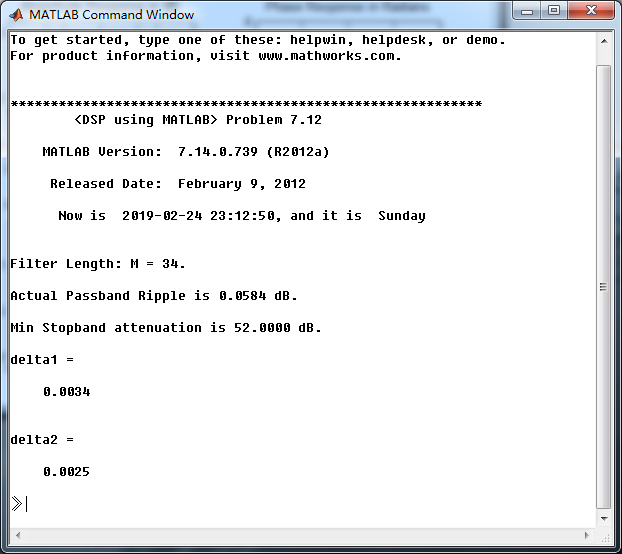
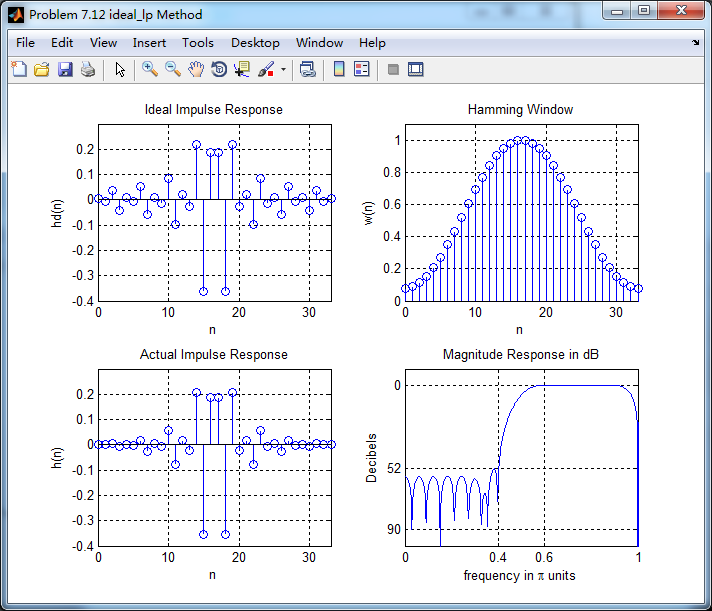
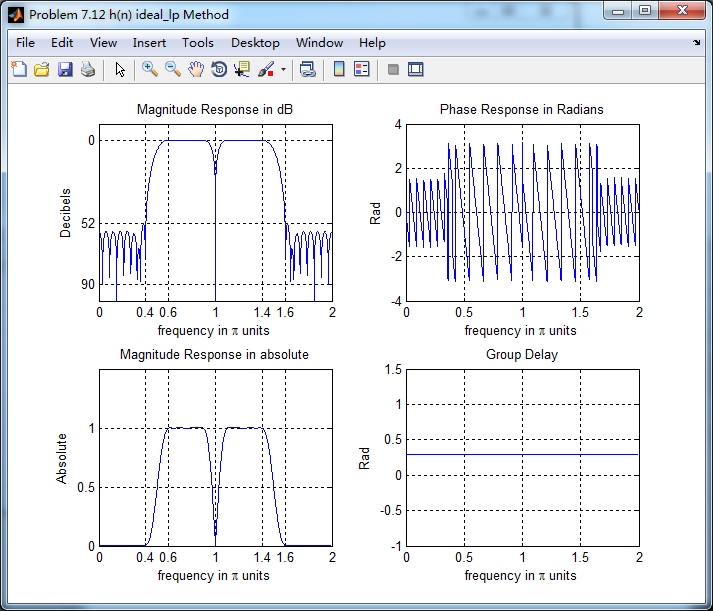
Hamming窗长度为M=34,实际最小阻带衰减为52dB,满足设计要求。
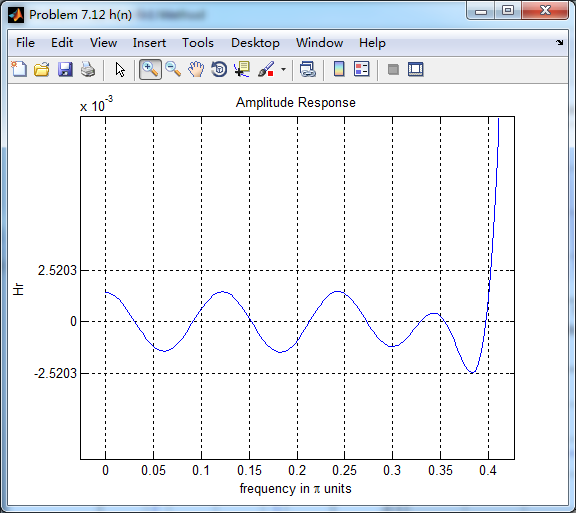
振幅响应的高通部分

低阻部分
下面是用fir1函数(默认Hamming窗)来求得脉冲响应,再计算其幅度响应(dB和Absolute单位)、相位响应和群延迟响应,

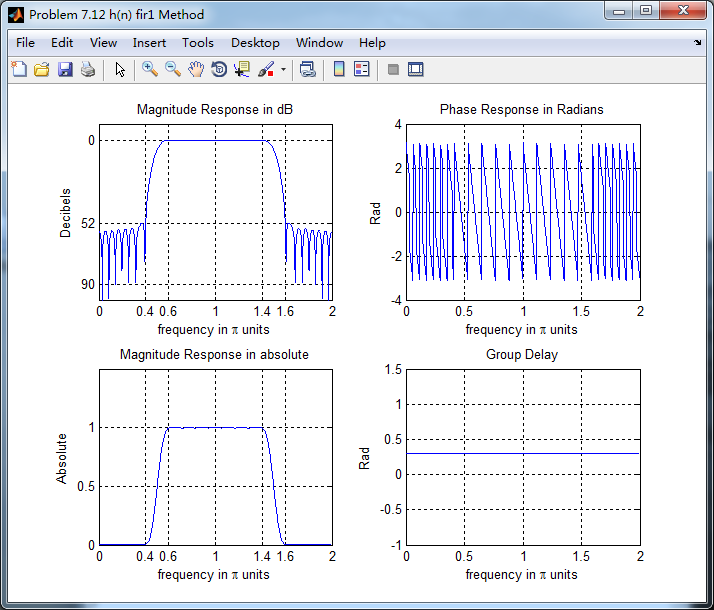
可以看出,两种方法得到的幅度响应和相位响应在接近π的较高频率部分,还是有差别的。
《DSP using MATLAB》Problem 7.12的更多相关文章
- 《DSP using MATLAB》Problem 6.12
代码: %% ++++++++++++++++++++++++++++++++++++++++++++++++++++++++++++++++++++++++++++++++ %% Output In ...
- 《DSP using MATLAB》Problem 5.12
1.从别的地方找的证明过程: 2.代码 function x2 = circfold(x1, N) %% Circular folding using DFT %% ----------------- ...
- 《DSP using MATLAB》Problem 8.12
代码: %% ------------------------------------------------------------------------ %% Output Info about ...
- 《DSP using MATLAB》Problem 4.12
代码: function [As, Ac, r, v0] = invCCPP(b0, b1, a1, a2) % Determine the signal parameters Ac, As, r, ...
- 《DSP using MATLAB》Problem 3.12
- 《DSP using MATLAB》Problem 7.6
代码: 子函数ampl_res function [Hr,w,P,L] = ampl_res(h); % % function [Hr,w,P,L] = Ampl_res(h) % Computes ...
- 《DSP using MATLAB》Problem 6.22
代码: %% ++++++++++++++++++++++++++++++++++++++++++++++++++++++++++++++++++++++++++++++++ %% Output In ...
- 《DSP using MATLAB》Problem 6.8
代码: %% ++++++++++++++++++++++++++++++++++++++++++++++++++++++++++++++++++++++++++++++++ %% Output In ...
- 《DSP using MATLAB》Problem 5.21
证明: 代码: %% ++++++++++++++++++++++++++++++++++++++++++++++++++++++++++++++++++++++++++++++++++++++++ ...
随机推荐
- bind封装
原理:通过apply或者call方法来实现. (1)初始版本 Function.prototype.bind=function(obj,arg){ var arg=Array.prototype.sl ...
- UVA11235 Frequent values
思路 连续的值只会分布在一起成一个块 讨论两边的块,中间就是RMQ了 ST表即可 代码 #include <cstdio> #include <algorithm> #incl ...
- ssm整合(方案一 引入jar)
最近为了研究redis整合,基本都是ssm+redis 好吧 我是老古董了,以前都是ssi,那就折腾一下ssm先,具体方案: 方案一:基本引入jar版.方案二:maven版(后续继续整) 这篇主要是通 ...
- 在1-10中选择一个数,输出x+xx+xxx+xxx....x之和,如:数字为2,则2+22=24
代码: package bao; import java.util.Random; public class a { public static void main(String[] args) { ...
- Ubuntu 16.04上搭建CDH5.16.1集群
本文参考自:<Ubuntu16.04上搭建CDH5.14集群> 1.准备三台(CDH默认配置为三台)安装Ubuntu 16.04.4 LTS系统的服务器,假设ip地址分布为 192.168 ...
- 启动欢迎页面时,Android Studio设置全屏Activity
问题 如何在Android Studio中做一个全屏的启动界面(Splash Activity)? 背景(基本是废话,没兴趣的请跳过) 前段时间把IED换成Android Studio2.2之后,碰到 ...
- 『Python CoolBook』数据结构和算法_字典比较&字典和集合
一.字典元素排序 dict.keys(),dict.values(),dict.items() 结合max.min.sorted.zip进行排序是个很好的办法,另外注意不使用zip时,字典的lambd ...
- 『TensorFlow』张量尺寸获取
tf.shape(a)和a.get_shape()比较 相同点:都可以得到tensor a的尺寸 不同点:tf.shape()中a 数据的类型可以是tensor, list, array a.get_ ...
- php 添加环境变量
1.php添加环境变量主要为了能在 cmd和软件的客户端用php来运行 首先我们要做的第一步: 添加环境变量(记住php.exe的路径,然后再环境变量中编辑path 多个用逗号分隔开,保存重启电脑) ...
- (02) 第一个springboot程序
1. 创建一个springboot程序 1. idea 自带的springboot插件 2. 直接从https://start.spring.io 创建好程序下载下来, 之后覆盖你的创建的项目 2. ...