
Reinforcement Learning: An Introduction读书笔记(3)--finite MDPs
> 目 录 <
- Agent–Environment Interface
- Goals and Rewards
- Returns and Episodes
- Policies and Value Functions
- Optimal Policies and Optimal Value Functions
> 笔 记 <
Agent–Environment Interface
MDPs are meant to be a straightforward framing of the problem of learning from interaction to achieve a goal. The learner and decision maker is called the agent. The thing it interacts with, comprising everything outside the agent, is called the environment. These interact continually, the agent selecting actions and the environment responding to these actions and presenting new situations to the agent.1 The environment also gives rise to rewards, special numerical values that the agent seeks to maximize over time through its choice of actions.
More specifcally, the agent and environment interact at each of a sequence of discrete time steps, t = 0,1,2,.... At each time step t, the agent receives some representation of the environment's state, $S_{t}\in S$, where $S$ is the set of possible states, and on that basis selects an action, $A_{t}\in A(S_{t})$, where $A(S_{t})$ is the set of actions available in state $S_{t}$. One time step later, in part as a consequence of its action, the agent receives a numerical reward, $R_{t+1}\in R \subset \mathbb{R}$, and finds itself in a new state, $S_{t+1}$.
At each time step, the agent implements a mapping from states to probabilities of selecting each possible action. This mapping is called the agent's policy and is denoted $\pi_{t}(a|s)$ is the probability that $A_{t}=a$ if $S_{t}=s$. Reinforcement learning methods specify how the agent changes its policy as a result of its experience. The agent's goal, roughly speaking, is to maximize the total amount of reward it receives over the long run.
the actions are the choices made by the agent; the states are the basis for making the choices; and the rewards are the basis for evaluating the choices.
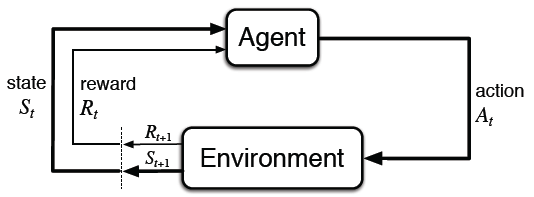
图1. agent-environment interaction in a MDP
马尔可夫性(Markov property): 如果state signal具有马尔科夫性,那么当前状态只跟上一状态有关,它包含了所有从过去经历中得到的信息。马尔可夫性对RL而言很重要,∵decisions和values通常都被认为是一个只跟当前state相关的函数。
MDP的动态性:$p(s',r|s,a)=Pr\left \{ S_{t}=s',R_{t}=r|S_{t-1}=s,A_{t-1}=a \right \}$,
where $ \underset{s'\in S \ r\in R}{\sum \sum}p(s',r|s,a)=1 $, for all $s\in S$, $a\in A(s)$.
基于the dynamics of the MDP, 我们可以很容易地得到状态转移概率(state-transition probabilities, $p(s'|s,a)$),state-action的期望回报(the expected rewards for state–action pairs, $r(s,a)$),以及state-action-next state的期望回报(the expected rewards for state–action-next state, $r(s,a,s')$)。
Goals and Rewards
agent的goal是以一个从environment传递给agent的reward signal的形式存在的。我们通过定义reward signal的值,可以实现跟agent的交流,告诉它what you want it to achieve, not how you want it achieved。
Agent的目标是最大化total reward。因此,最大化的不是immediate reward,而是cumulative reward in the long run。
Returns and Episodes
The return is the function of future rewards that the agent seeks to maximize (in expected value). return有多种形式,取决于task本身和是否希望对回报进行折扣。
Expected return: $G_{t}=R_{t+1}+R_{t+2}+...+R_{T}$, where T is a final time step。适合于episodic tasks。
Episodic tasks: each episode ends in the terminal state, followed by a reset to a standard starting state or a sample from a standard distribution of starting states.
Continuing tasks: the agent–environment interaction doesn’t break naturally into identifiable episodes, but goes on continually without limit.
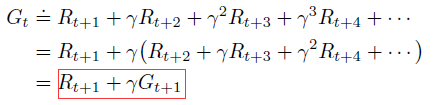
Expected discounted return: $G_{t}=R_{t+1}+\gamma R_{t+2}+ \gamma ^{2}R_{t+3}+...=\sum_{k=0}^{\infty}\gamma ^{k}R_{t+k+1}$。其中,折扣率(discount rate, $\gamma$)决定了未来rewards的当前价值。适合于continuing tasks。
Policies and Value Functions
Value functions: functions of states (or state-action pairs) that estimate how good it is for the agent to be in a given state (or how good it is to perform a given action in a given state). The notion of “how good” here is defined in terms of future rewards that can be expected, or, in terms of the expected return from that state (or state-action pair).
Policy: a mapping from states to probabilities of selecting each possible action. If the agent is following policy $\pi$ at time t, then $\pi(a|s)$ is the probability that $A_{t} = a$ if $S_{t} = s$.
the value function of a state s under a policy $\pi$: (i.e. the expected return when starting in s and following $\pi$ thereafter)
We call the function $ v_{\pi}$ is the state-value function for policy $\pi$
the value of taking action a in state s under a policy $\pi$: (i.e. the expected return starting from s, taking the action a, and thereafter following policy $\pi$)
We call $ q_{\pi}$ the action-value function for policy $\pi$
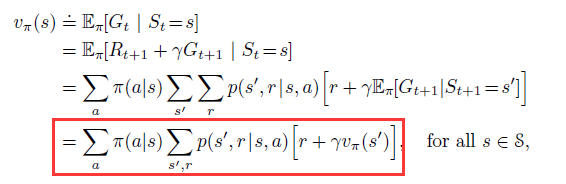
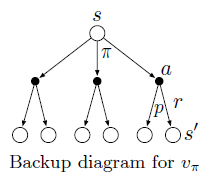
Bellman equation for $v_{\pi}$: It expresses a relationship between the value of a state and the values of its successor states.
Optimal Policies and Optimal Value Functions
Value functions define a partial ordering over policies. $\pi> \pi'$ if and only if $v_{\pi}(s) > v_{\pi'}(s)$, for all $s \in S$. The optimal value functions assign to each state, or state–action pair, the largest expected return achievable by any policy.
Optimal policy $\pi_{*}$:A policy whose value functions are optimal. There is always at least one (can be many) policy that is better than or equal to all other policies.
Optimal state-value function:
Optimal action-value function:
用$v_{*}$来表示$q_{*}$:
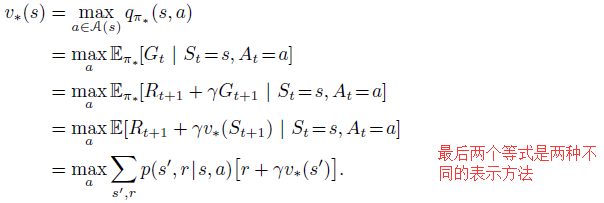
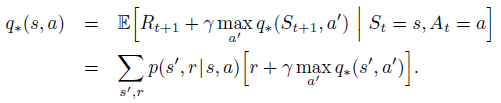
Any policy that is greedy with respect to the optimal value functions must be an optimal policy. The Bellman optimality equations are special consistency conditions that the optimal value functions must satisfy and that can, in principle, be solved for the optimal value functions.
Bellman optimality equation for $v_{*}$:
Bellman optimality equation for $q_{*}$:
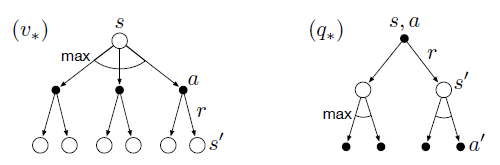
Backup diagrams for $v_{*}$ and $q_{*}$:
Reinforcement Learning: An Introduction读书笔记(3)--finite MDPs的更多相关文章
- Reinforcement Learning: An Introduction读书笔记(4)--动态规划
> 目 录 < Dynamic programming Policy Evaluation (Prediction) Policy Improvement Policy Iterat ...
- Reinforcement Learning: An Introduction读书笔记(1)--Introduction
> 目 录 < learning & intelligence 的基本思想 RL的定义.特点.四要素 与其他learning methods.evolutionary m ...
- Reinforcement Learning: An Introduction读书笔记(2)--多臂机
> 目 录 < k-armed bandit problem Incremental Implementation Tracking a Nonstationary Problem ...
- 《Machine Learning Yearing》读书笔记
——深度学习的建模.调参思路整合. 写在前面 最近偶尔从师兄那里获取到了吴恩达教授的新书<Machine Learning Yearing>(手稿),该书主要分享了神经网络建模.训练.调节 ...
- Machine Learning for hackers读书笔记(六)正则化:文本回归
data<-'F:\\learning\\ML_for_Hackers\\ML_for_Hackers-master\\06-Regularization\\data\\' ranks < ...
- Machine Learning for hackers读书笔记(三)分类:垃圾邮件过滤
#定义函数,打开每一个文件,找到空行,将空行后的文本返回为一个字符串向量,该向量只有一个元素,就是空行之后的所有文本拼接之后的字符串 #很多邮件都包含了非ASCII字符,因此设为latin1就可以读取 ...
- Machine Learning for hackers读书笔记_一句很重要的话
为了培养一个机器学习领域专家那样的直觉,最好的办法就是,对你遇到的每一个机器学习问题,把所有的算法试个遍,直到有一天,你凭直觉就知道某些算法行不通.
- Machine Learning for hackers读书笔记(十二)模型比较
library('ggplot2')df <- read.csv('G:\\dataguru\\ML_for_Hackers\\ML_for_Hackers-master\\12-Model_C ...
- Machine Learning for hackers读书笔记(十)KNN:推荐系统
#一,自己写KNN df<-read.csv('G:\\dataguru\\ML_for_Hackers\\ML_for_Hackers-master\\10-Recommendations\\ ...
随机推荐
- Node.js的安装以及npm的基础使用
索引: Node.js的安装以及Node.js的模块管理Node.js开发环境搭建以及对ES6的支持Node.js构建Vue.js项目Vue.js单文件组件的开发基于Vue.js的UI组件(Eleme ...
- Android APK安装过程学习笔记
1.什么是APK APK,即Android Package,Android安装包.不同平台的安装文件格式都不同,类似于Windows的安装包是二进制的exe格式,Mac的安装包是dmg格式.APK可以 ...
- core跨域问题
#region 跨域问题 app.UseCors(builder => builder .AllowAnyOrigin() .AllowAnyMethod() .AllowAnyHeader() ...
- Java-二进制转10进制原理机制
任何文件在计算机储存时都是以二进制储存的,由 1和0 组成,如: 101010101010100111110100101010 现在有一组二进制数据: 10010110 那么他转成10进制是多少呢(我 ...
- str() vs repr() in Python
str() 和 repr() 都是用作一个对象的字符表示. 1 str()的举例: s = 'Hello, Geeks.' print str(s) print str(2.0/11.0) 输出结果: ...
- python中numpy.ndarray.shape的用法
今天用到了shape,就顺便学习一下,这个shape的作用就是要把矩阵进行行列转换,请看下面的几个例子就明白了: >>> import numpy as np >>> ...
- ubuntu 16.04 和win10双系统ubuntu无法更新问题解决
错误:E: dpkg was interrupted, you must manually run 'sudo dpkg --configure -a' to correct the problem. ...
- 请求被中止: 未能创建 SSL/TLS 安全通道
出现“请求被中止: 未能创建 SSL/TLS 安全通道.”的问题. 在创建请求地址的前面加了这句代码就可以了 System.Net.ServicePointManager.SecurityProtoc ...
- Api 文档管理系统 RAP2 环境搭建
Api 文档管理系统 RAP2 环境搭建 发表于 2018-03-27 | 分类于 Api | 评论数: 4| 阅读次数: 4704 本文字数: 4.8k | 阅读时长 ≍ 9 分钟 RA ...
- Xamarin.Android 上中下布局
xml代码: <?xml version="1.0" encoding="utf-8"?> <RelativeLayout xmlns:and ...