
****Curling 2.0(深搜+回溯)
Curling 2.0
Time Limit : 2000/1000ms (Java/Other) Memory Limit : 131072/65536K (Java/Other)
Total Submission(s) : 30 Accepted Submission(s) : 16
On Planet MM-21, after their Olympic games this year, curling is getting popular. But the rules are somewhat different from ours. The game is played on an ice game board on which a square mesh is marked. They use only a single stone. The purpose of the game is to lead the stone from the start to the goal with the minimum number of moves.
Fig. 1 shows an example of a game board. Some squares may be occupied with blocks. There are two special squares namely the start and the goal, which are not occupied with blocks. (These two squares are distinct.) Once the stone begins to move, it will proceed until it hits a block. In order to bring the stone to the goal, you may have to stop the stone by hitting it against a block, and throw again.

Fig. 1: Example of board (S: start, G: goal)
The movement of the stone obeys the following rules:
- At the beginning, the stone stands still at the start square.
- The movements of the stone are restricted to x and y directions. Diagonal moves are prohibited.
- When the stone stands still, you can make it moving by throwing it. You may throw it to any direction unless it is blocked immediately(Fig. 2(a)).
- Once thrown, the stone keeps moving to the same direction until one of the following occurs:
- The stone hits a block (Fig. 2(b), (c)).
- The stone stops at the square next to the block it hit.
- The block disappears.
- The stone gets out of the board.
- The game ends in failure.
- The stone reaches the goal square.
- The stone stops there and the game ends in success.
- The stone hits a block (Fig. 2(b), (c)).
- You cannot throw the stone more than 10 times in a game. If the stone does not reach the goal in 10 moves, the game ends in failure.
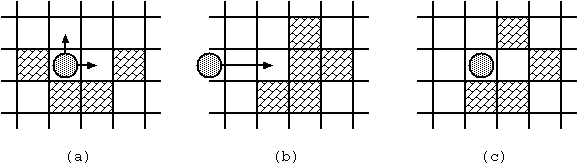
Fig. 2: Stone movements
Under the rules, we would like to know whether the stone at the start can reach the goal and, if yes, the minimum number of moves required.
With the initial configuration shown in Fig. 1, 4 moves are required to bring the stone from the start to the goal. The route is shown in Fig. 3(a). Notice when the stone reaches the goal, the board configuration has changed as in Fig. 3(b).
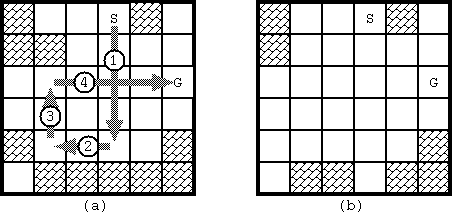
Fig. 3: The solution for Fig. D-1 and the final board configuration
The input is a sequence of datasets. The end of the input is indicated by a line containing two zeros separated by a space. The number of datasets never exceeds 100.
Each dataset is formatted as follows.
the width(=w) and the height(=h) of the board
First row of the board
...
h-th row of the board
The width and the height of the board satisfy: 2 <= w <= 20, 1 <= h <= 20.
Each line consists of w decimal numbers delimited by a space. The number describes the status of the corresponding square.
0 vacant square 1 block 2 start position 3 goal position
The dataset for Fig. D-1 is as follows:
6 6
1 0 0 2 1 0
1 1 0 0 0 0
0 0 0 0 0 3
0 0 0 0 0 0
1 0 0 0 0 1
0 1 1 1 1 1
For each dataset, print a line having a decimal integer indicating the minimum number of moves along a route from the start to the goal. If there are no such routes, print -1 instead. Each line should not have any character other than this number.
4
-1
4
10
-1
题意:
就是要求把一个冰壶从起点“2”用最少的步数移动到终点“3”
其中0为移动区域,1为石头区域,冰壶一旦想着某个方向运动就不会停止,也不会改变方向(想想冰壶在冰上滑动),除非冰壶撞到石头1 或者 到达终点 3
注意的是:
冰壶撞到石头后,冰壶会停在石头前面,此时(静止状态)才允许改变冰壶的运动方向,而该块石头会破裂,石头所在的区域由1变为0. 也就是说,冰壶撞到石头后,并不会取代石头的位置。
终点是一个摩擦力很大的区域,冰壶若到达终点3,就会停止在终点的位置不再移动。
解题思路:
其实与其说这是深搜题,我觉得更像模拟题。。。
要先明确:
0为滑动区域
1为石头区域
2为起点,也是可滑动区域
3为终点,不可滑动区域
(1) 起点为“2”,也是一个可滑动的区域,所以标记起点位置之后,可以把起点当做0
(2) 注意区分冰壶是运动的还是静止的,若是静止的话,旁边1格有石头是不能走的。
(3) 输出冰壶从2到3的最短路,如果最短路的步数大于10(不包括10),视作无法走到终点(其实这是用来剪枝的)
(4) 滑动过程中冰壶不允许出界
基于上面的原则,不难发现:
(1)所谓的“走一步”,就是指冰壶从一个静止状态到下一个静止状态,就是说冰壶在运动时经过的“格数”不视作“步数”,也就是说冰壶每次移动的距离都是不定的。
(2)还有就是由于石头会因为冰壶的碰撞而消失,因此冰壶每“走一步”,场地的环境就会改变一次。
(3)基于(2),可以发现本题虽然是要找 “最短路”,但是BFS几乎不可能,因为每“走一步”,场地的状态就要改变一次;而如果该步不满足要求,又要求把场地的状态还原到前一步,这只有DFS能做到。
(4)基于(3),DFS不是BFS,不能简单地用它来找最短路,必须要把所有可能的路一一找出来,再逐一比较它们的步数才能确定最短。但题目值允许1000MS,此时就面临一个超时的问题。所以题目才同时给出“步数超过10则视为失败”的条件,这是用来剪枝的
有了上面的分析,就能最终确定本题的解法了:
有2种方法:
DFS+Vector+剪枝
DFS+回溯+剪枝
但是由于POJ对STL的“兼容性”很差,我用STL就没见过不TLE的题。。。这题也一样,所以不推荐,其实Vector是很好用的,利用它的特性可以在DFS返回上一步时,自动还原场地状态,而回溯法则需要手动还原场地状态(其实也就8行代码)
DFS用于寻找路径,回溯(或Vector)用于还原棋盘状态,剪枝用于优化
回溯:
 #include<iostream>

 using namespace std;

 typedef class

 {

     public:

         int r,c;     //冰壶当前位置

         bool status; //status冰壶当前状态:运动true ,静止false

 }SE;

 SE s,e;   //记录冰壶起止点

 int w,h;  //场地size

 int MinStep;  //最短路

 int board[][];  //场地

 void DFS(int i,int j,bool status,int direction,int step,bool flag)

 { //direction:冰壶当前运动方向  North:0  West:1  South:2  East:3

   //flag:是否消除direction方向下一格位置的石头

     if(step>)   //剪枝,超过10步的走法就不再考虑了

         return;

     if(board[i][j]==)   //终点

     {

         if(MinStep>step)

             MinStep=step;

         return;

     }

     if(flag)  //消除石头

     {

         switch(direction)

         {

             case : {board[i-][j]=; break;}

             case : {board[i][j-]=; break;}

             case : {board[i+][j]=; break;}

             case : {board[i][j+]=; break;}

         }

     }

     if(!status)  //静止

     {

         if(i->= && (board[i-][j]== || board[i-][j]==))  //上

             DFS(i-,j,true,,step+,false);

         if(j->= && (board[i][j-]== || board[i][j-]==))  //左

             DFS(i,j-,true,,step+,false);

         if(i+<=h && (board[i+][j]== || board[i+][j]==))  //下

             DFS(i+,j,true,,step+,false);

         if(j+<=w && (board[i][j+]== || board[i][j+]==))  //右

             DFS(i,j-,true,,step+,false);

     }

     else  //运动

     {

         switch(direction)

         {

             case :

                 {

                     if(i-<)  //预判下一步是否越界 ,越界的话深搜停止

                         return;

                     else

                     {

                         if(board[i-][j]==)          //下一位置为0且不越界,继续运动

                             DFS(i-,j,true,,step,false);

                         else if(board[i-][j]==)          //下一位置为1且不越界,停止运动,并消除下一位置的石头

                             DFS(i,j,false,,step,true);

                         else if(board[i-][j]==)          //下一位置为3且不越界,运动到位置3后停止运动,游戏结束

                             DFS(i-,j,false,,step,false);

                     }

                     break;

                 }

             case :

                 {

                     if(j-<)  //预判下一步是否越界

                         return;

                     else

                     {

                         if(board[i][j-]==)          //下一位置为0且不越界,继续运动

                             DFS(i,j-,true,,step,false);

                         else if(board[i][j-]==)          //下一位置为1且不越界,停止运动,并消除下一位置的石头

                             DFS(i,j,false,,step,true);

                         else if(board[i][j-]==)          //下一位置为3且不越界,运动到位置3后停止运动,游戏结束

                             DFS(i,j-,false,,step,false);

                     }

                     break;

                 }

             case :

                 {

                     if(i+>h)  //预判下一步是否越界

                         return;

                     else

                     {

                         if(board[i+][j]==)          //下一位置为0且不越界,继续运动

                             DFS(i+,j,true,,step,false);

                         else if(board[i+][j]==)          //下一位置为1且不越界,停止运动,并消除下一位置的石头

                             DFS(i,j,false,,step,true);

                         else if(board[i+][j]==)          //下一位置为3且不越界,运动到位置3后停止运动,游戏结束

                             DFS(i+,j,false,,step,false);

                     }

                     break;

                 }

             case :

                 {

                     if(j+>w)  //预判下一步是否越界

                         return;

                     else

                     {

                         if(board[i][j+]==)          //下一位置为0且不越界,继续运动

                             DFS(i,j+,true,,step,false);

                         else if(board[i][j+]==)          //下一位置为1且不越界,停止运动,并消除下一位置的石头

                             DFS(i,j,false,,step,true);

                         else if(board[i][j+]==)          //下一位置为3且不越界,运动到位置3后停止运动,游戏结束

                             DFS(i,j+,false,,step,false);

                     }

                     break;

                 }

         }

     }

     if(flag)  //回溯前还原石头,即还原上一步的棋盘状态

     {

         switch(direction)

         {

             case : {board[i-][j]=; break;}

             case : {board[i][j-]=; break;}

             case : {board[i+][j]=; break;}

             case : {board[i][j+]=; break;}

         }

     }

     return;

 }

 int main(void)

 {

     while(cin>>w>>h)

     {

         if(!w && !h)

             break;

         MinStep=;

         for(int i=;i<=h;i++)

             for(int j=;j<=w;j++)

             {

                 cin>>board[i][j];

                 if(board[i][j]==)

                 {

                     s.r=i;

                     s.c=j;

                     s.status=false;

                     board[i][j]=;  //记录起点位置后,把它作为0处理

                 }

                 if(board[i][j]==)  //终点是特别位置,冰壶经过或到达该格都会停止

                 {

                     e.r=i;

                     e.c=j;

                 }

             }

         DFS(s.r , s.c , s.status ,  ,  , false);

         if(MinStep<=)

             cout<<MinStep<<endl;   //DFS里面虽然剪枝了,但是可能把全部走法都剪了,因此还是要判断

         else

             cout<<-<<endl;

     }

     return ;

 }
Vector:
 #include<iostream>

 #include<vector>

 using namespace std;

 const int inf=;

 typedef class

 {

     public:

         int r,c;     //冰壶当前位置

         bool status; //status冰壶当前状态:运动true ,静止false

 }SE;

 SE s,e;   //记录冰壶起止点

 int w,h;  //场地size

 int MinStep;  //最短路

 void DFS(vector<vector<int> >board,int i,int j,bool status,int direction,int step,bool flag)

 { //direction:冰壶当前运动方向  North:0  West:1  South:2  East:3

   //flag:是否消除direction方向下一格位置的石头

     if(step>)   //剪枝,超过10步的走法就不再考虑了

         return;

     if(board[i][j]==)   //终点

     {

         if(MinStep>step)

             MinStep=step;

         return;

     }

     if(flag)  //消除石头

     {

         switch(direction)

         {

             case : {board[i-][j]=; break;}     //board用vector表示的目的就是为了在当前步删除某位置的石头时

             case : {board[i][j-]=; break;}     //前一步并不会删除该位置的石头

             case : {board[i+][j]=; break;}

             case : {board[i][j+]=; break;}

         }

     }

     if(!status)  //静止

     {

         if(i->= && (board[i-][j]== || board[i-][j]==))  //North

             DFS(board,i-,j,true,,step+,false);

         if(j->= && (board[i][j-]== || board[i][j-]==))  //West

             DFS(board,i,j-,true,,step+,false);

         if(i+<=h && (board[i+][j]== || board[i+][j]==))  //South

             DFS(board,i+,j,true,,step+,false);

         if(j+<=w && (board[i][j+]== || board[i][j+]==))  //East

             DFS(board,i,j-,true,,step+,false);

     }

     else if(status)  //运动

     {

         switch(direction)

         {

             case :

                 {

                     if(i-<)  //预判下一步是否越界

                         return;

                     else

                     {

                         if(board[i-][j]==)          //下一位置为0且不越界,继续运动

                             DFS(board,i-,j,true,,step,false);

                         else if(board[i-][j]==)          //下一位置为1且不越界,停止运动,并消除下一位置的石头

                             DFS(board,i,j,false,,step,true);

                         else if(board[i-][j]==)          //下一位置为3且不越界,运动到位置3后停止运动,游戏结束

                             DFS(board,i-,j,false,,step,false);

                     }

                     break;

                 }

             case :

                 {

                     if(j-<)  //预判下一步是否越界

                         return;

                     else

                     {

                         if(board[i][j-]==)          //下一位置为0且不越界,继续运动

                             DFS(board,i,j-,true,,step,false);

                         else if(board[i][j-]==)          //下一位置为1且不越界,停止运动,并消除下一位置的石头

                             DFS(board,i,j,false,,step,true);

                         else if(board[i][j-]==)          //下一位置为3且不越界,运动到位置3后停止运动,游戏结束

                             DFS(board,i,j-,false,,step,false);

                     }

                     break;

                 }

             case :

                 {

                     if(i+>h)  //预判下一步是否越界

                         return;

                     else

                     {

                         if(board[i+][j]==)          //下一位置为0且不越界,继续运动

                             DFS(board,i+,j,true,,step,false);

                         else if(board[i+][j]==)          //下一位置为1且不越界,停止运动,并消除下一位置的石头

                             DFS(board,i,j,false,,step,true);

                         else if(board[i+][j]==)          //下一位置为3且不越界,运动到位置3后停止运动,游戏结束

                             DFS(board,i+,j,false,,step,false);

                     }

                     break;

                 }

             case :

                 {

                     if(j+>w)  //预判下一步是否越界

                         return;

                     else

                     {

                         if(board[i][j+]==)          //下一位置为0且不越界,继续运动

                             DFS(board,i,j+,true,,step,false);

                         else if(board[i][j+]==)          //下一位置为1且不越界,停止运动,并消除下一位置的石头

                             DFS(board,i,j,false,,step,true);

                         else if(board[i][j+]==)          //下一位置为3且不越界,运动到位置3后停止运动,游戏结束

                             DFS(board,i,j+,false,,step,false);

                     }

                     break;

                 }

         }

     }

     return;

 }

 int main(void)

 {

     while(cin>>w>>h)

     {

         if(!w && !h)

             break;

         /*Structure the Board*/

         MinStep=inf;

         vector<vector<int> >board(h+,vector<int>(w+));

         for(int i=;i<=h;i++)

             for(int j=;j<=w;j++)

             {

                 cin>>board[i][j];

                 if(board[i][j]==)

                 {

                     s.r=i;

                     s.c=j;

                     s.status=false;

                     board[i][j]=;  //记录起点位置后,把它作为0处理

                 }

                 if(board[i][j]==)  //终点是特别位置,冰壶经过或到达该格都会停止

                 {

                     e.r=i;

                     e.c=j;

                 }

             }

         /*Search the min path*/

         DFS(board , s.r , s.c , s.status ,  ,  , false);

         if(MinStep<=)

             cout<<MinStep<<endl;   //DFS里面虽然剪枝了,但是可能把全部走法都剪了,因此还是要判断

         else

             cout<<-<<endl;

         /*Relax*/

     //  board.swap(vector<vector<int> >());      //POJ好像禁用swap()

     }

     return ;

 }
****Curling 2.0(深搜+回溯)的更多相关文章
- poj3009 Curling 2.0 深搜
PS:以前看到题目这么长就没写下去了.今天做了半天,没做出来.准备看题解,打开了网站都忍住了,最后还是靠自己做出来的.算是一点进步吧. 分析: 题目的意思没明白或者理解有偏差都没办法做题.看样例3和样 ...
- HDU5723 Abandoned country (最小生成树+深搜回溯法)
Description An abandoned country has n(n≤100000) villages which are numbered from 1 to n. Since aban ...
- 深搜+回溯 POJ 2676 Sudoku
POJ 2676 Sudoku Time Limit: 2000MS Memory Limit: 65536K Total Submissions: 17627 Accepted: 8538 ...
- The 2016 ACM-ICPC Asia China-Final L World Cup(深搜+回溯 暴力求解)
题目分析: 对于A,B,C,D四支队伍,两两之间进行一场比赛,获胜得3分,平局得1分,失败不得分,现在对给出的四个队伍的得分,判断能否满足得到这种分数,且方案唯一输出yes,不唯一输出no,不可能则输 ...
- POJ 3009 Curling 2.0【带回溯DFS】
POJ 3009 题意: 给出一个w*h的地图,其中0代表空地,1代表障碍物,2代表起点,3代表终点,每次行动可以走多个方格,每次只能向附近一格不是障碍物的方向行动,直到碰到障碍物才停下来,此时障碍物 ...
- UVA 165 Stamps (DFS深搜回溯)
Stamps The government of Nova Mareterrania requires that various legal documents have stamps attac ...
- 【POJ - 3009】Curling 2.0 (dfs+回溯)
-->Curling 2.0 直接上中文 Descriptions: 今年的奥运会之后,在行星mm-21上冰壶越来越受欢迎.但是规则和我们的有点不同.这个游戏是在一个冰游戏板上玩的,上面有一个正 ...
- PAT Advanced 1155 Heap Paths (30) [DFS, 深搜回溯,堆]
题目 In computer science, a heap is a specialized tree-based data structure that satisfies the heap pr ...
- HDOJ1181变形课 深搜回溯
变形课 Time Limit: 2000/1000 MS (Java/Others) Memory Limit: 131072/65536 K (Java/Others) Total Submissi ...
随机推荐
- XTU 1245 Hamiltonian Path
$2016$长城信息杯中国大学生程序设计竞赛中南邀请赛$C$题 简单题. 注意题目中给出的数据范围:$1 \le ai < bi \le n$,说明这是一个有向无环图,并且哈密顿路一定是$1 \ ...
- Spring Security(19)——对Acl的支持
目录 1.1 准备工作 1.2 表功能介绍 1.2.1 表acl_sid 1.2.2 表acl_class 1.2.3 表acl_obj ...
- span标记
span标记为内联元素,本身布局有宽高所以要给他个属性 display:block; 转成快元素.
- NTFS 读写高手进阶 - Windows 格式硬盘 Mac存文件
常识:硬盘格式:FAT32 - WIndows 硬盘分区格式, 有点通用性高, 缺点不支持单个大于 4G 的文件. exFAT - Windows 硬盘分区格式, 兼容性低. 稳定性不如 FAT32. ...
- 构建maven的web项目时注意的问题
构建项目后或者导入项目后,我们需要bulid path--->config build path 特别是maven的依赖一定要 发布到WEB_INF的lib下面,不然在发布项目的时候,这些依赖都 ...
- 【转】Jmeter(二)-使用代理录制脚本
Jmeter脚本是以JMX格式为主 Jmeter也是支持录制的,支持第三方录制方式和代理录制方式. 1.第三方录制主要是通过badboy来录制,录制后另存为jmx格式即可. 2.Jmeter也有自己的 ...
- C# 正则表达式 结合 委托
使用正则表达式匹配字符串的同时,使用委托事件,处理每一个匹配项 示例代码: string msg = "我的邮箱是zxh@itcast.cn的邮箱是yzk365@chezhihui.com减 ...
- uitextfield银行卡加空格
- (BOOL)textField:(UITextField *)textField shouldChangeCharactersInRange:(NSRange)range replacementS ...
- LeetCode 328. Odd Even Linked List C#
Given a singly linked list, group all odd nodes together followed by the even nodes. Please note her ...
- Java中 +=是什么意思 什么情况下用
x+=1与x=x+1一样的效果执行一次x=x+1,就等于给x重新赋了值,这个值就是x+1例如:int x=1;x+=1;最后x的值是2x+=1一般在循环下使用,能发挥它的最大的作用.例如:while( ...