
Spark 中 GroupByKey 相对于 combineByKey, reduceByKey, foldByKey 的优缺点
避免使用GroupByKey
我们看一下两种计算word counts 的方法,一个使用reduceByKey,另一个使用 groupByKey:
val words = Array("one", "two", "two", "three", "three", "three")

val wordPairsRDD = sc.parallelize(words).map(word => (word, 1))

val wordCountsWithReduce = wordPairsRDD

  .reduceByKey(_ + _)

  .collect()

val wordCountsWithGroup = wordPairsRDD

  .groupByKey()

  .map(t => (t._1, t._2.sum))

  .collect()
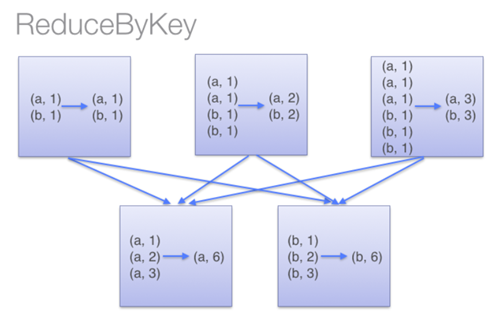
以上两个函数都会产生正确的结果,reduceByKey的例子在大型数据集上工作的效率会更高。因为Spark知道:在shuffle data之前,它可以根据key, 在每个partition上,对输出数据在本地做combine。
下图描述了reduceByKey的执行过程。值得注意的是,在shuffle 数据之前,同一个机器上具有相同key的item会先在本地combine(使用的combine函数是传递给reduceByKey的lambda 函数)。然后这个lambda 函数会再次在执行shuffle后的每个分区上被调用,以产生最终的结果。
而在groupByKey中,所有的key-value对被先shuffle到下游RDD分区中。这会导致很多不必要的网络数据传输。
在决定将一个key-value对shuffle到哪个机器上时,spark会key-value对中的key调用一个partitioning 函数,以决定分到的目标机器。在shuffle时,若是shuffle的数据(由于内存大小限制)无法全部放入到一个executor中,则Spark会将数据spill到disk。但是,在flush数据到disk时,一次只flush一个key(对应的key-value pairs 数据):所以如果单个key对应的key-value pairs 数据超出了executor可用的memory,则会抛出OOM异常。在较新版的Spark中会处理此异常并让job可以继续执行,但是仍需要尽量避免此类现象:当spark需要spill到磁盘时,spark性能会受到显著影响。
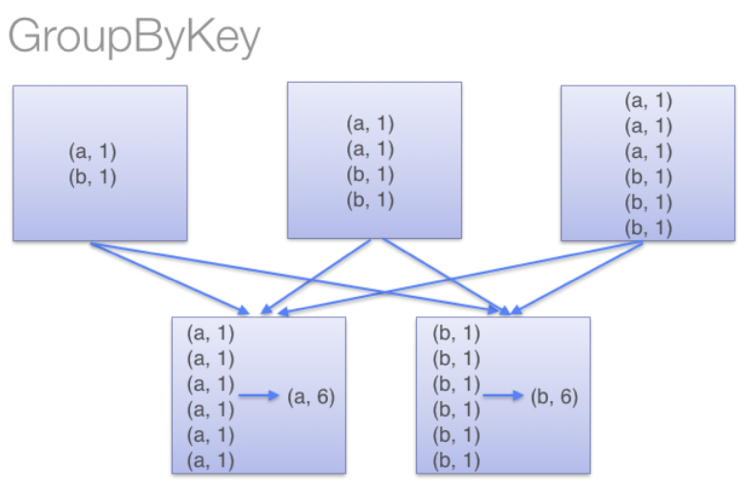
所以在非常大的数据集上计算时,对于reduceByKey与groupByKey来说,它们所需要传输的shuffle数据是有显著不同的。
而在小型数据集上进行测试时(仍使用word count的例子),从测试结果来看,groupByKey的表现要优于reduceByKey。抛开shuffle阶段来看,reduceByKey对内存率会更高于groupByKey,所以相对会报出更多内存不足的情况。若是需要使用reduceByKey,则需要给executor 更多内存在本地做计算。
相对于groupByKey,除了reduceByKey,下面的函数也会是更好的选择:
- combineByKey:可以用于combine元素,用于返回与输入类型不同类型的值
- foldByKey:初始化一个“zero value”,然后对每个Key的值做聚合操作
接下来详细介绍一下这两个函数。
combineByKey
我们先看一下combineByKey的定义:
def combineByKey[C](

    createCombiner: V => C,

    mergeValue: (C, V) => C,

    mergeCombiners: (C, C) => C): RDD[(K, C)] = self.withScope {

  combineByKeyWithClassTag(createCombiner, mergeValue, mergeCombiners)(null)

}
可以看到此方法调用的是 combineByKeyWithClassTag:
def combineByKeyWithClassTag[C](

    createCombiner: V => C,

    mergeValue: (C, V) => C,

    mergeCombiners: (C, C) => C)(implicit ct: ClassTag[C]): RDD[(K, C)] = self.withScope {

  combineByKeyWithClassTag(createCombiner, mergeValue, mergeCombiners, defaultPartitioner(self))

}
继续查看下一层调用:
def combineByKeyWithClassTag[C](

    createCombiner: V => C,

    mergeValue: (C, V) => C,

    mergeCombiners: (C, C) => C,

    partitioner: Partitioner,

    mapSideCombine: Boolean = true,

    serializer: Serializer = null)(implicit ct: ClassTag[C]): RDD[(K, C)]
查看reduceByKey代码,可以发现它最终调用的也是combineByKeyWithClassTag 方法:
def reduceByKey(partitioner: Partitioner, func: (V, V) => V): RDD[(K, V)] = self.withScope {

  combineByKeyWithClassTag[V]((v: V) => v, func, func, partitioner)

}
从combineByKeyWithClassTag方法定义来看,第一个参数是提供用户自定义的类型,用于将输入的<K,V> 中的 V 转化为用户指定类型,第二个参数用于merge V 的值到 C(用户定义类型),第三个参数用于将 C 的值 combine 为一个单值。这里可以看到默认是会在map端做combine,所以默认combineByKey与reduceByKey都是会在map端先做combine操作。
但是对于 groupByKey来说:
def groupByKey(partitioner: Partitioner): RDD[(K, Iterable[V])] = self.withScope {

  // groupByKey shouldn't use map side combine because map side combine does not

  // reduce the amount of data shuffled and requires all map side data be inserted

  // into a hash table, leading to more objects in the old gen.

  val createCombiner = (v: V) => CompactBuffer(v)

  val mergeValue = (buf: CompactBuffer[V], v: V) => buf += v

  val mergeCombiners = (c1: CompactBuffer[V], c2: CompactBuffer[V]) => c1 ++= c2

  val bufs = combineByKeyWithClassTag[CompactBuffer[V]](

    createCombiner, mergeValue, mergeCombiners, partitioner, mapSideCombine = false)

  bufs.asInstanceOf[RDD[(K, Iterable[V])]]

}
可以看到,groupByKey虽然最终调用的也是combineByKeyWithClassTag 方法,但是并不会在map端执行Combine操作(mapSideCombine为false)。
下面我们写一个combineByKey求解平均数的例子:
type ScoreCollector = (Int, Double)

type PersonScores = (String, (Int, Double))

val initialScores = Array(("Alice", 90.0), ("Bob", 100.0), ("Tom", 93.0), ("Alice", 95.0), ("Bob", 70.0), ("Jack", 98.0))

val scoreData = sc.parallelize(initialScores).cache()

val createScoreCombiner = (score: Double) => (1, score)

val scoreMerge = (scorecollector: ScoreCollector, score: Double) =>

  (scorecollector._1 +1, scorecollector._2 + score)

val scoreCombine = (scorecollector1: ScoreCollector, scorecollector2: ScoreCollector) =>

    (scorecollector1._1 + scorecollector2._1, scorecollector1._2 + scorecollector2._2)

scoreData.combineByKey(

  createScoreCombiner,

  scoreMerge,

  scoreCombine

).map( {pscore: PersonScores => (pscore._1, pscore._2._2 / pscore._2._1)}).collect
输出为: Array[(String, Double)] = Array((Tom,93.0), (Alice,92.5), (Bob,85.0), (Jack,98.0))
可以看到,首先原类型为(String, Double),然后我们通过combineByKey的第一个参数,将其转化为(Int, Double) 形式,用于统计次数与分数。接下来第二个参数用于merge,将同样key条目出现的次数、以及分数相加。最后第三个参数用于做combine,对每个key,求得的分数求总和,然后除以次数,求得平均值。
这里可以看出 combineByKey与reduceByKey的区别是:combineByKey的可以返回与输入数据类型不一样的输出。
foldByKey
foldByKey 是初始化一个“zero value“,然后对key的value值做聚合操作。例如:
val initialScores = Array(("Alice", 90.0), ("Bob", 100.0), ("Tom", 93.0), ("Alice", 95.0), ("Bob", 70.0), ("Jack", 98.0))

val scoreData = sc.parallelize(initialScores).cache()

scoreData.foldByKey(0)(_+_).collect
输出为: Array[(String, Double)] = Array((Tom,93.0), (Alice,185.0), (Bob,170.0), (Jack,98.0))
可以看到,这里给出的“zero value“为0,在执行计算时,会先将所有key的value值与”zero value“做一次加法操作(由_+_定义),然后再对所有key-pair做加法操作。所以若是此时使用:
scoreData.foldByKey(1)(_+_).collect
则输出为:Array[(String, Double)] = Array((Tom,94.0), (Alice,187.0), (Bob,172.0), (Jack,99.0))
下面是 foldByKey的源码:
def foldByKey(

    zeroValue: V,

    partitioner: Partitioner)(func: (V, V) => V): RDD[(K, V)] = self.withScope {

  // Serialize the zero value to a byte array so that we can get a new clone of it on each key

  val zeroBuffer = SparkEnv.get.serializer.newInstance().serialize(zeroValue)

  val zeroArray = new Array[Byte](zeroBuffer.limit)

  zeroBuffer.get(zeroArray)

  // When deserializing, use a lazy val to create just one instance of the serializer per task

  lazy val cachedSerializer = SparkEnv.get.serializer.newInstance()

  val createZero = () => cachedSerializer.deserialize[V](ByteBuffer.wrap(zeroArray))

  val cleanedFunc = self.context.clean(func)

  combineByKeyWithClassTag[V]((v: V) => cleanedFunc(createZero(), v),

    cleanedFunc, cleanedFunc, partitioner)

}
可以看到它与reduceByKey和combineByKye类似,最终调用的也是combineByKeyWithClassTag 方法,且未覆盖mapSideCombine 的值,所以默认也会在map端进行combine操作。
所以在大型数据集中,为了减少shuffle的数据量,相对于groupByKey来说,使用reduceByKey、combineByKey以及foldByKey 会是更好的选择。
References:
[2] http://codingjunkie.net/spark-combine-by-key/
Spark 中 GroupByKey 相对于 combineByKey, reduceByKey, foldByKey 的优缺点的更多相关文章
- Spark中groupByKey、reduceByKey与sortByKey
groupByKey把相同的key的数据分组到一个集合序列当中: [("hello",1), ("world",1), ("hello",1 ...
- spark中groupByKey与reducByKey
[译]避免使用GroupByKey Scala Spark 技术 by:leotse 原文:Avoid GroupByKey 译文 让我们来看两个wordcount的例子,一个使用了reduceB ...
- 在Spark中尽量少使用GroupByKey函数(转)
原文链接:在Spark中尽量少使用GroupByKey函数 为什么建议尽量在Spark中少用GroupByKey,让我们看一下使用两种不同的方式去计算单词的个数,第一种方式使用reduceByKey ...
- Spark中的键值对操作-scala
1.PairRDD介绍 Spark为包含键值对类型的RDD提供了一些专有的操作.这些RDD被称为PairRDD.PairRDD提供了并行操作各个键或跨节点重新进行数据分组的操作接口.例如,Pa ...
- Spark中的键值对操作
1.PairRDD介绍 Spark为包含键值对类型的RDD提供了一些专有的操作.这些RDD被称为PairRDD.PairRDD提供了并行操作各个键或跨节点重新进行数据分组的操作接口.例如,Pa ...
- 大数据学习day19-----spark02-------0 零碎知识点(分区,分区和分区器的区别) 1. RDD的使用(RDD的概念,特点,创建rdd的方式以及常见rdd的算子) 2.Spark中的一些重要概念
0. 零碎概念 (1) 这个有点疑惑,有可能是错误的. (2) 此处就算地址写错了也不会报错,因为此操作只是读取数据的操作(元数据),表示从此地址读取数据但并没有进行读取数据的操作 (3)分区(有时间 ...
- Spark中的编程模型
1. Spark中的基本概念 Application:基于Spark的用户程序,包含了一个driver program和集群中多个executor. Driver Program:运行Applicat ...
- spark中产生shuffle的算子
Spark中产生shuffle的算子 作用 算子名 能否替换,由谁替换 去重 distinct() 不能 聚合 reduceByKey() groupByKey groupBy() groupByKe ...
- Spark中shuffle的触发和调度
Spark中的shuffle是在干嘛? Shuffle在Spark中即是把父RDD中的KV对按照Key重新分区,从而得到一个新的RDD.也就是说原本同属于父RDD同一个分区的数据需要进入到子RDD的不 ...
随机推荐
- Python类的特殊成员方法
__doc__ 类的描述信息. class dog: '''这是狗的类''' def __init__(self,name): self.name = name self.__age = None p ...
- div中宽高度自适应文字换行居中问题解决
<html> <head> <meta charset="UTF-8"/> <title>div中宽高度自适应文字换行居中demo& ...
- Dubbo服务暴露分析
Dubbo的服务暴露是一个重要的特性,了解其机制很重要.之前有很多人写了有关的源代码分析,在本文中不再重新分析.官方文档中的一篇写的就很好,本文主要是有关内容进行补充与总结. 传送门:服务导出 为什么 ...
- ubuntu设置ulimit
centos系统的设置ulimit的时候是直接修改/etc/security/limits.conf文件,但是在ubuntu中却不行, ubuntu先修改/etc/security/limits.co ...
- 强烈推荐一款强大的公式编辑器软件AxMath
Axmath教程请移步:https://www.cnblogs.com/coco56/p/11759578.html
- 洛谷P1308 统计单词数
原题链接:https://www.luogu.org/problem/P1308 #include<iostream> #include<cstring> #include&l ...
- MariaDB 安装配置记录
1.集群搭建记录 iptables --append INPUT --protocol tcp \ --source 192.168.126.129 --jump ACCEPT iptables -- ...
- PP: Deep r -th Root of Rank Supervised Joint Binary Embedding for Multivariate Time Series Retrieval
from: Dacheng Tao 悉尼大学 PROBLEM: time series retrieval: given the current multivariate time series se ...
- HTML连载62-固定定位练习、z-index属性
一.固定定位应用场景 1.练习 <!DOCTYPE html> <html lang="en"> <head> <meta charset ...
- Java注释&标识符
注释: 单行注释:// 多行注释:/* */ 文档注释:/** */ 其中文档注释可以Export导出dox文档,常用Javadox标记如下: @author:指定Java程序的作者 @vers ...