
POJ1037 A decorative fence 【动态规划】
| Time Limit: 1000MS | Memory Limit: 10000K | |
| Total Submissions: 6489 | Accepted: 2363 |
Description
on cute little wooden fences. After reading its preface he already knew, what makes a little wooden fence cute.
A wooden fence consists of N wooden planks, placed vertically in a row next to each other. A fence looks cute if and only if the following conditions are met:
�The planks have different lengths, namely 1, 2, . . . , N plank length units.
�Each plank with two neighbors is either larger than each of its neighbors or smaller than each of them. (Note that this makes the top of the fence alternately rise and fall.)
It follows, that we may uniquely describe each cute fence with N planks as a permutation a1, . . . , aN of the numbers 1, . . . ,N such that (any i; 1 < i < N) (ai − ai−1)*(ai − ai+1) > 0 and vice versa, each such permutation describes a cute fence.
It is obvious, that there are many di erent cute wooden fences made of N planks. To bring some order into their catalogue, the sales manager of ACME decided to order them in the following way: Fence A (represented by the permutation a1, . . . , aN) is in the
catalogue before fence B (represented by b1, . . . , bN) if and only if there exists such i, that (any j < i) aj = bj and (ai < bi). (Also to decide, which of the two fences is earlier in the catalogue, take their corresponding permutations, find the first
place on which they differ and compare the values on this place.) All the cute fences with N planks are numbered (starting from 1) in the order they appear in the catalogue. This number is called their catalogue number.
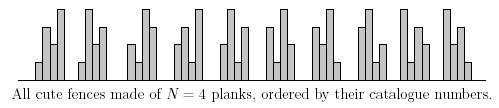
After carefully examining all the cute little wooden fences, Richard decided to order some of them. For each of them he noted the number of its planks and its catalogue number. Later, as he met his friends, he wanted to show them the fences he ordered, but
he lost the catalogue somewhere. The only thing he has got are his notes. Please help him find out, how will his fences look like.
Input
Each of the following K lines contains two integers N and C (1 <= N <= 20), separated by a space. N is the number of planks in the fence, C is the catalogue number of the fence.
You may assume, that the total number of cute little wooden fences with 20 planks fits into a 64-bit signed integer variable (long long in C/C++, int64 in FreePascal). You may also assume that the input is correct, in particular that C is at least 1 and it
doesn抰 exceed the number of cute fences with N planks.
Output
the correct order), separated by single spaces.
Sample Input
2

2 1

3 3
Sample Output
1 2

2 3 1
⊙﹏⊙ 这题做了整整一天,看着讲义做的,理解起来比扫描线还难..算是我眼下碰到的最难的动规题了..
题意:给定长度依次为1到n的木棒n个。 摆放规则为除了两边的木棒。剩下的木棒必需要比相邻的两个都高或者都低。求从小到大排列的第c个序列。
题解:状态方程dp[i][j][0]用来求在i个木棒中以第j根木棒打头且前两根为升序的排列方案数,dp[i][j][1]用来求在i个木棒中以第j根木棒打头且前两根为降序的排列方案数。详解在讲义代码的凝视里。
#include <stdio.h>

#include <string.h>

#define maxn 22

#define UP 0

#define DOWN 1

int vis[maxn], ans[maxn];

__int64 dp[maxn][maxn][2];

void Init(int n)

{

	int i, j, k;

	dp[1][1][UP] = dp[1][1][DOWN] = 1;

	for(i = 2; i <= n; ++i){ //i is the amount of total sticks

		for(j = 1; j <= i; ++j){ //j is the first stick's position

			for(k = j; k < i; ++k) //k is the subSolution of dp array

				dp[i][j][UP] += dp[i-1][k][DOWN];

			for(k = 1; k < j; ++k)

				dp[i][j][DOWN] += dp[i-1][k][UP];

		}

	}

}

void Print(int n, __int64 c)

{

	memset(vis, 0, sizeof(vis));

	int i, j, k, rank;

	__int64 skip = 0, pre = 0;

	for(i = 1; i <= n; ++i){ //i is the position to select now

		rank = 0; //the rank's min stick

		for(j = 1; j <= n; ++j){ //j is the stick to be select

			pre = skip;

			if(!vis[j]){

				++rank;

				if(i == 1) skip += dp[n][rank][UP] + dp[n][rank][DOWN];

				else if(j > ans[i-1] && (i == 2 || ans[i-2] > ans[i-1]))

					skip += dp[n-i+1][rank][DOWN];

				else if(j < ans[i-1] && (i == 2 || ans[i-2] < ans[i-1]))

					skip += dp[n-i+1][rank][UP];

				if(skip >= c) break;

			}

		}

		ans[i] = j;

		vis[j] = 1;

		skip = pre;

	}

	for(i = 1; i <= n; ++i)

		if(i != n) printf("%d ", ans[i]);

		else printf("%d\n", ans[i]);

}

int main()

{

	int t, n;

	__int64 c;

	Init(20);

	scanf("%d", &t);

	while(t--){

		scanf("%d%I64d", &n, &c);

		Print(n, c);

	}

	return 0;

}
附讲义代码:
#include <stdio.h>

#include <string.h>

#define UP 0

#define DOWN 1

#define maxn 25

long long C[maxn][maxn][2];

//C[i][k][DOWN] 是S(i)中以第k短的木棒打头的DOWN方案数,C[i][k][UP]

//是S(i)中以第k短的木棒打头的UP方案数,第k短指i根中第k短

void Init(int n)

{

    memset(C, 0, sizeof(C));

    C[1][1][UP] = C[1][1][DOWN] = 1;

    int i, k, M, N;

    for(i = 2; i <= n; ++i){

        for(k = 1; k <= i; ++k){ //枚举第一根木棒的长度

            //枚举第二根长度

            for(M = k; M < i; ++M) C[i][k][UP] += C[i-1][M][DOWN];

            //枚举第二根长度

            for(N = 1; N < k; ++N) C[i][k][DOWN] += C[i-1][N][UP];

        }

    }

    //总方案数是 Sum{ C[n][k][DOWN] + C[n][k][UP] } k = 1.. n;

}

void Print(int n, long long cc)

{

    long long skipped = 0, oldVal; //已经跳过的方案数

    int seq[maxn]; //终于要输出的答案

    int used[maxn]; //木棒是否用过

    memset(used, 0, sizeof(used));

    for(int i = 1, k; i <= n; ++i){ //依次确定位置i的木棒序号

        int No = 0;

        for(k = 1; k <= n; ++k){ //枚举位置i的木棒

            oldVal = skipped;

            if(!used[k]){

                ++No; //k是剩下木棒里的第No短的

                if(i == 1) skipped += C[n][No][UP] + C[n][No][DOWN];

                //下面寻找合法位置

                else if(k > seq[i-1] && (i == 2 || seq[i-2] > seq[i-1]))

                    skipped += C[n-i+1][No][DOWN];

                else if(k < seq[i-1] && (i == 2 || seq[i-2] < seq[i-1]))

                    skipped += C[n-i+1][No][UP];

                if(skipped >= cc) break;

            }

        }

        used[k] = 1;

        seq[i] = k;

        skipped = oldVal;

    }

    for(int i = 1; i <= n; ++i)

        if(i < n) printf("%d ", seq[i]);

        else printf("%d\n", seq[i]);

}

int main()

{

    int T, n; long long c;

    Init(20);

    scanf("%d", &T);

    while(T--){

        scanf("%d%lld", &n, &c);

        Print(n, c);

    }

    return 0;

}
POJ1037 A decorative fence 【动态规划】的更多相关文章
- POJ1037 A decorative fence
题意 Language:Default A decorative fence Time Limit: 1000MS Memory Limit: 10000K Total Submissions: 84 ...
- POJ1037A decorative fence(动态规划+排序计数+好题)
http://poj.org/problem?id=1037 题意:输入木棒的个数n,其中每个木棒长度等于对应的编号,把木棒按照波浪形排序,然后输出第c个; 分析:总数为i跟木棒中第k短的木棒 就等于 ...
- $Poj1037\ A\ Decorative\ Fence$ 计数类$DP$
Poj AcWing Description Sol 这题很数位$DP$啊, 预处理$+$试填法 $F[i][j][k]$表示用$i$块长度不同的木板,当前木板(第$i$块)在这$i$块木板中从小到 ...
- A decorative fence
A decorative fence 在\(1\sim n\)的全排列\(\{a_i\}\)中,只有大小交错的(即任意一个位置i满足\(a_{i-1}<a_i>a_{i+1}ora_{i- ...
- 【POJ1037】A decorative fence(DP)
BUPT2017 wintertraining(15) #6C 题意 给长度n的数列,1,2,..,n,按依次递增递减排序,求字典序第k小的排列. 题解 dp. up[i][j]表示长度为j,以第i小 ...
- poj1037 [CEOI 2002]A decorative fence 题解
---恢复内容开始--- 题意: t组数据,每组数据给出n个木棒,长度由1到n,除了两端的木棒外,每一根木棒,要么比它左右的两根都长,要么比它左右的两根都短.即要求构成的排列为波浪型.对符合要求的排列 ...
- poj 1037 A decorative fence
题目链接:http://poj.org/problem?id=1037 Description Richard just finished building his new house. Now th ...
- OpenJ_Bailian - 1037 A decorative fence
Discription Richard just finished building his new house. Now the only thing the house misses is a c ...
- POJ1037A decorative fence(好dp)
1037 带点组合的东西吧 黑书P257 其实我没看懂它写的嘛玩意儿 这题还是挺不错的 一个模糊的思路可能会好想一些 就是大体的递推方程 dp1[][]表示降序 dp2[][]表示升序 数组的含义为长 ...
随机推荐
- js 集合
[深入理解javascript原型和闭包系列 ] 历时半月完稿,求推荐 jQuery 学习笔记(未完待续) JavaScript作用域原理(三)——作用域根据函数划分
- Android xmlpull 方式解析xml文件
1.新建一个xml文件,放在res/xml目录下 <?xml version="1.0" encoding="utf-8"?> <citys& ...
- java异常基本知识
Throwable |--Error |--Exception |--RuntimeException 异常体系的特点:异常体系中的所有类 ...
- CF 990B. Micro-World【数组操作/贪心/STL/二分搜索】
[链接]:CF [题意]:对任意一个数a[i] ,可以对任意 满足 i != j 且 a[i] > a[j] && a[i] <= a[j] +k 的 a[j] 可以被删掉 ...
- Android学习--跨程序共享数据之内容提供其探究
什么是内容提供器? 跨程序共享数据之内容提供器,这是个什么功能?看到这个名称的时候最能给我们提供信息的应该是“跨程序”这个词了,是的重点就是这个词,这个内容提供器的作用主要是用于在不同的引用程序之间实 ...
- 【动态规划】bzoj1638 [Usaco2007 Mar]Cow Traffic 奶牛交通
设f[u]为从度数0到u的路径条数,f2[u]为从u到n的路径条数. ans=max{f[x[i]]*f2[y[i]]}(1<=i<=m). #include<cstdio> ...
- 【二分】bzoj2083 [Poi2010]Intelligence test
v[x]记录了x值的出现位置序列. 对每个b中的元素,每次在v[b[i]]中二分. 因此要记录上一次二分到了a数组的哪个位置. #include<cstdio> #include<v ...
- Problem N: 猴子吃桃
#include<stdio.h> int main() { int n,s,i; while(scanf("%d",&n)!=EOF){ s=; ;i> ...
- Scala实战高手****第4课:零基础彻底实战Scala控制结构及Spark源码解析
1.环境搭建 基础环境配置 jdk+idea+maven+scala2.11.以上工具安装配置此处不再赘述. 2.源码导入 官网下载spark源码后解压到合适的项目目录下,打开idea,File-&g ...
- java.io.IOException Too many open files 解决
网上很多关于解决这个问题的博客,没有提到需要查看JAVA进程的limits参数设置 命令 : cat /proc/进程PID/limits 有时就会发现该进程的 open files还是1024默 ...