
muduo网络库源码学习————线程类
muduo库里面的线程类是使用基于对象的编程思想,源码目录为muduo/base,如下所示:
线程类头文件:
// Use of this source code is governed by a BSD-style license

// that can be found in the License file.

//

// Author: Shuo Chen (chenshuo at chenshuo dot com)

//线程类

#ifndef MUDUO_BASE_THREAD_H

#define MUDUO_BASE_THREAD_H

#include <muduo/base/Atomic.h>

#include <muduo/base/Types.h>

#include <boost/function.hpp>

#include <boost/noncopyable.hpp>

#include <pthread.h>

//线程类头文件

namespace muduo

{

class Thread : boost::noncopyable

{

 public:

  typedef boost::function<void ()> ThreadFunc;//函数适配接收的函数

//线程构造函数,参数为回调函数和线程名称

  explicit Thread(const ThreadFunc&, const string& name = string());//名称默认值为空的字符串类

//线程析构函数

  ~Thread();

  void start();//启动线程

  int join(); // return pthread_join()

  bool started() const { return started_; }//线程是否已经启动

  // pthread_t pthreadId() const { return pthreadId_; }

  pid_t tid() const { return tid_; }//线程的真实pid

  const string& name() const { return name_; }//线程的名称

  static int numCreated() { return numCreated_.get(); }//已经启动的线程个数

 private:

  static void* startThread(void* thread);//现成的入口函数,调用runInThread函数

  void runInThread();//调用回调函数func_

  bool       started_;//线程是否已经启动

  pthread_t  pthreadId_;//线程的pthread_t

  pid_t      tid_;//线程真实的 pid

  ThreadFunc func_;//线程的回调函数

  string     name_;//线程的名称

  static AtomicInt32 numCreated_;//已经创建的线程的个数,每当创建一个线程,该值就加一(原子整数类)

};

}

#endif
线程类的实现文件:
// Use of this source code is governed by a BSD-style license

// that can be found in the License file.

//

// Author: Shuo Chen (chenshuo at chenshuo dot com)

//线程类实现文件

#include <muduo/base/Thread.h>

#include <muduo/base/CurrentThread.h>

#include <muduo/base/Exception.h>

//#include <muduo/base/Logging.h>

//暂时不用日志文件,先注释掉

#include <boost/static_assert.hpp>

#include <boost/type_traits/is_same.hpp>

#include <errno.h>

#include <stdio.h>

#include <unistd.h>

#include <sys/syscall.h>

#include <sys/types.h>

#include <linux/unistd.h>

namespace muduo

{

namespace CurrentThread

{//__thread两个下划线是gcc 内置的线程局部存储设施

//每个线程各有一个,并不会去共享他

//缓存获取tid是为了提高获取tid的效率

  __thread int t_cachedTid = 0;//线程真实pid的缓存,如果每次都用系统调用去获取pid,效率会低

  __thread char t_tidString[32];//tid的字符串表示形式

  __thread const char* t_threadName = "unknown";//线程的名称

  const bool sameType = boost::is_same<int, pid_t>::value;//如果是相同类型,返回true

  BOOST_STATIC_ASSERT(sameType);//编译时断言

}

namespace detail

{

pid_t gettid()//通过系统调用SYS_gettid获得tid

{

  return static_cast<pid_t>(::syscall(SYS_gettid));//类型转化为pid_t

}

void afterFork()//子进程调用的

{

  muduo::CurrentThread::t_cachedTid = 0;//当前线程pid赋值0

  muduo::CurrentThread::t_threadName = "main";//名称赋值name

  CurrentThread::tid();//进行缓存

  // no need to call pthread_atfork(NULL, NULL, &afterFork);

}

class ThreadNameInitializer

{

 public:

  ThreadNameInitializer()//构造函数

  {

    muduo::CurrentThread::t_threadName = "main";//线程名称赋为main,即为主线程名称

    CurrentThread::tid();//缓存当前线程的pid

    //#include <pthread.h>

    //int pthread_atfork(void (*prepare)(void), void (*parent)(void), void (*child)(void));

      //调用fork时,内部创建子进程前在父进程中会调用prepare,

      //内部创建子进程成功后,父进程会调用parent ,子进程会调用child

    pthread_atfork(NULL, NULL, &afterFork);//如果使用fork函数,那么子进程会调用邋afterFork

  }

};

ThreadNameInitializer init;

}

}

using namespace muduo;

void CurrentThread::cacheTid()

{

  if (t_cachedTid == 0)

  {

    t_cachedTid = detail::gettid();//调用gettid函数获得tid

    int n = snprintf(t_tidString, sizeof t_tidString, "%5d ", t_cachedTid);//将tid格式化保存在t_tidString中

    assert(n == 6);//断言长度是6,5d后面还有一个空格,所以是6

    (void) n;//这一句主要是预防n没有使用从而产生警告

  }

}

bool CurrentThread::isMainThread()

{

  return tid() == ::getpid();//查看tid是否等于当前进程id

}

AtomicInt32 Thread::numCreated_;

//构造函数,初始化

Thread::Thread(const ThreadFunc& func, const string& n) : started_(false), pthreadId_(0),tid_(0),func_(func),name_(n)

{

  numCreated_.increment();//创建的线程的个数加一,为原子性操作

}

Thread::~Thread()

{

  // no join

}

void Thread::start()

{

  assert(!started_);

  started_ = true;

  //创建线程,startThread为线程的入口函数

  errno = pthread_create(&pthreadId_, NULL, &startThread, this);

  if (errno != 0)

  {//日志

   // LOG_SYSFATAL << "Failed in pthread_create";

  }

}

int Thread::join()

{

  assert(started_);

  return pthread_join(pthreadId_, NULL);

}

//线程的入口函数

void* Thread::startThread(void* obj)

{//this指针传到obj

  Thread* thread = static_cast<Thread*>(obj);//转化为线程基类的指针

  thread->runInThread();//调用线程函数runInThread

  return NULL;

}

//被线程的入口函数调用

void Thread::runInThread()

{

  tid_ = CurrentThread::tid();//获取线程的tid

  muduo::CurrentThread::t_threadName = name_.c_str();//缓存该线程的名称

  try

  {

    func_();//调用回调函数

    muduo::CurrentThread::t_threadName = "finished";

  }

  catch (const Exception& ex)//异常捕捉

  {

    muduo::CurrentThread::t_threadName = "crashed";

    fprintf(stderr, "exception caught in Thread %s\n", name_.c_str());

    fprintf(stderr, "reason: %s\n", ex.what());

    fprintf(stderr, "stack trace: %s\n", ex.stackTrace());

    abort();

  }

  catch (const std::exception& ex)

  {

    muduo::CurrentThread::t_threadName = "crashed";

    fprintf(stderr, "exception caught in Thread %s\n", name_.c_str());

    fprintf(stderr, "reason: %s\n", ex.what());

    abort();

  }

  catch (...)

  {

    muduo::CurrentThread::t_threadName = "crashed";

    fprintf(stderr, "unknown exception caught in Thread %s\n", name_.c_str());

    throw; // rethrow

  }

}
CurrentThread头文件
// Use of this source code is governed by a BSD-style license

// that can be found in the License file.

//

// Author: Shuo Chen (chenshuo at chenshuo dot com)

#ifndef MUDUO_BASE_CURRENTTHREAD_H

#define MUDUO_BASE_CURRENTTHREAD_H

namespace muduo

{//CurrentThread的名称空间

namespace CurrentThread

{

  // internal

  extern __thread int t_cachedTid;

  extern __thread char t_tidString[32];

  extern __thread const char* t_threadName;

  void cacheTid();

  inline int tid()

  {

    if (t_cachedTid == 0)//还没有缓存过

    {//t_cachedTid初值 是0

      cacheTid();//进行缓存

    }

    return t_cachedTid;//返回缓存的tid

  }

  inline const char* tidString() // for logging

  {

    return t_tidString;//返回tid的字符串表示形式

  }

  inline const char* name()

  {

    return t_threadName;//返回线程名称

  }

  bool isMainThread();//是否是主线程

}

}

#endif
测试代码位于muduo/base/tests
//线程测试程序

#include <muduo/base/Thread.h>

#include <muduo/base/CurrentThread.h>

#include <string>

#include <boost/bind.hpp>

#include <stdio.h>

void threadFunc()

{

  printf("tid=%d\n", muduo::CurrentThread::tid());

}

void threadFunc2(int x)

{

  printf("tid=%d, x=%d\n", muduo::CurrentThread::tid(), x);

}

class Foo

{

 public:

  explicit Foo(double x) : x_(x)

  {

  }

  void memberFunc()

  {

    printf("tid=%d, Foo::x_=%f\n", muduo::CurrentThread::tid(), x_);

  }

  void memberFunc2(const std::string& text)

  {

    printf("tid=%d, Foo::x_=%f, text=%s\n", muduo::CurrentThread::tid(), x_, text.c_str());

  }

 private:

  double x_;

};

int main()

{//获取当前线程的pid(进程id 线程pid)

  printf("pid=%d, tid=%d\n", ::getpid(), muduo::CurrentThread::tid());

//创建一个线程对象,传递一个函数

  muduo::Thread t1(threadFunc);

  t1.start();//启动线程

  t1.join();

//threadFunc2带了一个参数,用boost::bind函数传递进去,最后是线程的名称,可以不传

  muduo::Thread t2(boost::bind(threadFunc2, 42), "thread for free function with argument");

  t2.start();

  t2.join();

//创建一个对象

  Foo foo(87.53);

//创建第三个线程(成员函数的话一定要用&)

  muduo::Thread t3(boost::bind(&Foo::memberFunc, &foo), "thread for member function without argument");

  t3.start();

  t3.join();

//创建第四个线程,这里传进去的函数是带参数的

  muduo::Thread t4(boost::bind(&Foo::memberFunc2, boost::ref(foo), std::string("Shuo Chen")));

  t4.start();

  t4.join();

//打印最后创建的线程总数

  printf("number of created threads %d\n", muduo::Thread::numCreated());

}
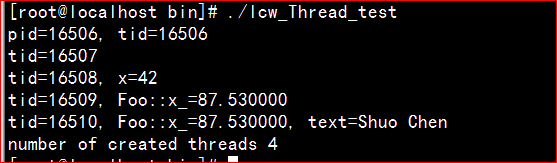
单独编译后运行结果如下:
muduo网络库源码学习————线程类的更多相关文章
- muduo网络库源码学习————线程本地单例类封装
muduo库中线程本地单例类封装代码是ThreadLocalSingleton.h 如下所示: //线程本地单例类封装 // Use of this source code is governed b ...
- muduo网络库源码学习————线程池实现
muduo库里面的线程池是固定线程池,即创建的线程池里面的线程个数是一定的,不是动态的.线程池里面一般要包含线程队列还有任务队列,外部程序将任务存放到线程池的任务队列中,线程池中的线程队列执行任务,也 ...
- muduo网络库源码学习————线程特定数据
muduo库线程特定数据源码文件为ThreadLocal.h //线程本地存储 // Use of this source code is governed by a BSD-style licens ...
- muduo网络库源码学习————日志类封装
muduo库里面的日志使方法如下 这里定义了一个宏 #define LOG_INFO if (muduo::Logger::logLevel() <= muduo::Logger::INFO) ...
- muduo网络库源码学习————线程安全
线程安全使用单例模式,保证了每次只创建单个对象,代码如下: Singleton.h // Use of this source code is governed by a BSD-style lice ...
- muduo网络库源码学习————Exception类
Exception类是为异常捕获而设计,可以获得异常的信息以及栈的回溯信息 (原来的代码没有demangle成员函数,输出的格式比较难看,加了demangle成员函数,利用demangle成员函数可以 ...
- muduo网络库源码学习————Timestamp.cc
今天开始学习陈硕先生的muduo网络库,moduo网络库得到很多好评,陈硕先生自己也说核心代码不超过5000行,所以我觉得有必要拿过来好好学习下,学习的时候在源码上面添加一些自己的注释,方便日后理解, ...
- muduo网络库源码学习————互斥锁
muduo源码的互斥锁源码位于muduo/base,Mutex.h,进行了两个类的封装,在实际的使用中更常使用MutexLockGuard类,因为该类可以在析构函数中自动解锁,避免了某些情况忘记解锁. ...
- muduo网络库源码学习————日志滚动
muduo库里面的实现日志滚动有两种条件,一种是日志文件大小达到预设值,另一种是时间到达超过当天.滚动日志类的文件是LogFile.cc ,LogFile.h 代码如下: LogFile.cc #in ...
随机推荐
- C/C++内存详解
众所周知,堆和栈是数据结构中的两种数据结构类型,堆是一种具有优先顺序的完全二叉树(或者说是一种优先队列,因为它在一定的优先顺序下满足队列先进先出的特点),排队打饭就是它的典型实例,栈是一种后进先出的数 ...
- 37.3 net--TcpDemo1 大小写转换
需求:使用TCP协议发送数据,并将接收到的数据转换成大写返回 启动方式:先打开服务端,再打开客户端 客户端 package day35_net_网络编程.tcp传输; import java.io.I ...
- String 对象-->substring() 方法
1.定义和用法 substring() 方法用于提取两个指定下标之间的字符. substring() 方法返回的子串包括 开始 处的字符,但不包括 结束 处的字符 语法: string.substri ...
- python3(十九)Partial func
# 偏函数(Partial function) # 如int()函数可以把字符串转换为整数,当仅传入字符串时,int()函数默认按十进制转换 # 但int()函数还提供额外的base参数,默认值为10 ...
- 【Java】【设计模式 Design Pattern】单例模式 Singleton
什么是设计模式? 设计模式是在大量的实践中总结和理论化之后的最佳的类设计结构,编程风格,和解决问题的方式 设计模式已经帮助我们想好了所有可能的设计问题,总结在这些各种各样的设计模式当中,也成为GOF2 ...
- 转载:URL链接中的不同用处
,井号:表示网页中的一个位置,被称之为锚点,常用于某个网页间不同位置的跳转,简单的说就是在一个网页中,URL 不变的情况下,通过添加"#buy"的字符在 URL 最后可以跳转到当前 ...
- B. 蚂蚁觅食(二)
B. 蚂蚁觅食(二) 单点时限: 1.0 sec 内存限制: 512 MB 一只饥饿的小蚂蚁外出觅食,幸运的的小蚂蚁发现了好多食物.但是这些食物位于一个N∗M的方格魔法阵的右下角,而小蚂蚁位于方格法阵 ...
- Oracle使用fy_recover_data恢复truncate删除的数据
(一)truncate操作概述 在生产中,truncate是使用的多的命令,在使用不当的情况下,往往会造成表的数据全部丢失,恢复较为困难.对于truncate恢复,常见的有以下几种方法可以进行恢复: ...
- Xshell 中文提示乱码
1.Alt+P 打开配置对话框,点击终端->编码,选择Unicode(utf-8)编码
- selenium 元素定位常用的方法
元素定位的方法有2个 driver.findElement(By.args) 返回值是WebElement //此方法是获取单一的页面元素 driver.findElements ...