
VGG网络的Pytorch实现
1.文章原文地址
Very Deep Convolutional Networks for Large-Scale Image Recognition
2.文章摘要
在这项工作中,我们研究了在大规模的图像识别数据集上卷积神经网络的深度对准确率的影响。我们主要贡献是使用非常小(3×3)卷积核的架构对深度增加的网络进行全面的评估,其结果表明将深度增大到16-19层时网络的性能会显著提升。这些发现是基于我们在ImageNet Challenge 2014的目标检测和分类任务分别获得了第一名和第二名的成绩而得出的。另外该网络也可以很好的推广到其他数据集上,在这些数据集上获得了当前最好结果。我们已经公开了性能最佳的ConvNet模型,为了促进在计算机视觉中使用深度视觉表征的进一步研究。
3.网络结构
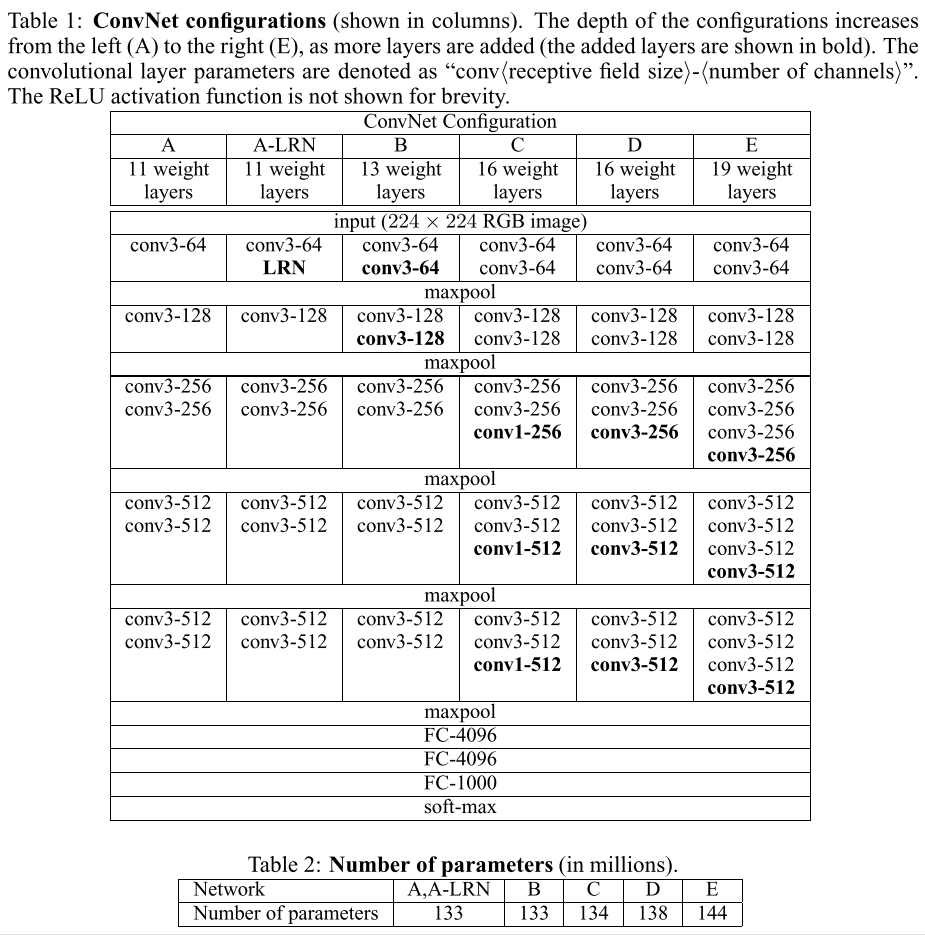
4.Pytorch实现
 import torch.nn as nn

 try:

     from torch.hub import load_state_dict_from_url

 except ImportError:

     from torch.utils.model_zoo import load_url as load_state_dict_from_url

 __all__ = [

     'VGG', 'vgg11', 'vgg11_bn', 'vgg13', 'vgg13_bn', 'vgg16', 'vgg16_bn',

     'vgg19_bn', 'vgg19',

 ]

 model_urls = {

     'vgg11': 'https://download.pytorch.org/models/vgg11-bbd30ac9.pth',

     'vgg13': 'https://download.pytorch.org/models/vgg13-c768596a.pth',

     'vgg16': 'https://download.pytorch.org/models/vgg16-397923af.pth',

     'vgg19': 'https://download.pytorch.org/models/vgg19-dcbb9e9d.pth',

     'vgg11_bn': 'https://download.pytorch.org/models/vgg11_bn-6002323d.pth',

     'vgg13_bn': 'https://download.pytorch.org/models/vgg13_bn-abd245e5.pth',

     'vgg16_bn': 'https://download.pytorch.org/models/vgg16_bn-6c64b313.pth',

     'vgg19_bn': 'https://download.pytorch.org/models/vgg19_bn-c79401a0.pth',

 }

 class VGG(nn.Module):

     def __init__(self, features, num_classes=1000, init_weights=True):

         super(VGG, self).__init__()

         self.features = features

         self.avgpool = nn.AdaptiveAvgPool2d((7, 7))  #固定全连接层的输入

         self.classifier = nn.Sequential(

             nn.Linear(512 * 7 * 7, 4096),

             nn.ReLU(True),

             nn.Dropout(),

             nn.Linear(4096, 4096),

             nn.ReLU(True),

             nn.Dropout(),

             nn.Linear(4096, num_classes),

         )

         if init_weights:

             self._initialize_weights()

     def forward(self, x):

         x = self.features(x)

         x = self.avgpool(x)

         x = x.view(x.size(0), -1)

         x = self.classifier(x)

         return x

     def _initialize_weights(self):

         for m in self.modules():

             if isinstance(m, nn.Conv2d):

                 nn.init.kaiming_normal_(m.weight, mode='fan_out', nonlinearity='relu')

                 if m.bias is not None:

                     nn.init.constant_(m.bias, 0)

             elif isinstance(m, nn.BatchNorm2d):

                 nn.init.constant_(m.weight, 1)

                 nn.init.constant_(m.bias, 0)

             elif isinstance(m, nn.Linear):

                 nn.init.normal_(m.weight, 0, 0.01)

                 nn.init.constant_(m.bias, 0)

 def make_layers(cfg, batch_norm=False):

     layers = []

     in_channels = 3

     for v in cfg:

         if v == 'M':

             layers += [nn.MaxPool2d(kernel_size=2, stride=2)]

         else:

             conv2d = nn.Conv2d(in_channels, v, kernel_size=3, padding=1)

             if batch_norm:

                 layers += [conv2d, nn.BatchNorm2d(v), nn.ReLU(inplace=True)]

             else:

                 layers += [conv2d, nn.ReLU(inplace=True)]

             in_channels = v

     return nn.Sequential(*layers)

 cfgs = {

     'A': [64, 'M', 128, 'M', 256, 256, 'M', 512, 512, 'M', 512, 512, 'M'],

     'B': [64, 64, 'M', 128, 128, 'M', 256, 256, 'M', 512, 512, 'M', 512, 512, 'M'],

     'D': [64, 64, 'M', 128, 128, 'M', 256, 256, 256, 'M', 512, 512, 512, 'M', 512, 512, 512, 'M'],

     'E': [64, 64, 'M', 128, 128, 'M', 256, 256, 256, 256, 'M', 512, 512, 512, 512, 'M', 512, 512, 512, 512, 'M'],

 }

 def _vgg(arch, cfg, batch_norm, pretrained, progress, **kwargs):

     if pretrained:

         kwargs['init_weights'] = False

     model = VGG(make_layers(cfgs[cfg], batch_norm=batch_norm), **kwargs)

     if pretrained:

         state_dict = load_state_dict_from_url(model_urls[arch],

                                               progress=progress)

         model.load_state_dict(state_dict)

     return model

 def vgg11(pretrained=False, progress=True, **kwargs):

     """VGG 11-layer model (configuration "A")

     Args:

         pretrained (bool): If True, returns a model pre-trained on ImageNet

         progress (bool): If True, displays a progress bar of the download to stderr

     """

     return _vgg('vgg11', 'A', False, pretrained, progress, **kwargs)

 def vgg11_bn(pretrained=False, progress=True, **kwargs):

     """VGG 11-layer model (configuration "A") with batch normalization

     Args:

         pretrained (bool): If True, returns a model pre-trained on ImageNet

         progress (bool): If True, displays a progress bar of the download to stderr

     """

     return _vgg('vgg11_bn', 'A', True, pretrained, progress, **kwargs)

 def vgg13(pretrained=False, progress=True, **kwargs):

     """VGG 13-layer model (configuration "B")

     Args:

         pretrained (bool): If True, returns a model pre-trained on ImageNet

         progress (bool): If True, displays a progress bar of the download to stderr

     """

     return _vgg('vgg13', 'B', False, pretrained, progress, **kwargs)

 def vgg13_bn(pretrained=False, progress=True, **kwargs):

     """VGG 13-layer model (configuration "B") with batch normalization

     Args:

         pretrained (bool): If True, returns a model pre-trained on ImageNet

         progress (bool): If True, displays a progress bar of the download to stderr

     """

     return _vgg('vgg13_bn', 'B', True, pretrained, progress, **kwargs)

 def vgg16(pretrained=False, progress=True, **kwargs):

     """VGG 16-layer model (configuration "D")

     Args:

         pretrained (bool): If True, returns a model pre-trained on ImageNet

         progress (bool): If True, displays a progress bar of the download to stderr

     """

     return _vgg('vgg16', 'D', False, pretrained, progress, **kwargs)

 def vgg16_bn(pretrained=False, progress=True, **kwargs):

     """VGG 16-layer model (configuration "D") with batch normalization

     Args:

         pretrained (bool): If True, returns a model pre-trained on ImageNet

         progress (bool): If True, displays a progress bar of the download to stderr

     """

     return _vgg('vgg16_bn', 'D', True, pretrained, progress, **kwargs)

 def vgg19(pretrained=False, progress=True, **kwargs):

     """VGG 19-layer model (configuration "E")

     Args:

         pretrained (bool): If True, returns a model pre-trained on ImageNet

         progress (bool): If True, displays a progress bar of the download to stderr

     """

     return _vgg('vgg19', 'E', False, pretrained, progress, **kwargs)

 def vgg19_bn(pretrained=False, progress=True, **kwargs):

     """VGG 19-layer model (configuration 'E') with batch normalization

     Args:

         pretrained (bool): If True, returns a model pre-trained on ImageNet

         progress (bool): If True, displays a progress bar of the download to stderr

     """

     return _vgg('vgg19_bn', 'E', True, pretrained, progress, **kwargs)
参考
https://github.com/pytorch/vision/tree/master/torchvision/models
VGG网络的Pytorch实现的更多相关文章
- ResNet网络的Pytorch实现
1.文章原文地址 Deep Residual Learning for Image Recognition 2.文章摘要 神经网络的层次越深越难训练.我们提出了一个残差学习框架来简化网络的训练,这些 ...
- VGG网络
VGG论文给出了一个非常振奋人心的结论:卷积神经网络的深度增加和小卷积核的使用对网络的最终分类识别效果有很大的作用.记得在AlexNet论文中,也做了最后指出了网络深度的对最终的分类结果有很大的作用. ...
- 第二十四节,TensorFlow下slim库函数的使用以及使用VGG网络进行预训练、迁移学习(附代码)
在介绍这一节之前,需要你对slim模型库有一些基本了解,具体可以参考第二十二节,TensorFlow中的图片分类模型库slim的使用.数据集处理,这一节我们会详细介绍slim模型库下面的一些函数的使用 ...
- 关于VGG网络的介绍
本博客参考作者链接:https://zhuanlan.zhihu.com/p/41423739 前言: VGG是Oxford的Visual Geometry Group的组提出的(大家应该能看出VGG ...
- 基于深度学习的人脸识别系统(Caffe+OpenCV+Dlib)【三】VGG网络进行特征提取
前言 基于深度学习的人脸识别系统,一共用到了5个开源库:OpenCV(计算机视觉库).Caffe(深度学习库).Dlib(机器学习库).libfacedetection(人脸检测库).cudnn(gp ...
- 群等变网络的pytorch实现
CNN对于旋转不具有等变性,对于平移有等变性,data augmentation的提出就是为了解决这个问题,但是data augmentation需要很大的模型容量,更多的迭代次数才能够在训练数据集合 ...
- U-Net网络的Pytorch实现
1.文章原文地址 U-Net: Convolutional Networks for Biomedical Image Segmentation 2.文章摘要 普遍认为成功训练深度神经网络需要大量标注 ...
- GoogLeNet网络的Pytorch实现
1.文章原文地址 Going deeper with convolutions 2.文章摘要 我们提出了一种代号为Inception的深度卷积神经网络,它在ILSVRC2014的分类和检测任务上都取得 ...
- AlexNet网络的Pytorch实现
1.文章原文地址 ImageNet Classification with Deep Convolutional Neural Networks 2.文章摘要 我们训练了一个大型的深度卷积神经网络用于 ...
随机推荐
- Fiddler抓取Android手机网络数据包
也许你也有疑问,如果开发没有完备的接口文档,我如何知道他API的信息? 这时我们就得通过一些抓包工具抓取这些API信息. 常见抓包工具 HTTP抓包工具:Fiddler.Charles.Firebug ...
- Terence’s Stuff: Why do we do research?
This sound like a question best answered via a survey conducted by a body such as Vitae, an internat ...
- 最新 安易迅java校招面经 (含整理过的面试题大全)
从6月到10月,经过4个月努力和坚持,自己有幸拿到了网易雷火.京东.去哪儿. 安易迅等10家互联网公司的校招Offer,因为某些自身原因最终选择了 安易迅.6.7月主要是做系统复习.项目复盘.Leet ...
- Linux【Ubuntu】安装docker
内核要大于3.10才能安装docker 查看内核 uname -r 安装yum命令 sudo apt install yum 由于 apt 源使用 HTTPS 以确保软件下载过程中不被篡改,故添加使用 ...
- Mac上Docker的安装
安装 安装包安装 由于历史原因, 本人使用的是安装安装的方式, 这也是很多Windows用户的习惯. 下载地址: https://download.docker.com/mac/stable/Dock ...
- Resin 与 Tomcat 服务器对比
Resin 与 Tomcat对比(个人总结) 图片来源Tomcat PK Resin 上图对比发现Tomcat对于Resin来说,有诸多优点,但是Resin也有很多优点. 比方说: 速度比较 re ...
- 剑指offer11:输入一个整数,输出该数二进制表示中1的个数。其中负数用补码表示。(进制转换,补码反码)
1. 题目描述 输入一个整数,输出该数二进制表示中1的个数.其中负数用补码表示. 2. 思路和方法 使用移位(<<)和 “| & !”操作来实现.1的二进制是:前面都是0,最后一位 ...
- scrapy2——框架简介和抓取流程
scrapy简介 Scrapy是一个为了爬取网站数据,提取结构性数据而编写的应用框架. 可以应用在包括数据挖掘,信息处理或存储历史数据等一系列的程序中 scrapy的执行流程 Scrapy主要包括 ...
- 20191125:Python中的上下文管理机制with
20191125:with上下文管理 with是一个上下文管理器,用于执行代码块所需要的运行的时候的上下文入口和出口.上下文管理器的典型用法包括保存和还原各种全局状态,锁定和解锁资源,关闭打开的文件等 ...
- 十六、USB驱动
一.USB固件和USB传输方式 USB固件: USB固件一般不需要我们编写,在此不做程序分析. USB固件中包含USB设备的出厂信息,如厂商ID.产品ID.主版本号和次版本号等.这就是为什么当我们把U ...