
GoogLeNet网络的Pytorch实现
1.文章原文地址
Going deeper with convolutions
2.文章摘要
我们提出了一种代号为Inception的深度卷积神经网络,它在ILSVRC2014的分类和检测任务上都取得当前最佳成绩。这种结构的主要特点是提高了网络内部计算资源的利用率。这是通过精心的设计实现的,它允许增加网络的深度和宽度,同时保持计算预算不变。为了提高效果,这个网络的架构确定是基于Hebbian原则和多尺度处理的直觉。其中一个典型的实例用于提交到ILSVRC2014上,我们称之为GoogLeNet,它是一个22层的深度网络,该网络的效果通过分类和检测任务来加以评估。
3.网络结构

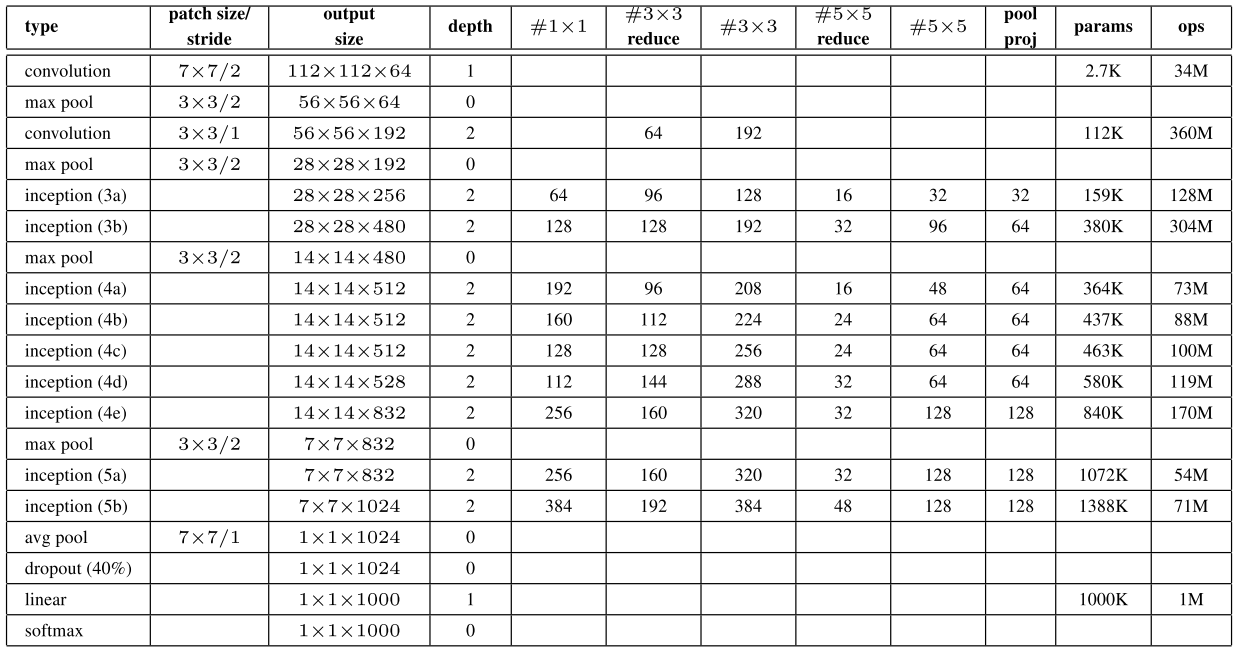
4.Pytorch实现
 import warnings

 from collections import namedtuple

 import torch

 import torch.nn as nn

 import torch.nn.functional as F

 from torch.utils.model_zoo import load_url as load_state_dict_from_url

 from torchsummary import summary

 __all__ = ['GoogLeNet', 'googlenet']

 model_urls = {

     # GoogLeNet ported from TensorFlow

     'googlenet': 'https://download.pytorch.org/models/googlenet-1378be20.pth',

 }

 _GoogLeNetOuputs = namedtuple('GoogLeNetOuputs', ['logits', 'aux_logits2', 'aux_logits1'])

 def googlenet(pretrained=False, progress=True, **kwargs):

     r"""GoogLeNet (Inception v1) model architecture from

     `"Going Deeper with Convolutions" <http://arxiv.org/abs/1409.4842>`_.

     Args:

         pretrained (bool): If True, returns a model pre-trained on ImageNet

         progress (bool): If True, displays a progress bar of the download to stderr

         aux_logits (bool): If True, adds two auxiliary branches that can improve training.

             Default: *False* when pretrained is True otherwise *True*

         transform_input (bool): If True, preprocesses the input according to the method with which it

             was trained on ImageNet. Default: *False*

     """

     if pretrained:

         if 'transform_input' not in kwargs:

             kwargs['transform_input'] = True

         if 'aux_logits' not in kwargs:

             kwargs['aux_logits'] = False

         if kwargs['aux_logits']:

             warnings.warn('auxiliary heads in the pretrained googlenet model are NOT pretrained, '

                           'so make sure to train them')

         original_aux_logits = kwargs['aux_logits']

         kwargs['aux_logits'] = True

         kwargs['init_weights'] = False

         model = GoogLeNet(**kwargs)

         state_dict = load_state_dict_from_url(model_urls['googlenet'],

                                               progress=progress)

         model.load_state_dict(state_dict)

         if not original_aux_logits:

             model.aux_logits = False

             del model.aux1, model.aux2

         return model

     return GoogLeNet(**kwargs)

 class GoogLeNet(nn.Module):

     def __init__(self, num_classes=1000, aux_logits=True, transform_input=False, init_weights=True):

         super(GoogLeNet, self).__init__()

         self.aux_logits = aux_logits

         self.transform_input = transform_input

         self.conv1 = BasicConv2d(3, 64, kernel_size=7, stride=2, padding=3)

         self.maxpool1 = nn.MaxPool2d(3, stride=2, ceil_mode=True)   #向上取整

         self.conv2 = BasicConv2d(64, 64, kernel_size=1)

         self.conv3 = BasicConv2d(64, 192, kernel_size=3, padding=1)

         self.maxpool2 = nn.MaxPool2d(3, stride=2, ceil_mode=True)

         self.inception3a = Inception(192, 64, 96, 128, 16, 32, 32)

         self.inception3b = Inception(256, 128, 128, 192, 32, 96, 64)

         self.maxpool3 = nn.MaxPool2d(3, stride=2, ceil_mode=True)

         self.inception4a = Inception(480, 192, 96, 208, 16, 48, 64)

         self.inception4b = Inception(512, 160, 112, 224, 24, 64, 64)

         self.inception4c = Inception(512, 128, 128, 256, 24, 64, 64)

         self.inception4d = Inception(512, 112, 144, 288, 32, 64, 64)

         self.inception4e = Inception(528, 256, 160, 320, 32, 128, 128)

         self.maxpool4 = nn.MaxPool2d(2, stride=2, ceil_mode=True)

         self.inception5a = Inception(832, 256, 160, 320, 32, 128, 128)

         self.inception5b = Inception(832, 384, 192, 384, 48, 128, 128)

         if aux_logits:

             self.aux1 = InceptionAux(512, num_classes)

             self.aux2 = InceptionAux(528, num_classes)

         self.avgpool = nn.AdaptiveAvgPool2d((1, 1))

         self.dropout = nn.Dropout(0.2)

         self.fc = nn.Linear(1024, num_classes)

         if init_weights:

             self._initialize_weights()

     def _initialize_weights(self):

         for m in self.modules():

             if isinstance(m, nn.Conv2d) or isinstance(m, nn.Linear):

                 import scipy.stats as stats

                 X = stats.truncnorm(-2, 2, scale=0.01)

                 values = torch.as_tensor(X.rvs(m.weight.numel()), dtype=m.weight.dtype)

                 values = values.view(m.weight.size())

                 with torch.no_grad():

                     m.weight.copy_(values)

             elif isinstance(m, nn.BatchNorm2d):

                 nn.init.constant_(m.weight, 1)

                 nn.init.constant_(m.bias, 0)

     def forward(self, x):

         if self.transform_input:

             x_ch0 = torch.unsqueeze(x[:, 0], 1) * (0.229 / 0.5) + (0.485 - 0.5) / 0.5

             x_ch1 = torch.unsqueeze(x[:, 1], 1) * (0.224 / 0.5) + (0.456 - 0.5) / 0.5

             x_ch2 = torch.unsqueeze(x[:, 2], 1) * (0.225 / 0.5) + (0.406 - 0.5) / 0.5

             x = torch.cat((x_ch0, x_ch1, x_ch2), 1)

         # N x 3 x 224 x 224

         x = self.conv1(x)

         # N x 64 x 112 x 112

         x = self.maxpool1(x)

         # N x 64 x 56 x 56

         x = self.conv2(x)

         # N x 64 x 56 x 56

         x = self.conv3(x)

         # N x 192 x 56 x 56

         x = self.maxpool2(x)

         # N x 192 x 28 x 28

         x = self.inception3a(x)

         # N x 256 x 28 x 28

         x = self.inception3b(x)

         # N x 480 x 28 x 28

         x = self.maxpool3(x)

         # N x 480 x 14 x 14

         x = self.inception4a(x)

         # N x 512 x 14 x 14

         if self.training and self.aux_logits:

             aux1 = self.aux1(x)

         x = self.inception4b(x)

         # N x 512 x 14 x 14

         x = self.inception4c(x)

         # N x 512 x 14 x 14

         x = self.inception4d(x)

         # N x 528 x 14 x 14

         if self.training and self.aux_logits:

             aux2 = self.aux2(x)

         x = self.inception4e(x)

         # N x 832 x 14 x 14

         x = self.maxpool4(x)

         # N x 832 x 7 x 7

         x = self.inception5a(x)

         # N x 832 x 7 x 7

         x = self.inception5b(x)

         # N x 1024 x 7 x 7

         x = self.avgpool(x)

         # N x 1024 x 1 x 1

         x = x.view(x.size(0), -1)

         # N x 1024

         x = self.dropout(x)

         x = self.fc(x)

         # N x 1000 (num_classes)

         if self.training and self.aux_logits:

             return _GoogLeNetOuputs(x, aux2, aux1)

         return x

 class Inception(nn.Module):     #Inception模块

     def __init__(self, in_channels, ch1x1, ch3x3red, ch3x3, ch5x5red, ch5x5, pool_proj):

         super(Inception, self).__init__()

         self.branch1 = BasicConv2d(in_channels, ch1x1, kernel_size=1)

         self.branch2 = nn.Sequential(

             BasicConv2d(in_channels, ch3x3red, kernel_size=1),

             BasicConv2d(ch3x3red, ch3x3, kernel_size=3, padding=1)

         )

         self.branch3 = nn.Sequential(

             BasicConv2d(in_channels, ch5x5red, kernel_size=1),

             BasicConv2d(ch5x5red, ch5x5, kernel_size=3, padding=1)

         )

         self.branch4 = nn.Sequential(

             nn.MaxPool2d(kernel_size=3, stride=1, padding=1, ceil_mode=True),

             BasicConv2d(in_channels, pool_proj, kernel_size=1)

         )

     def forward(self, x):

         branch1 = self.branch1(x)

         branch2 = self.branch2(x)

         branch3 = self.branch3(x)

         branch4 = self.branch4(x)

         outputs = [branch1, branch2, branch3, branch4]

         return torch.cat(outputs, 1)

 class InceptionAux(nn.Module):      #辅助分支

     def __init__(self, in_channels, num_classes):

         super(InceptionAux, self).__init__()

         self.conv = BasicConv2d(in_channels, 128, kernel_size=1)

         self.fc1 = nn.Linear(2048, 1024)

         self.fc2 = nn.Linear(1024, num_classes)

     def forward(self, x):

         # aux1: N x 512 x 14 x 14, aux2: N x 528 x 14 x 14

         x = F.adaptive_avg_pool2d(x, (4, 4))

         # aux1: N x 512 x 4 x 4, aux2: N x 528 x 4 x 4

         x = self.conv(x)

         # N x 128 x 4 x 4

         x = x.view(x.size(0), -1)

         # N x 2048

         x = F.relu(self.fc1(x), inplace=True)

         # N x 1024

         x = F.dropout(x, 0.7, training=self.training)

         # N x 1024

         x = self.fc2(x)

         # N x num_classes

         return x

 class BasicConv2d(nn.Module):       #Conv2d+BN+Relu

     def __init__(self, in_channels, out_channels, **kwargs):

         super(BasicConv2d, self).__init__()

         self.conv = nn.Conv2d(in_channels, out_channels, bias=False, **kwargs)

         self.bn = nn.BatchNorm2d(out_channels, eps=0.001)

     def forward(self, x):

         x = self.conv(x)

         x = self.bn(x)

         return F.relu(x, inplace=True)

 if __name__=="__main__":

     model=googlenet()

     print(model,(3,224,224))
参考
https://github.com/pytorch/vision/tree/master/torchvision/models
GoogLeNet网络的Pytorch实现的更多相关文章
- 跟我学算法-图像识别之图像分类(下)(GoogleNet网络, ResNet残差网络, ResNext网络, CNN设计准则)
1.GoogleNet 网络: Inception V1 - Inception V2 - Inception V3 - Inception V4 1. Inception v1 split - me ...
- 群等变网络的pytorch实现
CNN对于旋转不具有等变性,对于平移有等变性,data augmentation的提出就是为了解决这个问题,但是data augmentation需要很大的模型容量,更多的迭代次数才能够在训练数据集合 ...
- U-Net网络的Pytorch实现
1.文章原文地址 U-Net: Convolutional Networks for Biomedical Image Segmentation 2.文章摘要 普遍认为成功训练深度神经网络需要大量标注 ...
- ResNet网络的Pytorch实现
1.文章原文地址 Deep Residual Learning for Image Recognition 2.文章摘要 神经网络的层次越深越难训练.我们提出了一个残差学习框架来简化网络的训练,这些 ...
- AlexNet网络的Pytorch实现
1.文章原文地址 ImageNet Classification with Deep Convolutional Neural Networks 2.文章摘要 我们训练了一个大型的深度卷积神经网络用于 ...
- VGG网络的Pytorch实现
1.文章原文地址 Very Deep Convolutional Networks for Large-Scale Image Recognition 2.文章摘要 在这项工作中,我们研究了在大规模的 ...
- googLeNet网络
1.什么是inception结构 2.什么是Hebbian原理 3.什么是多尺度处理 最近深度学习的发展,大多来源于新的想法,算法以及网络结构的改善,而不是依赖于硬件,新的数据集,更深的网络,并且深度 ...
- SegNet网络的Pytorch实现
1.文章原文地址 SegNet: A Deep Convolutional Encoder-Decoder Architecture for Image Segmentation 2.文章摘要 语义分 ...
- 深度学习——卷积神经网络 的经典网络(LeNet-5、AlexNet、ZFNet、VGG-16、GoogLeNet、ResNet)
一.CNN卷积神经网络的经典网络综述 下面图片参照博客:http://blog.csdn.net/cyh_24/article/details/51440344 二.LeNet-5网络 输入尺寸:32 ...
随机推荐
- Excel对某一列的数据插入处理,域名得出IP
早期都是通过Excel做数据统计,对某一列的数据插入处理. 代码功能是从A列纯域名,将域名转换为IP,从域名A列得到IP写到B列. 代码 #!/usr/bin/python #coding:utf-8 ...
- SpringBoot学习笔记:自定义拦截器
SpringBoot学习笔记:自定义拦截器 快速开始 拦截器类似于过滤器,但是拦截器提供更精细的的控制能力,它可以在一个请求过程中的两个节点进行拦截: 在请求发送到Controller之前 在响应发送 ...
- Kafka运维大全来了!优化、监控、故障处理
Kafka运维大全来了!优化.监控.故障处理…… Kafka概念 Kafka是分布式发布-订阅消息系统.它最初由LinkedIn公司开发,之后成为Apache项目的一部分.Kafka是一个分布式的 ...
- ECOC 2019展会:以太网联盟公开展示其下一代网络100/200/400G互通测试能力,网络自动化测试能力再次被提出
欧洲光纤通讯展ECOC 2019正在火热进行,以太网联盟组织Ethernet Alliance在其公开展台演示了其下一代高速网络100G/200G/400G相关能力,其成员单位Cisco,Arista ...
- linux c基础技巧
C语言:向文件末尾进行追加数据https://blog.csdn.net/qq_31243065/article/details/82354557 https://zhidao.baidu.com/q ...
- Fiddler使其在HttpURLConnection下正常抓包
像陌陌这样使用HttpURLConnection进行通讯的APP还是无能为力 还需要对fiddler进行如下设置: 点击"Rules->CustomizeRules"; 在这 ...
- java多线程中篇(三) —— 线程的控制(创建,运行,阻塞,中断,结束)
简介 线程的控制就是程序对线程的主要管理,最重要的就是状态的切换维护. 每种转态都有不同的引发事件(对应线程的方法),每种状态又有各自不同的处理步骤和过程,整个线程控制主要就是涉及这些内容. 正文 线 ...
- (十七)springMvc 对表单提交的日期以及JSON中的日期的参数绑定
文章目录 前言 `Ajax`提交表单数据 `Ajax`提交`JSON` 格式数据 解决输出JSON乱码的问题 控制JSON输出日期格式 小记 前言 springMVC 提供强大的参数绑定功能,使得我们 ...
- Python04之数据类型
Python的数据类型主要有四类:整型.浮点型.字符串类型.布尔类型 整型:所有整数都属于整型(长整型和整型) 如:-121,0,765,89,12306 浮点型:数字上有小数点的数 ...
- 剑指offer54:字符流中第一个不重复的字符
1 题目描述 请实现一个函数用来找出字符流中第一个只出现一次的字符.例如,当从字符流中只读出前两个字符"go"时,第一个只出现一次的字符是"g".当从该字符流中 ...