
PAT 1127 ZigZagging on a Tree[难]
1127 ZigZagging on a Tree (30 分)
Suppose that all the keys in a binary tree are distinct positive integers. A unique binary tree can be determined by a given pair of postorder and inorder traversal sequences. And it is a simple standard routine to print the numbers in level-order. However, if you think the problem is too simple, then you are too naive. This time you are supposed to print the numbers in "zigzagging order" -- that is, starting from the root, print the numbers level-by-level, alternating between left to right and right to left. For example, for the following tree you must output: 1 11 5 8 17 12 20 15.
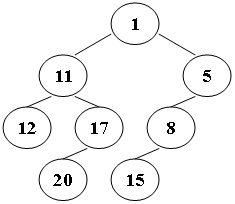
Input Specification:
Each input file contains one test case. For each case, the first line gives a positive integer N (≤30), the total number of nodes in the binary tree. The second line gives the inorder sequence and the third line gives the postorder sequence. All the numbers in a line are separated by a space.
Output Specification:
For each test case, print the zigzagging sequence of the tree in a line. All the numbers in a line must be separated by exactly one space, and there must be no extra space at the end of the line.
Sample Input:
8

12 11 20 17 1 15 8 5

12 20 17 11 15 8 5 1
Sample Output:
1 11 5 8 17 12 20 15题目大意:给出二叉树的中根遍历和后根遍历序列,给出zigzag遍历序列,就是隔层从左到右,从右到左这样转换遍历。
//这个我当然是不会了,好久没做二叉树的题目了。
转自:https://www.liuchuo.net/archives/3758
#include <iostream>

#include <vector>

#include <queue>

#include<cstdio>

using namespace std;

vector<int> in, post, result[];

int n, tree[][], root;

struct node {

    int index, depth;//保存index和深度。

};

//将二叉树的结构存储在了tree中。

void dfs(int &index, int inLeft, int inRight, int postLeft, int postRight) {

    if (inLeft > inRight) return;

    index = postRight;//进来之后再赋值,真的厉害。

    int i = ;

    while (in[i] != post[postRight]) i++;

    dfs(tree[index][], inLeft, i - , postLeft, postLeft + (i - inLeft) - );

    dfs(tree[index][], i + , inRight, postLeft + (i - inLeft), postRight - );

}

//dfs函数得到的root实际上是post遍历中的下标。

void bfs() {

    queue<node> q;

    q.push(node{root, });

    while (!q.empty()) {

        node temp = q.front();

        q.pop();

        result[temp.depth].push_back(post[temp.index]);

        if (tree[temp.index][] != )//左子树不为空。

            q.push(node{tree[temp.index][], temp.depth + });

        //那么此时push进的是左子树,并且深度+1.

        if (tree[temp.index][] != )//右子树不为空。

            q.push(node{tree[temp.index][], temp.depth + });

    }

}

int main() {

    cin >> n;

    in.resize(n + ), post.resize(n + );

    for (int i = ; i <= n; i++) cin >> in[i];//输入中序遍历

    for (int i = ; i <= n; i++) cin >> post[i];//输入后序遍历

    dfs(root, , n, , n);//将根存在了root中。

    bfs();

    printf("%d", result[][]);

    for (int i = ; i < ; i++) {

        if (i %  == ) {

            for (int j = ; j < result[i].size(); j++)

                printf(" %d", result[i][j]);

        } else {

            for (int j = result[i].size() - ; j >= ; j--)

                printf(" %d", result[i][j]);

        }

    }

    return ;

}
//柳神真厉害。
1.使用dfs在遍历的过程中传进去index引用参数,直接赋值,并且使用tree二维数组存储二叉树的结构
2.使用结构体node,存储下标和层数,下标是在post序列中可以寻到节点的。
3.对奇数层和偶数层,分别用不同的方式打印。
代码来自:https://www.cnblogs.com/chenxiwenruo/p/6506517.html
#include <iostream>

#include <cstdio>

#include <algorithm>

#include <string.h>

#include <string>

#include <map>

#define LEFT 0

#define RIGHT 1

using namespace std;

const int maxn=;

int inorder[maxn];

int postorder[maxn];

int level[maxn][maxn]; //每层的节点id

int levelcnt[maxn]; //每层的节点个数

int maxlayer=;

int cnt=; //节点id

struct Node{

    int left=-,right=-;

    int val;

}node[maxn];

//根据中序遍历和后序遍历建立树

void build(int inL,int inR,int postL,int postR,int fa,int LorR){

    if(inL>inR)

        return;

    int val=postorder[postR];

    int idx;

    //在中序遍历中找出父亲节点的索引,其左边是左子树,右边是右子树

    for(int i=inL;i<=inR;i++){

        if(inorder[i]==val){

            idx=i;

            break;

        }

    }

    int lnum=idx-inL;//左子树的节点个数

    cnt++;

    node[cnt].val=val;

    if(LorR==LEFT)

        node[fa].left=cnt;

    else if(LorR==RIGHT)

        node[fa].right=cnt;

    int tmp=cnt;

    build(inL,idx-,postL,postL+lnum-,tmp,LEFT);

    //这里的left标志是当前深度遍历中是左子树还是右子树。

    build(idx+,inR,postL+lnum,postR-,tmp,RIGHT);

}

void dfs(int root,int layer){

    if(root==-)

        return;

    maxlayer=max(layer,maxlayer);

    level[layer][levelcnt[layer]]=root;

    levelcnt[layer]++;

    dfs(node[root].left,layer+);

    dfs(node[root].right,layer+);

}

int main()

{

    int n;

    cin>>n;

    for(int i=;i<=n;i++)

        cin>>inorder[i];

    for(int i=;i<=n;i++)

        cin>>postorder[i];

    build(,n,,n,-,-);

    dfs(,);

    bool flag=true;

    printf("%d",node[].val);

    for(int i=;i<=maxlayer;i++){

        if(flag){

            for(int j=;j<levelcnt[i];j++)

                printf(" %d",node[level[i][j]].val);

        }

        else{

            for(int j=levelcnt[i]-;j>=;j--)

                printf(" %d",node[level[i][j]].val);

        }

        flag=!flag;

    }

    return ;

}
1.这个是使用函数建树,具体的代码理解在代码里。
PAT 1127 ZigZagging on a Tree[难]的更多相关文章
- PAT 1127 ZigZagging on a Tree
Suppose that all the keys in a binary tree are distinct positive integers. A unique binary tree can ...
- PAT甲级1127. ZigZagging on a Tree
PAT甲级1127. ZigZagging on a Tree 题意: 假设二叉树中的所有键都是不同的正整数.一个唯一的二叉树可以通过给定的一对后序和顺序遍历序列来确定.这是一个简单的标准程序,可以按 ...
- PAT甲级 1127. ZigZagging on a Tree (30)
1127. ZigZagging on a Tree (30) 时间限制 400 ms 内存限制 65536 kB 代码长度限制 16000 B 判题程序 Standard 作者 CHEN, Yue ...
- pat 甲级 1127. ZigZagging on a Tree (30)
1127. ZigZagging on a Tree (30) 时间限制 400 ms 内存限制 65536 kB 代码长度限制 16000 B 判题程序 Standard 作者 CHEN, Yue ...
- 1127 ZigZagging on a Tree (30 分)
1127 ZigZagging on a Tree (30 分) Suppose that all the keys in a binary tree are distinct positive in ...
- PAT 甲级 1127 ZigZagging on a Tree
https://pintia.cn/problem-sets/994805342720868352/problems/994805349394006016 Suppose that all the k ...
- PAT Advanced 1127 ZigZagging on a Tree (30) [中序后序建树,层序遍历]
题目 Suppose that all the keys in a binary tree are distinct positive integers. A unique binary tree c ...
- PAT甲题题解-1127. ZigZagging on a Tree (30)-中序、后序建树
根据中序遍历和前序遍历确定一棵二叉树,然后按“层次遍历”序列输出.输出规则:除根节点外,接下来每层的节点输出顺序是:先从左到右,再从右到左,交替输出 #include <iostream> ...
- PAT A1127 ZigZagging on a Tree (30 分)——二叉树,建树,层序遍历
Suppose that all the keys in a binary tree are distinct positive integers. A unique binary tree can ...
随机推荐
- CSS3 经典教程系列:CSS3 圆角(border-radius)详解
http://www.cnblogs.com/lhb25/archive/2013/01/30/css3-border-radius.html 特别好的一篇文章
- Makefile--伪目标 (三)
原创博文,转载请标明出处--周学伟http://www.cnblogs.com/zxouxuewei/ 一般情况下,Makefile都会有一个clean目标,用于清除编译过程中产生的二进制文件.我们在 ...
- usb摄像头的检测
下面写一下过程: 如果你能在http://www.ideasonboard.org/uvc/找到你的摄像头的ID,即UVC支持的,那么就可以在linux下使用了.至于从哪个版本开始内核支持UVC,官方 ...
- LinkedBlockingQueue(lbq)阻塞队列
最近开发中,经常使用这个类LinkedBlockingQueue,它是BlockingQueue这个子类. 并发库中的BlockingQueue是一个比较好玩的类,顾名思义,就是阻塞队列.该类主要提供 ...
- 批量执行命令:fabric
Fabric 可以通过 SSH 在多台客户端主机上批量执行任务,是基于 paramiko 封装开发的,paramiko 更底层一些,安装方法如下: [root@localhost ~]$ yum in ...
- HTTP 代理
HTTP 代理: (1) 如果我们一直用同一个IP去爬取同一个网站上的网页,久了之后可能会被该网站服务器屏蔽,因此我们可以使用代理IP来爬取,代理实际上指的就是代理服务器(2) 当我们使用代理IP爬取 ...
- Unity3D自己常用代码
常需要,常查找! 自己记录下! 1. var ray = Camera.main.ScreenPointToRay(Input.mousePosition); //GameObject.CreateP ...
- Spring 工作流程简单介绍
Spring Web MVC 处理Http请求的大致过程: 一旦Http请求到来,DispatcherSevlet将负责将请求分发. DispatcherServlet可以认为是Spring提供的前端 ...
- EF更新的时候出错
错误提示: 存储区更新.插入或删除语句影响到了意外的行数(0).实体在加载后可能被修改或删除.刷新 ObjectStateManager 项. 说明: 执行当前 Web 请求期间,出现未经处理的异常. ...
- 静态资源的gzip
1.项目中,接触到gzip.未压缩的文件和压缩后的文件的比例可能达到:3:1.所以,gzip是网络中文件高速传输的很好方法. 2.一般js.css.html文件都会在后端进行gzip.当浏览器请求这些 ...