
Linux内核中的常用宏container_of
Container_of在Linux内核中是一个常用的宏,用于从包含在某个结构中的指针获得结构本身的指针,通俗地讲就是通过结构体变量中某个成员的首地址进而获得整个结构体变量的首地址。
Container_of的定义如下:
- #define container_of(ptr, type, member) ({ \
- const typeof( ((type *)0)->member ) *__mptr = (ptr); \
- (type *)( (char *)__mptr - offsetof(type,member) );})
其实它的语法很简单,只是一些指针的灵活应用,它分两步:
第一步,首先定义一个临时的数据类型(通过typeof( ((type *)0)->member )获得)与ptr相同的指针变量__mptr,然后用它来保存ptr的值。
第二步,用(char *)__mptr减去member在结构体中的偏移量,得到的值就是整个结构体变量的首地址(整个宏的返回值就是这个首地址)。
其中的语法难点就是如何得出成员相对结构体的偏移量?
通过例子说明,如清单1:
- /* linux-2.6.38.8/include/linux/compiler-gcc4.h */
- #define __compiler_offsetof(a,b) __builtin_offsetof(a,b)
- /* linux-2.6.38.8/include/linux/stddef.h */
- #undef offsetof
- #ifdef __compiler_offsetof
- #define offsetof(TYPE,MEMBER) __compiler_offsetof(TYPE,MEMBER)
- #else
- #define offsetof(TYPE, MEMBER) ((size_t) &((TYPE *)0)->MEMBER)
- #endif
- #include <stdio.h>
- struct test_struct {
- int num;
- char ch;
- float fl;
- };
- int main(void)
- {
- printf("offsetof(struct test_struct, num) = %d\n",
- offsetof(struct test_struct, num));
- printf("offsetof(struct test_struct, ch) = %d\n",
- offsetof(struct test_struct, ch));
- printf("offsetof(struct test_struct, fl) = %d\n",
- offsetof(struct test_struct, fl));
- return 0;
- }
说明,__builtin_offsetof(a,b)是GCC的内置函数,可认为它的实现与((size_t) &((TYPE *)0)->MEMBER)这段代码是一致的。
例子输出结果:
- offsetof(struct test_struct, num) = 0
- offsetof(struct test_struct, ch) = 4
- offsetof(struct test_struct, fl) = 8
其中代码难以理解的地方就是它灵活地运用了0地址。如果觉得&( (struct test_struct *)0 )->ch这样的代码不好理解,那么我们可以假设在0地址分配了一个结构体变量struct test_struct a,然后定义结构体指针变量p并指向a(struct test_struct *p = &a),如此我们就可以通过&p->ch获得成员ch的地址。由于a的首地址为0x0,所以成员ch的首地址为0x4。
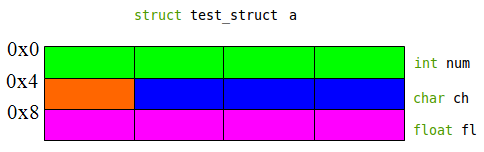
最后通过强制类型转换(size_t)把一个地址值转换为一个整数。
分析完container_of的定义,接下来举两个例子来体会一下它的使用方法。
正确的例子,如清单2:
- /* linux-2.6.38.8/include/linux/compiler-gcc4.h */
- #define __compiler_offsetof(a,b) __builtin_offsetof(a,b)
- /* linux-2.6.38.8/include/linux/stddef.h */
- #undef offsetof
- #ifdef __compiler_offsetof
- #define offsetof(TYPE,MEMBER) __compiler_offsetof(TYPE,MEMBER)
- #else
- #define offsetof(TYPE, MEMBER) ((size_t) &((TYPE *)0)->MEMBER)
- #endif
- /* linux-2.6.38.8/include/linux/kernel.h *
- * container_of - cast a member of a structure out to the containing structure
- * @ptr: the pointer to the member.
- * @type: the type of the container struct this is embedded in.
- * @member: the name of the member within the struct.
- *
- */
- #define container_of(ptr, type, member) ({ \
- const typeof( ((type *)0)->member ) *__mptr = (ptr); \
- (type *)( (char *)__mptr - offsetof(type,member) );})
- #include <stdio.h>
- struct test_struct {
- int num;
- char ch;
- float fl;
- };
- int main(void)
- {
- struct test_struct init_test_struct = { 99, 'C', 59.12 };
- char *char_ptr = &init_test_struct.ch;
- struct test_struct *test_struct = container_of(char_ptr, struct test_struct, ch);
- printf(" test_struct->num = %d\n test_struct->ch = %c\n test_struct->fl = %f\n",
- test_struct->num, test_struct->ch, test_struct->fl);
- return 0;
- }
例子输出结果:
- test_struct->num = 99
- test_struct->ch = C
- test_struct->fl = 59.119999
不适当的例子,如清单3:
- /* linux-2.6.38.8/include/linux/compiler-gcc4.h */
- #define __compiler_offsetof(a,b) __builtin_offsetof(a,b)
- /* linux-2.6.38.8/include/linux/stddef.h */
- #undef offsetof
- #ifdef __compiler_offsetof
- #define offsetof(TYPE,MEMBER) __compiler_offsetof(TYPE,MEMBER)
- #else
- #define offsetof(TYPE, MEMBER) ((size_t) &((TYPE *)0)->MEMBER)
- #endif
- /* linux-2.6.38.8/include/linux/kernel.h *
- * container_of - cast a member of a structure out to the containing structure
- * @ptr: the pointer to the member.
- * @type: the type of the container struct this is embedded in.
- * @member: the name of the member within the struct.
- *
- */
- #define container_of(ptr, type, member) ({ \
- const typeof( ((type *)0)->member ) *__mptr = (ptr); \
- (type *)( (char *)__mptr - offsetof(type,member) );})
- #include <stdio.h>
- struct test_struct {
- int num;
- char ch;
- float fl;
- };
- int main(void)
- {
- char real_ch = 'A';
- char *char_ptr = &real_ch;
- struct test_struct *test_struct = container_of(char_ptr, struct test_struct, ch);
- printf(" char_ptr = %p test_struct = %p\n\n", char_ptr, test_struct);
- printf(" test_struct->num = %d\n test_struct->ch = %c\n test_struct->fl = %f\n",
- test_struct->num, test_struct->ch, test_struct->fl);
- return 0;
- }
例子输出结果:
- char_ptr = 0xbfb72d7f test_struct = 0xbfb72d7b
- test_struct->num = -1511000897
- test_struct->ch = A
- test_struct->fl = 0.000000
注意,由于这里并没有一个具体的结构体变量,所以成员num和fl的值是不确定的。
Linux内核中的常用宏container_of的更多相关文章
- (十)Linux内核中的常用宏container_of
Container_of在Linux内核中是一个常用的宏,用于从包含在某个结构中的指针获得结构本身的指针,通俗地讲就是通过结构体变量中某个成员的首地址进而获得整个结构体变量的首地址. Containe ...
- Linux内核中的常用宏container_of其实很简单【转】
转自:http://blog.csdn.net/npy_lp/article/details/7010752 开发平台:Ubuntu11.04 编 译器:gcc version 4.5.2 (Ubun ...
- Linux内核中的常用宏container_of其实很简单
http://blog.csdn.net/npy_lp/article/details/7010752 通过一个结构体变量的地址,求该结构体的首地址. #ifndef CONTAINER_OF #de ...
- 《C预处理》Linux内核中可变参数宏的用法
http://blog.csdn.net/tankai19880619/article/details/12015305
- linux内核中的宏ffs(x)
linux内核中ffs(x)宏是平台相关的宏,在arm平台,该宏定义在 arch/arm/include/asm/bitops.h #define ffs(x) ({ unsigned long __ ...
- Linux内核中双向链表的经典实现
概要 前面一章"介绍双向链表并给出了C/C++/Java三种实现",本章继续对双向链表进行探讨,介绍的内容是Linux内核中双向链表的经典实现和用法.其中,也会涉及到Linux内核 ...
- Linux 内核中的 GCC 特性
https://www.ibm.com/developerworks/cn/linux/l-gcc-hacks/ GCC 和 Linux 是出色的组合.尽管它们是独立的软件,但是 Linux 完全依靠 ...
- 剖析linux内核中的宏---------container_of
#define container_of(ptr, type, member) ({ \ const typeof(((type *)0)->member) * __mptr = (ptr); ...
- Linux内核中常用的数据结构和算法(转)
知乎链接:https://zhuanlan.zhihu.com/p/58087261 Linux内核代码中广泛使用了数据结构和算法,其中最常用的两个是链表和红黑树. 链表 Linux内核代码大量使用了 ...
随机推荐
- Centos7下安装iF.svnadmin实现web方式管理svn(源码安装)
iF.SVNAdmin 是一个基于 Web 的,用来管理 Subversion 的认证文件的项目.无需数据库支持,直接对 Subversion 的认证文件和用户认证文件进行设置,支持 LDAP,同时也 ...
- 关于简明Vim练级攻略
本文装载于:http://coolshell.cn/articles/5426.html vim的学习曲线相当的大(参看各种文本编辑器的学习曲线),所以,如果你一开始看到的是一大堆VIM的命令分类,你 ...
- 【数论】UVa 10586 - Polynomial Remains
Problem F: Polynomial Remains Given the polynomial a(x) = an xn + ... + a1 x + a0, compute the remai ...
- 为什么Java byte 类型的取值范围是-128~127 (转)
概念:负数的补码是该 数 绝 对 值 的 原 码 按 位 取 反 ,然 后 对 整个数 加 1 步骤: 1.确定byte是1个字节,也就是8位 2.最大的应该是0111 1111,因为第一位是符号位, ...
- js如何判断一个数组中是否有重复的值
引自:http://bbs.tianya.cn/post-414-38497-1.shtml 方法一: var ary = new Array("111","22&quo ...
- Android之日历触屏测试
结构: 查看运行效果点这里 DiaryTest.apk下载 BaseCalendar: package com.cdp.Activity; import java.util.Calendar; imp ...
- CSS之边框属性
border-style 属性用于设置元素所有边框的样式,或者单独地为各边设置边框样式. border-style:dotted solid double dashed; border-style的属 ...
- JAVA语法之小结
对于JAVA的语法,我做了个小节: 类名:所有类名称首字母大写,如果由几个单词组成,那么组合内的第一个单词首字母应当大写,可以包括数字但是不能以数字开头. 方法名:方法没应当小写,如果由几个单词组成, ...
- win7下将主分区转换成逻辑分区
在了解怎么转换之前,先搞清楚主分区,扩展分区,逻辑分区的基本概念. 主分区,也称为主磁盘分区,和扩展分区.逻辑分区一样,是一种分区类型.主分区中不能再划分其他类型的分区,因此每个主分区都相当于一个逻辑 ...
- 开源而又强大的迷你型web服务器推荐
appweb显然是不二之选,看了下最新版,已经到了4了 下载下来,http://appwebserver.org/software/appweb-4.4.4-0-src.tgz,十几M,直接吓傻,离我 ...