
Popular Deep Learning Tools – a review
Popular Deep Learning Tools – a review
Deep Learning is the hottest trend now in AI and Machine Learning. We review the popular software for Deep Learning, including Caffe, Cuda-convnet, Deeplearning4j, Pylearn2, Theano, and Torch.

By Ran Bi.
 Deep Learning is now of the hottest trends in Artificial Intelligence and Machine Learning, with daily reports of amazing new achievements, like doing better than humans on IQ test.
In 2015 KDnuggets Software Poll, a new category for Deep Learning Tools was added, with most popular tools in that poll listed below.
- Pylearn2 (55 users)
- Theano (50)
- Caffe (29)
- Torch (27)
- Cuda-convnet (17)
- Deeplearning4j (12)
- Other Deep Learning Tools (106)
I haven’t used all of them, so this is a brief summary of these popular tools based on their homepages and tutorials.
Theano and Pylearn2 are both developed at University of Montreal with most developers in the LISA group led by Yoshua Bengio. Theano is a Python library, and you can also consider it as a mathematical expression compiler. It is good for making algorithms from scratch. Here is an intuitive example of Theano training.
If we want to use standard algorithms, we can write Pylearn2 plugins as Theano expressions, and Theano will optimize and stabilize the expressions. It includes all things needed for multilayer perceptron/RBM/Stacked Denoting Autoencoder/ConvNets. Here is a quick start tutorial to walk you through some basic ideas on Pylearn2.
Caffe is developed by the Berkeley Vision and Learning Center, created by Yangqing Jia and led by Evan Shelhamer. It is a fast and readable implementation of ConvNets in C++. As shown on its official page, Caffe can process over 60M images per day with a single NVIDIA K40 GPU with AlexNet. It can be used like a toolkit for image classification, while not for other deep learning application such as text or speech.
Torch is written in Lua, and used at NYU, Facebook AI lab and Google DeepMind. It claims to provide a MATLAB-like environment for machine learning algorithms. Why did they choose Lua/LuaJIT instead of the more popular Python? They said in Torch7 paper that “Lua is easily to be integrated with C so within a few hours’ work, any C or C++ library can become a Lua library.” With Lua written in pure ANSI C, it can be easily compiled for arbitrary targets.
 OverFeat is a feature extractor trained on the ImageNet dataset with Torch7 and also easy to start with.
Cuda:
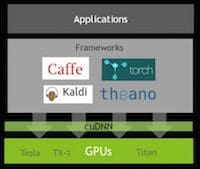
There is no doubt that GPU accelerates deep learning researches these days. News about GPU especially Nvidia Cuda is all over the Internet. Cuda-convnet/CuDNNsupports all the mainstream softwares such as Caffe, Torch and Theano and is very easy to enable.
Unlike the above packages, Deeplearning4j is designed to be used in business environments, rather than as a research tool. As on its introduction, DL4J is a “Java-based, industry-focused, commercially supported, distributed deep-learning framework.”
Comparison
These tools seem to be in a friendly competition of speed and ease of use.
Caffe developers say that “Caffe is the fastest convnet implementation available.”
Torch7 is proved to be faster than Theano on most benchmarks as shown inTorch7 paper.
Soumith gave his convnet benchmarks of all public open-source implementations.

A comparison table of some popular deep learning tools is listed in the Caffe paper.
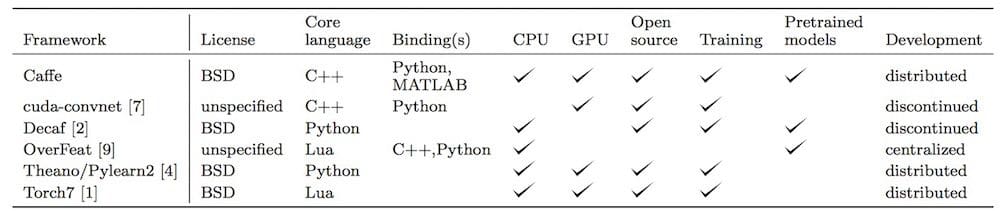
There is a thread on reddit about “best framework for deep neural nets”. DL4J also gives DL4J vs. Torch vs. Theano vs. Caffe on its website.
Related:
- R leads RapidMiner, Python catches up, Big Data tools grow, Spark ignites
- Where to Learn Deep Learning – Courses, Tutorials, Software
- CuDNN – A new library for Deep Learning
What is your favorite Deep Learning package?
 Previous post
Most popular last 30 days
Most viewed last 30 days
- Top 20 Python Machine Learning Open Source Projects - Jun 1, 2015.
- R vs Python for Data Science: The Winner is ... - May 26, 2015.
- R leads RapidMiner, Python catches up, Big Data tools grow, Spark ignites - May 25, 2015.
- Top 10 Data Mining Algorithms, Explained - May 21, 2015.
- Which Big Data, Data Mining, and Data Science Tools go together? - Jun 11, 2015.
- 9 Must-Have Skills You Need to Become a Data Scientist - Nov 22, 2014.
- 7 Steps for Learning Data Mining and Data Science - Oct 10, 2013.
- Top 10 Data Analysis Tools for Business - Jun 13, 2014.
Most shared last 30 days
- Top 20 Python Machine Learning Open Source Projects - Jun 1, 2015.
- R vs Python for Data Science: The Winner is ... - May 26, 2015.
- Which Big Data, Data Mining, and Data Science Tools go together? - Jun 11, 2015.
- R leads RapidMiner, Python catches up, Big Data tools grow, Spark ignites - May 25, 2015.
- Popular Deep Learning Tools - a review - Jun 18, 2015.
- 150 Most Influential People in Big Data & Hadoop - May 27, 2015.
- Exclusive Interview: Matei Zaharia, creator of Apache Spark, on Spark, Hadoop, Flink, and Big Data in 2020 - May 22, 2015.
- 21 Essential Data Visualization Tools - May 28, 2015.
Popular Deep Learning Tools – a review的更多相关文章
- What are some good books/papers for learning deep learning?
What's the most effective way to get started with deep learning? 29 Answers Yoshua Bengio, ...
- (转) Learning Deep Learning with Keras
Learning Deep Learning with Keras Piotr Migdał - blog Projects Articles Publications Resume About Ph ...
- 如何选择分类器?LR、SVM、Ensemble、Deep learning
转自:https://www.quora.com/What-are-the-advantages-of-different-classification-algorithms There are a ...
- 【CS-4476-project 6】Deep Learning
AlexNet / VGG-F network visualized by mNeuron. Project 6: Deep LearningIntroduction to Computer Visi ...
- Review of Semantic Segmentation with Deep Learning
In this post, I review the literature on semantic segmentation. Most research on semantic segmentati ...
- (转) Deep Learning Research Review Week 2: Reinforcement Learning
Deep Learning Research Review Week 2: Reinforcement Learning 转载自: https://adeshpande3.github.io/ad ...
- (转)Deep Learning Research Review Week 1: Generative Adversarial Nets
Adit Deshpande CS Undergrad at UCLA ('19) Blog About Resume Deep Learning Research Review Week 1: Ge ...
- 论文笔记:A Review on Deep Learning Techniques Applied to Semantic Segmentation
A Review on Deep Learning Techniques Applied to Semantic Segmentation 2018-02-22 10:38:12 1. Intr ...
- Deep learning for visual understanding: A review 视觉理解中的深度学习:回顾 之一
Deep learning for visual understanding: A review 视觉理解中的深度学习:回顾 ABSTRACT: Deep learning algorithms ar ...
随机推荐
- 学习NodeJS第一天:node.js引言
Node.JS 是资深 C 程序猿 Ryan Dahl(http://four.livejournal.com/)的作品,根据 Google 著名的开源 JavaScript 引擎 V8 来进行二次开 ...
- myeclipse一些技巧
ctrl+h-----------------查找字符串 ctrl+A 全选→ctrl+shift+f 代码格式化,排版 ctrl+shift+O 自动引用
- 浏览器中JavaScript执行原理
本章我们讨论javascript在浏览器中是如果工作的,包括:下载.解析.执行的全过程.javascript的这些讨人嫌的地方我们是知道的: i.需要串行下载 ii.需要解析 iii.需要串行执行 而 ...
- react native mac install
Mac上使用react native tips: 1. 安装Homebrew ruby -e "$(curl -fsSL https://raw.githubusercontent.com/ ...
- order by 自定义排序
使用order by排序,有时候不是根据字符或数字顺序,而是根据实际要求排序. 例如有客户A,B,C,我希望排序结果是B,C,A,那么就要通过自定义的规则排序. 第一种方法,可以构造一张映射表,将客户 ...
- lucene 抛出的异常(分享)
1) too many boolean clauses异常 例如: String keyword=".......";//(keyword的长度太长) Query indexQue ...
- fiddler了解
常常听到有人会所抓包什么的,自己电脑上有一段fiddler软件,但是一直没有使用,因为不了解.今天终于看视频,看博客,大致了解了fiddler这个软件,看着是非常强大啊.那么fiddler到底是什么, ...
- Java-Hibernate官方英文文档地址
Hibernate官方英文文档地址 http://docs.jboss.org/hibernate/orm/4.3/manual/en-US/html/
- clientX 属性.
Syntax: event.clientX The clientX event attribute returns the horizontal coordinate (according to th ...
- JS计算指定日期是距今的第几周,星期几
无意中在百度知道上发现这样一个问题,就抽时间见写了一个函数. 首先我们需要明确,既然是指定日期距今的第几周,那么就要知道指定的日期是什么,而且是不能确定的,会根据使用者不同而得到不同的日期,所以我们需 ...