
A beginner’s guide to Cache synchronization strategies--转载
原文地址:http://vladmihalcea.com/2015/04/20/a-beginners-guide-to-cache-synchronization-strategies/
Introduction
A system of record is the authoritative data source when information is scattered among various data providers. When we introduce a caching solution, we automatically duplicate our data. To avoid inconsistent reads and data integrity issues, it’s very important to synchronize the database and the cache (whenever a change occurs into the system).
There are various ways to keep the cache and the underlying database in sync and this article will present some of the most common cache synchronization strategies.
Cache-aside
The application code can manually manage both the database and the cache information. The application logic inspects the cache before hitting the database and it updates the cache after any database modification.
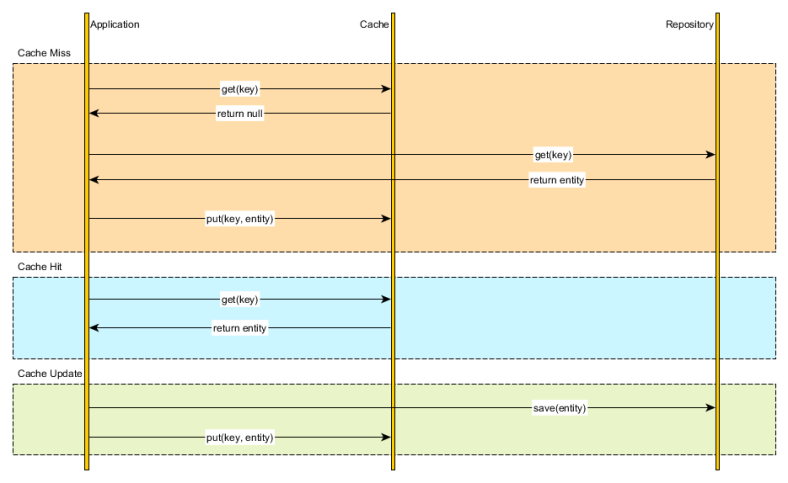
Mixing caching management and application is not very appealing, especially if we have to repeat these steps in every data retrieval method. Leveraging an Aspect-Oriented caching interceptor can mitigate the cache leaking into the application code, but it doesn’t exonerate us from making sure that both the database and the cache are properly synchronized.
Read-through
Instead of managing both the database and the cache, we can simply delegate the database synchronization to the cache provider. All data interactions is therefore done through the cache abstraction layer.
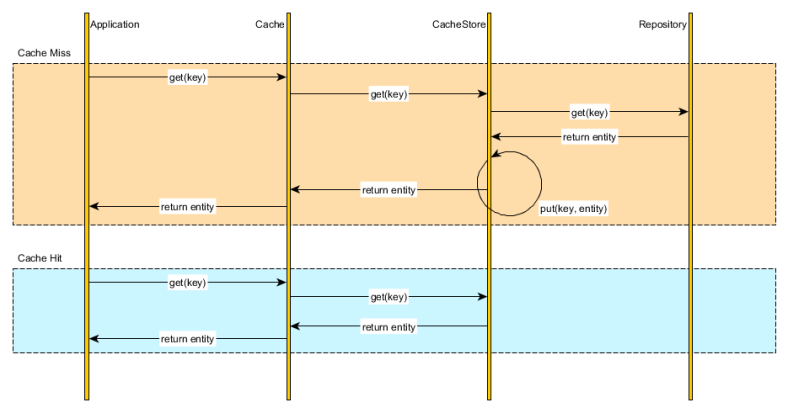
Upon fetching a cache entry, the Cache verifies the cached element availability and loads the underlying resource on our behalf. The application uses the cache as thesystem of record and the cache is able to auto-populate on demand.
Write-through
Analogous to the read-through data fetching strategy, the cache can update the underlying database every time a cache entry is changed.
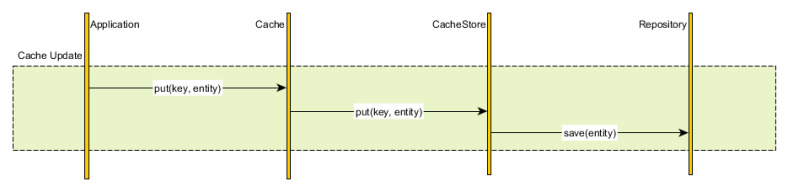
Although the database and the cache are updated synchronously, we have the liberty of choosing the transaction boundaries according to our current business requirements.
- If strong consistency is mandatory and the cache provider offers an XAResource we can then enlist the cache and the database in the same global transaction. The database and the cache are therefore updated in a single atomic unit-of-work
- If consistency can be weaken, we can update the cache and the database sequentially, without using a global transaction. Usually the cache is changed first and if the database update fails, the cache can use a compensating action to roll-back the current transaction changes
Write-behind
If strong consistency is not mandated, we can simply enqueue the cache changes and periodically flush them to the database.
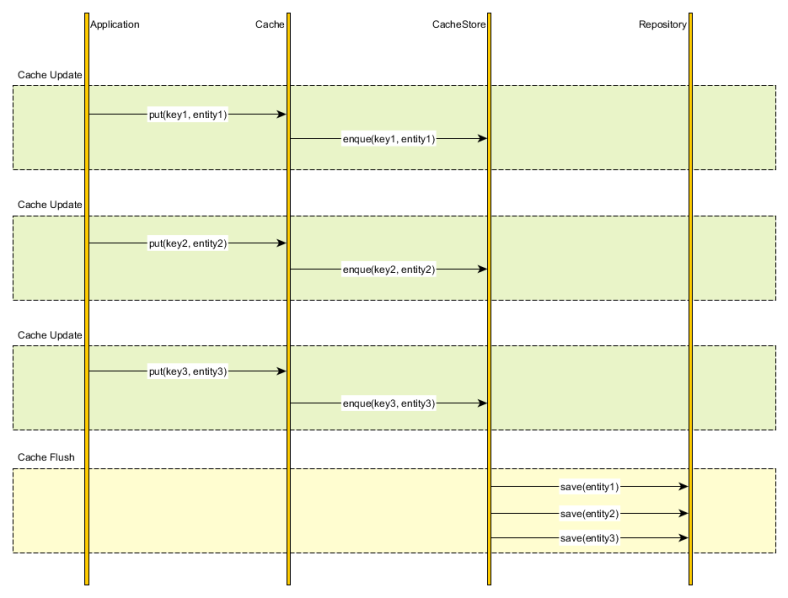
This strategy is employed by the Java PersistenceEntityManager (first-level cache), all entity state transitions being flushed towards the end of the current running transaction (or when a query is issued).
Although it breaks transaction guarantees, the write-behind caching strategy can outperform the write-through policy, because database updates can be batched and the number of DML transactions is also reduced.
A beginner’s guide to Cache synchronization strategies--转载的更多相关文章
- Photography theory: a beginner's guide(telegraph.co.uk)
By Diane Smyth, Tim Clark, Rachel Segal Hamilton and Lewis Bush 11:00AM BST 09 Jun 2014 Have you r ...
- A Beginner's Guide to Paxos
Google Drive: A Beginner's Guide to Paxos The code ideas of Paxos protocol: 1) Optimistic concurrenc ...
- Beginner's Guide to Python-新手指导
Refer English Version: http://wiki.python.org/moin/BeginnersGuide New to programming? Python is free ...
- A Beginner's Guide To Understanding Convolutional Neural Networks(转)
A Beginner's Guide To Understanding Convolutional Neural Networks Introduction Convolutional neural ...
- (转)A Beginner's Guide To Understanding Convolutional Neural Networks Part 2
Adit Deshpande CS Undergrad at UCLA ('19) Blog About A Beginner's Guide To Understanding Convolution ...
- (转)A Beginner's Guide To Understanding Convolutional Neural Networks
Adit Deshpande CS Undergrad at UCLA ('19) Blog About A Beginner's Guide To Understanding Convolution ...
- 新手教程之:循环网络和LSTM指南 (A Beginner’s Guide to Recurrent Networks and LSTMs)
新手教程之:循环网络和LSTM指南 (A Beginner’s Guide to Recurrent Networks and LSTMs) 本文翻译自:http://deeplearning4j.o ...
- A Beginner’s Guide to Eigenvectors, PCA, Covariance and Entropy
A Beginner’s Guide to Eigenvectors, PCA, Covariance and Entropy Content: Linear Transformations Prin ...
- A Beginner’s Guide to the OUTPUT Clause in SQL Server
原文 A Beginner’s Guide to the OUTPUT Clause in SQL Server T-SQL supports the OUTPUT clause after the ...
随机推荐
- 通过库函数API和C代码中嵌入汇编代码剖析系统调用的工作机制
作者:吴乐 山东师范大学<Linux内核分析>MOOC课程http://mooc.study.163.com/course/USTC-1000029000 本次实验的主要内容就是分别采用A ...
- codeforce 702C Cellular Network 二分答案
http://codeforces.com/contest/702 题意:n个村庄,m个机站,问机站最短半径覆盖完所有村庄 思路:直接二分答案 二分太弱,调了半天..... // #pragma co ...
- Unity3D-美术相关
1.导入动画 (1)使用预分解的动画模型,导入后面板中会含有一个可用的动画片段列表. (2)使用未分解的动画模型,自行添加动画片段. (3)使用多个动画文件,模型与动画分离.对于goober.fbx模 ...
- AS3 条件编译
转:http://www.lite3.cn/blog/?p=404&cpage=1 知道C/C++ 有条件编译,一直想着AS要是也有条件编译就好了,今天搜了半天Google,终于让我找到了 下 ...
- JAVA基础----java中E,T,?的区别
遇到<A>,<B>,<K,V>等,是用到了java中的泛型. 一般使用<T>来声明类型持有者名称,自定义泛型类时,类持有者名称可以使用T(Type) 如 ...
- 无线 WIFI 的13个信道频率范围
目前主流的无线WIFI网络设备不管是802.11b/g还是802.11b/g/n 一般都支持13个信道.它们的中心频率虽然不同,但是因为都占据一定的频率范围,所以会有一些相互重叠的情况.下面是13个信 ...
- Layout No collapsible
center 不可折叠 其它的,没有 title 没法折叠 title 使用子控件的
- 第二百四十一天 how can I 坚持
今天去了趟小米之家,红米note3感觉还好吧.小米,希望不会令人失望啊,很看好的,应该不算是米粉吧. 腾讯课堂. hadoop. 摄影. 没有真正的兴趣啊,一心只想着玩,什么事真正的兴趣,就是无时无刻 ...
- Linux下文件的权限
一.Linux下查看文件属性 命令为: [root@localhost ~]# ls -al 结果: ls是『list』的意思,重点在显示文件的文件名与相关属性.而选项『-al』则表示列出所有的文件详 ...
- Struts2的运行流程以及关键拦截器介绍
Struts2的运行流程 1.ActionProxy是Action的一个代理类,也就是说Action的调用是通过ActionProxy实现的,其实就是调用了ActionProxy.execute()方 ...