
poj 1696(极角排序)
| Time Limit: 1000MS | Memory Limit: 10000K | |
| Total Submissions: 3924 | Accepted: 2457 |
Description
- It can not turn right due to its special body structure.
- It leaves a red path while walking.
- It hates to pass over a previously red colored path, and never does that.
The pictures transmitted by the Discovery space ship depicts that
plants in the Y1999 grow in special points on the planet. Analysis of
several thousands of the pictures have resulted in discovering a magic
coordinate system governing the grow points of the plants. In this
coordinate system with x and y axes, no two plants share the same x or y.
An M11 needs to eat exactly one plant in each day to stay alive.
When it eats one plant, it remains there for the rest of the day with no
move. Next day, it looks for another plant to go there and eat it. If
it can not reach any other plant it dies by the end of the day. Notice
that it can reach a plant in any distance.
The problem is to find a path for an M11 to let it live longest.
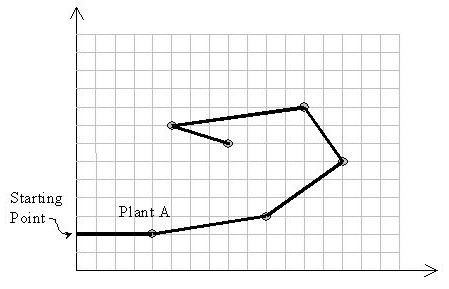
Input is a set of (x, y) coordinates of plants. Suppose A with the
coordinates (xA, yA) is the plant with the least y-coordinate. M11
starts from point (0,yA) heading towards plant A. Notice that the
solution path should not cross itself and all of the turns should be
counter-clockwise. Also note that the solution may visit more than two
plants located on a same straight line.
Input
first line of the input is M, the number of test cases to be solved (1
<= M <= 10). For each test case, the first line is N, the number
of plants in that test case (1 <= N <= 50), followed by N lines
for each plant data. Each plant data consists of three integers: the
first number is the unique plant index (1..N), followed by two positive
integers x and y representing the coordinates of the plant. Plants are
sorted by the increasing order on their indices in the input file.
Suppose that the values of coordinates are at most 100.
Output
should have one separate line for the solution of each test case. A
solution is the number of plants on the solution path, followed by the
indices of visiting plants in the path in the order of their visits.
Sample Input
2

10

1 4 5

2 9 8

3 5 9

4 1 7

5 3 2

6 6 3

7 10 10

8 8 1

9 2 4

10 7 6

14

1 6 11

2 11 9

3 8 7

4 12 8

5 9 20

6 3 2

7 1 6

8 2 13

9 15 1

10 14 17

11 13 19

12 5 18

13 7 3

14 10 16
Sample Output
10 8 7 3 4 9 5 6 2 1 10

14 9 10 11 5 12 8 7 6 13 4 14 1 3 2


题意:一只蚂蚁走一个点集,每次只能往左走。。问最长能走的路。。
题解:我开始想到死胡同了,想用Graham解。。解不出来,,然后在网上找的解法。不停地排序排序。
http://www.cnblogs.com/ACMan/archive/2012/08/17/2644644.html大概就是这个过程。。
///判断线段与矩形是否相交

#include<stdio.h>

#include<iostream>

#include<string.h>

#include<math.h>

#include<algorithm>

using namespace std;

const double eps = 1e-;

const int N = ;

struct Point

{

    int idx,x,y;

} p[N];

Point result[N];

int n,pos;

int cross(Point a,Point b,Point c)

{

    return (a.x-c.x)*(b.y-c.y)-(a.y-c.y)*(b.x-c.x);

}

int dis(Point a,Point b)

{

    return (a.x-b.x)*(a.x-b.x)+(a.y-b.y)*(a.y-b.y);

}

int cmp(Point a,Point b)

{

    if(cross(a,b,p[pos])>) return ;

    if(cross(a,b,p[pos])==&&dis(b,p[pos])>dis(a,p[pos])) return ;

    return ;

}

int main()

{

    int tcase;

    scanf("%d",&tcase);

    while(tcase--)

    {

        scanf("%d",&n);

        for(int i=; i<n; i++)

        {

            scanf("%d%d%d",&p[i].idx,&p[i].x,&p[i].y);

            if( p[i].y < p[].y || (p[i].y == p[].y && p[i].x < p[].x) )

                swap(p[],p[i]);

        }

        pos = ;

        int j = ;

        sort(p+,p+n,cmp);

        result[j++] = p[pos++];

        for (int i = ; i < n; i++)

        {

            sort(p + pos, p + n, cmp);

            result[j++] = p[pos++];

        }

        result[j++] = p[pos++];

        printf("%d", j);

        for (int i = ; i < j; i++)

        {

            printf(" %d", result[i].idx);

        }

        printf("\n");

    }

    return ;

}
poj 1696(极角排序)的更多相关文章
- poj 1696 极角排序求最长逆时针螺旋线
Space Ant Time Limit: 1000MS Memory Limit: 10000K Total Submissions: 4970 Accepted: 3100 Descrip ...
- poj 1696 极角排序(解题报告)
#include<iostream> #include<cmath> #include<algorithm> using namespace std; double ...
- Scrambled Polygon POJ - 2007 极角排序
题意: 给你n个点,这n个点可以构成一个多边形(但是不是按顺序给你的).原点(0,0)为起点,让你按顺序逆序输出所有点 题解: 就是凸包问题的极角排序 用double一直Wa,改了int就可以了 // ...
- POJ - 2007 极角排序(Java 实现)
POJ 2007 将所有的点按逆时针输出 import java.io.*; import java.util.*; public class Main { static class Point im ...
- Space Ant--poj1696(极角排序)
http://poj.org/problem?id=1696 极角排序是就是字面上的意思 按照极角排序 题目大意:平面上有n个点然后有一只蚂蚁他只能沿着点向左走 求最多能做多少点 分析: 其实 ...
- poj 1696 Space Ant (极角排序)
链接:http://poj.org/problem?id=1696 Space Ant Time Limit: 1000MS Memory Limit: 10000K Total Submissi ...
- POJ 1696 Space Ant 【极角排序】
题意:平面上有n个点,一只蚂蚁从最左下角的点出发,只能往逆时针方向走,走过的路线不能交叉,问最多能经过多少个点. 思路:每次都尽量往最外边走,每选取一个点后对剩余的点进行极角排序.(n个点必定能走完, ...
- POJ 1696 Space Ant(极角排序)
Space Ant Time Limit: 1000MS Memory Limit: 10000K Total Submissions: 2489 Accepted: 1567 Descrip ...
- poj 1696:Space Ant(计算几何,凸包变种,极角排序)
Space Ant Time Limit: 1000MS Memory Limit: 10000K Total Submissions: 2876 Accepted: 1839 Descrip ...
随机推荐
- NHibernate3.3.3 学习笔记1
前言 昨天在园友的介绍下,我找了一本学习NHibernate的书:<NHibernate 3 Beginner’s Guide>. 第一章我直接跳过了,因为是英文版的看起来很吃力,且第一章 ...
- C++中getline()函数简介
有时我们希望能在最终得到的字符中保留输入时的空白符,这时应该用getline()函数代替原来的>>运算符. 下面是使用getline读取一整行的示例代码: #include<iost ...
- Java中输入输出流
InputStream:所有字节输入流的所有类的超类. read(byte[] b)从输入流中读取一定数量的字节,并将其存储在缓冲数组b中 reset()将此流重新定位到最后一次对此流调用mark方法 ...
- hibernate笔记(三)
目标: 第1部分: 对象的状态: 第2部分:缓存 1) 一级缓存 2) 相关知识 ----懒加载--- 第3部分:映射 一对一映射 组件映射 继承映射 一.对象的状态 举例: User user ...
- Java学习全攻略-->阅读官方文档
一直感觉Java的官方文档有些杂乱,最近特意整理了一下,仅供参考. 入口 Oracle官方文档入口:http://docs.oracle.com/.下级页面这边只整理了JavaEE跟JavaSE的文档 ...
- HDFS集群和YARN集群
Hadoop集群环境搭建(一) 1集群简介 HADOOP集群具体来说包含两个集群:HDFS集群和YARN集群,两者逻辑上分离,但物理上常在一起 HDFS集群: 负责海量数据的存储,集群中的角色主要 ...
- sessionStorage的用法总结
sessionStorage用于本地存储一个会话(session)中的数据,这些数据只有在同一个会话中的页面才能访问并且当会话结束后数据也随之销毁.因此sessionStorage不是一种持久化的本地 ...
- BZOJ 4777 Usaco2017 Open Switch Grass Kruskal+替罪羊树+权值线段树
这道题首先可以看出答案一定是一条边,而且答案一定在最小生成树上,那么我们就可以在这个最小生成树上维护他与异色儿子的边最小值,所以我们就可以已通过Kruskal和一棵平衡树来解决,时间复杂度是O(n*l ...
- 谈一谈深度学习之semantic Segmentation
上一次发博客已经是9月份的事了....这段时间公司的事实在是多,有写博客的时间都拿去看paper了..正好春节回来写点东西,也正好对这段时间做一个总结. 首先当然还是好好说点这段时间的主要工作:语义分 ...
- Codeforces Round #520 (Div. 2) D. Fun with Integers
D. Fun with Integers 题目链接:https://codeforc.es/contest/1062/problem/D 题意: 给定一个n,对于任意2<=|a|,|b|< ...