
poj 1696 Space Ant (极角排序)
| Time Limit: 1000MS | Memory Limit: 10000K | |
| Total Submissions: 3077 | Accepted: 1965 |
Description
- It can not turn right due to its special body structure.
- It leaves a red path while walking.
- It hates to pass over a previously red colored path, and never does that.
The pictures transmitted by the Discovery space ship depicts that plants in the Y1999 grow in special points on the planet. Analysis of several thousands of the pictures have resulted in discovering a magic coordinate system governing the grow points of the plants. In this coordinate system with x and y axes, no two plants share the same x or y.
An M11 needs to eat exactly one plant in each day to stay alive. When it eats one plant, it remains there for the rest of the day with no move. Next day, it looks for another plant to go there and eat it. If it can not reach any other plant it dies by the end of the day. Notice that it can reach a plant in any distance.
The problem is to find a path for an M11 to let it live longest.
Input is a set of (x, y) coordinates of plants. Suppose A with the coordinates (xA, yA) is the plant with the least y-coordinate. M11 starts from point (0,yA) heading towards plant A. Notice that the solution path should not cross itself and all of the turns should be counter-clockwise. Also note that the solution may visit more than two plants located on a same straight line. 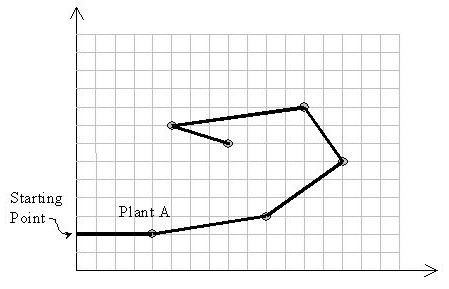
Input
Output
Sample Input
2

10

1 4 5

2 9 8

3 5 9

4 1 7

5 3 2

6 6 3

7 10 10

8 8 1

9 2 4

10 7 6

14

1 6 11

2 11 9

3 8 7

4 12 8

5 9 20

6 3 2

7 1 6

8 2 13

9 15 1

10 14 17

11 13 19

12 5 18

13 7 3

14 10 16
Sample Output
10 8 7 3 4 9 5 6 2 1 10

14 9 10 11 5 12 8 7 6 13 4 14 1 3 2
Source
=======================================================================
好题,一开始没看懂测试样例,谁知道第一个是走过的路的数目,只要按极角排序后,所有点无疑都会走过一遍
然后就一直更新极角最小的那个,输出,并再次赋值
#include <stdio.h>

#include <string.h>

#include <stdlib.h>

#include <iostream>

#include <algorithm>

#include <math.h>

using namespace std;

typedef struct

{

    int x,y,num;

}point;

point tmp;

int crossProduct(point a,point b,point c)

{

    return (c.x-a.x)*(b.y-a.y)-(c.y-a.y)*(b.x-a.x);

}

bool cmp1(point a,point b)

{

    return a.y<b.y;

}

int dist(point a,point b)

{

    return sqrt((double)(a.x-b.x)*(a.x-b.x)+(double)(a.y-b.y)*(a.y-b.y));

}

bool cmp2(point a,point b)

{

    int len=crossProduct(tmp,a,b);

    if(len == )

    {

        return dist(tmp,a)<dist(tmp,b);

    }

    return len<;

}

point stk[];

int main()

{

    int n,m,i,j,k,t;

    scanf("%d",&n);

    while(n--)

    {

        scanf("%d",&m);

        for(i=;i<m;i++)

        {

            scanf("%d%d%d",&stk[i].num,&stk[i].x,&stk[i].y);

        }

        sort(stk,stk+m,cmp1);

        printf("%d %d ",m,stk[].num);

        tmp=stk[];

        for(i=;i<m;i++)

        {

            sort(stk+i,stk+m,cmp2);

            printf("%d ",stk[i].num);

            tmp=stk[i];

        }

        printf("\n");

    }

    return ;

}
poj 1696 Space Ant (极角排序)的更多相关文章
- poj 1696 Space Ant 极角排序
#include<cstdio> #include<cstring> #include<cmath> #include<iostream> #inclu ...
- POJ 1696 Space Ant 极角排序(叉积的应用)
题目大意:给出n个点的编号和坐标,按逆时针方向连接着n个点,按连接的先后顺序输出每个点的编号. 题目思路:Cross(a,b)表示a,b的叉积,若小于0:a在b的逆时针方向,若大于0a在b的顺时针方向 ...
- POJ 1696 Space Ant(极角排序)
Space Ant Time Limit: 1000MS Memory Limit: 10000K Total Submissions: 2489 Accepted: 1567 Descrip ...
- poj 1696:Space Ant(计算几何,凸包变种,极角排序)
Space Ant Time Limit: 1000MS Memory Limit: 10000K Total Submissions: 2876 Accepted: 1839 Descrip ...
- POJ 1696 Space Ant 【极角排序】
题意:平面上有n个点,一只蚂蚁从最左下角的点出发,只能往逆时针方向走,走过的路线不能交叉,问最多能经过多少个点. 思路:每次都尽量往最外边走,每选取一个点后对剩余的点进行极角排序.(n个点必定能走完, ...
- 2018.07.04 POJ 1696 Space Ant(凸包卷包裹)
Space Ant Time Limit: 1000MS Memory Limit: 10000K Description The most exciting space discovery occu ...
- POJ 1696 Space Ant 卷包裹法
Space Ant Time Limit: 1000MS Memory Limit: 10000K Total Submissions: 3316 Accepted: 2118 Descrip ...
- POJ 1696 Space Ant(点积的应用)
Space Ant 大意:有一仅仅蚂蚁,每次都仅仅向当前方向的左边走,问蚂蚁走遍全部的点的顺序输出.開始的点是纵坐标最小的那个点,開始的方向是開始点的x轴正方向. 思路:从開始点開始,每次找剩下的点中 ...
- poj 1696 Space Ant(模拟+叉积)
Space Ant Time Limit: 1000MS Memory Limit: 10000K Total Submissions: 3840 Accepted: 2397 Descrip ...
随机推荐
- html5 canvas 笔记一(基本用法与绘制图形)
<canvas> 元素 <canvas id="tutorial" width="150" height="150"> ...
- du -sh
评估文件空间利用率: [root@vm-xiluhua][/home]$ du -sh /home 409M /home --exclude选项,排除指定模式的文件的大小 [root@vm-xiluh ...
- 完整学习git二 git 暂存区
1 git log 命令查看提交日志信息 git log --pretty-fuller #详细查看 git log --stat #查看每次提交的文件变更 git log --pretty-onli ...
- jquery 操作select 语句大全
jquery select操作大全 添加option $("#ID option").each(function(){ ){ $(this).remove(); } }); ...
- 减少C++代码编译时间的方法
c++ 的代码包含头文件和实现文件两部分, 头文件一般是提供给别人(也叫客户)使用的, 但是一旦头文件发生改变,不管多小的变化,所有引用他的文件就必须重新编译,编译就要花时间,假如你做的工程比较大(比 ...
- c#省市联动
using System; using System.Collections.Generic; using System.ComponentModel; using System.Data; usin ...
- bootstrap弹出层效果
<!DOCTYPE html> <html> <head> <meta http-equiv="Content-type" content ...
- Is It A Tree?(并查集)
Is It A Tree? Time Limit: 1000MS Memory Limit: 10000K Total Submissions: 26002 Accepted: 8879 De ...
- 第十二届浙江省大学生程序设计大赛-Demacia of the Ancients 分类: 比赛 2015-06-26 14:39 30人阅读 评论(0) 收藏
Demacia of the Ancients Time Limit: 2 Seconds Memory Limit: 65536 KB There is a popular multiplayer ...
- LAMMP架构的企业级应用
LAMMP架构的企业级应用 ========================================= LAMMP是什么 LAMMP的实现 LAMMP适用的生产环境 ============= ...