
吴裕雄--天生自然 R语言开发学习:回归(续三)


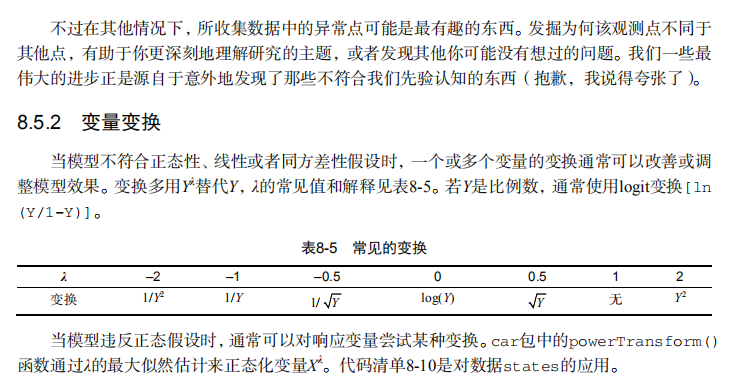
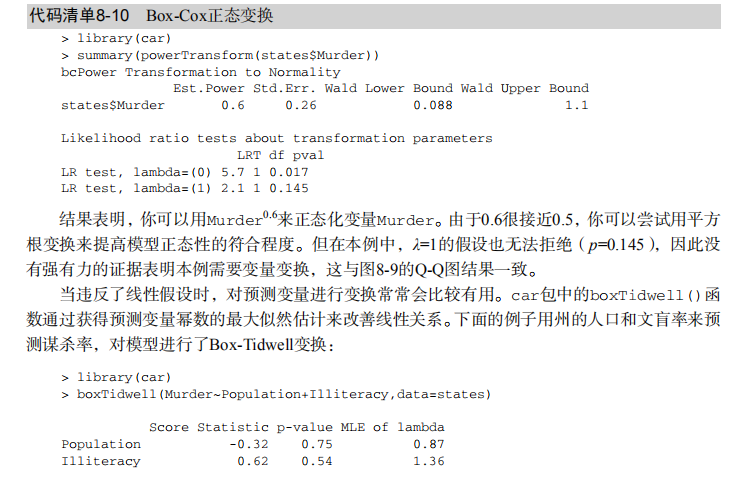

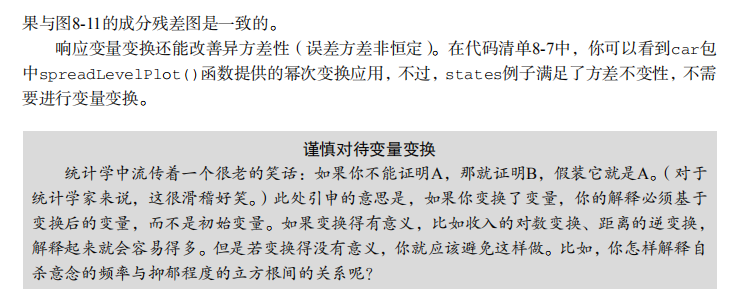
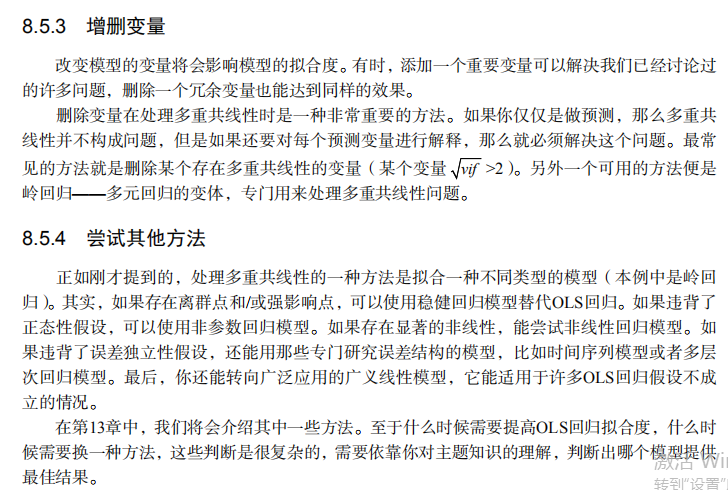

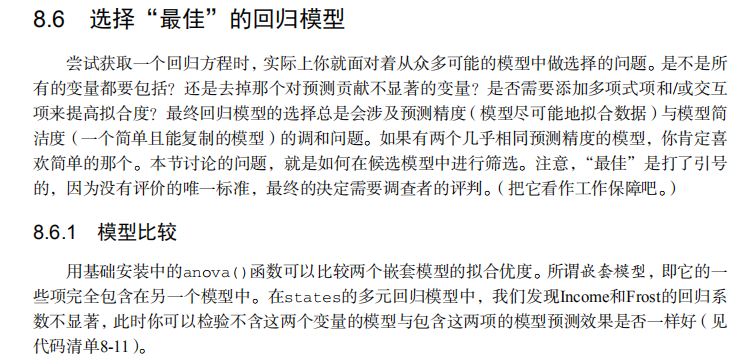


#------------------------------------------------------------#

# R in Action (2nd ed): Chapter 8                            #

# Regression                                                 #

# requires packages car, gvlma, MASS, leaps to be installed  #

# install.packages(c("car", "gvlma", "MASS", "leaps"))       #

#------------------------------------------------------------#

par(ask=TRUE)

opar <- par(no.readonly=TRUE)

# Listing 8.1 - Simple linear regression

fit <- lm(weight ~ height, data=women)

summary(fit)

women$weight

fitted(fit)

residuals(fit)

plot(women$height,women$weight,

     main="Women Age 30-39",

     xlab="Height (in inches)",

     ylab="Weight (in pounds)")

# add the line of best fit

abline(fit)

# Listing 8.2 - Polynomial regression

fit2 <- lm(weight ~ height + I(height^2), data=women)

summary(fit2)

plot(women$height,women$weight,

     main="Women Age 30-39",

     xlab="Height (in inches)",

     ylab="Weight (in lbs)")

lines(women$height,fitted(fit2))

# Enhanced scatterplot for women data

library(car)

library(car)

scatterplot(weight ~ height, data=women,

            spread=FALSE, smoother.args=list(lty=2), pch=19,

            main="Women Age 30-39",

            xlab="Height (inches)",

            ylab="Weight (lbs.)")

# Listing 8.3 - Examining bivariate relationships

states <- as.data.frame(state.x77[,c("Murder", "Population",

                                     "Illiteracy", "Income", "Frost")])

cor(states)

library(car)

scatterplotMatrix(states, spread=FALSE, smoother.args=list(lty=2),

                  main="Scatter Plot Matrix")

# Listing 8.4 - Multiple linear regression

states <- as.data.frame(state.x77[,c("Murder", "Population",

                                     "Illiteracy", "Income", "Frost")])

fit <- lm(Murder ~ Population + Illiteracy + Income + Frost, data=states)

summary(fit)

# Listing 8.5 - Mutiple linear regression with a significant interaction term

fit <- lm(mpg ~ hp + wt + hp:wt, data=mtcars)

summary(fit)

library(effects)

plot(effect("hp:wt", fit,, list(wt=c(2.2, 3.2, 4.2))), multiline=TRUE)

# simple regression diagnostics

fit <- lm(weight ~ height, data=women)

par(mfrow=c(2,2))

plot(fit)

newfit <- lm(weight ~ height + I(height^2), data=women)

par(opar)

par(mfrow=c(2,2))

plot(newfit)

par(opar)

# basic regression diagnostics for states data

opar <- par(no.readonly=TRUE)

fit <- lm(weight ~ height, data=women)

par(mfrow=c(2,2))

plot(fit)

par(opar)

fit2 <- lm(weight ~ height + I(height^2), data=women)

opar <- par(no.readonly=TRUE)

par(mfrow=c(2,2))

plot(fit2)

par(opar)

# Assessing normality

library(car)

states <- as.data.frame(state.x77[,c("Murder", "Population",

                                     "Illiteracy", "Income", "Frost")])

fit <- lm(Murder ~ Population + Illiteracy + Income + Frost, data=states)

qqPlot(fit, labels=row.names(states), id.method="identify",

       simulate=TRUE, main="Q-Q Plot")

# Listing 8.6 - Function for plotting studentized residuals

residplot <- function(fit, nbreaks=10) {

  z <- rstudent(fit)

  hist(z, breaks=nbreaks, freq=FALSE,

       xlab="Studentized Residual",

       main="Distribution of Errors")

  rug(jitter(z), col="brown")

  curve(dnorm(x, mean=mean(z), sd=sd(z)),

        add=TRUE, col="blue", lwd=2)

  lines(density(z)$x, density(z)$y,

        col="red", lwd=2, lty=2)

  legend("topright",

         legend = c( "Normal Curve", "Kernel Density Curve"),

         lty=1:2, col=c("blue","red"), cex=.7)

}

residplot(fit)

# Assessing linearity

library(car)

crPlots(fit)

# Listing 8.7 - Assessing homoscedasticity

library(car)

ncvTest(fit)

spreadLevelPlot(fit)

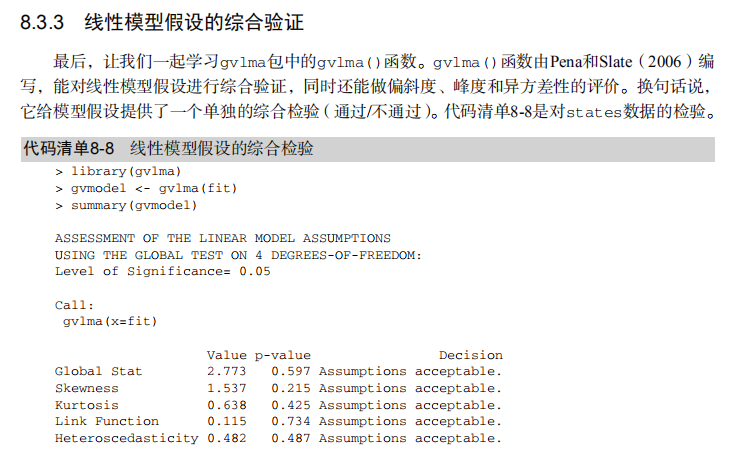
# Listing 8.8 - Global test of linear model assumptions

library(gvlma)

gvmodel <- gvlma(fit)

summary(gvmodel)

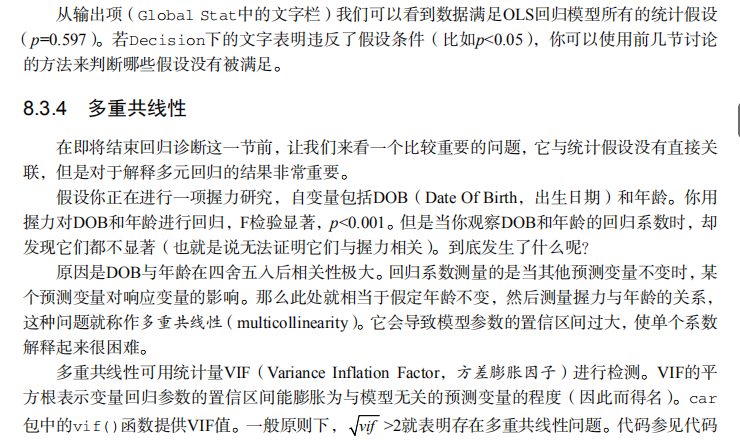
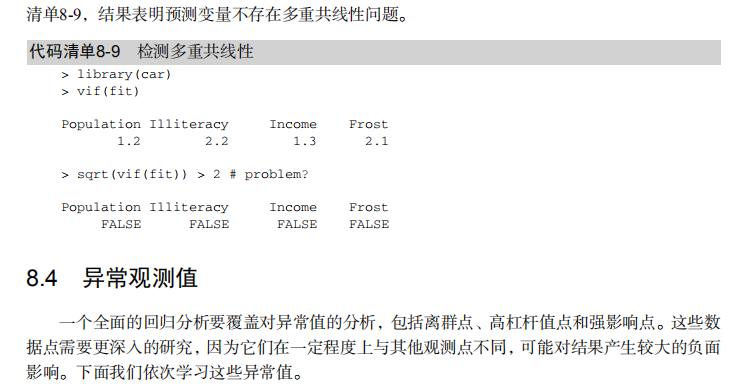
# Listing 8.9 - Evaluating multi-collinearity

library(car)

vif(fit)

sqrt(vif(fit)) > 2 # problem?

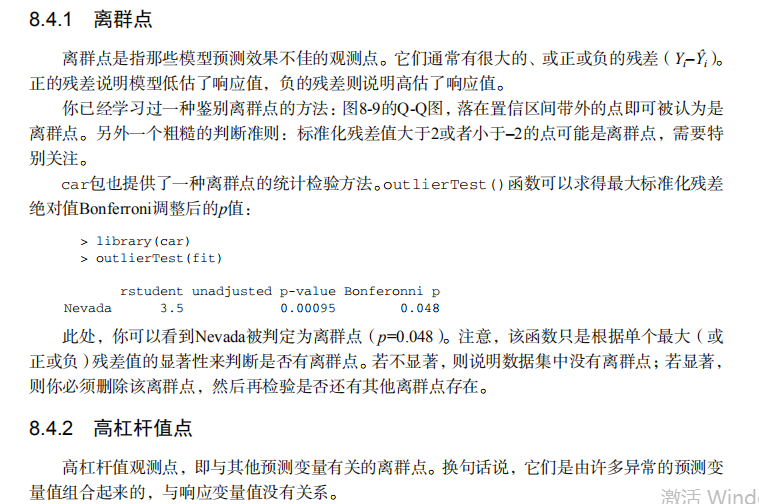
# Assessing outliers

library(car)

outlierTest(fit)

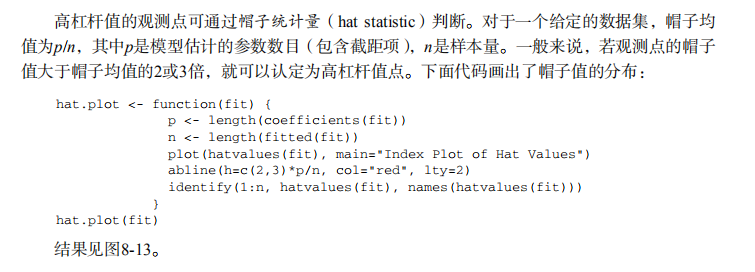
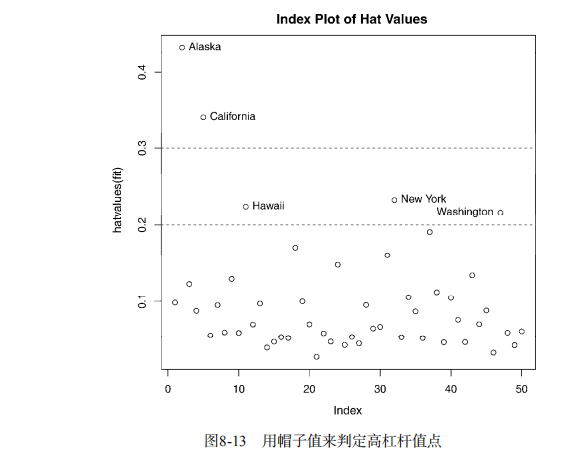
#  Identifying high leverage points

hat.plot <- function(fit) {

  p <- length(coefficients(fit))

  n <- length(fitted(fit))

  plot(hatvalues(fit), main="Index Plot of Hat Values")

  abline(h=c(2,3)*p/n, col="red", lty=2)

  identify(1:n, hatvalues(fit), names(hatvalues(fit)))

}

hat.plot(fit)

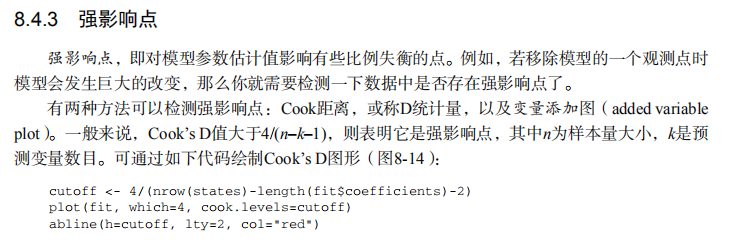
# Identifying influential observations

# Cooks Distance D

# identify D values > 4/(n-k-1)

cutoff <- 4/(nrow(states)-length(fit$coefficients)-2)

plot(fit, which=4, cook.levels=cutoff)

abline(h=cutoff, lty=2, col="red")

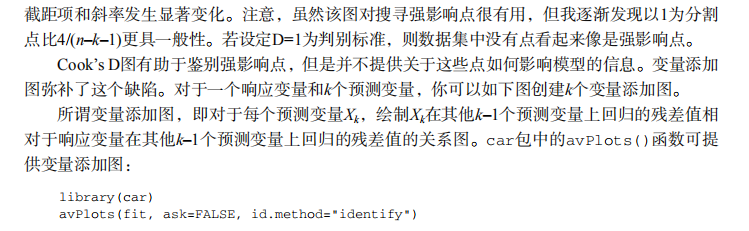
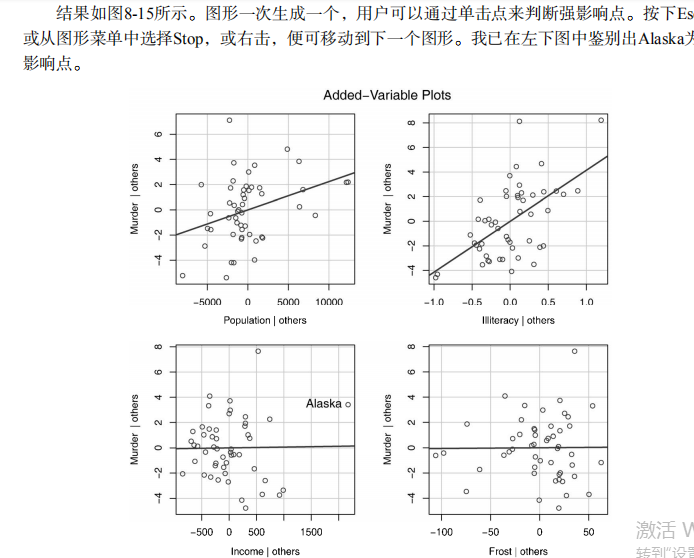
# Added variable plots

# add id.method="identify" to interactively identify points

library(car)

avPlots(fit, ask=FALSE, id.method="identify")

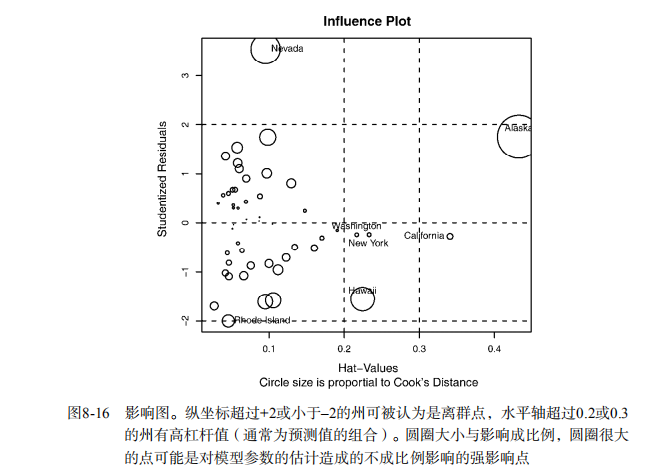
# Influence Plot

library(car)

influencePlot(fit, id.method="identify", main="Influence Plot",

              sub="Circle size is proportial to Cook's Distance" )

# Listing 8.10 - Box-Cox Transformation to normality

library(car)

summary(powerTransform(states$Murder))

# Box-Tidwell Transformations to linearity

library(car)

boxTidwell(Murder~Population+Illiteracy,data=states)

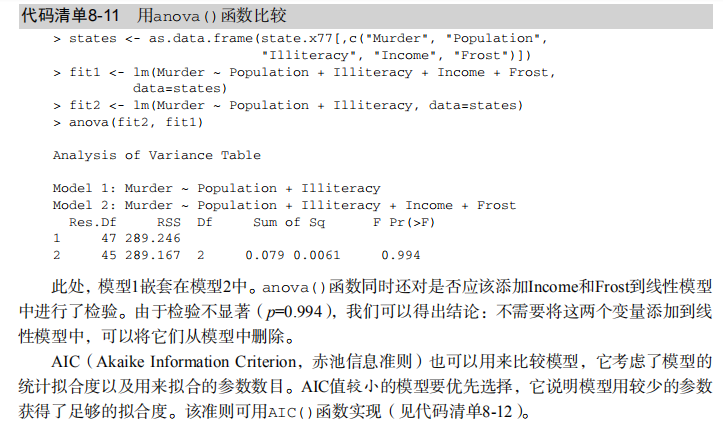
# Listing 8.11 - Comparing nested models using the anova function

states <- as.data.frame(state.x77[,c("Murder", "Population",

                                     "Illiteracy", "Income", "Frost")])

fit1 <- lm(Murder ~ Population + Illiteracy + Income + Frost,

           data=states)

fit2 <- lm(Murder ~ Population + Illiteracy, data=states)

anova(fit2, fit1)

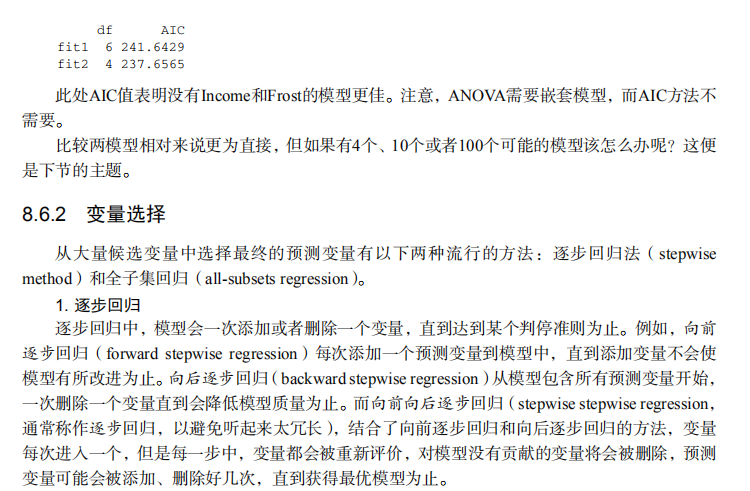
# Listing 8.12 - Comparing models with the AIC

fit1 <- lm(Murder ~ Population + Illiteracy + Income + Frost,

           data=states)

fit2 <- lm(Murder ~ Population + Illiteracy, data=states)

AIC(fit1,fit2)

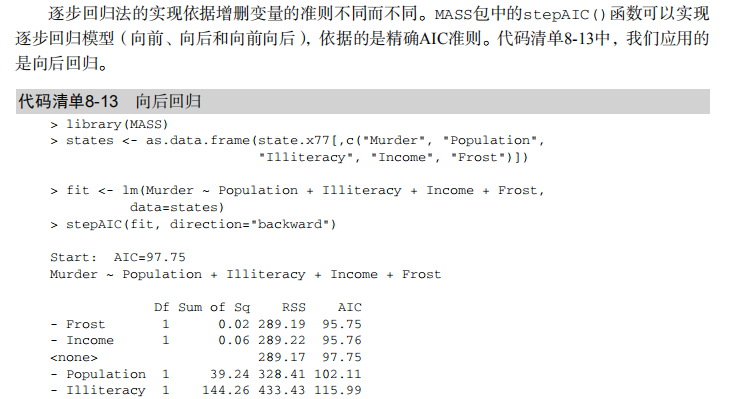
# Listing 8.13 - Backward stepwise selection

library(MASS)

states <- as.data.frame(state.x77[,c("Murder", "Population",

                                     "Illiteracy", "Income", "Frost")])

fit <- lm(Murder ~ Population + Illiteracy + Income + Frost,

          data=states)

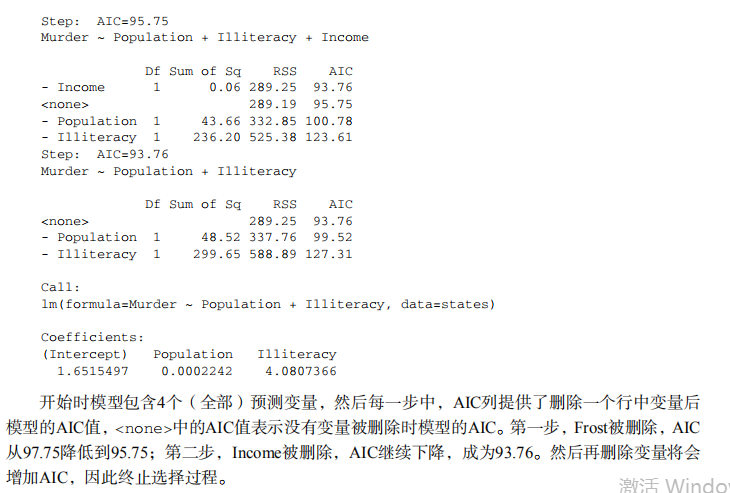
stepAIC(fit, direction="backward")

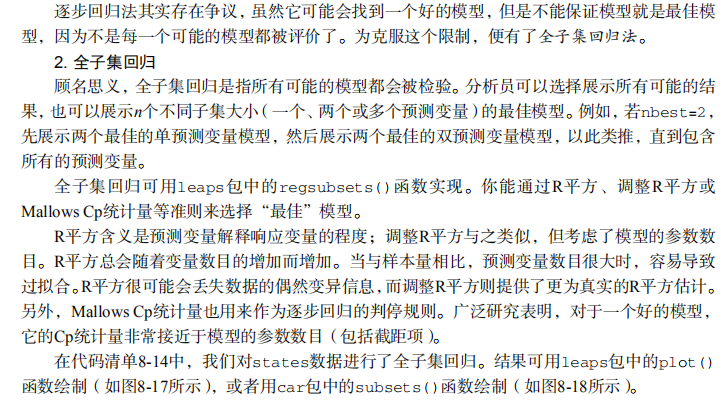
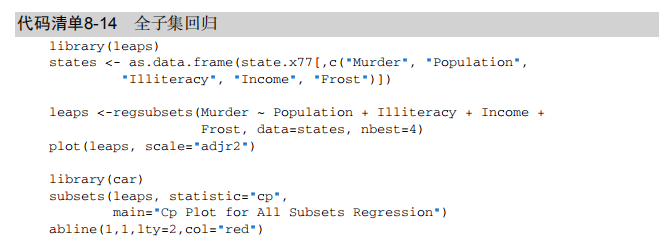
# Listing 8.14 - All subsets regression

library(leaps)

states <- as.data.frame(state.x77[,c("Murder", "Population",

                                     "Illiteracy", "Income", "Frost")])

leaps <-regsubsets(Murder ~ Population + Illiteracy + Income +

                     Frost, data=states, nbest=4)

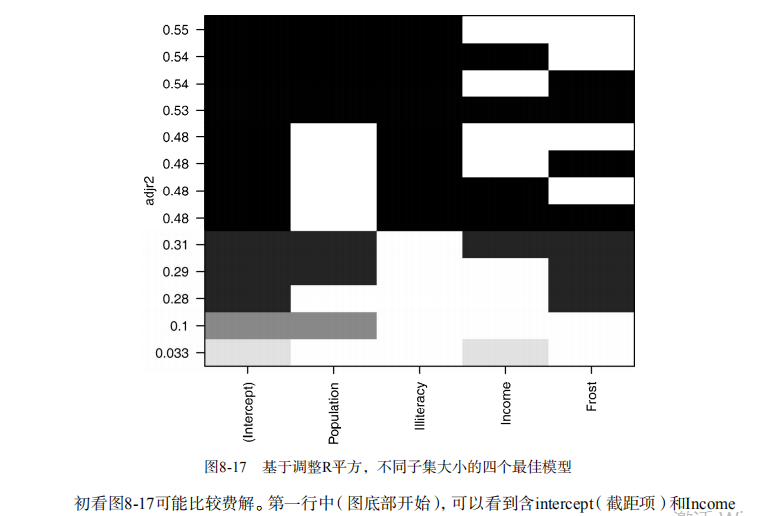
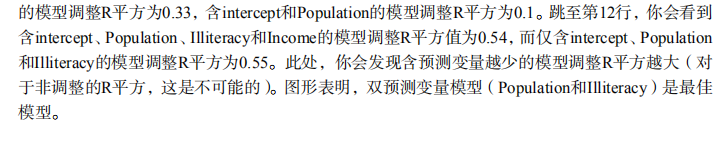
plot(leaps, scale="adjr2")

library(car)

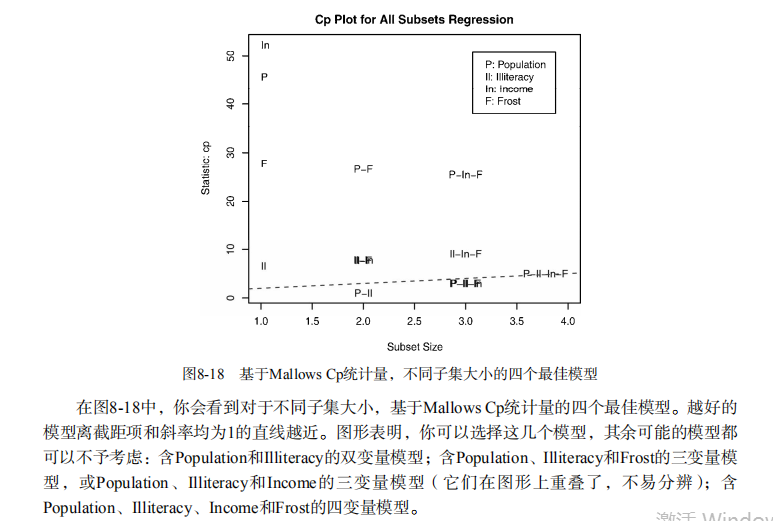
subsets(leaps, statistic="cp",

        main="Cp Plot for All Subsets Regression")

abline(1,1,lty=2,col="red")

# Listing 8.15 - Function for k-fold cross-validated R-square

shrinkage <- function(fit,k=10){

  require(bootstrap)

  # define functions

  theta.fit <- function(x,y){lsfit(x,y)}

  theta.predict <- function(fit,x){cbind(1,x)%*%fit$coef}

  # matrix of predictors

  x <- fit$model[,2:ncol(fit$model)]

  # vector of predicted values

  y <- fit$model[,1]

  results <- crossval(x,y,theta.fit,theta.predict,ngroup=k)

  r2 <- cor(y, fit$fitted.values)**2 # raw R2

  r2cv <- cor(y,results$cv.fit)**2 # cross-validated R2

  cat("Original R-square =", r2, "\n")

  cat(k, "Fold Cross-Validated R-square =", r2cv, "\n")

  cat("Change =", r2-r2cv, "\n")

}

# using it

states <- as.data.frame(state.x77[,c("Murder", "Population",

                                     "Illiteracy", "Income", "Frost")])

fit <- lm(Murder ~ Population + Income + Illiteracy + Frost, data=states)

shrinkage(fit)

fit2 <- lm(Murder~Population+Illiteracy,data=states)

shrinkage(fit2)

#  Calculating standardized regression coefficients

states <- as.data.frame(state.x77[,c("Murder", "Population",

                                     "Illiteracy", "Income", "Frost")])

zstates <- as.data.frame(scale(states))

zfit <- lm(Murder~Population + Income + Illiteracy + Frost, data=zstates)

coef(zfit)

# Listing 8.16 rlweights function for clculating relative importance of predictors

relweights <- function(fit,...){

  R <- cor(fit$model)

  nvar <- ncol(R)

  rxx <- R[2:nvar, 2:nvar]

  rxy <- R[2:nvar, 1]

  svd <- eigen(rxx)

  evec <- svd$vectors

  ev <- svd$values

  delta <- diag(sqrt(ev))

  lambda <- evec %*% delta %*% t(evec)

  lambdasq <- lambda ^ 2

  beta <- solve(lambda) %*% rxy

  rsquare <- colSums(beta ^ 2)

  rawwgt <- lambdasq %*% beta ^ 2

  import <- (rawwgt / rsquare) * 100

  import <- as.data.frame(import)

  row.names(import) <- names(fit$model[2:nvar])

  names(import) <- "Weights"

  import <- import[order(import),1, drop=FALSE]

  dotchart(import$Weights, labels=row.names(import),

           xlab="% of R-Square", pch=19,

           main="Relative Importance of Predictor Variables",

           sub=paste("Total R-Square=", round(rsquare, digits=3)),

           ...)

  return(import)

  }

  # Listing 8.17 - Applying the relweights function

  states <- as.data.frame(state.x77[,c("Murder", "Population",

                                       "Illiteracy", "Income", "Frost")])

  fit <- lm(Murder ~ Population + Illiteracy + Income + Frost, data=states)

  relweights(fit, col="blue")
吴裕雄--天生自然 R语言开发学习:回归(续三)的更多相关文章
- 吴裕雄--天生自然 R语言开发学习:R语言的安装与配置
下载R语言和开发工具RStudio安装包 先安装R
- 吴裕雄--天生自然 R语言开发学习:数据集和数据结构
数据集的概念 数据集通常是由数据构成的一个矩形数组,行表示观测,列表示变量.表2-1提供了一个假想的病例数据集. 不同的行业对于数据集的行和列叫法不同.统计学家称它们为观测(observation)和 ...
- 吴裕雄--天生自然 R语言开发学习:导入数据
2.3.6 导入 SPSS 数据 IBM SPSS数据集可以通过foreign包中的函数read.spss()导入到R中,也可以使用Hmisc 包中的spss.get()函数.函数spss.get() ...
- 吴裕雄--天生自然 R语言开发学习:使用键盘、带分隔符的文本文件输入数据
R可从键盘.文本文件.Microsoft Excel和Access.流行的统计软件.特殊格 式的文件.多种关系型数据库管理系统.专业数据库.网站和在线服务中导入数据. 使用键盘了.有两种常见的方式:用 ...
- 吴裕雄--天生自然 R语言开发学习:R语言的简单介绍和使用
假设我们正在研究生理发育问 题,并收集了10名婴儿在出生后一年内的月龄和体重数据(见表1-).我们感兴趣的是体重的分 布及体重和月龄的关系. 可以使用函数c()以向量的形式输入月龄和体重数据,此函 数 ...
- 吴裕雄--天生自然 R语言开发学习:基础知识
1.基础数据结构 1.1 向量 # 创建向量a a <- c(1,2,3) print(a) 1.2 矩阵 #创建矩阵 mymat <- matrix(c(1:10), nrow=2, n ...
- 吴裕雄--天生自然 R语言开发学习:图形初阶(续二)
# ----------------------------------------------------# # R in Action (2nd ed): Chapter 3 # # Gettin ...
- 吴裕雄--天生自然 R语言开发学习:图形初阶(续一)
# ----------------------------------------------------# # R in Action (2nd ed): Chapter 3 # # Gettin ...
- 吴裕雄--天生自然 R语言开发学习:图形初阶
# ----------------------------------------------------# # R in Action (2nd ed): Chapter 3 # # Gettin ...
- 吴裕雄--天生自然 R语言开发学习:基本图形(续二)
#---------------------------------------------------------------# # R in Action (2nd ed): Chapter 6 ...
随机推荐
- 吴裕雄--天生自然 PHP开发学习:表单 - 必需字段
<?php // 定义变量并默认设为空值 $nameErr = $emailErr = $genderErr = $websiteErr = ""; $name = $ema ...
- JS变量、作用域及内存
1.动态属性var box = new Object();box.name = 'lee';alert(box.name); var box = 'lee';box.age = '28';alert( ...
- webgis笔记
3.8(02) .特点:由服务端进行数据管理 开源的GO sever WMS/WCS/WTS 1sever/2engine/3database/4standard 扩展的空间数据库,存矢量.栅格.直接 ...
- Velocity脚本入门教程
下面资料整理自网络 一.Velocity介绍 Velocity是Apache公司的开源产品,是一套基于Java语言的模板引擎,可以很灵活的将后台数据对象与模板文件结合在一起,说的直白一点,就是允许任何 ...
- apk反编译安装工具
一.需要工具 apktool:反编译APK文件,得到classes.dex文件,同时也能获取到资源文件以及布局文件. dex2jar:将反编译后的classes.dex文件转化为.jar文件. jd- ...
- 9.windows-oracle实战第九课--plsql
一.oracle的pl/sql的概念 pl/sql是oracle在标准的sql语言上的扩展,不仅允许嵌入sql,还允许定义变量和常量,允许使用条件语句和循环语句,允许使用例外处理各种错误,这样使得它的 ...
- Android如何制作自己的依赖库上传至github供别人下载使用
Android如何制作自己的依赖库上传至github供别人下载使用 https://blog.csdn.net/xuchao_blog/article/details/62893851
- unless|until|LABEL|{}|last|next|redo| || |//|i++|++i
#!/usr/bin/perl use strict; use warnings; $_ = 'oireqo````'; unless($_ =~ /^a/m){print "no matc ...
- adaptation|domestication|genome evolution|convergent evolution|whole-genome shotgun sequencing|IHGSC
Dissecting evolution and disease using comparative vertebrate genomics-online 因为基因组不是独一无二的,同时人类基因组可以 ...
- java中多线程入门有趣介绍
我们在网上可以看到所有有关于java的线程的基本概念的很多解释,不乏有很多详细经典的解释和代码解说.但是我们的很多初学者看完不能有一个直观的印象,特别是一些没有编程基础的学习者,很多时候要花很多时间去 ...