
Linux 虚拟机扩容
由于在装软件,原来的20G空间不够使用,需要扩容操作。
1.关闭虚拟机
2.点击编辑虚拟机设置

选中硬盘,添加,硬盘,推荐,确定大小,完成。
2.启动虚拟机
查看磁盘使用情况:
[root@master ~]# df -h

Filesystem      Size  Used Avail Use% Mounted on

/dev/sda2        18G  .0G   14G  % /

tmpfs           931M   80K  931M   % /dev/shm

/dev/sda1       291M   39M  238M  % /boot

/dev/sr0        .6G  .6G      % /media/RHEL_6. x86_64 Disc
查看我们新的磁盘
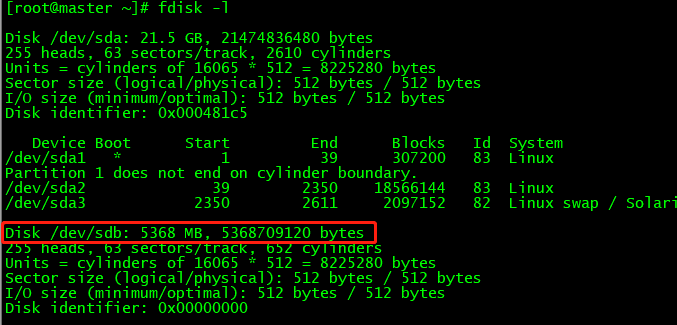
对新加的硬盘进行分区,格式化,因为我的磁盘名称是/dev/sdb,所以输入 fdisk /dev/sdb命令:
[root@master ~]# fdisk /dev/sdb
Device contains neither a valid DOS partition table, nor Sun, SGI or OSF disklabel
Building a new DOS disklabel with disk identifier 0xc2e1095b.
Changes will remain in memory only, until you decide to write them.
After that, of course, the previous content won't be recoverable.
Warning: invalid flag 0x0000 of partition table 4 will be corrected by w(rite)
WARNING: DOS-compatible mode is deprecated. It's strongly recommended to
switch off the mode (command 'c') and change display units to
sectors (command 'u').
Command (m for help): m
Command action
a toggle a bootable flag
b edit bsd disklabel
c toggle the dos compatibility flag
d delete a partition
l list known partition types
m print this menu
n add a new partition
o create a new empty DOS partition table
p print the partition table
q quit without saving changes
s create a new empty Sun disklabel
t change a partition's system id
u change display/entry units
v verify the partition table
w write table to disk and exit
x extra functionality (experts only)
Command (m for help): n
Command action
e extended
p primary partition (1-4)
p
Partition number (1-4): 1
First cylinder (1-652, default 1): 1
Last cylinder, +cylinders or +size{K,M,G} (1-652, default 652):
Using default value 652
Command (m for help): p
Disk /dev/sdb: 5368 MB, 5368709120 bytes
255 heads, 63 sectors/track, 652 cylinders
Units = cylinders of 16065 * 512 = 8225280 bytes
Sector size (logical/physical): 512 bytes / 512 bytes
I/O size (minimum/optimal): 512 bytes / 512 bytes
Disk identifier: 0xc2e1095b
Device Boot Start End Blocks Id System
/dev/sdb1 1 652 5237158+ 83 Linux
Command (m for help): w
The partition table has been altered!
Calling ioctl() to re-read partition table.
Syncing disks.
下一步,查看
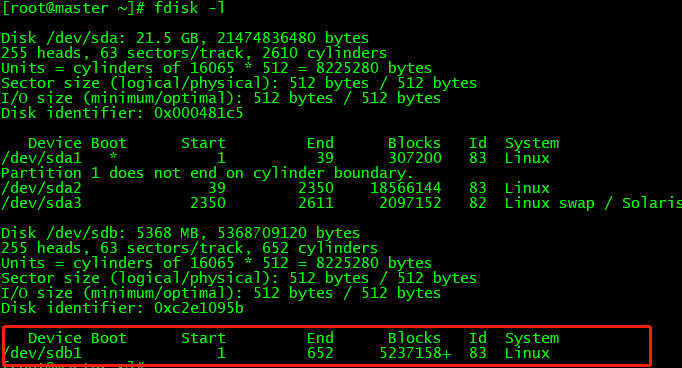
格式化:

另一种格式化:mkfs -t ext3 /dev/sdb1
[root@master ~]# cd /

[root@master /]# ls

bin   dev  home  lib64       media  opt   root  selinux  sys  usr

boot  etc  lib   lost+found  mnt    proc  sbin  srv      tmp  var

[root@master /]# mkdir exapp

[root@master /]# mount /dev/sdb1 /exapp/

[root@master /]# df -h

Filesystem      Size  Used Avail Use% Mounted on

/dev/sda2        18G  .0G   14G  % /

tmpfs           931M   72K  931M   % /dev/shm

/dev/sda1       291M   39M  238M  % /boot

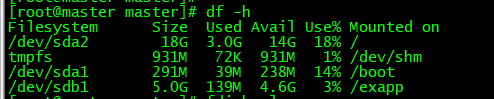
/dev/sdb1       5.0G  139M  4.6G   3% /exapp
这个是挂载上了
开机自动挂载,则修改 /etc/fstab 文件,在这个文件里面添加一行:
/dev/sdb1 /exapp ext3 defaults 0 0
然而:我想扩大 / 下的空间 ,关闭虚拟机,重新给虚拟机分配2G的空间,启动
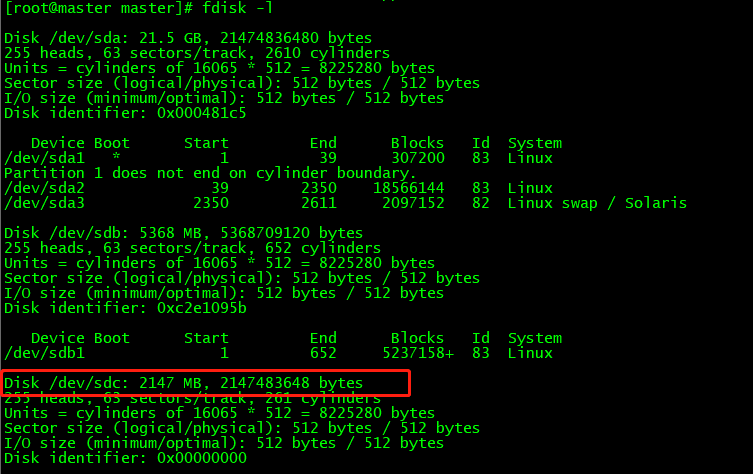
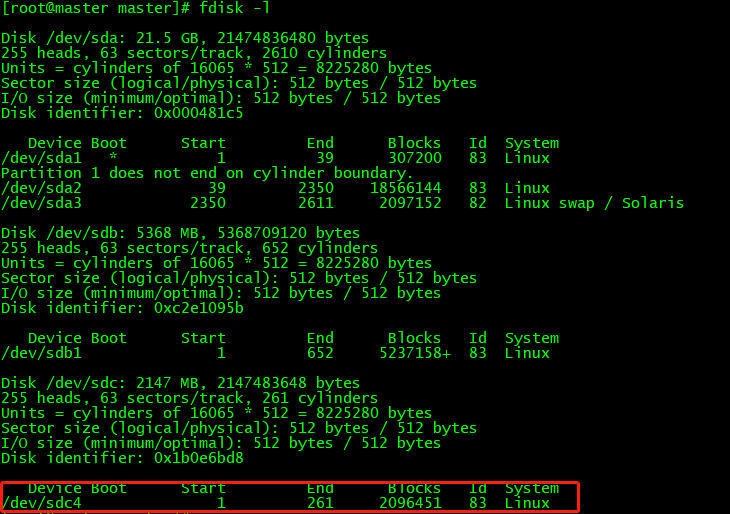
对磁盘进行分区
[root@master master]# fdisk /dev/sdc
Device contains neither a valid DOS partition table, nor Sun, SGI or OSF disklabel
Building a new DOS disklabel with disk identifier 0x1b0e6bd8.
Changes will remain in memory only, until you decide to write them.
After that, of course, the previous content won't be recoverable.
Warning: invalid flag 0x0000 of partition table 4 will be corrected by w(rite)
WARNING: DOS-compatible mode is deprecated. It's strongly recommended to
switch off the mode (command 'c') and change display units to
sectors (command 'u').
Command (m for help): m
Command action
a toggle a bootable flag
b edit bsd disklabel
c toggle the dos compatibility flag
d delete a partition
l list known partition types
m print this menu
n add a new partition
o create a new empty DOS partition table
p print the partition table
q quit without saving changes
s create a new empty Sun disklabel
t change a partition's system id
u change display/entry units
v verify the partition table
w write table to disk and exit
x extra functionality (experts only)
Command (m for help): n
Command action
e extended
p primary partition (1-4)
p
Partition number (1-4):
First cylinder (1-261, default 1):
Using default value 1
Last cylinder, +cylinders or +size{K,M,G} (1-261, default 261):
Using default value 261
Command (m for help): p
Disk /dev/sdc: 2147 MB, 2147483648 bytes
255 heads, 63 sectors/track, 261 cylinders
Units = cylinders of 16065 * 512 = 8225280 bytes
Sector size (logical/physical): 512 bytes / 512 bytes
I/O size (minimum/optimal): 512 bytes / 512 bytes
Disk identifier: 0x1b0e6bd8
Device Boot Start End Blocks Id System
/dev/sdc4 1 261 2096451 83 Linux
Command (m for help): w
The partition table has been altered!
Calling ioctl() to re-read partition table.
Syncing disks.
[root@master dev]# df -h
Filesystem Size Used Avail Use% Mounted on
/dev/sda2 18G 3.0G 14G 18% /
tmpfs 931M 72K 931M 1% /dev/shm
/dev/sda1 291M 39M 238M 14% /boot
/dev/sdb1 5.0G 139M 4.6G 3% /exapp
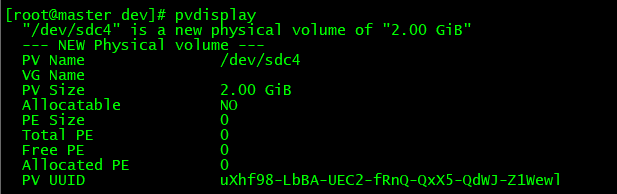
[root@master master]# pvcreate /dev/sdc4 -- //创建物理卷
dev_is_mpath: failed to get device for 8:36
Physical volume "/dev/sdc4" successfully created
查看新建的物理卷和大小,使用pvdisplay命令。
为啥我的根目录下没有卷组?
根目录下有卷组的话,vgextend ubuntu14-vg /dev/sdc4
vgdisplay 会显示一个卷组信息
lvresize -L +120G /dev/mapper/ubuntu14--vg-root
resize2fs /dev/mapper/ubuntu14--vg-root
df -h
应该会添加成功。
Linux 虚拟机扩容的更多相关文章
- [linux]vmware中linux虚拟机扩容 标签: vmware虚拟机linux 2016-09-05 08:03 315人阅读 评
扩容原因 现阶段,虚拟机的标配都是1G内存和20G硬盘,大部分时候是够用的,但是也会出现虚拟机里面东西放多了硬盘不够用的情况,这种情况下,除了清理垃圾,另外就只能给虚拟机扩容了.因为window扩容相 ...
- Linux虚拟机扩容根分区CentOs6.9 VMware14
1.首先关闭虚拟机点击编辑虚拟机设置 2.点击想要扩容的硬盘点击扩容 3.增加容量 输入想增加的容量,因为我本身是30G写到35G是加了5G不是增加30G.(此处为了演示只增加5G) 4.开启虚拟机 ...
- (转)vmware下给linux虚拟机扩容
“Well, here’s another fine mess you’ve gotten me into” Let us pretend that you have an Ubuntu Server ...
- Linux Centos虚拟机扩容
Linux Centos虚拟机扩容(/dev/mapper/centos-root) 1:.首先查看我们的根分区大小是多少 df -h 文件系统 类型 容量 已用 可用 已用% 挂载点``/dev/m ...
- Linux系统盘扩容-物理机非虚拟机
# Linux系统盘扩容 ## 了解磁盘分区情况 - `blkid` 查看分区情况- `fdisk -l` 分区表 ## 系统挂载分区 - `/etc/fstab` 启动挂载分区情况 ## 双系统下分 ...
- VMware虚拟机扩容
作者:金良(golden1314521@gmail.com) csdn博客:http://blog.csdn.net/u012176591 用了一段Linux虚拟机.发现安装虚拟机时分配的空间不够用, ...
- Linux分区扩容
lz在MAC上面使用Linux虚拟机,开始只建了一个分区,挂载在”/”目录下.现在硬盘空间不够了,所以lz就来给这个分区扩容. 首先,当然是要给虚拟机分配更多的硬盘空间喽(lz用的是VMware Fu ...
- 为Xen虚拟机扩容根文件系统(LVM)
===== 为Xen虚拟机扩容根文件系统(LVM) ===== 1. 增加1个4G的映像文件 # dd if=/dev/zero of=data.img bs=4k seek=1024k count= ...
- linux 系统扩容 VMware Centos---VMware ESXi
用到的命令 df fdisk pvcreate pvdisplay vgdisplay vgextend lvdisplay lvextend resize2fs 0 ...
随机推荐
- Vs code调试Dart语言
1.下载Dart SDK,地址:Dart Windows下载 安装稳定版本,安装完看看有没有配置系统变量. 2.在VS code中安装Dart和Code Runner插件: 3.如果Dart有乱码输出 ...
- 阶段5 3.微服务项目【学成在线】_day02 CMS前端开发_01-vuejs研究-vuejs介绍
1.vue.js是什么? Vue (读音 /vjuː/,类似于 view) 是一套用于构建用户界面的渐进式框架.与其它大型框架不同的是,Vue 被设计 为可以自底向上逐层应用.Vue 的核心库只关注视 ...
- python封装和解构
封装 将多个值使用逗号分割,组合在一起 本质上,返回一个元组,只是省略了小括号 python的特有的语法,被很多语言学习借鉴 t1 = (1,2) #定义元组 t2 = 1,2 #将1和2封装成元组 ...
- linux扩展根目录空间
转自:http://blog.chinaunix.net/uid-363820-id-2181838.html Linux用户如何扩展磁盘空间? 这里以B型VPS为例,说明磁盘空间的具体扩展方法如下: ...
- hibernate 第二次深入接触
1.session 到底如何进行脏处理? 当一个Dept对象加入到session缓存时,Session会为Dept对象的值属性复制一份快照,当Session刷新缓存时,会进行脏处理. 2.OID 用来 ...
- iOS-项目重构(浅谈)
如何重构 首先,要对程序的一般架构烂熟于心,尤其是MVC,这是基本.还有就是分离存储和网络请求的逻辑. 对于一些常用的控件尽量分离复用,设置开关函数,适当的时候开启,不要的时候关闭,有必要的话还可以 ...
- K8s架构详解
每个微服务通过 Docker 进行发布,随着业务的发展,系统中遍布着各种各样的容器.于是,容器的资源调度,部署运行,扩容缩容就是我们要面临的问题. 基于 Kubernetes 作为容器集群的管理平台被 ...
- Encoding.GetEncoding 编码列表
代码页 名称 显示名称 37 IBM037 IBM EBCDIC(美国 - 加拿大) 437 IBM437 OEM 美国 500 IBM500 IBM EBCDIC(国际) 708 A ...
- 学习笔记:CentOS7学习之十八:Linux系统启动原理及故障排除
目录 学习笔记:CentOS7学习之十八:Linux系统启动原理及故障排除 18.1 centos6系统启动过程及相关配置文件 18.1.1 centos6系统启动过程 18.1.2 centos6启 ...
- Django soft-delete软删除
在django中,实现这个功能很简单,我们采用一个字段用来保存删除的时间.若记录没有被删除,那么设置该值为None,如果被删除,那么设置时间为删除的时间. class BaseSchema(model ...