
Angular5 父组件获取子组件实例( ViewChildren、ViewChild用法)
原文链接
Understanding ViewChildren, ContentChildren, and QueryList in Angular
使用场景
有时候,我们想要在父组件中访问它的子组件。在Angular中可以使用ViewChildren ViewChild ContentChildren 来实现对子组件的访问。
假设,我们封装了一个Alert子组件
// alert.component.html

<h1 (click)="alert()">{{type}}</h1>
import { Component, OnInit, Input } from '@angular/core';

@Component({

  selector: 'app-alert',

  templateUrl: './alert.component.html',

  styleUrls: ['./alert.component.scss']

})

export class AlertComponent implements OnInit {

  @Input() type = 'success';

  constructor() { }

  ngOnInit() {

  }

  alert() {

    console.log('alert');

  }

}
然后,在HomeComponent 使用它多次
// home.component.html

    <app-alert></app-alert>

    <app-alert type="info"></app-alert>

    <app-alert type="danger"></app-alert>
ViewChildren
使用 @ViewChildren decorator 来获取所有的子组件。@ViewChildren 支持的参数包括 directive 、component type 和 模板变量。
// home.component.js

export class HomeComponent implements OnInit, AfterViewInit {

  @ViewChildren(AlertComponent) alerts: QueryList<AlertComponent>;

  ngAfterViewInit() {

    console.log(this.alerts);

    this.alerts.forEach(alertInstance => console.log(alertInstance));

  }

}
控制台打印出了3个AlertComponent的instance 对象
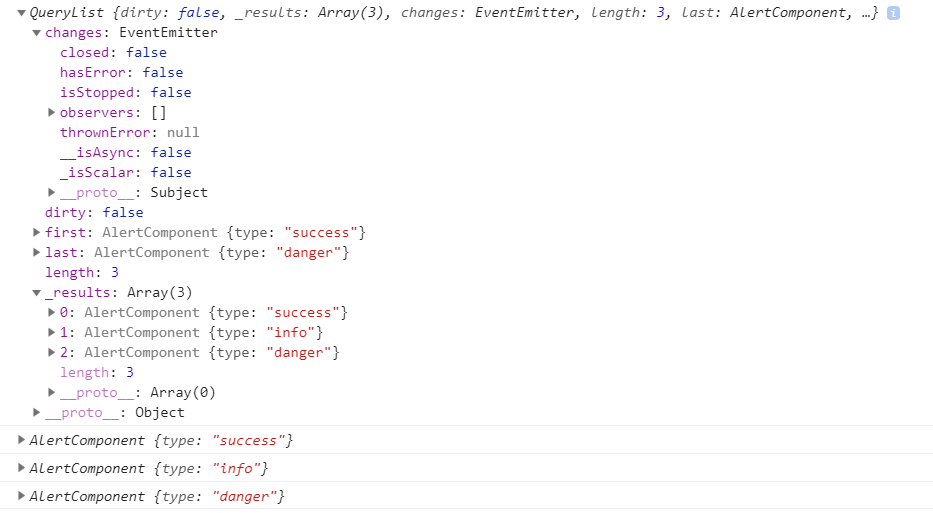
当@ViewChildren的参数是 component 或者 directive时,会返回component 或者 directive的实例对象。
当@ViewChildren的参数是模板变量时,会分两种情况。如果模板变量对应的是一个component,则返回实例对象;如果模板变量对应的是一个普通html标签,则返回本地元素的引用 ElementRef。
// home.component.html

<div class="col" #div>

    <app-alert #alert1></app-alert>

    <app-alert type="info"></app-alert>

    <app-alert type="danger"></app-alert>

  </div>
// home.component.ts

export class HomeComponent implements OnInit, AfterViewInit {

  @ViewChildren('alert1') alerts: QueryList<any>;

  @ViewChildren('div') div: QueryList<any>;

  ngAfterViewInit() {

    console.log(this.div);

    this.div.forEach(inst => console.log(inst));

    console.log(this.alerts);

    this.alerts.forEach(alertInstance => console.log(alertInstance));

  }

}
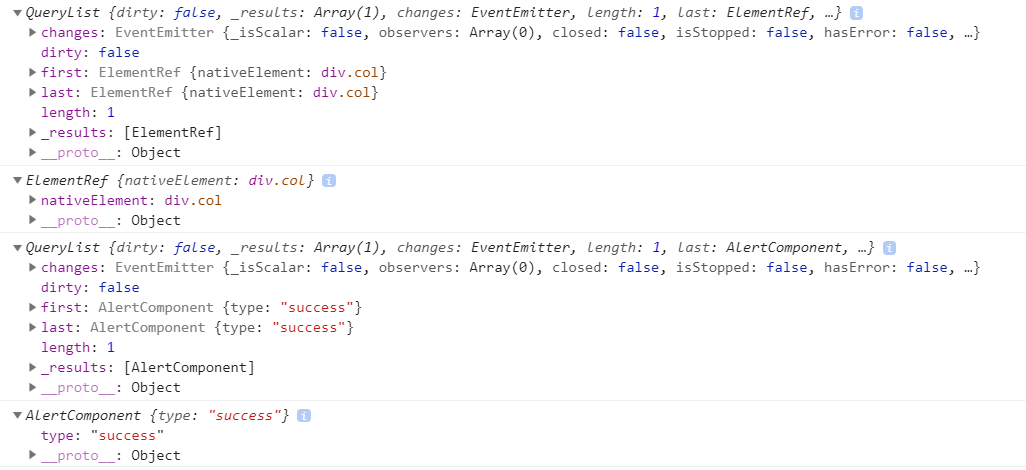
需要注意的是:如果使用了
*ngIf来控制子组件是否显示,只有在子组件显示的时候,才能够获取到子组件。
ViewChild
如果在父组件中只有一个子组件,使用@ViewChild比较合适。
// home.component.ts

export class HomeComponent implements OnInit, AfterViewInit {

  @ViewChild('alert1') alerts: any;

  @ViewChild('div') div: any;

  ngAfterViewInit() {

    console.log(this.div);

    console.log(this.alerts);

  }

}
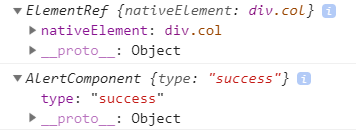
read 参数
ElementRef
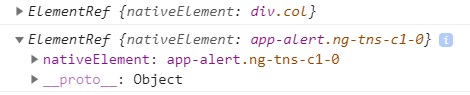
如果不想获取子组件的实例,只想访问Dom元素,可以添加read参数
// home.component.ts

@ViewChild('alert1', {read: ElementRef}) alerts: any;
@ViewChildren也支持read 参数。
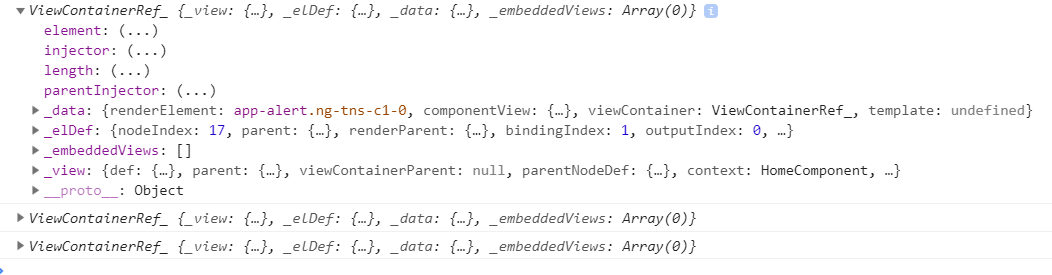
ViewContainerRef
You need this token when you need to create templates or components dynamically。当需要动态创建组件时,需要这个参数。
@ViewChildren(AlertComponent, {read: ViewContainerRef}) alerts: QueryList<AlertComponent>;
Angular5 父组件获取子组件实例( ViewChildren、ViewChild用法)的更多相关文章
- Vee-validate 父组件获取子组件表单校验结果
vee-validate 是为 Vue.js 量身打造的表单校验框架,允许您校验输入的内容并显示对应的错误提示信息.它内置了很多常见的校验规则,可以组合使用多种校验规则,大部分场景只需要配置就能实现开 ...
- 子组件获取父组件数据 propsDown, 父组件获取子组件数据 eventUp
(一) popsDowm 三种方法获取父组件数据:被动获得(1):主动获取(2). 1.被动获得: 父组件:v-bind: 绑定变量参数和方法参数:子组件:props 接收参数.可以在模板中直接使用也 ...
- vue父组件获取子组件页面的数组 以城市三级联动为例
父组件调用子组件 <Cselect ref="registerAddress"></Cselect> import Cselect from '../../ ...
- 关于Vue中,父组件获取子组件的数据(子组件调用父组件函数)的方法
1. 父组件调用子组件时,在调用处传给子组件一个方法 :on-update="updateData" 2. 子组件在props中,接收这个方法并声明 props: { onUp ...
- React Hook父组件获取子组件的数据/函数
我们知道在react中,常用props实现子组件数据到父组件的传递,但是父组件调用子组件的功能却不常用.文档上说ref其实不是最佳的选择,但是想着偷懒不学redux,在网上找了很多教程,要不就是hoo ...
- antd 父组件获取子组件中form表单的值
还是拿代码来讲吧,详情见注释 子组件 import React, { Component } from 'react'; import { Form, Input } from 'antd'; con ...
- vue 的父组件和子组件互相获取数据和方法
父组件主动获取子组件的数据和方法 一.ref(但不能实时更新获取) 1.调用子组件的时候 定义一个ref <child ref="headerChild"></c ...
- vue3 template refs dom的引用、组件的引用、获取子组件的值
介绍 通过 ref() 还可以引用页面上的元素或组件. DOM 的引用 <template> <div> <h3 ref="h3Ref">Tem ...
- vue:父子组件间通信,父组件调用子组件方法进行校验子组件的表单
参考: ElementUI多个子组件表单的校验管理:https://www.jianshu.com/p/541d8b18cf95 Vue 子组件调用父组件方法总结:https://juejin.im/ ...
随机推荐
- 【leetcode】1266. Minimum Time Visiting All Points
题目如下: On a plane there are n points with integer coordinates points[i] = [xi, yi]. Your task is to f ...
- __stdcall、__cdcel、__fastcall 调用
常用的调用约定有stdcall,cdecl,fastcall,thiscall,naked call等,以下将 __stdcall.__cdecl和__fastcall三种函数调用协议加以比较,函数调 ...
- web前端:上传文件夹(需支持多浏览器)
在Web应用系统开发中,文件上传和下载功能是非常常用的功能,今天来讲一下JavaWeb中的文件上传和下载功能的实现. 先说下要求: PC端全平台支持,要求支持Windows,Mac,Linux 支持所 ...
- Android_(游戏)打飞机01:前言
(游戏)打飞机01:前言 传送门 (游戏)打飞机02:游戏背景滚动 传送门 (游戏)打飞机03:控制玩家飞机 传送门 (游戏)打飞机04:绘画敌机.添加子弹 传送门 (游戏)打飞机05:处理子弹, ...
- Java并发编程的艺术笔记(九)——FutureTask详解
FutureTask是一种可以取消的异步的计算任务.它的计算是通过Callable实现的,多用于耗时的计算. 一.FutureTask的三种状态 二.get()和cancel()执行示意 三.使用 一 ...
- Spring Boot使用阿里云证书启用HTTPS
1.到阿里云下载证书页面下载证书 2.根据页面内容,可以使用2种证书:PFX JKS 把对应证书放到src/main/resources目录下 在application.properties文件中加入 ...
- 第七周学习总结&JAVA实验五报告。
JAVA实验报告五: 实验四 类的继承 实验目的 理解抽象类与接口的使用: 了解包的作用,掌握包的设计方法. 实验要求 掌握使用抽象类的方法. 掌握使用系统接口的技术和创建自定义接口的方法. 了解 J ...
- LeetCode 2. 两数相加(Add Two Numbers)
题目描述 给定两个非空链表来表示两个非负整数.位数按照逆序方式存储,它们的每个节点只存储单个数字.将两数相加返回一个新的链表. 你可以假设除了数字 0 之外,这两个数字都不会以零开头. 示例: 输入: ...
- xgboost原理与实战
目录 xgboost原理 xgboost和gbdt的区别 xgboost安装 实战 xgboost原理 xgboost是一个提升模型,即训练多个分类器,然后将这些分类器串联起来,达到最终的预测效果.每 ...
- track-by的使用
<!DOCTYPE html><html lang="en"><head> <meta charset="UTF-8" ...