
2.kafka单节点broker的安装与启动
下载kafka,http://kafka.apache.org/downloads
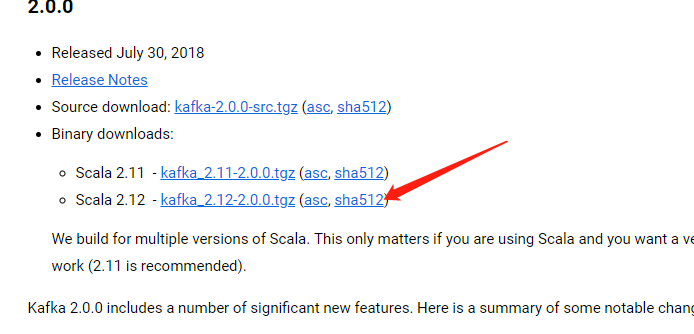

kafka下面的文件结构如下:

进入bin目录,启动kafka之前要先启动zookeeper
./zookeeper-server-start.sh ../config/zookeeper.properties 启动zookeeper
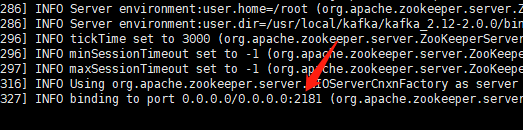
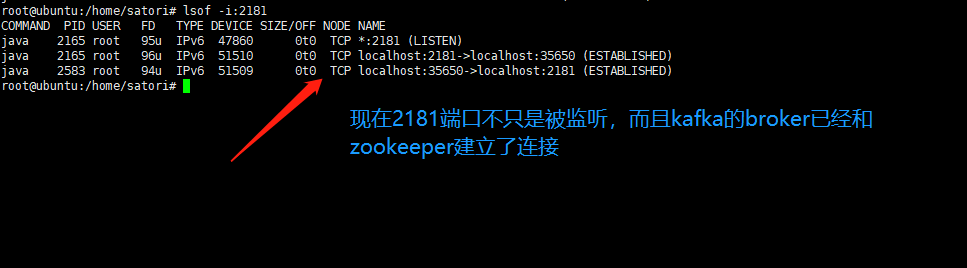
显示绑定了2181端口,我们来查看一下

zookeeper启动成功
接下来启动kafka
./kafka-server-start.sh ../config/server.properties, 和启动zookeeper类似
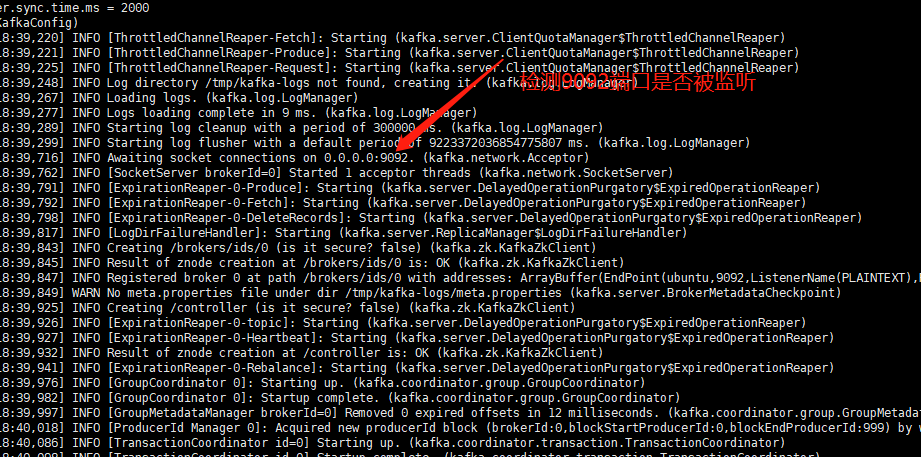

kafka启动成功
创建topic
之前说过,kafka是基于发布订阅的方式。并且生产者要指定这条消息是发送到什么topic上的,而且消费者一般也不会消费所有的消息,需要指定订阅的消息是属于哪个topic。
如果想创建一个名为satori的topic就可以这么写,后面的参数之后会介绍
./kafka-topics.sh --zookeeper localhost:2181 --create --topic satori --partitions 3 --replication-factor 1

查看satori这个topic,直接将create改成describe

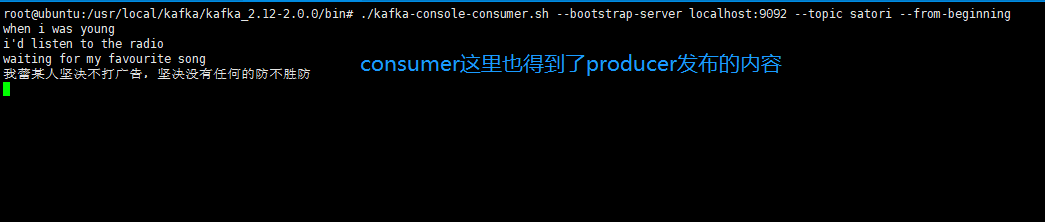
启动一个consumer
./kafka-console-consumer.sh --bootstrap-server localhost:9092 --topic satori --from-beginning
顺带一提,在低版本的kafka中还可以通过 ./kafka-console-consumer.sh --zookeeper localhost:2181 --topic satori,但是已经在0.9.0之后被移除了

启动一个producer
./kafka-console-producer.sh --broker-list localhost:9092 --topic satori
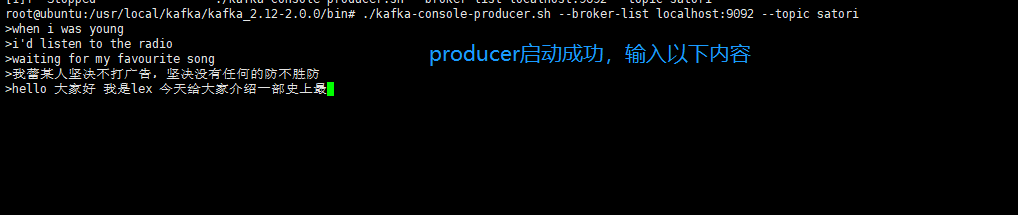
我们再来看看consumer
-------------------------------------------------------------------
以上是通过kafka自带的zookeeper启动的,接下来我们演示如何通过单独的zookeeper启动kafka
先安装zookeeper,http://archive.cloudera.com/cdh5/cdh/5/
然后配置到环境变量里面去,激活一下。

然后还要修改一个配置文件,进入conf目录下。


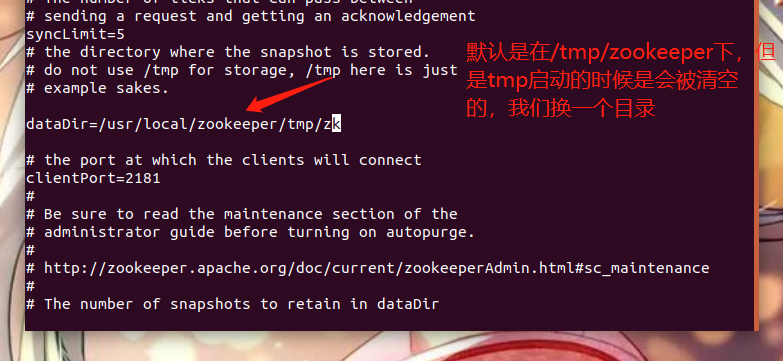
启动zookeeper,进入bin目录

zkServer.sh则是启动文件

但是提示我们需要加一些参数,我们选一下start

我们还可以使用zkCli.sh连接一下
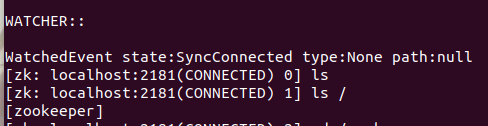
连接成功,这个比较简单
我们再回过头来看kafka的配置文件
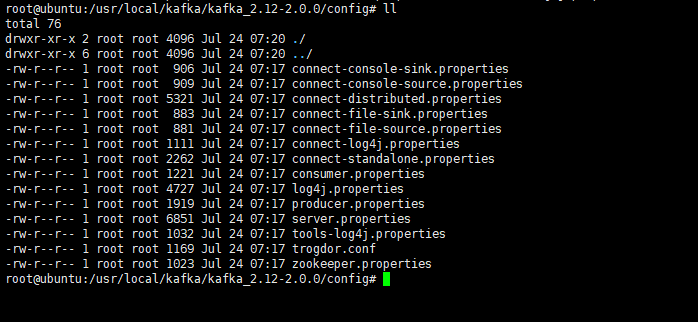
我们来看看server.properties
# Licensed to the Apache Software Foundation (ASF) under one or more
# contributor license agreements.  See the NOTICE file distributed with
# this work for additional information regarding copyright ownership.
# The ASF licenses this file to You under the Apache License, Version 2.0
# (the "License"); you may not use this file except in compliance with
# the License.  You may obtain a copy of the License at
#
#    http://www.apache.org/licenses/LICENSE-2.0
#
# Unless required by applicable law or agreed to in writing, software
# distributed under the License is distributed on an "AS IS" BASIS,
# WITHOUT WARRANTIES OR CONDITIONS OF ANY KIND, either express or implied.
# See the License for the specific language governing permissions and
# limitations under the License.

# see kafka.server.KafkaConfig for additional details and defaults

############################# Server Basics #############################

# The id of the broker. This must be set to a unique integer for each broker.
broker.id=0

############################# Socket Server Settings #############################

# The address the socket server listens on. It will get the value returned from
# java.net.InetAddress.getCanonicalHostName() if not configured.
#   FORMAT:
#     listeners = listener_name://host_name:port
#   EXAMPLE:
#     listeners = PLAINTEXT://your.host.name:9092
#listeners=PLAINTEXT://:9092

# Hostname and port the broker will advertise to producers and consumers. If not set,
# it uses the value for "listeners" if configured.  Otherwise, it will use the value
# returned from java.net.InetAddress.getCanonicalHostName().
#advertised.listeners=PLAINTEXT://your.host.name:9092

# Maps listener names to security protocols, the default is for them to be the same. See the config documentation for more details
#listener.security.protocol.map=PLAINTEXT:PLAINTEXT,SSL:SSL,SASL_PLAINTEXT:SASL_PLAINTEXT,SASL_SSL:SASL_SSL

# The number of threads that the server uses for receiving requests from the network and sending responses to the network
num.network.threads=3

# The number of threads that the server uses for processing requests, which may include disk I/O
num.io.threads=8

# The send buffer (SO_SNDBUF) used by the socket server
socket.send.buffer.bytes=102400

# The receive buffer (SO_RCVBUF) used by the socket server
socket.receive.buffer.bytes=102400

# The maximum size of a request that the socket server will accept (protection against OOM)
socket.request.max.bytes=104857600

############################# Log Basics #############################

# A comma separated list of directories under which to store log files
log.dirs=/tmp/kafka-logs

# The default number of log partitions per topic. More partitions allow greater
# parallelism for consumption, but this will also result in more files across
# the brokers.
num.partitions=1

# The number of threads per data directory to be used for log recovery at startup and flushing at shutdown.
# This value is recommended to be increased for installations with data dirs located in RAID array.
num.recovery.threads.per.data.dir=1

############################# Internal Topic Settings  #############################
# The replication factor for the group metadata internal topics "__consumer_offsets" and "__transaction_state"
# For anything other than development testing, a value greater than 1 is recommended for to ensure availability such as 3.
offsets.topic.replication.factor=1
transaction.state.log.replication.factor=1
transaction.state.log.min.isr=1

############################# Log Flush Policy #############################

# Messages are immediately written to the filesystem but by default we only fsync() to sync
# the OS cache lazily. The following configurations control the flush of data to disk.
# There are a few important trade-offs here:
#    1. Durability: Unflushed data may be lost if you are not using replication.
#    2. Latency: Very large flush intervals may lead to latency spikes when the flush does occur as there will be a lot of data to flush.
#    3. Throughput: The flush is generally the most expensive operation, and a small flush interval may lead to excessive seeks.
# The settings below allow one to configure the flush policy to flush data after a period of time or
# every N messages (or both). This can be done globally and overridden on a per-topic basis.

# The number of messages to accept before forcing a flush of data to disk
#log.flush.interval.messages=10000

# The maximum amount of time a message can sit in a log before we force a flush
#log.flush.interval.ms=1000

############################# Log Retention Policy #############################

# The following configurations control the disposal of log segments. The policy can
# be set to delete segments after a period of time, or after a given size has accumulated.
# A segment will be deleted whenever *either* of these criteria are met. Deletion always happens
# from the end of the log.

# The minimum age of a log file to be eligible for deletion due to age
log.retention.hours=168

# A size-based retention policy for logs. Segments are pruned from the log unless the remaining
# segments drop below log.retention.bytes. Functions independently of log.retention.hours.
#log.retention.bytes=1073741824

# The maximum size of a log segment file. When this size is reached a new log segment will be created.
log.segment.bytes=1073741824

# The interval at which log segments are checked to see if they can be deleted according
# to the retention policies
log.retention.check.interval.ms=300000

############################# Zookeeper #############################

# Zookeeper connection string (see zookeeper docs for details).
# This is a comma separated host:port pairs, each corresponding to a zk
# server. e.g. "127.0.0.1:3000,127.0.0.1:3001,127.0.0.1:3002".
# You can also append an optional chroot string to the urls to specify the
# root directory for all kafka znodes.
zookeeper.connect=localhost:2181

# Timeout in ms for connecting to zookeeper
zookeeper.connection.timeout.ms=6000

############################# Group Coordinator Settings #############################

# The following configuration specifies the time, in milliseconds, that the GroupCoordinator will delay the initial consumer rebalance.
# The rebalance will be further delayed by the value of group.initial.rebalance.delay.ms as new members join the group, up to a maximum of max.poll.interval.ms.
# The default value for this is 3 seconds.
# We override this to 0 here as it makes for a better out-of-the-box experience for development and testing.
# However, in production environments the default value of 3 seconds is more suitable as this will help to avoid unnecessary, and potentially expensive, rebalances during application startup.
group.initial.rebalance.delay.ms=0
我们来慢慢看
# The id of the broker. This must be set to a unique integer for each broker.
broker.id=0
之前说过kafka就相当于一个broker,而且还可以有多个broker,那么为了区分,因此每一个broker都是有一个id的,并且id还必须唯一。
这个就不需要改,直接从零开始的异世界生活就行。
#listeners=PLAINTEXT://:9092
监听的端口
# A comma separated list of directories under which to store log files
log.dirs=/tmp/kafka-logs
这个log.dirs是用来存放kafka的日志文件的,这个也不能用这个路径,重启的时候回废掉的,我们自己指定一个,就在kafka下面建一个目录吧。

# The default number of log partitions per topic. More partitions allow greater
# parallelism for consumption, but this will also result in more files across
# the brokers.
num.partitions=1
分区的数量,后面介绍,就先让它为1
zookeeper.connect=localhost:2181
zookeeper的地址
配置文件就先到这,我们再来启动kafka。忘记说了我们要把kafka加到环境变量里面去
然后kafka-server-start.sh $KAFKA_HOME/config/server.properties
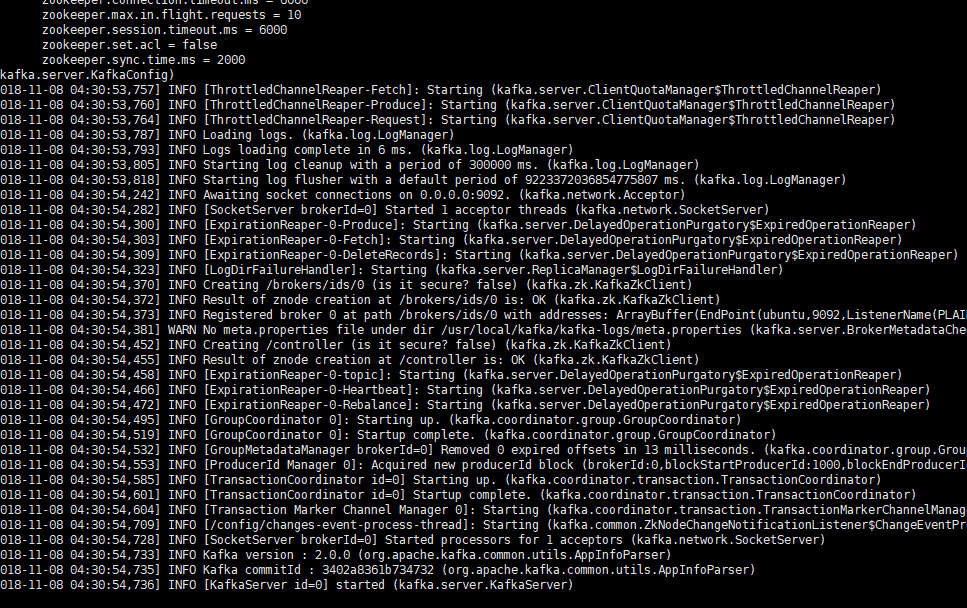
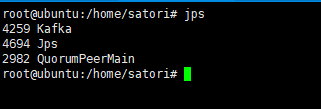
接下来创建topic
kafka-topics.sh --create --zookeeper localhost:2181 --replication-factor 1 --partitions 1 --topic hello_satori
指定一个zookeeper,副本系数是1,我们这就一个节点,分区也是1
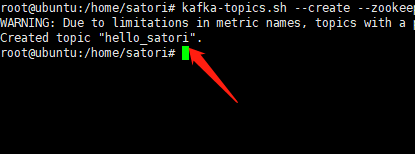
创建成功
查看topic
kafka-topics.sh --list --zookeeper localhost:2181
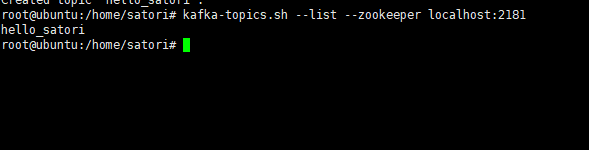
显示只有一个topic,就是我们的hello_satori
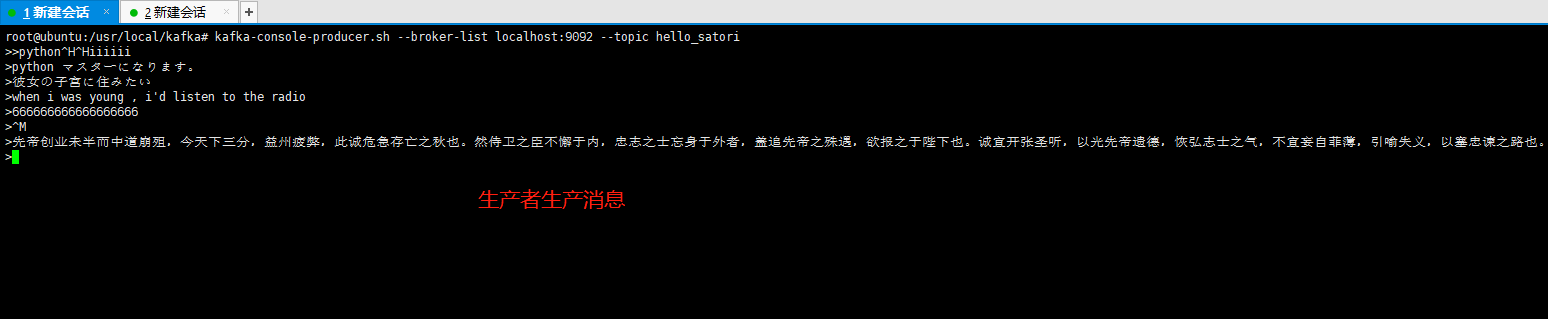
发送消息
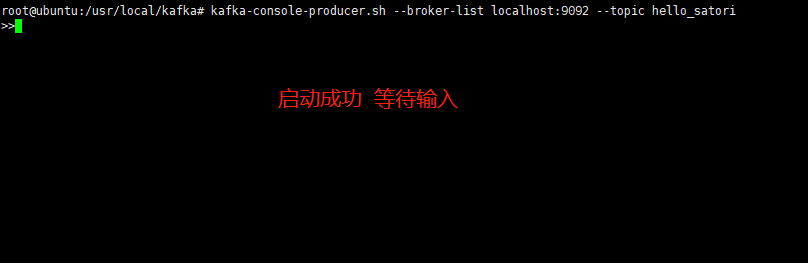
kafka-console-producer.sh --broker-list localhost:9092 --topic hello_satori
我们发送消息是往篮子里面发送,所以需要指定--broker-list,指定topic是往哪个topic里面发送,9092是我们在配置文件中写的监听的端口
接收消息
kafka-console-consumer.sh --bootstrap-server localhost:9092 --topic hello_satori --from-beginning
顺带一提,在低版本的kafka中还可以通过 ./kafka-console-consumer.sh --zookeeper localhost:2181 --topic satori,但是已经在0.9.0之后被移除了
注意这里的--from-beginning,如果带上,那么以前的数据也会被消费

启动成功,等待生产者生产数据

2.kafka单节点broker的安装与启动的更多相关文章
- Kafka 单节点多Kafka Broker集群
Kafka 单节点多Kafka Broker集群 接前一篇文章,今天搭建一下单节点多Kafka Broker集群环境. 配置与启动服务 由于是在一个节点上启动多个 Kafka Broker实例,所以我 ...
- Kafka单节点及集群配置安装
一.单节点 1.上传Kafka安装包到Linux系统[当前为Centos7]. 2.解压,配置conf/server.property. 2.1配置broker.id 2.2配置log.dirs 2. ...
- zookeeper单节点windows下安装
由于需要在windows下面安装zookeeper,故做个整理 1.下载zookeeper http://mirrors.hust.edu.cn/apache/zookeeper/ 2.解压 3.修改 ...
- 吴裕雄--天生自然HADOOP操作实验学习笔记:单节点伪分布式安装
实验目的 了解java的安装配置 学习配置对自己节点的免密码登陆 了解hdfs的配置和相关命令 了解yarn的配置 实验原理 1.Hadoop安装 Hadoop的安装对一个初学者来说是一个很头疼的事情 ...
- Apache Kafka(二)- Kakfa 安装与启动
安装并启动Kafka 1.下载最新版Kafka(当前为kafka_2.12-2.3.0)并解压: > wget http://mirror.bit.edu.cn/apache/kafka/2.3 ...
- Kafka 单节点单Kafka Broker集群
下载与安装 从 http://www.apache.org/dist/kafka/ 下载最新版本的 kafka,这里使用的是 kafka_2.12-0.10.2.1.tgz $ tar zxvf ka ...
- kafka单节点的安装,部署,使用
1.kafka官网:http://kafka.apache.org/downloads jdk:https://www.oracle.com/technetwork/java/javase/downl ...
- kafka单节点测试
======================命令====================== 启动zookeeper server bin/zookeeper-server-start.sh conf ...
- kafka单节点部署无法访问问题解决
场景:在笔记本安装了一台虚拟机, 在本地的虚拟机上部署了一个kafka服务: 写了一个测试程序,在笔记本上运行测试程序,访问虚拟机上的kafka,报如下异常: 2015-01-15 09:33:26 ...
随机推荐
- NO5——素数筛选
#include <stdio.h> int main() { ]={}; ;i<=;i++) a[i]=; ;i<=;i++) if(a[i]) ;j+=i) a[j]=; ...
- nopcommerce商城系统--技术与系统需求
原址:http://www.nopcommerce.com/technologysystemrequirements.aspx 在这里,我们将着眼于nopCommerce的系统要求.为了运行nopCo ...
- lintcode-64-合并排序数组 II
64-合并排序数组 II 合并两个排序的整数数组A和B变成一个新的数组. 注意事项 你可以假设A具有足够的空间(A数组的大小大于或等于m+n)去添加B中的元素. 样例 给出 A = [1, 2, 3, ...
- 算法(11)Find All Duplicates in an Array
题目:数组的长度是n,里面的数是1到n,其中肯定有重复的,找到里面重复的数字 思路:自己想愣是没有想出来,直接看答案,关键点是看nums[i]和nums[nums[i]-1]之间的关系,遍历整个数组, ...
- Java IO 小结
Java IO 的学习需要明白流设计的体系结构,这样才能在实际需要的时候,通过API文档查阅,快速实现功能.
- 正式进军Matlab图像处理
Matlab取整函数有:fix, floor, ceil, round,具体应用方法如下: 1. fix朝零方向取整,如fix(-1.3) = -1; fix(1.3) = 1; 2. floor顾名 ...
- 【考试记录】4.8 Path (网络流 —— 劲题)
手抄代码 + 学习指针 + 冥思苦想一晚上终于——在一瞬间开窍了.果然题目都是这样:突破了一个点,一切都是柳暗花明. 题面描述: 样例: 这道题目,首先注意到给定的边的性质:这些边在平面上构成了一棵树 ...
- [LG1886]滑动窗口 单调队列
---题面--- 题解: 观察数据范围,这应该是一个复杂度O(n)的题.以最大值为例,考虑单调队列,维护一个单调递减的队列.从前向后扫,每次答案取队首,如果后面进入的比前面大,那么就弹出前面的数,因为 ...
- cdh版本的hadoop安装及配置(伪分布式模式) MapReduce配置 yarn配置
安装hadoop需要jdk依赖,我这里是用jdk8 jdk版本:jdk1.8.0_151 hadoop版本:hadoop-2.5.0-cdh5.3.6 hadoop下载地址:链接:https://pa ...
- [Leetcode] distinct subsequences 不同子序列
Given a string S and a string T, count the number of distinct subsequences of T in S. A subsequence ...