
Android_(控件)使用ListView显示Android系统中SD卡的文件列表
使用ListView显示Android SD卡中的文件列表
父类布局activity_main.xml,子类布局line.xml(一个文件的单独存放)
运行截图:
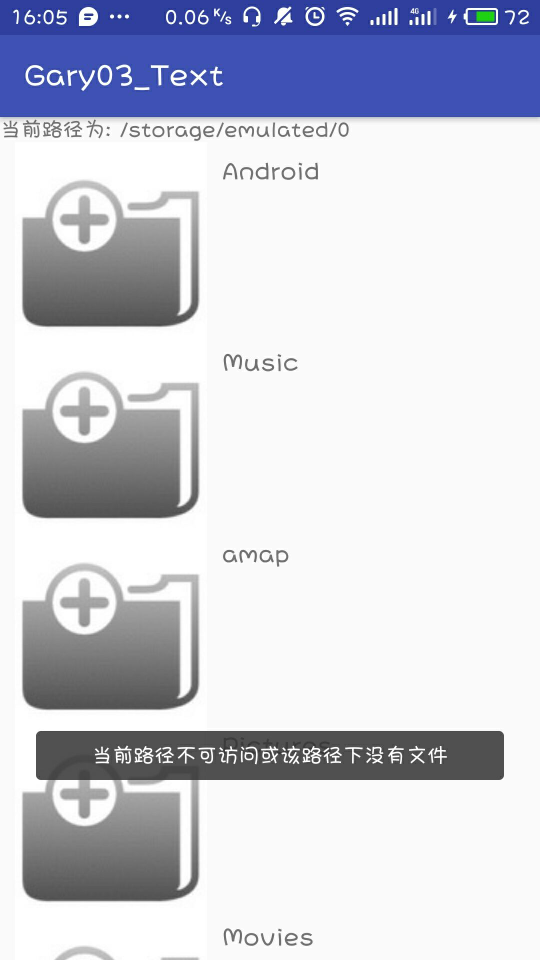
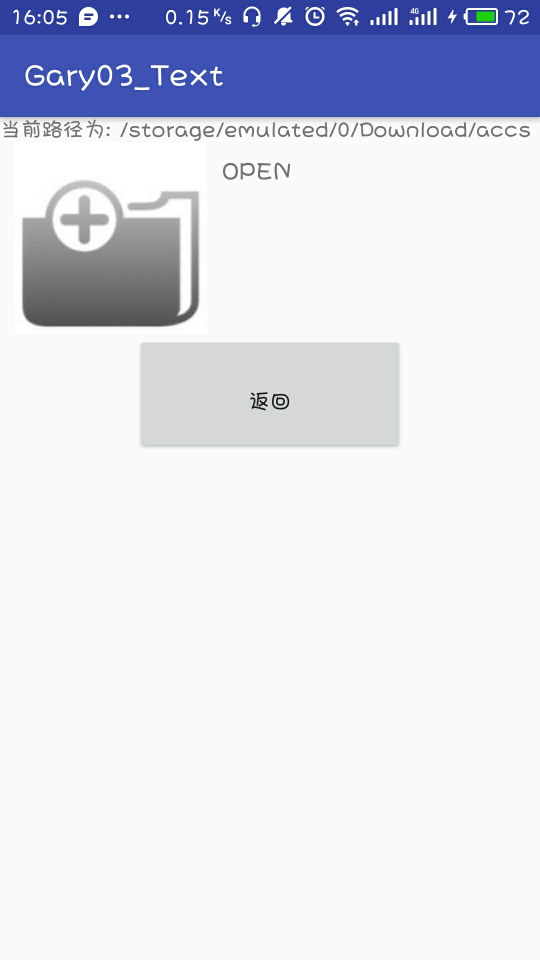
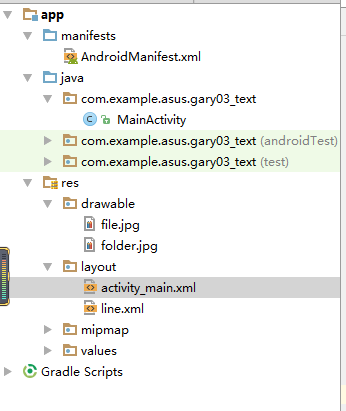
程序结构:
<?xml version="1.0" encoding="utf-8"?>

<manifest xmlns:android="http://schemas.android.com/apk/res/android"

    package="com.example.asus.gary03_text">

    <!--AndroidManifest.xml获取手机存储卡权限-->

    <uses-permission android:name="android.permission.READ_EXTERNAL_STORAGE"/>

    <application

        android:allowBackup="true"

        android:icon="@mipmap/ic_launcher"

        android:label="@string/app_name"

        android:roundIcon="@mipmap/ic_launcher_round"

        android:supportsRtl="true"

        android:theme="@style/AppTheme">

        <activity android:name=".MainActivity">

            <intent-filter>

                <action android:name="android.intent.action.MAIN" />

                <category android:name="android.intent.category.LAUNCHER" />

            </intent-filter>

        </activity>

    </application>

</manifest>
AndroidManifest.xml
package com.example.asus.gary03_text;

import android.support.v7.app.AppCompatActivity;

import java.io.File;

import java.util.ArrayList;

import java.util.HashMap;

import java.util.List;

import java.util.Map;

import android.os.Bundle;

import android.view.View;

import android.view.View.OnClickListener;

import android.widget.AdapterView;

import android.widget.AdapterView.OnItemClickListener;

import android.widget.Button;

import android.widget.ListView;

import android.widget.SimpleAdapter;

import android.widget.TextView;

import android.widget.Toast;

public class MainActivity extends AppCompatActivity {

    ListView listView;

    TextView textView;

    //记录当前的父文件夹

    File currentParent;

    //记录当前目录路径下的所有文件的文件数组

    File[] currentFiles;

    @Override

    public void onCreate(Bundle savedInstanceState) {

        super.onCreate(savedInstanceState);

        setContentView(R.layout.activity_main);

        //获取列出全部文件的ListView

        listView = (ListView)findViewById(R.id.list);

        textView = (TextView)findViewById(R.id.path);

        //获取系统的SD卡的目录

        File root = new File("/mnt/sdcard/");

        //如果SD卡存在

        if(root.exists()){

            currentParent = root;

            currentFiles = root.listFiles();

            //使用当前目录下的全部文件、文件夹来填充ListView

            inflateListView(currentFiles);

        }

        //为ListView的列表项的单击事件绑定监听器

        listView.setOnItemClickListener(new OnItemClickListener() {

            public void onItemClick(AdapterView<?> arg0, View arg1, int arg2,

                                    long arg3) {

                // TODO Auto-generated method stub

                //用户单击了文件,直接返回,不做任何处理

                if(currentFiles[arg2].isFile())

                    return;

                //获取用户单击的文件夹下的所有文件

                File[] tmp = currentFiles[arg2].listFiles();

                if(tmp == null || tmp.length == 0){

                    Toast.makeText(MainActivity.this, "当前路径不可访问或该路径下没有文件",Toast.LENGTH_SHORT).show();

                }

                else{

                    //获取用户单击的列表项对应的文件夹,设为当前的父文件夹

                    currentParent = currentFiles[arg2];

                    //保存当前的父文件夹内的全部文件和文件夹

                    currentFiles = tmp;

                    //再次更新ListView

                    inflateListView(currentFiles);

                }

            }

        });

        //获取上一级目录的按钮

        Button parent = (Button)findViewById(R.id.parent);

        parent.setOnClickListener(new OnClickListener() {

            public void onClick(View v) {

                // TODO Auto-generated method stub

                try{

                    if(!currentParent.getCanonicalPath().equals("/mnt/sdcard")){

                        //获取上级目录

                        currentParent = currentParent.getParentFile();

                        //列出当前目录下所有文件

                        currentFiles = currentParent.listFiles();

                        //再次更新ListView

                        inflateListView(currentFiles);

                    }

                }catch (Exception e) {

                    // TODO: handle exception

                    e.printStackTrace();

                }

            }

        });

    }

    private void inflateListView(File[] files){

        //创建一个List集合,List集合的元素是Map

        List<Map<String, Object>> listItems = new ArrayList<Map<String, Object>>();

        for(int i = 0; i < files.length; i++){

            Map<String, Object> listItem = new HashMap<String, Object>();

            //如果当前File是文件夹,使用floder图标;否则使用file图标

            if(files[i].isDirectory()){

                listItem.put("icon", R.drawable.folder);

            }

            else{

                listItem.put("icon", R.drawable.file);

            }

            listItem.put("fileName", files[i].getName());

            //添加List项

            listItems.add(listItem);

        }

        //创建一个SimpleAdapter

        SimpleAdapter simpleAdapter = new SimpleAdapter(this, listItems, R.layout.line,

                new String[]{"icon","fileName"}, new int[]{R.id.icon, R.id.file_name});

        //为ListView设置Adapter

        listView.setAdapter(simpleAdapter);

        try{

            textView.setText("当前路径为: " + currentParent.getCanonicalPath());

        }catch (Exception e) {

            // TODO: handle exception

            e.printStackTrace();

        }

    }

}
MainActivity
<?xml version="1.0" encoding="utf-8"?>

<LinearLayout xmlns:android="http://schemas.android.com/apk/res/android"

    android:orientation="vertical"

    android:layout_width="fill_parent"

    android:layout_height="fill_parent"

    >

    <!-- 显示当前路径的的文本框 -->

    <TextView

        android:id="@+id/path"

        android:layout_width="fill_parent"

        android:layout_height="wrap_content"

        android:layout_gravity="center_horizontal"

        />

    <!-- 列出当前路径下所有文件的ListView -->

    <ListView

        android:id="@+id/list"

        android:layout_width="wrap_content"

        android:layout_height="wrap_content"

        android:divider="#000"

        />

    <!-- 返回上一级目录的按钮 -->

    <Button android:id="@+id/parent"

        android:layout_width="180dp"

        android:layout_height="80dp"

        android:text="返回"

        android:paddingTop="20dp"

        android:layout_gravity="center"/>

</LinearLayout>
activity_main
<?xml version="1.0" encoding="UTF-8"?>

<LinearLayout xmlns:android="http://schemas.android.com/apk/res/android"

    android:orientation="horizontal"

    android:layout_width="fill_parent"

    android:layout_height="fill_parent"

    >

    <!-- 定义一个ImageView,用于作为列表项的一部分。 -->

    <ImageView android:id="@+id/icon"

        android:layout_width="wrap_content"

        android:layout_height="wrap_content"

        android:paddingLeft="10dp"

        />

    <!-- 定义一个TextView,用于作为列表项的一部分。 -->

    <TextView android:id="@+id/file_name"

        android:layout_width="wrap_content"

        android:layout_height="wrap_content"

        android:textSize="16dp"

        android:gravity="center_vertical"

        android:paddingLeft="10dp"

        android:paddingTop="10dp"

        android:paddingBottom="10dp"

        />

</LinearLayout>
line
一、获取手机存储卡权限
<uses-permission android:name="android.permission.READ_EXTERNAL_STORAGE"/>
二、界面布局
activity_main.xml布局中
TextView中显示当前路径的的文本框,ListView列出当前路径下所有文件的ListView ,Button按钮返回上一级目录
link.xml布局中
ImageView和extView,用于作为列表项的一部分
三、实现程序功能
1、ListView列表的事件监听器
      listView.setOnItemClickListener(new OnItemClickListener() {

            public void onItemClick(AdapterView<?> arg0, View arg1, int arg2,

                                    long arg3) {

                // TODO Auto-generated method stub

                //用户单击了文件,直接返回,不做任何处理

                if(currentFiles[arg2].isFile())

                    return;

                //获取用户单击的文件夹下的所有文件

                File[] tmp = currentFiles[arg2].listFiles();

                if(tmp == null || tmp.length == 0){

                    Toast.makeText(MainActivity.this, "当前路径不可访问或该路径下没有文件",Toast.LENGTH_SHORT).show();

                }

                else{

                    //获取用户单击的列表项对应的文件夹,设为当前的父文件夹

                    currentParent = currentFiles[arg2];

                    //保存当前的父文件夹内的全部文件和文件夹

                    currentFiles = tmp;

                    //再次更新ListView

                    inflateListView(currentFiles);

                }

            }

        });
2、返回按键按钮
  Button parent = (Button)findViewById(R.id.parent);

        parent.setOnClickListener(new OnClickListener() {

            public void onClick(View v) {

                // TODO Auto-generated method stub

                try{

                    if(!currentParent.getCanonicalPath().equals("/mnt/sdcard")){

                        //获取上级目录

                        currentParent = currentParent.getParentFile();

                        //列出当前目录下所有文件

                        currentFiles = currentParent.listFiles();

                        //再次更新ListView

                        inflateListView(currentFiles);

                    }

                }catch (Exception e) {

                    // TODO: handle exception

                    e.printStackTrace();

                }

            }

        });

    }
3、用List集合存放文件,并且创建一个适配器SimpleAdapter
构造方法:SimpleAdapter(Contextcontext,List>data,intresource,String[]from,int[]to)
context:要使用的上下文环境。
data:是一个List>类型的集合对象,该集合中每个Map对象生成一个列表项。
resource:界面布局文件的ID,对应的布局文件作为列表项的组件。
from:是一个String[]类型的参数,该参数决定提取Map对象中哪些key对应的value来生成列表项。
to:该参数是一个int[]类型的参数,该参数决定填充哪些组件。
private void inflateListView(File[] files){

        //创建一个List集合,List集合的元素是Map

        List<Map<String, Object>> listItems = new ArrayList<Map<String, Object>>();

        for(int i = 0; i < files.length; i++){

            Map<String, Object> listItem = new HashMap<String, Object>();

            //如果当前File是文件夹,使用floder图标;否则使用file图标

            if(files[i].isDirectory()){

                listItem.put("icon", R.drawable.folder);

            }

            else{

                listItem.put("icon", R.drawable.file);

            }

            listItem.put("fileName", files[i].getName());

            //添加List项

            listItems.add(listItem);

        }

        //创建一个SimpleAdapter

        SimpleAdapter simpleAdapter = new SimpleAdapter(this, listItems, R.layout.line,

                new String[]{"icon","fileName"}, new int[]{R.id.icon, R.id.file_name});

        //为ListView设置Adapter

        listView.setAdapter(simpleAdapter);

        try{

            textView.setText("当前路径为: " + currentParent.getCanonicalPath());

        }catch (Exception e) {

            // TODO: handle exception

            e.printStackTrace();

        }

    }
Android_(控件)使用ListView显示Android系统中SD卡的文件列表的更多相关文章
- Android_(控件)使用ListView显示Android系统中联系人信息
使用ListView显示手机中联系人的姓名和电话号码 父类布局activity_main.xml,子类布局line.xml(一个文件的单独存放) 运行截图: (避免泄露信息对部分地方进行了涂鸦O(∩_ ...
- Android_(控件)使用ListView显示Android系统SD卡的文件列表_02
使用ListView显示Android SD卡中的文件列表 父类布局activity_main.xml,子类布局item_filelayout(一个文件的单独存放) 运行截图: 程序结构 <?x ...
- Android系统中默认值的意义列表
转自:http://blog.csdn.net/yabg_zhi_xiang/article/details/51727844 在SettingsProvider中设置系统中默认值,我们可以在fram ...
- Android开发之SD卡上文件操作
1. 得到存储设备的目录:/SDCARD(一般情况下) SDPATH=Environment.getExternalStorageDirectory()+"/"; 2. 判断SD卡 ...
- 查看Android系统中硬件信息的文件
文件目录: 使用Linux命令,进入到/proc目录 进入/proc目录,可以查看内存信息(memoinfo)或CPU信息(cpuinfo),使用cat命令
- Android_(控件)使用Gallery浏览手机上SD卡中图片
运行截图: (发现后面两张照片是自己自拍,大写的尴尬对图片进行涂鸦了!!!) 程序结构: <?xml version="1.0" encoding="utf-8&q ...
- Android模拟器使用SD卡
在Android的应用开发中经常要用到与SD卡有关的调试,本文就是介绍关于在Android模拟器中SD卡的使用 一. 准备工作 在介绍之前首先做好准备工作,即配好android的应用开发环境 ...
- Android的WebView控件载入网页显示速度慢的究极解决方案
Android的WebView控件载入网页显示速度慢的究极解决方案 [转载来源自http://hi.baidu.com/goldchocobo/] 秒(甚至更多)时间才会显示出来.研究了很久,搜遍了国 ...
- XE6 FMX之控件绘制与显示
中午,有个货随手买的2块钱的彩票,尼玛中了540块,这是啥子狗屎气运.稍微吐槽一下,现在开始正规的笔记录入.经常有朋友说为毛我的博客不更新了或者说更新的少了,为啥呢!一来自己懒了,没学习什么新的东西, ...
随机推荐
- c# winfrom 界面设计
1.在用DotnetBar的RibbonControl时,界面最大化时,会把电脑桌面的任务栏遮盖住: 解决办法:在load事件中写入: , Screen.PrimaryScreen.WorkingAr ...
- unity 3D循环滚动效果
https://blog.csdn.net/qinyuanpei/article/details/52765356 https://blog.csdn.net/chongzi_daima/articl ...
- 解决EntityFramework与System.ComponentModel.DataAnnotations命名冲突
比如,定义entity时指定一个外键, [ForeignKey("CustomerID")] public Customer Customer { get; set; } 编译时报 ...
- 谁是嫌疑犯问题Python枚举法
原文:https://blog.csdn.net/yunzifengqing/article/details/81941592 问题描述:有6名犯罪嫌疑人A.B.C.D.E.F,已知如下事实: A.B ...
- 配置lombok到eclipse上去
使用maven导入lombok.jar包,可以帮助我们省略掉getter/setting方法. 1.pom.xml 添加依赖: <dependency> <groupId>or ...
- Centos7:ActiveMQ安装,配置及使用
解压缩ActiveMQ 的压缩包 使用 命令在bin目录下 ./activemq stat//开启 ./activemq stop//关闭 ./activemq status//状态 进入管理后台 U ...
- Docker 容器数据卷(Data Volume)与数据管理
卷(Volume)是容器中的一个数据挂载点,卷可以绕过联合文件系统,从而为Docker 提供持久数据,所提供的数据还可以在宿主机-容器或多个容器之间共享.通过卷,我们可以可以使修改数据直接生效,而不必 ...
- vue项目使用qrcodejs2生成二维码
最近写项目遇到一个需求,根据后台给的地址生成二维码,在网上找了下,qrcodejs2使用还是比较多,试了下也能实现需求,就整理下使用方法,方便以后使用 1. 安装包 cnpm i qrcodejs ...
- ASP.NET实现验证码图片
新建一个checkcode.aspx文件,页面中不用写任何东西,在代码中,Page_Load中写入如下代码: string chkCode = string.Empty; int ix, ...
- celery:强大的定时任务模块
什么是celery 还是一个老生常谈的话题,假设用户注册,首先注册信息入库,然后要调用验证码服务接口,然后根据手机号发送验证码,最后再返回响应给浏览器.但显然调用接口.发送验证码之后成功再给浏览器响应 ...