
Paper Reading - Convolutional Sequence to Sequence Learning ( CoRR 2017 ) ★
Link of the Paper: https://arxiv.org/abs/1705.03122
Motivation:
- Compared to recurrent layers, convolutions create representations for fixed size contexts, however, the effective context size of the network can easily be made larger by stacking several layers on top of each other. This allows to precisely control the maximum length of dependencies to be modeled. Convolutional networks do not depend on the computations of the previous time step and therefore allow parallelization over every element in a sequence. This contrasts with RNNs which maintain a hidden state of the entire past that prevents parallel computation within a sequence.
- Multi-layer convolutional neural networks create hierarchical representations over the input sequence in which nearby input elements interact at lower layers while distant elements interact at higher layers. Hierarchical structure provides a shorter path to capture long-range dependencies compared to the chain structure modeled by recurrent networks. Inputs to a convolutional network are fed through a constant number of kernels and non-linearities, whereas recurrent networks apply up to n operations and non-linearities to the first word and only a single set of operations to the last word. Fixing the number of nonlinearities applied to the inputs also eases learning.
Innotation:
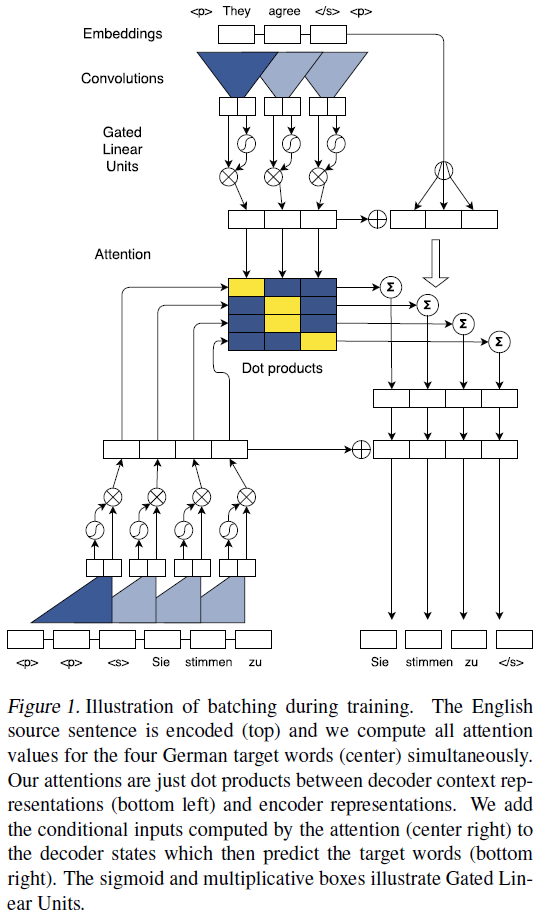
- An architecture for Seq2Seq modeling based entirely on convolutional neural networks. Both encoder and decoder networks share a simple block structure that computes intermediate states based on a fixed number of input elements. Each block contains a one dimensional convolution followed by a non-linearity. For a decoder network with a single block and kernel width k, each resulting state hi1 contains information over k input elements. Stacking several blocks on top of each other increases the number of input elements represented in a state. ( Stacking is similar to the pooling process. )
- Position Embeddings: Input elements x = (x1, . . . , xm) embedded in distributional space as w = (w1, . . . , wm), where wj ∈ Rf is a column in an embedding matrix D ∈ RV×f. The authors also equip the model with a sense of order by embedding the absolute position of input elements p = (p1, . . . , pm) where pj ∈ Rf. Both are combined to obtain input element representations e = (w1+p1, . . . , wm+pm). Position embeddings are useful in the architecture since they give the model a sense of which portion of the sequence in the input or output it is currently dealing with.
- The authors introduce a separate attention mechanism for each decoder layer.
Improvement:
- The model is equipped with gated linear units ( Language modeling with gated linear units - Dauphin et al., arXiv 2016 ) and residual connections ( Deep Residual Learning for Image Recognition - He et al., CVPR 2015a ).
- The authors choose gated linear units as non-linearity which implement a simple gating mechanism over the output of the convolution Y = [A B] ∈ R2d: v([A B]) = A ⓧ σ(B), where A, B ∈ Rd are the inputs to the non-linearity, ⓧ is the point-wise multiplication and the output v([A B]) ∈ Rd is half the size of Y. The gates σ(B) control which inputs A of the current context are relevant. And GLUs perform better than tanh in the context of language modelling.
- To enable deep convolutional networks, authors add residual connections from the input of each convolution to the output of the block. hil = v( Wl [hi−k/2l−1, . . . , hi+k/2l−1] + bwl ) + hil−1
- For encoder networks authors ensure that the output of the convolutional layers matches the input length by padding the input at each layer. However, for decoder networks they have to take care that no future information is available to the decoder. Specifically, we pad the input by k − 1 elements on both the left and right side by zero vectors, and then remove k elements from the end of the convolution output.
General Points:
- Sequence to sequence modeling has been synonymous with recurrent neural network based encoder-decoder architectures. The encoder RNN processes an input sequence x = (x1, . . . , xm) of m elements and returns state representations z = (z1, . . . , zm). The decoder RNN takes z and generates the output sequence y = (y1, . . . , yn) left to right, one element at a time. To generate output yi+1, the decoder computes a new hidden state hi+1 based on the previous state hi, an embedding gi of the previous target language word yi, as well as a conditional input ci derived from the encoder output z. Models without attention consider only the final encoder state zm by setting ci = zm for all i, or simply initialize the first decoder state with zm, in which case ci is not used. Architectures with attention compute ci as a weighted sum of (z1, . . . , zm) at each time step. The weights of the sum are referred to as attention scores and allow the network to focus on different parts of the input sequence as it generates the output sequences. Attention scores are computed by essentially comparing each encoder state zj to a combination of the previous decoder state hi and the last prediction yi; the result is normalized to be a distribution over input elements.
Paper Reading - Convolutional Sequence to Sequence Learning ( CoRR 2017 ) ★的更多相关文章
- Paper Reading - Convolutional Image Captioning ( CVPR 2018 )
Link of the Paper: https://arxiv.org/abs/1711.09151 Motivation: LSTM units are complex and inherentl ...
- [paper reading] C-MIL: Continuation Multiple Instance Learning for Weakly Supervised Object Detection CVPR2019
MIL陷入局部最优,检测到局部,无法完整的检测到物体.将instance划分为空间相关和类别相关的子集.在这些子集中定义一系列平滑的损失近似代替原损失函数,优化这些平滑损失. C-MIL learns ...
- Paper Reading - Attention Is All You Need ( NIPS 2017 ) ★
Link of the Paper: https://arxiv.org/abs/1706.03762 Motivation: The inherently sequential nature of ...
- Convolutional Sequence to Sequence Learning 论文笔记
目录 简介 模型结构 Position Embeddings GLU or GRU Convolutional Block Structure Multi-step Attention Normali ...
- PP: Sequence to sequence learning with neural networks
From google institution; 1. Before this, DNN cannot be used to map sequences to sequences. In this p ...
- 【论文阅读】Sequence to Sequence Learning with Neural Network
Sequence to Sequence Learning with NN <基于神经网络的序列到序列学习>原文google scholar下载. @author: Ilya Sutske ...
- Mol Cell Proteomics. | Prediction of LC-MS/MS properties of peptides from sequence by deep learning (通过深度学习技术根据肽段序列预测其LC-MS/MS谱特征) (解读人:梅占龙)
通过深度学习技术根据肽段序列预测其LC-MS/MS谱特征 解读人:梅占龙 质谱平台 文献名:Prediction of LC-MS/MS properties of peptides from se ...
- Paper Read: Convolutional Image Captioning
Convolutional Image Captioning 2018-11-04 20:42:07 Paper: http://openaccess.thecvf.com/content_cvpr_ ...
- A neural chatbot using sequence to sequence model with attentional decoder. This is a fully functional chatbot.
原项目链接:https://github.com/chiphuyen/stanford-tensorflow-tutorials/tree/master/assignments/chatbot 一个使 ...
随机推荐
- Decorator(装饰)模式
1. 概述 若你从事过面向对象开发,实现给一个类或对象增加行为,使用继承机制,这是所有面向对象语言的一个基本特性.如果已经存在的一个类缺少某些方法,或者须要给方法添加更多的功能(魅力),你也许会仅仅继 ...
- AutoMapper 帮助类
AutoMapper帮助类 /// <summary> /// AutoMapper帮助类 /// </summary> public static class AutoMap ...
- JAVA并发(一)
java并发的一系列框架和技术主要是由java.util.concurrent 包所提供.包下的所有类可以分为如下几大类: locks部分:显式锁(互斥锁和速写锁)相关: atomic部分:原子变量类 ...
- python - 流程控制基础习题
#打印1 到100 的和** i = 0 s = 0 while i <100: i += 1 s += i print(s) print('1+2+,,100=',s) #打印字符A~Z fo ...
- c#使用emit方法DB,实体相互转换
网上有很多ORM框架和数据库转换方法. c#由EF控制,但是大家知道的是影响效率和底层控制. 因此最近几个月一直在研究.最后产出了Hikari数据库连接池. 但是该库只是定位在连接池,无法有效进行后续 ...
- 前端基础-jQuery中的如何操作标签
阅读目录 样式操作 文本操作 属性操作 文档操作 一.样式操作 1.样式类 addClass();// 添加指定的CSS类名. removeClass();// 移除指定的CSS类名. hasClas ...
- javascript编写的一个完整全方位轮播图效果
1 <!DOCTYPE html> <html lang="en"> <head> <meta charset="UTF-8&q ...
- python2.7入门---多线程
多线程类似于同时执行多个不同程序,多线程运行有如下优点: 使用线程可以把占据长时间的程序中的任务放到后台去处理. 用户界面可以更加吸引人,这样比如用户点击了一个按钮去触发某些事件的处理,可以弹 ...
- VS.NET2013发布网站的时候去掉.cs文件(预编译)(转)
在要发布的网站上右键,选择"发布网站". 在发布窗口中,会让你选择一个发布配置文件,没有的话点击下拉菜单在里面选择新建一个. NEXT. 好,现在发布一下网站.发布出来 ...
- 20155227 2016-2017-2 《Java程序设计》实验一 Java开发环境的熟悉(Windws + IDEA)实验报告
20155227 2016-2017-2 <Java程序设计>实验一 Java开发环境的熟悉(Windws + IDEA)实验报告 实验内容 1.使用JDK编译.运行简单的Java程序: ...