
Paper Reading - Attention Is All You Need ( NIPS 2017 ) ★
Link of the Paper: https://arxiv.org/abs/1706.03762
Motivation:
- The inherently sequential nature of Recurrent Models precludes parallelization within training examples.
- Attention mechanisms have become an integral part of compelling sequence modeling and transduction models in various tasks, allowing modeling of dependencies without regard to their distance in the input or output sequences. In all but a few cases, however, such attention mechanisms are used in conjunction with a recurrent network.
Innovation:
- The first sequence transduction model, the Transformer, relying entirely on self-attention to compute representations of its input and output without using sequence-aligned RNNs or Convolutions. The Transformer follows the overall architecture using stacked self-attention and point-wise, fully connected layers for both the encoder and decoder, shown in the left and right halves of Figure 1, respectively.
- Encoder: The encoder is composed of a stack of N = 6 identical layers. Each layer has two sub-layers. The first is a multi-head self-attention mechanism, and the second is a simple, position-wise fully connected feed-forward network. The authors employ a residual connection around each of the two sub-layers, followed by layer normalization. That is, the output of each sub-layer is LayerNorm (x + Sublayer(x)), where Sublayer(x) is the function implemented by the sub-layer itself. To facilitate these residual connections, all sub-layers in the model, as well as the embedding layers, produce outputs of dimension dmodel = 512.
- Decoder: The decoder is also composed of a stack of N = 6 identical layers. In addition to the two sub-layers in each encoder layer, the decoder inserts a third sub-layer, which performs multi-head attention over the output of the encoder stack. Similar to the encoder, they employ residual connections around each of the sub-layers, followed by layer normalization. They also modify the self-attention sub-layer in the decoder stack to prevent positions from attending to subsequent positions. This masking, combined with fact that the output embeddings are offset by one position, ensures that the predictions for position i can depend only on the known outputs at positions less than i.
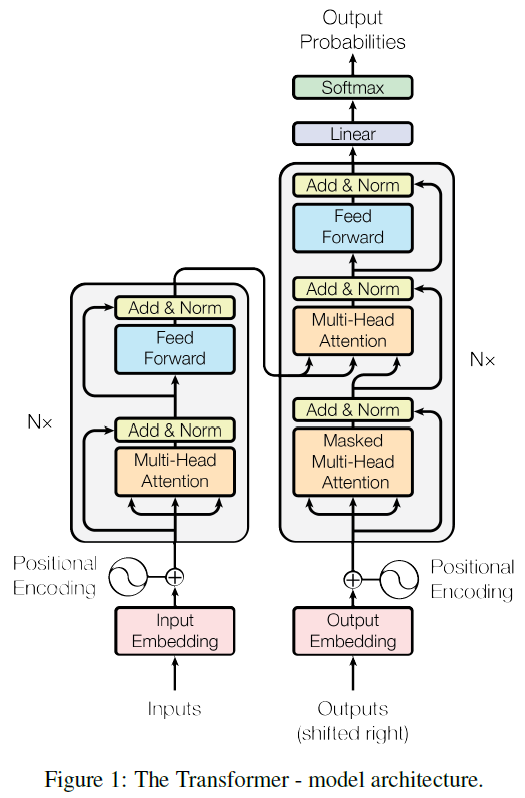
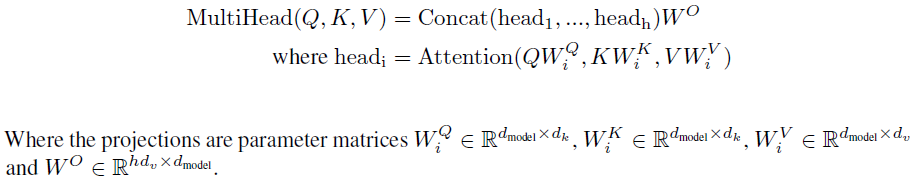
- Scaled Dot-Product Attention and Multi-Head Attention. The Transformer uses multi-head attention in three different ways:
- In "encoder-decoder attention" layers, the queries come from the previous decoder layer, and the memory keys and values come from the output of the encoder. This allows every position in the decoder to attend over all positions in the input sequence. This mimics the typical encoder-decoder attention mechanisms in sequence-to-sequence models such as [ Google’s neural machine translation system: Bridging the gap between human and machine translation. ].
- The encoder contains self-attention layers. In a self-attention layer all of the keys, values and queries come from the same place, in this case, the output of the previous layer in the encoder. Each position in the encoder can attend to all positions in the previous layer of the encoder. [ More about Attention Definition ]
- Similarly, self-attention layers in the decoder allow each position in the decoder to attend to all positions in the decoder up to and including that position. They need to prevent leftward information flow in the decoder to preserve the auto-regressive property. They implement this inside of scaled dot-product attention by masking out (setting to -∞) all values in the input of the softmax which correspond to illegal connections. See Figure 2.
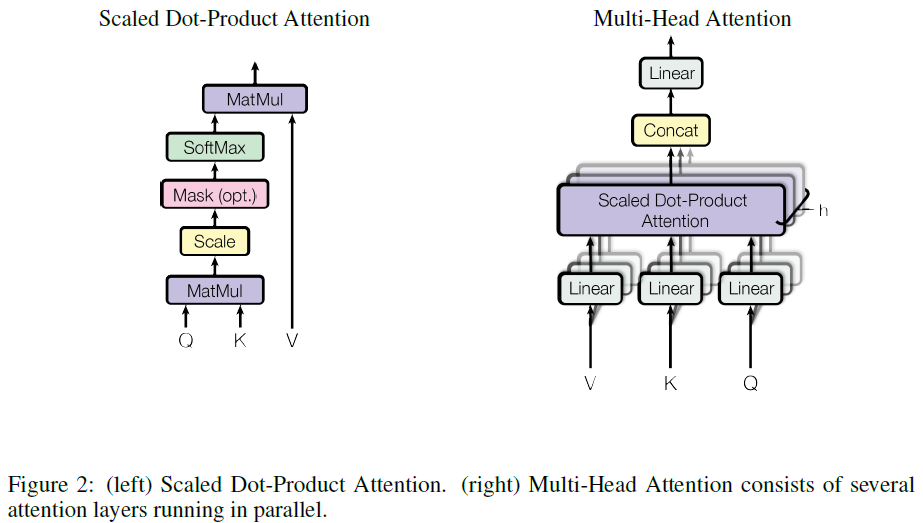
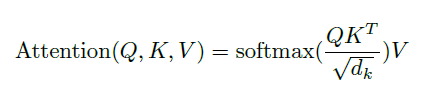
In terms of encoder-decoder, the query Q is usually the hidden state of the decoder. Whereas key K, is the hidden state of the encoder, and the corresponding value V is normalized weight, representing how much attention a key gets. -- The Transformer - Attention is all you need.
- Positional Encoding: Add "positional encodings" to the input embeddings at the bottoms of the encoder and decoder stacks. In this work, they use sine and cosine functions of different frequencies:
- PE(pos, 2i) = sin ( pos / 100002i/dmodel )
- PE(pos, 2i+1) = cos ( pos / 100002i/dmodel)
Improvement:
- Position-wise Feed-Forward Networks: In addition to attention sub-layers, each of the layers in their encoder and decoder contains a fully connected feed-forward network, which is applied to each position separately and identically. This consists of two linear transformations with a ReLU activation in between. FFN(x) = max(0, xW1 + b1)W2 + b2.
General Points:
- An attention function can be described as mapping a query and a set of key-value pairs to an output, where the query, keys, values, and output are all vectors. The output is computed as a weighted sum of the values, where the weight assigned to each value is computed by a compatibility function of the query with the corresponding key.
- Why Self-Attention:
- One is the total computational complexity per layer. Another is the amount of computation that can be parallelized, as measured by the minimum number of sequential operations required.
- The third is the path length between long-range dependencies in the network.
Paper Reading - Attention Is All You Need ( NIPS 2017 ) ★的更多相关文章
- Paper Reading - Convolutional Sequence to Sequence Learning ( CoRR 2017 ) ★
Link of the Paper: https://arxiv.org/abs/1705.03122 Motivation: Compared to recurrent layers, convol ...
- Paper Reading: Stereo DSO
开篇第一篇就写一个paper reading吧,用markdown+vim写东西切换中英文挺麻烦的,有些就偷懒都用英文写了. Stereo DSO: Large-Scale Direct Sparse ...
- Paper Reading - Im2Text: Describing Images Using 1 Million Captioned Photographs ( NIPS 2011 )
Link of the Paper: http://papers.nips.cc/paper/4470-im2text-describing-images-using-1-million-captio ...
- Paper Reading - Show, Attend and Tell: Neural Image Caption Generation with Visual Attention ( ICML 2015 )
Link of the Paper: https://arxiv.org/pdf/1502.03044.pdf Main Points: Encoder-Decoder Framework: Enco ...
- Paper Reading - Sequence to Sequence Learning with Neural Networks ( NIPS 2014 )
Link of the Paper: https://arxiv.org/pdf/1409.3215.pdf Main Points: Encoder-Decoder Model: Input seq ...
- [Paper Reading] Show, Attend and Tell: Neural Image Caption Generation with Visual Attention
论文链接:https://arxiv.org/pdf/1502.03044.pdf 代码链接:https://github.com/kelvinxu/arctic-captions & htt ...
- Paper Reading - CNN+CNN: Convolutional Decoders for Image Captioning
Link of the Paper: https://arxiv.org/abs/1805.09019 Innovations: The authors propose a CNN + CNN fra ...
- Paper Reading - Learning to Evaluate Image Captioning ( CVPR 2018 ) ★
Link of the Paper: https://arxiv.org/abs/1806.06422 Innovations: The authors propose a novel learnin ...
- Paper Reading - Convolutional Image Captioning ( CVPR 2018 )
Link of the Paper: https://arxiv.org/abs/1711.09151 Motivation: LSTM units are complex and inherentl ...
随机推荐
- EF Core 2.1 Raw SQL Queries (转自MSDN)
Entity Framework Core allows you to drop down to raw SQL queries when working with a relational data ...
- 安装maven提示ERROR: JAVA_HOME is set to an invalid directory.
查询网上资料发现多种解决办法:有的是多写了分号,有的路径错误. 需要注意的是maven配置前需要配置好jdk的路径. 我的java_home 之前的配置为:C:\Program Files\Java\ ...
- Java中的集合和常用类
Java中的常用类: ▪ Object类 ▪ Math类 ▪ String类和StringBuffer类(字符串) ▪ 8种基本类型所对应的包装类 ▪ java.util包中的类——Date类 Obj ...
- MVC与MVVM之间在IOS中的区别
作为一个iOS开发者,我不止一次听到我的一些开发者朋友跟我说我写的iOS代码看起来好舒服,很整洁,为什么咱们iOS开发的相当一大部分应用软件都给人以美的享受,究竟是什么使得iOS上的应用可以如此漂亮? ...
- js获取当前时间并转化
1.转化为 年月日 function getNowFormatDate() { var date = new Date(); var seperator1 = "-"; var ...
- 832. Flipping an Image (5月22日 )
解答 class Solution { public: vector<vector<int>> flipAndInvertImage(vector<vector<i ...
- mysql5.7关于使用到OR是否会用到索引并提高查询效率的探讨
相信很多人在mysql中看到了where条件中使用到了or就会以为这样是不会走索引的,通常会使用union all或者in 来进行优化,事实并不是想象的这样具体问题具体分析. 下面我们来看看 首先我们 ...
- $.post({})请求springmvc -5.x 的方法,没有 返回数据的情况
转载请注明出处,毕竟调试了一天 今天用$.post({})传递参数,账号和密码来验证登录,验证成功返回1,验证不成功返回0,结果,$.post({}),的回调函数一直无法执行,但是原来是可以的,不重大 ...
- Yar请求数据接口
//[['u'=>'site.index','d'=>['a'=>2],'k'=>'test']]; public function apiBatch($arr,$timeou ...
- 2.4 自己编写一个vivi驱动程序
学习目标:从零编写一个vivi驱动程序,并测试: 一. vivi驱动应用程序调用过程 上节对xawtv对vivi程序调用欧城进行了详细分析,可总结为以下流程: 二.仿照vivi.c编写myvivi.c ...