
hdu2586&&poj1330 求点间最短距&&最近公共祖先(在线&&离线处理):::可做模板
How far away ?
Time Limit: 2000/1000 MS (Java/Others) Memory Limit: 32768/32768 K (Java/Others)
Total Submission(s): 9097 Accepted Submission(s): 3171
are n houses in the village and some bidirectional roads connecting
them. Every day peole always like to ask like this "How far is it if I
want to go from house A to house B"? Usually it hard to answer. But
luckily int this village the answer is always unique, since the roads
are built in the way that there is a unique simple path("simple" means
you can't visit a place twice) between every two houses. Yout task is to
answer all these curious people.
For
each test case,in the first line there are two numbers
n(2<=n<=40000) and m (1<=m<=200),the number of houses and
the number of queries. The following n-1 lines each consisting three
numbers i,j,k, separated bu a single space, meaning that there is a road
connecting house i and house j,with length k(0<k<=40000).The
houses are labeled from 1 to n.
Next m lines each has distinct integers i and j, you areato answer the distance between house i and house j.
25
100
100
描述:
已知在一个村庄中有n个房子,一些双向的道路把这些房子连接了起来。但是每天都有人询问诸如“如果我想从A房子走到B房子需要走多远的距离?” 的问题。幸运的是,在这个村庄中这个答案总是唯一的,因为任意两个房子之间仅存在一条简单路径(路径上的地点只能访问一次)。你现在的任务是回答这些人的询问。
输入:
输入一个整数n表示房子总数,一个整数m表示询问的总数(n<=40000,m<=200),接下来的n-1行输入n-1条道路的状况,每行3个整数a,b,c表示a房子和b房子之间有一条长度为c的双向道路,接下来输入m行询问,每行两个整数a,b要求给出a房子和b房子的最小距离。
思路: 可以用LCA算法计算出任意两个房子u,v的最近公共祖先lca(u,v)
假设d[]数组为每个房子节点到根节点的距离,那么有
dis(u, v) = d[u] + d[v] – 2*d[lca(u, v)]
在线算法
    /*

    这个版本的在线算法比自创的好看简洁多了,可以当模板,效率不高在于算法其本身的原因;

    据说离线算法要快不少。

    */

    #include <cstdio>

    #include <cstring>

    #include <iostream>

    #include <cmath>

    #include <vector>

    using namespace std;

    const int NN=;

    int n,rt;

    vector<pair<int,int> > edge[NN];

    int depth=;

    int bn=,b[NN*]; //深度序列

    int f[NN*];          //对应深度序列中的结点编号

    int p[NN];             //结点在深度序列中的首位置

    int dis[NN];          //结点到根的距离

    void dfs(int u,int fa)

    {

        int tmp=++depth;

        b[++bn]=tmp; f[tmp]=u; p[u]=bn;

        for (int i=; i<edge[u].size(); i++)

        {

            int v=edge[u][i].first;

            if (v==fa) continue;

            dis[v]=dis[u]+edge[u][i].second;

            dfs(v,u);

            b[++bn]=tmp;

        }

    }

    int dp[NN*][];

    void rmq_init(int n) //以深度序列做rmq

    {

        for (int i=; i<=n; i++) dp[i][]=b[i];

        int m=floor(log(n*1.0)/log(2.0));

        for (int j=; j<=m; j++)

          for (int i=; i<=n-(<<j)+; i++)

              dp[i][j]=min(dp[i][j-],dp[i+(<<(j-))][j-]);

    }

    int rmq(int l,int r)

    {

        int k=floor(log((r-l+)*1.0)/log(2.0));

        return min(dp[l][k],dp[r-(<<k)+][k]);

    }

    int lca(int a,int b)

    {

        if (p[a]>p[b]) swap(a,b);

        int k=rmq(p[a],p[b]);

        return f[k];

    }

    int main()

    {

        int m,u,v,w;

        int t;

        scanf("%d",&t);

        while(t--){

        scanf("%d%d",&n,&m);

        for (int i=; i<=n; i++) edge[i].clear();

        for(int i=;i<n;i++)

        {

            scanf("%d%d%d",&u,&v,&w);

            edge[u].push_back(make_pair(v,w));

            edge[v].push_back(make_pair(u,w));

        }

        rt=; dis[rt]=;

        dfs(,);

        rmq_init(bn);

        while (m--)

        {

            scanf("%d%d",&u,&v);

            printf("%d\n",dis[u]+dis[v]-*dis[lca(u,v)]);

        }

        }

        return ;

    }
离线算法
#include <cstdio>
#include <cstring>
#include <iostream>
#include <vector>
using namespace std;

const int NN=50010;

int n,m;
vector<pair<int,int> > edge[NN],qe[NN];
vector<int> q1,q2;

int p[NN];
int find(int x)
{
    if (p[x]!=x) p[x]=find(p[x]);
    return p[x];
}

int sum=0,ans[NN],dis[NN];
bool vis[NN]={0};
void lca(int u,int fa)
{
    p[u]=u;
    for (int i=0; i<edge[u].size(); i++)
    {
        int v=edge[u][i].first;
        if (v==fa) continue;
        dis[v]=dis[u]+edge[u][i].second;
        lca(v,u);
        p[v]=u;
    }
    vis[u]=true;
    if (sum==m) return;
    for (int i=0; i<qe[u].size(); i++)
    {
        int v=qe[u][i].first;
        if (vis[v])
            ans[qe[u][i].second]=dis[u]+dis[v]-2*dis[find(v)];
    }
}

int main()
{
    int u,v,w;

    int t;
    scanf("%d",&t);
    while(t--){
    scanf("%d%d",&n,&m);
    for (int i=1; i<=n; i++)
    {
        edge[i].clear();
    }
    for (int i=1; i<n; i++)
    {
        scanf("%d%d%d",&u,&v,&w);
        edge[u].push_back(make_pair(v,w));
        edge[v].push_back(make_pair(u,w));
    }

    for (int i=0; i<m; i++)
    {
        scanf("%d%d",&u,&v);
        qe[u].push_back(make_pair(v,i));
        qe[v].push_back(make_pair(u,i));
        ans[i]=0;
    }
    dis[1]=0;
    lca(1,0);
    for (int i=0; i<m; i++) printf("%d\n",ans[i]);
    }
    return 0;
}
| Time Limit: 1000MS | Memory Limit: 10000K | |
| Total Submissions: 22116 | Accepted: 11566 |
Description
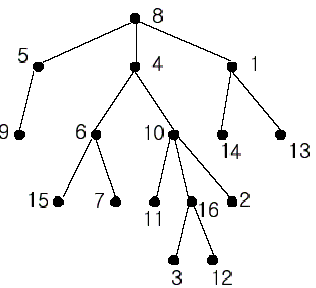
In the figure, each node is labeled with an integer from {1,
2,...,16}. Node 8 is the root of the tree. Node x is an ancestor of node
y if node x is in the path between the root and node y. For example,
node 4 is an ancestor of node 16. Node 10 is also an ancestor of node
16. As a matter of fact, nodes 8, 4, 10, and 16 are the ancestors of
node 16. Remember that a node is an ancestor of itself. Nodes 8, 4, 6,
and 7 are the ancestors of node 7. A node x is called a common ancestor
of two different nodes y and z if node x is an ancestor of node y and an
ancestor of node z. Thus, nodes 8 and 4 are the common ancestors of
nodes 16 and 7. A node x is called the nearest common ancestor of nodes y
and z if x is a common ancestor of y and z and nearest to y and z among
their common ancestors. Hence, the nearest common ancestor of nodes 16
and 7 is node 4. Node 4 is nearer to nodes 16 and 7 than node 8 is.
For other examples, the nearest common ancestor of nodes 2 and 3 is
node 10, the nearest common ancestor of nodes 6 and 13 is node 8, and
the nearest common ancestor of nodes 4 and 12 is node 4. In the last
example, if y is an ancestor of z, then the nearest common ancestor of y
and z is y.
Write a program that finds the nearest common ancestor of two distinct nodes in a tree.
Input
input consists of T test cases. The number of test cases (T) is given in
the first line of the input file. Each test case starts with a line
containing an integer N , the number of nodes in a tree,
2<=N<=10,000. The nodes are labeled with integers 1, 2,..., N.
Each of the next N -1 lines contains a pair of integers that represent
an edge --the first integer is the parent node of the second integer.
Note that a tree with N nodes has exactly N - 1 edges. The last line of
each test case contains two distinct integers whose nearest common
ancestor is to be computed.
Output
Sample Input
2

16

1 14

8 5

10 16

5 9

4 6

8 4

4 10

1 13

6 15

10 11

6 7

10 2

16 3

8 1

16 12

16 7

5

2 3

3 4

3 1

1 5

3 5
Sample Output
4

3
Source
//这个tarjan算法使用了并查集+dfs的操作。中间的那个并查集操作的作用,只是将已经查找过的节点捆成一个集合然后再指向一个公共的祖先。另外,如果要查询LCA(a,b),必须把(a,b)和(b,a)都加入邻接表。

//

//O(n+Q)

#include <iostream>

#include <cstdio>

#include <cstring>

#include <vector>

using namespace std;

#define MAXN 10001

int n,fa[MAXN];

int rank[MAXN];

int indegree[MAXN];

int vis[MAXN];

vector<int> hash[MAXN],Qes[MAXN];

int ances[MAXN];//祖先

void init(int n)

{

    for(int i=;i<=n;i++)

    {

        fa[i]=i;

        rank[i]=;

        indegree[i]=;

        vis[i]=;

        ances[i]=;

        hash[i].clear();

        Qes[i].clear();

    }

}

int find(int x)

{

    if(x != fa[x])

        fa[x]=find(fa[x]);

    return fa[x];

}

void unio(int x,int y)

{

    int fx=find(x),fy=find(y);

    if(fx==fy) return ;

    if(rank[fy]<rank[fx])

        fa[fy]=fx;

    else

    {

        fa[fx]=fy;

        if(rank[fx]==rank[fy])

            rank[fy]++;

    }

}

void Tarjan(int u)

{

    ances[u]=u;

    int i,size = hash[u].size();

    for(i=;i<size;i++)

    {

        Tarjan(hash[u][i]);//递归处理儿子

        unio(u,hash[u][i]);//将儿子父亲合并,合并时会将儿子的父亲改为u

        ances[find(u)]=u;//此时find(u)仍为u,即

    }

    vis[u]=;

    //查询

    size = Qes[u].size();

    for(i=;i<size;i++)

    {

        if(vis[Qes[u][i]]==)//即查询的另一个结点开始已经访问过,当前的u在此回合访问。

        {

            printf("%d\n",ances[find(Qes[u][i])]);//由于递归,此时还是在u

            return;

        }

    }

}

int main()

{

    int t;

    int i,j;

    scanf("%d",&t);

    while(t--)

    {

        scanf("%d",&n);

        init(n);

        int s,d;

        for(i=;i<=n-;i++)

        {

            scanf("%d%d",&s,&d);

            hash[s].push_back(d);

            indegree[d]++;

        }

        scanf("%d%d",&s,&d);

    //    if(s==d)//如果需要计数的时候注意

//            ans[d]++;

//        else

//        {

            Qes[s].push_back(d);

            Qes[d].push_back(s);

//        }

        for(j=;j<=n;j++)

        {

            if(indegree[j]==)

            {

                Tarjan(j);

                break;

            }

        }

    }

    return ;

}
hdu2586&&poj1330 求点间最短距&&最近公共祖先(在线&&离线处理):::可做模板的更多相关文章
- 求LCA最近公共祖先的离线Tarjan算法_C++
这个Tarjan算法是求LCA的算法,不是那个强连通图的 它是 离线 算法,时间复杂度是 O(m+n),m 是询问数,n 是节点数 它的优点是比在线算法好写很多 不过有些题目是强制在线的,此类离线算法 ...
- HDU 1330 Nearest Common Ancestors(求两个点的近期公共祖先)
题目链接:id=1330">传送门 在线算法: #include <iostream> #include <cstdio> #include <cstri ...
- HDU2586.How far away ?——近期公共祖先(离线Tarjan)
http://acm.hdu.edu.cn/showproblem.php?pid=2586 给定一棵带权有根树,对于m个查询(u,v),求得u到v之间的最短距离 那么仅仅要求得LCA(u,v),di ...
- POJ 1330 Nearest Common Ancestors(求最近的公共祖先)
题意:给出一棵树,再给出两个节点a.b,求离它们最近的公共祖先.方法一: 先用vector存储某节点的子节点,fa数组存储某节点的父节点,最后找出fa[root]=0的根节点root. 之后 ...
- LCA 在线倍增法 求最近公共祖先
第一步:建树 这个就不说了 第二部:分为两步 分别是深度预处理和祖先DP预处理 DP预处理: int i,j; ;(<<j)<n;j++) ;i<n;++i) ) fa[i ...
- 倍增法求lca(最近公共祖先)
倍增法求lca(最近公共祖先) 基本上每篇博客都会有参考文章,一是弥补不足,二是这本身也是我学习过程中找到的觉得好的资料 思路: 大致上算法的思路是这样发展来的. 想到求两个结点的最小公共祖先,我们可 ...
- POJ 1986 Distance Queries (Tarjan算法求最近公共祖先)
题目链接 Description Farmer John's cows refused to run in his marathon since he chose a path much too lo ...
- 连通分量模板:tarjan: 求割点 && 桥 && 缩点 && 强连通分量 && 双连通分量 && LCA(近期公共祖先)
PS:摘自一不知名的来自大神. 1.割点:若删掉某点后.原连通图分裂为多个子图.则称该点为割点. 2.割点集合:在一个无向连通图中,假设有一个顶点集合,删除这个顶点集合,以及这个集合中全部顶点相关联的 ...
- 求最近公共祖先(LCA)的各种算法
水一发题解. 我只是想存一下树剖LCA的代码...... 以洛谷上的这个模板为例:P3379 [模板]最近公共祖先(LCA) 1.朴素LCA 就像做模拟题一样,先dfs找到基本信息:每个节点的父亲.深 ...
随机推荐
- 测试发布(maven-assembly-plugin看好你哦)
项目改成了maven管理,现场需要用增量补丁包的形式发布代码: 2015/4/21 以前试过用ant打补丁包,现在试试maven能不能做同样的事情: maven-assembly-plugin看着可以 ...
- iOS解析新浪微博的@##以及URL链接并展示
最近在做一个跟微博相关的应用.其中涉及到了对微博中@.##以及URL链接的解析与展示.分享一下个人处理的方式,希望对需要的人有所帮助. 最终的展现效果: 首先,第一步是你得从纯文本中找到它们.毫无疑问 ...
- mysqlimport命令
mysqlimport的大多数选项直接对应LOAD DATA INFILE子句. 选项: -u,--user 指定连接用户名. -p,--password[name] 指定连接用户的密码. - ...
- UVA 12169 Disgruntled Judge(Extended_Euclid)
用扩展欧几里德Extended_Euclid解线性模方程,思路在注释里面了. 注意数据范围不要爆int了. /********************************************* ...
- 【51nod1743】雪之国度(最小生成树+倍增)
点此看题面 大致题意: 给你一张无向连通图,其中每条边的边权为这条边连接的两点的权值之差.每次询问两点之间是否存在两条不重复的路径,若存在则输出这两条路径上最大值的最小值. 大致思路 这题显然就是要让 ...
- Drupal7新装一个主题时页面白屏,如何设置一个默认主题?
问题: 请问我不小心退出登陆了 但这个主题没有登录口 而且之前不知道为什么我其他界面都不能显示内容所以 ?q=user 也不行,怎么办呢?看网上说更换默认主题 去variable表里把默认主题换了,我 ...
- 操作系统(3)_CPU调度_李善平ppt
不只上面的四种,比如时间片到了也会引起调度. 具体的调度算法: fcfs简单,但是波动很大. 最高相应比算法,执行时间最长就应该等待的长点,比sjf多了一个等待时间的考虑. 硬件定时器和软件计数器共同 ...
- IOS后台执行
大多数应用程序进入后台状态不久后转入暂停状态.在这种状态下,应用程序不执行任何代码,并有可能在任意时候从内存中删除.应用程序提供特定的服务,用户可以请求后台执行时间,以提供这些服务. 判断是否支持多线 ...
- LIS最长上升子序列模板
LIS n2解法: #include<iostream> #include<cstdio> using namespace std; int n,ans; ],f[]; int ...
- 爬取代理IP,并判断是否可用。
# -*- coding:utf-8 -*- from gevent import monkey monkey.patch_all() import urllib2 from gevent.pool ...