
ACM-ICPC 2017 Asia Urumqi(第八场)
A. Coins
Alice and Bob are playing a simple game. They line up a row of nnn identical coins, all with the heads facing down onto the table and the tails upward.
For exactly mmm times they select any kkk of the coins and toss them into the air, replacing each of them either heads-up or heads-down with the same possibility. Their purpose is to gain as many coins heads-up as they can.
Input
The input has several test cases and the first line contains the integer t(1≤t≤1000) which is the total number of cases.
For each case, a line contains three space-separated integers n, m(1≤n,m≤100) and k(1≤k≤n.
Output
For each test case, output the expected number of coins heads-up which you could have at the end under the optimal strategy, as a real number with the precision of 3 digits.
样例输入
6

2 1 1

2 3 1

5 4 3

6 2 3

6 100 1

6 100 2
样例输出
0.500

1.250

3.479

3.000

5.500

5.000
题目来源
概率DP.
设dp[i][j]是第i次操作后正面朝上的概率,则反面朝上还有n-j枚,若n-j大于k,则k中任取
若n-j小于k,则必须从已经正面朝上的硬币中取j-(k-(n-j))枚
#include <iostream>

#include <algorithm>

#include <cstring>

#include <cstdio>

#include <vector>

#include <queue>

#include <stack>

#include <cstdlib>

#include <iomanip>

#include <cmath>

#include <cassert>

#include <ctime>

#include <map>

#include <set>

using namespace std;

#pragma comment(linker, "/stck:1024000000,1024000000")

#pragma GCC diagnostic error "-std=c++11"

#define lowbit(x) (x&(-x))

#define max(x,y) (x>=y?x:y)

#define min(x,y) (x<=y?x:y)

#define MAX 100000000000000000

#define MOD 1000000007

#define esp 1e-9

#define pi acos(-1.0)

#define ei exp(1)

#define PI 3.1415926535897932384626433832

#define ios() ios::sync_with_stdio(true)

#define INF 0x3f3f3f3f

#define mem(a) (memset(a,0,sizeof(a)))

int dcmp(double x){return fabs(x)<esp?:x<?-:;}

typedef long long ll;

int n,m,k,T;

double dp[][];

double p[],c[][];

void solve()

{

    c[][]=;

    for(int i=;i<=;i++)

    {

        c[i][]=;

        for(int j=;j<=;j++)

            c[i][j]=c[i-][j-]+c[i-][j];

    }

    p[]=;

    for(int i=;i<=;i++)

        p[i]=p[i-]/2.0;

}

int main()

{

    solve();

    scanf("%d",&T);

    while(T--)

    {

        scanf("%d%d%d",&n,&m,&k);

        memset(dp,,sizeof(dp));

        dp[][]=;

        for(int i=;i<m;i++)

        {

            for(int j=;j<=n;j++)

            {

                for(int t=;t<=k;t++)

                {

                    if(n-j>=k) dp[i+][j+t]+=dp[i][j]*c[k][t]*p[k];

                    else dp[i+][n-k+t]+=dp[i][j]*c[k][t]*p[k];

                }

            }

        }

        double ans=0.0;

        for(int i=;i<=n;i++)

            ans+=i*dp[m][i];

        printf("%.3lf\n",ans);

    }

    return ;

}
B. The Difference
Alice was always good at math. Her only weak points were multiplication and subtraction. To help her with that, Bob presented her with the following problem.
He gave her four positive integers. Alice can change their order optionally. Her task is to find an order, denoted by A1,A2,A and A4, with the maximum value of A1×A2−A3×A4.
Input
The input contains several test cases and the first line provides an integer t(1≤t≤100) indicating the number of cases.
Each of the following t lines contains four space-separated integers.
All integers are positive and not greater than 100.
Output
For each test case, output a line with a single integer, the maximum value of A1×A2−A3×A4.
样例输入
5

1 2 3 4

2 2 2 2

7 4 3 8

100 99 98 97

100 100 1 2
样例输出
10

0

44

394

9998
签到题
#include <iostream>

#include <algorithm>

#include <cstring>

#include <cstdio>

#include <vector>

#include <queue>

#include <stack>

#include <cstdlib>

#include <iomanip>

#include <cmath>

#include <cassert>

#include <ctime>

#include <map>

#include <set>

using namespace std;

#pragma comment(linker, "/stck:1024000000,1024000000")

#pragma GCC diagnostic error "-std=c++11"

#define lowbit(x) (x&(-x))

#define max(x,y) (x>=y?x:y)

#define min(x,y) (x<=y?x:y)

#define MAX 100000000000000000

#define MOD 1000000007

#define esp 1e-9

#define pi acos(-1.0)

#define ei exp(1)

#define PI 3.1415926535897932384626433832

#define ios() ios::sync_with_stdio(true)

#define INF 0x3f3f3f3f

#define mem(a) (memset(a,0,sizeof(a)))

int dcmp(double x){return fabs(x)<esp?:x<?-:;}

typedef long long ll;

int main()

{

    int n,a[];

    scanf("%d",&n);

    while(n--){

        for(int i=;i<;i++)

            scanf("%d",&a[i]);

        int ans=a[]*a[]-a[]*a[];

        for(int i=;i<;i++)

            for(int j=;j<;j++)

                for(int k=;k<;k++)

                    if(!(i==j || j==k || i==k))

                        ans=max(ans,a[i]*a[j]-a[k]*a[-i-j-k]);

        printf("%d\n",ans);

    }

    return ;

}
D. Fence Building
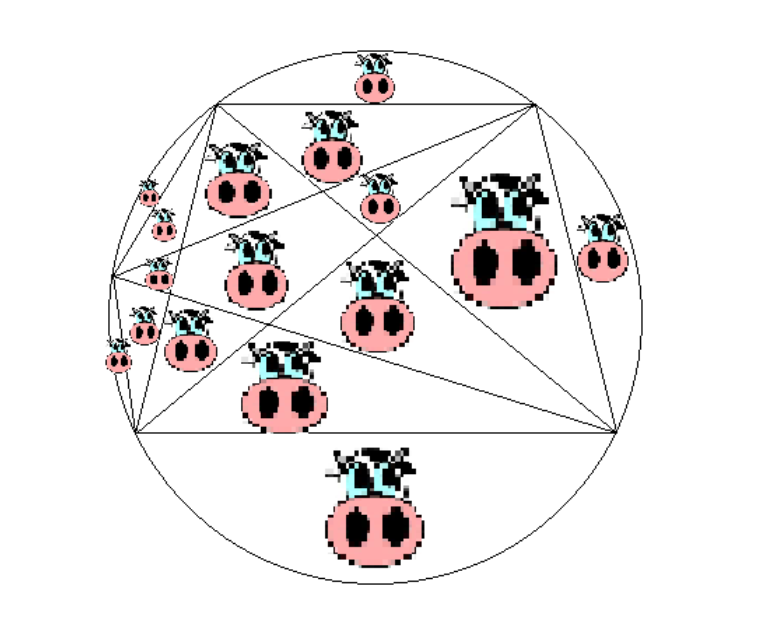
Farmer John owns a farm. He first builds a circle fence. Then, he will choose n points and build some straight fences connecting them. Next, he will feed a cow in each region so that cows cannot play with each other without breaking the fences. In order to feed more cows, he also wants to have as many regions as possible. However, he is busy building fences now, so he needs your help to determine what is the maximum number of cows he can feed if he chooses these n points properly.
Input
The first line contains an integer 1≤T≤100000, the number of test cases. For each test case, there is one line that contains an integer n. It is guaranteed that 1≤T≤105 and 1≤n≤1018.
Output
For each test case, you should output a line ”Case #i: ans” where i is the test caseS number, starting from 1 and ans is the remainder of the maximum number of cows farmer John can feed when divided by 109+7.
样例输入
3

1

3

5
样例输出
Case #1: 1

Case #2: 4

Case #3: 16
结论题
w=C(n,2)+C(n,4)+1;
#include <iostream>

#include <algorithm>

#include <cstring>

#include <cstdio>

#include <vector>

#include <queue>

#include <stack>

#include <cstdlib>

#include <iomanip>

#include <cmath>

#include <cassert>

#include <ctime>

#include <map>

#include <set>

using namespace std;

#pragma comment(linker, "/stck:1024000000,1024000000")

#pragma GCC diagnostic error "-std=c++11"

#define lowbit(x) (x&(-x))

#define max(x,y) (x>=y?x:y)

#define min(x,y) (x<=y?x:y)

#define MAX 100000000000000000

#define MOD 1000000007

#define esp 1e-9

#define pi acos(-1.0)

#define ei exp(1)

#define PI 3.1415926535897932384626433832

#define ios() ios::sync_with_stdio(true)

#define INF 0x3f3f3f3f

#define mem(a) (memset(a,0,sizeof(a)))

int dcmp(double x){return fabs(x)<esp?:x<?-:;}

typedef long long ll;

ll n,t;

void exgcd(ll a,ll b,ll &x,ll &y)

{

    ll t;

    if(!b){x=;y=;return ;}

    exgcd(b,a%b,x,y);

    t=x;x=y;

    y=t-a/b*x;

}

ll inv(ll n)

{

    ll x,y;

    exgcd(n,MOD,x,y);

    return (x+MOD)%MOD;

}

ll C(ll n,ll m)

{

    if(m>n) return ;

    ll ans=;

    for(ll i=;i<=m;i++)

    {

        ans=(ans*(n-i+)%MOD*inv(i)%MOD)%MOD;

    }

    return ans;

}

ll solve(ll n,ll m)

{

    if(m==) return ;

    return C(n%MOD,m%MOD)*solve(n/MOD,m/MOD)%MOD;

}

int main()

{

    scanf("%lld",&t);

    ll o=t;

    while(t--)

    {

        scanf("%lld",&n);

        printf("Case #%lld: %lld\n",o-t,(solve(n,)+solve(n,)+)%MOD);

    }

    return ;

}
G. The Mountain
All as we know, a mountain is a large landform that stretches above the surrounding land in a limited area. If we as the tourists take a picture of a distant mountain and print it out, the image on the surface of paper will be in the shape of a particular polygon.
From mathematics angle we can describe the range of the mountain in the picture as a list of distinct points, denoted by (x1,y1) to (xn,yn). The first point is at the original point of the coordinate system and the last point is lying on the x-axis. All points else have positive y coordinates and incremental xxx coordinates. Specifically, all x coordinates satisfy 0=x1<x2<x3<...<xn. All y coordinates are positive except the first and the last points whose yyy coordinates are zeroes.
The range of the mountain is the polygon whose boundary passes through points (x1,y1) to (xn,yn) in turn and goes back to the first point. In this problem, your task is to calculate the area of the range of a mountain in the picture.
Input
The input has several test cases and the first line describes an integer t(1≤t≤20) which is the total number of cases.
In each case, the first line provides the integer n(1≤n≤100) which is the number of points used to describe the range of a mountain. Following n lines describe all points and the iii-th line contains two integers xix_ixi and yi(0≤xi,yi≤1000) indicating the coordinate of the i-th point.
Output
For each test case, output the area in a line with the precision of 666 digits.
样例输入
3

3

0 0

1 1

2 0

4

0 0

5 10

10 15

15 0

5

0 0

3 7

7 2

9 10

13 0
样例输出
1.000000

125.000000

60.500000
计算不规则多边形面积,因为x有序,y>0所以切成梯形来计算
#include <iostream>

#include <algorithm>

#include <cstring>

#include <cstdio>

#include <vector>

#include <queue>

#include <stack>

#include <cstdlib>

#include <iomanip>

#include <cmath>

#include <cassert>

#include <ctime>

#include <map>

#include <set>

using namespace std;

#pragma comment(linker, "/stck:1024000000,1024000000")

#pragma GCC diagnostic error "-std=c++11"

#define lowbit(x) (x&(-x))

#define max(x,y) (x>=y?x:y)

#define min(x,y) (x<=y?x:y)

#define MAX 100000000000000000

#define MOD 1000000007

#define esp 1e-9

#define pi acos(-1.0)

#define ei exp(1)

#define PI 3.1415926535897932384626433832

#define ios() ios::sync_with_stdio(true)

#define INF 0x3f3f3f3f

#define mem(a) (memset(a,0,sizeof(a)))

int dcmp(double x){return fabs(x)<esp?:x<?-:;}

typedef long long ll;

struct Point{

    double x,y;

}e[];

int n,t;

int main()

{

    scanf("%d",&t);

    while(t--){

        scanf("%d",&n);

        for(int i=;i<n;i++)

            scanf("%lf%lf",&e[i].x,&e[i].y);

        double ans=0.0;

        for(int i=;i<n;i++)

            ans+=(e[i].y+e[i-].y)*(e[i].x-e[i-].x);

        printf("%.6lf\n",ans/);

    }

    return ;

}
ACM-ICPC 2017 Asia Urumqi(第八场)的更多相关文章
- ACM ICPC 2017 Warmup Contest 9 I
I. Older Brother Your older brother is an amateur mathematician with lots of experience. However, hi ...
- ACM ICPC 2017 Warmup Contest 9 L
L. Sticky Situation While on summer camp, you are playing a game of hide-and-seek in the forest. You ...
- ACM-ICPC 2017 Asia Urumqi A. Coins
Alice and Bob are playing a simple game. They line up a row of n identical coins, all with the heads ...
- ACM-ICPC 2017 Asia Urumqi G. The Mountain
All as we know, a mountain is a large landform that stretches above the surrounding land in a limite ...
- ACM-ICPC 2017 Asia Urumqi:A. Coins(DP) 组合数学
Alice and Bob are playing a simple game. They line up a row of nn identical coins, all with the head ...
- ACM/ICPC 之 BFS-广搜进阶-八数码(经典)(POJ1077+HDU1043)
八数码问题也称为九宫问题.(本想查查历史,结果发现居然没有词条= =,所谓的历史也就不了了之了) 在3×3的棋盘,摆有八个棋子,每个棋子上标有1至8的某一数字,不同棋子上标的数字不相同.棋盘上还有一个 ...
- ACM-ICPC 2017 Asia Urumqi:A. Coins(DP)
挺不错的概率DP,看似基础,实则很考验扎实的功底 这题很明显是个DP,为什么???找规律或者算组合数这种概率,N不可能给的这么友善... 因为DP一般都要在支持N^2操作嘛. 稍微理解一下,这DP[i ...
- ACM-ICPC 2017 Asia Urumqi A. Coins【期望dp】
题目链接:https://www.jisuanke.com/contest/2870?view=challenges 题目大意:给出n个都正面朝下的硬币,操作m次,每次都选取k枚硬币抛到空中,求操作m ...
- hdu 6143: Killer Names (2017 多校第八场 1011)
题目链接 题意,有m种颜色,给2n个位置染色,使左边n个和右边n个没有共同的颜色. 可以先递推求出恰用i种颜色染n个位置的方案数,然后枚举两边的染色数就可以了,代码很简单. #include<b ...
随机推荐
- JavaScript 没有函数重载&Arguments对象
对于学过Java的人来说.函数重载并非一个陌生的概念,可是javaScript中有函数重载么...接下来我们就进行測试 <script type="text/javascript&qu ...
- Javascript防冒泡事件与Event对象
防冒泡 防冒泡用到的就是event的属性和方法 function add2shop(e) { if (!e) var e = window.event; e.cancelBubble = true; ...
- m-orchastration system
m-orchastration system 1.bootstrap上面有很多前台的页面代码可以用 2.H-ui里面的案例我可以去看看,这个网站也有后台框架 H-ui案例 - H-ui前端框架官方网站 ...
- Kettle学习系列之数据仓库、数据整合、ETL、ELT和EII之间的区别?
不多说,直接上干货! 在数据仓库领域里,的一个重要概念就是数据整合(data intergration).数据整合它就是把不同数据库中的数据整合到一起,对外提供统一的数据视图. 数据整合最典型的案例就 ...
- Kali linux 2016.2(Rolling)中的payloads模块详解
不多说,直接上干货! 前期博客 Kali linux 2016.2(Rolling)中的Exploits模块详解 payloads模块,也就是shellcode,就是在漏洞利用成功后所要做的事情.在M ...
- 滚动监听 after选择器
一.如何实现滚动到一定位置将内容固定在页面顶部 window.onscroll=function(){ //滚动的距离,距离顶部的距离 var topScroll =document.body.scr ...
- ADO.NET之断开数据连接的数据库操作
在ADO.NET对数据库操作时有两种方式一种时与数据库实时连接,第二种时断开连接的操作. 断开连接的操作使用SqlDataAdapter来实现,我们要把数据库中的表数据加载到winform中的data ...
- 使用Python进行多线程检查.moe三位剩余有效域名
翻看博客看到一段不错的代码 虽然近期没有购买域名的需求 不过日后有购买域名的需求的话 稍作修改直接使用还是很方便的 import threading import requests import js ...
- Markdown语法简记
目录 一.标题 1. 六个级别的标题 2. 主.副两级标题 二.根据标题生成文档结构大纲 三.字体 1. 斜体 2. 粗体 3. 倾斜加粗 4. 行首缩进 5. 删除线 四.引用块 五.代码块 1. ...
- LightOJ-1220 Mysterious Bacteria 唯一分解定理 带条件的最大公因数
题目链接:https://cn.vjudge.net/problem/LightOJ-1220 题意 给x=y^p,问p最大多少 注意x可能负数 思路 唯一分解定理,求各素因数指数的GCD 注意负数的 ...