
ACM-ICPC 2017 Asia Urumqi(第八场)
A. Coins
Alice and Bob are playing a simple game. They line up a row of nnn identical coins, all with the heads facing down onto the table and the tails upward.
For exactly mmm times they select any kkk of the coins and toss them into the air, replacing each of them either heads-up or heads-down with the same possibility. Their purpose is to gain as many coins heads-up as they can.
Input
The input has several test cases and the first line contains the integer t(1≤t≤1000) which is the total number of cases.
For each case, a line contains three space-separated integers n, m(1≤n,m≤100) and k(1≤k≤n.
Output
For each test case, output the expected number of coins heads-up which you could have at the end under the optimal strategy, as a real number with the precision of 3 digits.
样例输入
6

2 1 1

2 3 1

5 4 3

6 2 3

6 100 1

6 100 2
样例输出
0.500

1.250

3.479

3.000

5.500

5.000
题目来源
概率DP.
设dp[i][j]是第i次操作后正面朝上的概率,则反面朝上还有n-j枚,若n-j大于k,则k中任取
若n-j小于k,则必须从已经正面朝上的硬币中取j-(k-(n-j))枚
#include <iostream>

#include <algorithm>

#include <cstring>

#include <cstdio>

#include <vector>

#include <queue>

#include <stack>

#include <cstdlib>

#include <iomanip>

#include <cmath>

#include <cassert>

#include <ctime>

#include <map>

#include <set>

using namespace std;

#pragma comment(linker, "/stck:1024000000,1024000000")

#pragma GCC diagnostic error "-std=c++11"

#define lowbit(x) (x&(-x))

#define max(x,y) (x>=y?x:y)

#define min(x,y) (x<=y?x:y)

#define MAX 100000000000000000

#define MOD 1000000007

#define esp 1e-9

#define pi acos(-1.0)

#define ei exp(1)

#define PI 3.1415926535897932384626433832

#define ios() ios::sync_with_stdio(true)

#define INF 0x3f3f3f3f

#define mem(a) (memset(a,0,sizeof(a)))

int dcmp(double x){return fabs(x)<esp?:x<?-:;}

typedef long long ll;

int n,m,k,T;

double dp[][];

double p[],c[][];

void solve()

{

    c[][]=;

    for(int i=;i<=;i++)

    {

        c[i][]=;

        for(int j=;j<=;j++)

            c[i][j]=c[i-][j-]+c[i-][j];

    }

    p[]=;

    for(int i=;i<=;i++)

        p[i]=p[i-]/2.0;

}

int main()

{

    solve();

    scanf("%d",&T);

    while(T--)

    {

        scanf("%d%d%d",&n,&m,&k);

        memset(dp,,sizeof(dp));

        dp[][]=;

        for(int i=;i<m;i++)

        {

            for(int j=;j<=n;j++)

            {

                for(int t=;t<=k;t++)

                {

                    if(n-j>=k) dp[i+][j+t]+=dp[i][j]*c[k][t]*p[k];

                    else dp[i+][n-k+t]+=dp[i][j]*c[k][t]*p[k];

                }

            }

        }

        double ans=0.0;

        for(int i=;i<=n;i++)

            ans+=i*dp[m][i];

        printf("%.3lf\n",ans);

    }

    return ;

}
B. The Difference
Alice was always good at math. Her only weak points were multiplication and subtraction. To help her with that, Bob presented her with the following problem.
He gave her four positive integers. Alice can change their order optionally. Her task is to find an order, denoted by A1,A2,A and A4, with the maximum value of A1×A2−A3×A4.
Input
The input contains several test cases and the first line provides an integer t(1≤t≤100) indicating the number of cases.
Each of the following t lines contains four space-separated integers.
All integers are positive and not greater than 100.
Output
For each test case, output a line with a single integer, the maximum value of A1×A2−A3×A4.
样例输入
5

1 2 3 4

2 2 2 2

7 4 3 8

100 99 98 97

100 100 1 2
样例输出
10

0

44

394

9998
签到题
#include <iostream>

#include <algorithm>

#include <cstring>

#include <cstdio>

#include <vector>

#include <queue>

#include <stack>

#include <cstdlib>

#include <iomanip>

#include <cmath>

#include <cassert>

#include <ctime>

#include <map>

#include <set>

using namespace std;

#pragma comment(linker, "/stck:1024000000,1024000000")

#pragma GCC diagnostic error "-std=c++11"

#define lowbit(x) (x&(-x))

#define max(x,y) (x>=y?x:y)

#define min(x,y) (x<=y?x:y)

#define MAX 100000000000000000

#define MOD 1000000007

#define esp 1e-9

#define pi acos(-1.0)

#define ei exp(1)

#define PI 3.1415926535897932384626433832

#define ios() ios::sync_with_stdio(true)

#define INF 0x3f3f3f3f

#define mem(a) (memset(a,0,sizeof(a)))

int dcmp(double x){return fabs(x)<esp?:x<?-:;}

typedef long long ll;

int main()

{

    int n,a[];

    scanf("%d",&n);

    while(n--){

        for(int i=;i<;i++)

            scanf("%d",&a[i]);

        int ans=a[]*a[]-a[]*a[];

        for(int i=;i<;i++)

            for(int j=;j<;j++)

                for(int k=;k<;k++)

                    if(!(i==j || j==k || i==k))

                        ans=max(ans,a[i]*a[j]-a[k]*a[-i-j-k]);

        printf("%d\n",ans);

    }

    return ;

}
D. Fence Building
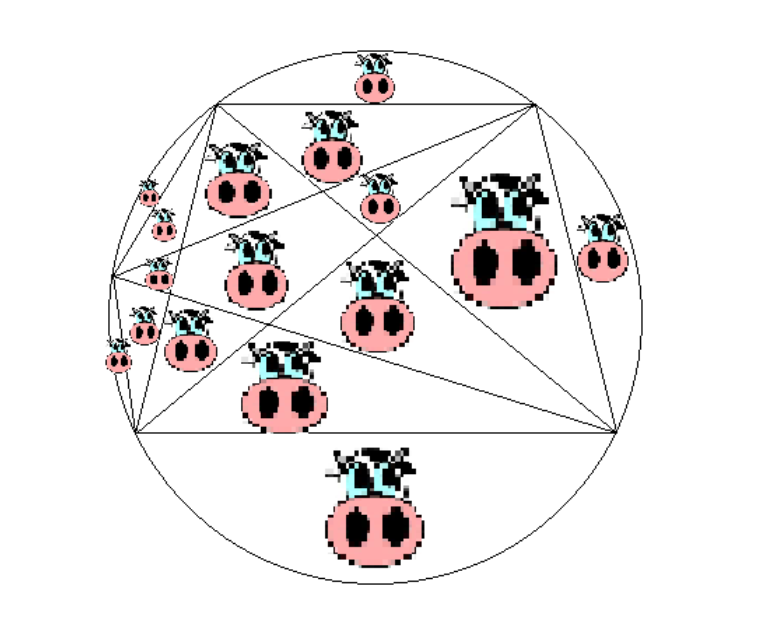
Farmer John owns a farm. He first builds a circle fence. Then, he will choose n points and build some straight fences connecting them. Next, he will feed a cow in each region so that cows cannot play with each other without breaking the fences. In order to feed more cows, he also wants to have as many regions as possible. However, he is busy building fences now, so he needs your help to determine what is the maximum number of cows he can feed if he chooses these n points properly.
Input
The first line contains an integer 1≤T≤100000, the number of test cases. For each test case, there is one line that contains an integer n. It is guaranteed that 1≤T≤105 and 1≤n≤1018.
Output
For each test case, you should output a line ”Case #i: ans” where i is the test caseS number, starting from 1 and ans is the remainder of the maximum number of cows farmer John can feed when divided by 109+7.
样例输入
3

1

3

5
样例输出
Case #1: 1

Case #2: 4

Case #3: 16
结论题
w=C(n,2)+C(n,4)+1;
#include <iostream>

#include <algorithm>

#include <cstring>

#include <cstdio>

#include <vector>

#include <queue>

#include <stack>

#include <cstdlib>

#include <iomanip>

#include <cmath>

#include <cassert>

#include <ctime>

#include <map>

#include <set>

using namespace std;

#pragma comment(linker, "/stck:1024000000,1024000000")

#pragma GCC diagnostic error "-std=c++11"

#define lowbit(x) (x&(-x))

#define max(x,y) (x>=y?x:y)

#define min(x,y) (x<=y?x:y)

#define MAX 100000000000000000

#define MOD 1000000007

#define esp 1e-9

#define pi acos(-1.0)

#define ei exp(1)

#define PI 3.1415926535897932384626433832

#define ios() ios::sync_with_stdio(true)

#define INF 0x3f3f3f3f

#define mem(a) (memset(a,0,sizeof(a)))

int dcmp(double x){return fabs(x)<esp?:x<?-:;}

typedef long long ll;

ll n,t;

void exgcd(ll a,ll b,ll &x,ll &y)

{

    ll t;

    if(!b){x=;y=;return ;}

    exgcd(b,a%b,x,y);

    t=x;x=y;

    y=t-a/b*x;

}

ll inv(ll n)

{

    ll x,y;

    exgcd(n,MOD,x,y);

    return (x+MOD)%MOD;

}

ll C(ll n,ll m)

{

    if(m>n) return ;

    ll ans=;

    for(ll i=;i<=m;i++)

    {

        ans=(ans*(n-i+)%MOD*inv(i)%MOD)%MOD;

    }

    return ans;

}

ll solve(ll n,ll m)

{

    if(m==) return ;

    return C(n%MOD,m%MOD)*solve(n/MOD,m/MOD)%MOD;

}

int main()

{

    scanf("%lld",&t);

    ll o=t;

    while(t--)

    {

        scanf("%lld",&n);

        printf("Case #%lld: %lld\n",o-t,(solve(n,)+solve(n,)+)%MOD);

    }

    return ;

}
G. The Mountain
All as we know, a mountain is a large landform that stretches above the surrounding land in a limited area. If we as the tourists take a picture of a distant mountain and print it out, the image on the surface of paper will be in the shape of a particular polygon.
From mathematics angle we can describe the range of the mountain in the picture as a list of distinct points, denoted by (x1,y1) to (xn,yn). The first point is at the original point of the coordinate system and the last point is lying on the x-axis. All points else have positive y coordinates and incremental xxx coordinates. Specifically, all x coordinates satisfy 0=x1<x2<x3<...<xn. All y coordinates are positive except the first and the last points whose yyy coordinates are zeroes.
The range of the mountain is the polygon whose boundary passes through points (x1,y1) to (xn,yn) in turn and goes back to the first point. In this problem, your task is to calculate the area of the range of a mountain in the picture.
Input
The input has several test cases and the first line describes an integer t(1≤t≤20) which is the total number of cases.
In each case, the first line provides the integer n(1≤n≤100) which is the number of points used to describe the range of a mountain. Following n lines describe all points and the iii-th line contains two integers xix_ixi and yi(0≤xi,yi≤1000) indicating the coordinate of the i-th point.
Output
For each test case, output the area in a line with the precision of 666 digits.
样例输入
3

3

0 0

1 1

2 0

4

0 0

5 10

10 15

15 0

5

0 0

3 7

7 2

9 10

13 0
样例输出
1.000000

125.000000

60.500000
计算不规则多边形面积,因为x有序,y>0所以切成梯形来计算
#include <iostream>

#include <algorithm>

#include <cstring>

#include <cstdio>

#include <vector>

#include <queue>

#include <stack>

#include <cstdlib>

#include <iomanip>

#include <cmath>

#include <cassert>

#include <ctime>

#include <map>

#include <set>

using namespace std;

#pragma comment(linker, "/stck:1024000000,1024000000")

#pragma GCC diagnostic error "-std=c++11"

#define lowbit(x) (x&(-x))

#define max(x,y) (x>=y?x:y)

#define min(x,y) (x<=y?x:y)

#define MAX 100000000000000000

#define MOD 1000000007

#define esp 1e-9

#define pi acos(-1.0)

#define ei exp(1)

#define PI 3.1415926535897932384626433832

#define ios() ios::sync_with_stdio(true)

#define INF 0x3f3f3f3f

#define mem(a) (memset(a,0,sizeof(a)))

int dcmp(double x){return fabs(x)<esp?:x<?-:;}

typedef long long ll;

struct Point{

    double x,y;

}e[];

int n,t;

int main()

{

    scanf("%d",&t);

    while(t--){

        scanf("%d",&n);

        for(int i=;i<n;i++)

            scanf("%lf%lf",&e[i].x,&e[i].y);

        double ans=0.0;

        for(int i=;i<n;i++)

            ans+=(e[i].y+e[i-].y)*(e[i].x-e[i-].x);

        printf("%.6lf\n",ans/);

    }

    return ;

}
ACM-ICPC 2017 Asia Urumqi(第八场)的更多相关文章
- ACM ICPC 2017 Warmup Contest 9 I
I. Older Brother Your older brother is an amateur mathematician with lots of experience. However, hi ...
- ACM ICPC 2017 Warmup Contest 9 L
L. Sticky Situation While on summer camp, you are playing a game of hide-and-seek in the forest. You ...
- ACM-ICPC 2017 Asia Urumqi A. Coins
Alice and Bob are playing a simple game. They line up a row of n identical coins, all with the heads ...
- ACM-ICPC 2017 Asia Urumqi G. The Mountain
All as we know, a mountain is a large landform that stretches above the surrounding land in a limite ...
- ACM-ICPC 2017 Asia Urumqi:A. Coins(DP) 组合数学
Alice and Bob are playing a simple game. They line up a row of nn identical coins, all with the head ...
- ACM/ICPC 之 BFS-广搜进阶-八数码(经典)(POJ1077+HDU1043)
八数码问题也称为九宫问题.(本想查查历史,结果发现居然没有词条= =,所谓的历史也就不了了之了) 在3×3的棋盘,摆有八个棋子,每个棋子上标有1至8的某一数字,不同棋子上标的数字不相同.棋盘上还有一个 ...
- ACM-ICPC 2017 Asia Urumqi:A. Coins(DP)
挺不错的概率DP,看似基础,实则很考验扎实的功底 这题很明显是个DP,为什么???找规律或者算组合数这种概率,N不可能给的这么友善... 因为DP一般都要在支持N^2操作嘛. 稍微理解一下,这DP[i ...
- ACM-ICPC 2017 Asia Urumqi A. Coins【期望dp】
题目链接:https://www.jisuanke.com/contest/2870?view=challenges 题目大意:给出n个都正面朝下的硬币,操作m次,每次都选取k枚硬币抛到空中,求操作m ...
- hdu 6143: Killer Names (2017 多校第八场 1011)
题目链接 题意,有m种颜色,给2n个位置染色,使左边n个和右边n个没有共同的颜色. 可以先递推求出恰用i种颜色染n个位置的方案数,然后枚举两边的染色数就可以了,代码很简单. #include<b ...
随机推荐
- nyoj--1239--引水工程(最小生成树)
引水工程 时间限制:2000 ms | 内存限制:65535 KB 难度: 描述 南水北调工程是优化水资源配置.促进区域协调发展的基础性工程,是新中国成立以来投资额最大.涉及面最广的战略性工程,事 ...
- vue 初始化项目模板报错
E:\xiaogezi.cn\vue>vue init webpack myProject vue-cli · Failed to download repo vuejs-templates/w ...
- label标签的可访问性问题
label标签可以优雅地扩大表单控件元素的点击区域.例如,单纯的单选框点击区域就鼻屎那么大的地方,经常会点不到位置.因此,label标签的使用对于提高页面的可用性可访问性是很有帮助的. 其实,它的样子 ...
- Codeforces 982 B. Bus of Characters(模拟一个栈)
解题思路: 排序之后模拟一个栈(也可以用真的栈),时间复杂度o(n). 代码: #include <bits/stdc++.h> using namespace std; typedef ...
- ActiveMQ学习笔记(20)----Consumer高级特性(二)
1. Message Selectors JMS Selectors 用在获取消息的时候,可以基于消息属性和Xpath语法对消息进行过滤.JMS Selectors有SQL92语义定义.以下是个Sel ...
- Web前端为什么这么火爆?
Web前端为什么这么火爆? 互联网发展到今天,全球已有28.9亿互联网用户,中国有355万网站,6.5亿网民,13亿手机用户,5亿微信用户,当步入互联网+时代后,互联网已经越来越复杂,纷繁复杂的互联网 ...
- js的运算小数点的问题
问题这样的: 37.5*5.5=206.08 (JS算出来是这样的一个结果,我四舍五入取两位小数) 我先怀疑是四舍五入的问题,就直接用JS算了一个结果为:206.08499999999998 怎么会这 ...
- vue-cli 打包 使用 history模式 的后端配置
apache的配置 这是windows下的 在httpd-vhosts.conf文件中把目录指向项目index.html文件所在的位置 # Virtual Hosts # <VirtualHos ...
- 让div垂直居中
参考链接:https://www.cnblogs.com/softwarefang/p/6095806.html 以前我的方法总是比较粗暴,纯粹通过margin来实现,这个方法的缺点不仅在于需要多次微 ...
- Qt之pro配置多个子工程/子模块
简述 进行Qt项目开发的时候,尤其是大型项目,经常涉及多工程/多模块问题,其主要思想还是模块化,目的是为了降低程序复杂度,使程序设计.调试和维护等操作简单化. 简述 配置 效果 多工程 多模块 更多参 ...