
POJ1330 Nearest Common Ancestors
| Time Limit: 1000MS | Memory Limit: 10000K | |
| Total Submissions: 24587 | Accepted: 12779 |
Description
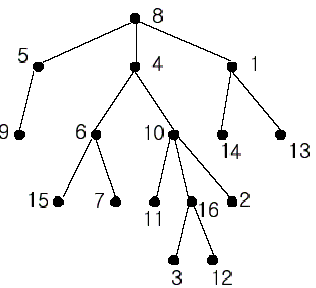
In the figure, each node is labeled with an integer from {1, 2,...,16}. Node 8 is the root of the tree. Node x is an ancestor of node y if node x is in the path between the root and node y. For example, node 4 is an ancestor of node 16. Node 10 is also an ancestor of node 16. As a matter of fact, nodes 8, 4, 10, and 16 are the ancestors of node 16. Remember that a node is an ancestor of itself. Nodes 8, 4, 6, and 7 are the ancestors of node 7. A node x is called a common ancestor of two different nodes y and z if node x is an ancestor of node y and an ancestor of node z. Thus, nodes 8 and 4 are the common ancestors of nodes 16 and 7. A node x is called the nearest common ancestor of nodes y and z if x is a common ancestor of y and z and nearest to y and z among their common ancestors. Hence, the nearest common ancestor of nodes 16 and 7 is node 4. Node 4 is nearer to nodes 16 and 7 than node 8 is.
For other examples, the nearest common ancestor of nodes 2 and 3 is node 10, the nearest common ancestor of nodes 6 and 13 is node 8, and the nearest common ancestor of nodes 4 and 12 is node 4. In the last example, if y is an ancestor of z, then the nearest common ancestor of y and z is y.
Write a program that finds the nearest common ancestor of two distinct nodes in a tree.
Input
Output
Sample Input
2

16

1 14

8 5

10 16

5 9

4 6

8 4

4 10

1 13

6 15

10 11

6 7

10 2

16 3

8 1

16 12

16 7

5

2 3

3 4

3 1

1 5

3 5
Sample Output
4

3
Source
LCA(最近公共祖先)
先找到树根,之后倍增处理出每个点的祖先结点,然后同时上溯即可。
 //lca

 #include<algorithm>

 #include<iostream>

 #include<cstdio>

 #include<cstring>

 #include<cmath>

 #include<vector>

 using namespace std;

 const int mxn=;

 int n;

 vector<int> e[mxn];

 int fa[mxn][];

 int dep[mxn];

 int in[mxn];

 void add_edge(int u,int v){

     e[u].push_back(v);

     in[v]++;

 }

 void dfs(int u){//求点深度,倍增算祖先结点fa

     for(int i=;i<e[u].size();i++){

         int v=e[u][i];

         fa[v][]=u;

         dep[v]=dep[u]+;

         for(int j=;(<<j)<=dep[v];j++){

             fa[v][j]=fa[fa[v][j-]][j-];

         }

         dfs(v);

     }

     return;

 }

 int lca(int a,int b){

     if(dep[a]<dep[b])swap(a,b);//(处理深度更大的那个)

     for(int i=;i!=-;i--)//从高位开始试。(其实从低开始也一样?)

         if(dep[a]>=dep[b]+(<<i))a=fa[a][i];//此步结束后,a和b查找到的深度相同

     if(a==b)return a;

     for(int i=;i!=-;i--)//共同上溯

         if(fa[a][i]!=fa[b][i])a=fa[a][i],b=fa[b][i];

     return fa[a][];

 }

 int main(){

     int T;

     scanf("%d",&T);

     int i,j;

     while(T--){

         memset(dep,,sizeof(dep));

         memset(fa,,sizeof(fa));

         memset(in,,sizeof(in));

         scanf("%d",&n);

         for(i=;i<=n;i++) e[i].clear();

         int u,v;

         for(i=;i<n;i++){

             scanf("%d%d",&u,&v);

             add_edge(u,v);

         }

         int root=;

         for(i=;i<=n;i++)if(in[i]==){root=i;break;}//入度为0的那个点是根

         dep[root]=;

         fa[root][]=-;

         dfs(root);

         int a,b;

         scanf("%d%d",&a,&b);

         printf("%d\n",lca(a,b));

     }

     return ;

 }
POJ1330 Nearest Common Ancestors的更多相关文章
- POJ1330 Nearest Common Ancestors(最近公共祖先)(tarjin)
A - Nearest Common Ancestors Time Limit:1000MS Memory Limit:10000KB 64bit IO Format:%lld &am ...
- POJ1330 Nearest Common Ancestors (JAVA)
经典LCA操作.. 贴AC代码 import java.lang.reflect.Array; import java.util.*; public class POJ1330 { // 并查集部分 ...
- [POJ1330]Nearest Common Ancestors(LCA, 离线tarjan)
题目链接:http://poj.org/problem?id=1330 题意就是求一组最近公共祖先,昨晚学了离线tarjan,今天来实现一下. 个人感觉tarjan算法是利用了dfs序和节点深度的关系 ...
- POJ 1330 Nearest Common Ancestors / UVALive 2525 Nearest Common Ancestors (最近公共祖先LCA)
POJ 1330 Nearest Common Ancestors / UVALive 2525 Nearest Common Ancestors (最近公共祖先LCA) Description A ...
- POJ 1330 Nearest Common Ancestors (LCA,dfs+ST在线算法)
Nearest Common Ancestors Time Limit: 1000MS Memory Limit: 10000K Total Submissions: 14902 Accept ...
- JDOJ 3055: Nearest Common Ancestors
JDOJ 3055: Nearest Common Ancestors JDOJ传送门 Description 给定N个节点的一棵树,有K次查询,每次查询a和b的最近公共祖先. 样例中的16和7的公共 ...
- POJ 1330 Nearest Common Ancestors(Targin求LCA)
传送门 Nearest Common Ancestors Time Limit: 1000MS Memory Limit: 10000K Total Submissions: 26612 Ac ...
- [最近公共祖先] POJ 1330 Nearest Common Ancestors
Nearest Common Ancestors Time Limit: 1000MS Memory Limit: 10000K Total Submissions: 27316 Accept ...
- POJ 1330 Nearest Common Ancestors
Nearest Common Ancestors Time Limit: 1000MS Memory Limit: 10000K Total Submissions: 14698 Accept ...
随机推荐
- smarty中section遍历数组
smarty中section遍历数组
- no.3 base64
tool.chinaz.com的base64有的无法解密: 如:ZXZhbCgkX1BPU1RbcDRuOV96MV96aDNuOV9qMXVfU2gxX0oxM10pNTU2NJC3ODHHYWJI ...
- Jdeveloper 太慢 slowly
https://blogs.oracle.com/shay/entry/is_your_jdeveloper_slow_it_sho http://bexhuff.com/2012/09/jdevel ...
- php基础19:文件
<?php //1.打开文件的更好的方法是通过 fopen() 函数.此函数为您提供比 readfile() 函数更多的选项. //fopen() 的第一个参数包含被打开的文件名,第二个参数规定 ...
- IBatis.net介绍
IBatis.net介绍 IBatis.net 是2001年发起的开源项目,它是一个轻量级的ORM框架,现在IBatisNET已经是属于Apache下的一个子项目了,最新版本是1.6.2. 官方网站: ...
- 分享到微信微博空间等第三方平台的JS代码
分享功能有利于传播更多优质的内容,所以在web项目中也是比较常用的.今天就抽空整理下常用的分享平台的JS代码.这些代码可以在对应平台的官方网站上生成,官网上对分享内容的参数也有详尽说明.这里只对常用的 ...
- JS案例之4——Ajax多图上传
近期项目中有好几次用到多图上传,第一次在项目中真正用到Ajax技术,稍微整理了下,贴个案例出来. 我们传统的做法是当用户提交一个表单时,就向web服务器端发送一个请求.服务器接受并处理传来的表单信息, ...
- 《图解tcp/ip》读书笔记(二)
<图解tcp/ip>读书笔记(二) 本周主要阅读的是本书的第三章--数据链路. 当然了,从某些角度讲,我认为这一章就是计算机网络的最基本的内容之一.整章讲述了数据链路层的作用和相关技术,主 ...
- Servlet响应的中文字符集问题
在Servlet中利用response向客户端浏览器输出中文时有时会遇到乱码问题,总结如下: response输出流有两种,一是以字节流输出,一是以字符流输出. 一.以字节流输出: 1.默认编码输出木 ...
- Unknown column '' in 'field list'解决方案
很多人在用php+MySQL做网站往数据库插入数据时发现如下错误: 注册失败!Unknown column '1a' in 'field list' 结果发现用数字提交是没有问题的,其他如char型就 ...