
架构:The Onion Architecture : part 1(洋葱架构:第一篇)(转载)
原文地址:http://jeffreypalermo.com/blog/the-onion-architecture-part-1/。
I've spoken several times about a specific type of architecture I call "Onion Architecture". I've found that it leads to more maintainable applications since it emphasizes separation of concerns throughout the system. I must set the context for the use of this architecture before proceeding. This architecture is not appropriate for small websites. It is appropriate for long-lived business applications as well as applications with complex behavior. It emphasizes the use of interfaces for behavior contracts, and it forces the externalization of infrastructure.

The diagram you see here is a representation of traditional layered architecture. This is the basic architecture I see most frequently used. Each subsequent layer depends on the layers beneath it, and then every layer normally will depend on some common infrastructure and utility services. The big drawback to this top-down layered architecture is the coupling that it creates. Each layer is coupled to the layers below it, and each layer is often coupled to various infrastructure concerns. However, without coupling, our systems wouldn't do anything useful, but this architecture creates unnecessary coupling.
The biggest offender (and most common) is the coupling of UI and business logic to data access. Yes, UI is coupled to data access with this approach. Transitive dependencies are still dependencies. The UI can't function if business logic isn't there. Business logic can't function if data access isn't there. I'm intentionally ignoring infrastructure here because this typically varies from system to system. Data access changes frequently. Historically, the industry has modified data access techniques at least every three years; therefore, we can count on needing to modify data access three years from now for any healthy, long-lived systems that's mission-critical to the business. We often don't keep systems up-to-date because it's impossible to do. If coupling prevents easily upgrading parts of the system, then the business has no choice but to let the system fall behind into a state of disrepair. This is how legacy systems become stale, and eventually they are rewritten.
I propose a new approach to architecture. Honestly, it's not completely new, but I'm proposing it as a named, architectural pattern. Patterns are useful because it gives software professionals a common vocabulary with which to communicate. There are a lot of aspects to the Onion Architecture, and if we have a common term to describe this approach, we can communicate more effectively.
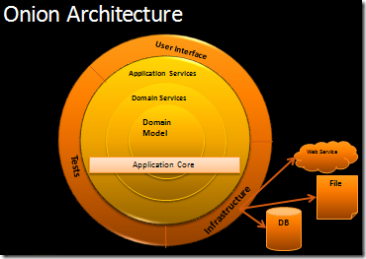
The diagram to the left depicts the Onion Architecture. The main premise is that it controls coupling. The fundamental rule is that all code can depend on layers more central, but code cannot depend on layers further out from the core. In other words, all coupling is toward the center. This architecture is unashamedly biased toward object-oriented programming, and it puts objects before all others.
In the very center we see the Domain Model, which represents the state and behavior combination that models truth for the organization. Around the Domain Model are other layers with more behavior. The number of layers in the application core will vary, but remember that the Domain Model is the very center, and since all coupling is toward the center, the Domain Model is only coupled to itself. The first layer around the Domain Model is typically where we would find interfaces that provide object saving and retrieving behavior, called repository interfaces. The object saving behavior is not in the application core, however, because it typically involves a database. Only the interface is in the application core. Out on the edges we see UI, Infrastructure, and Tests. The outer layer is reserved for things that change often. These things should be intentionally isolated from the application core. Out on the edge, we would find a class that implements a repository interface. This class is coupled to a particular method of data access, and that is why it resides outside the application core. This class implements the repository interface and is thereby coupled to it.
The Onion Architecture relies heavily on the Dependency Inversion principle. The application core needs implementation of core interfaces, and if those implementing classes reside at the edges of the application, we need some mechanism for injecting that code at runtime so the application can do something useful.
The database is not the center. It is external. Externalizing the database can be quite a change for some people used to thinking about applications as "database applications". With Onion Architecture, there are no database applications. There are applications that might use a database as a storage service but only though some external infrastructure code that implements an interface which makes sense to the application core. Decoupling the application from the database, file system, etc, lowers the cost of maintenance for the life of the application.
Alistair Cockburn has written a bit about Hexagonal architecture. Hexagonal architecture and Onion Architecture share the following premise: Externalize infrastructure and write adapter code so that the infrastructure does not become tightly coupled.
I'll be writing more about the Onion Architecture as a default approach for building enterprise applications. I will stay in the enterprise system space and all discussion will reside in that context. This gets even more interesting when there are multiple processes making up a single software system.
架构:The Onion Architecture : part 1(洋葱架构:第一篇)(转载)的更多相关文章
- 企业架构研究总结(38)——TOGAF架构能力框架之架构能力建设和架构治理
为了确保架构功能在企业中能够被成功地运用,企业需要通过建立适当的组织结构.流程.角色.责任和技能来实现其自身的企业架构能力,而这也正是TOGAF的架构能力框架(Architecture Capabil ...
- 架构:The Onion Architecture : part 3(洋葱架构:第三篇)(转载)
In my previous installments, I described what has become my approach to defining the architecture fo ...
- 架构:The Onion Architecture : part 2(洋葱架构:第二篇)(转载)
原位地址:http://jeffreypalermo.com/blog/the-onion-architecture-part-2/. In part 1, I introduced an archi ...
- 干净的架构The Clean Architecture
干净的架构The Clean Architecture 这是著名软件大师Bob大叔提出的一种架构,也是当前各种语言开发架构.干净架构提出了一种单向依赖关系,从而从逻辑上形成一种向上的抽象系统. 我们经 ...
- 企业架构(Enterprise Architecture)
ylbtech-Miscellaneos: 企业架构(Enterprise Architecture) A,返回顶部 1, 简称EA.是指对企业事业信息管理系统中具有体系的.普遍性的问题而提供的通用解 ...
- [Architecture Design] 3-Layer基础架构
[Architecture Design] 3-Layer基础架构 三层式体系结构 只要是软件从业人员,不管是不是本科系出身的,相信对于三层式体系结构一定都不陌生.在三层式体系结构中,将软件开发所产出 ...
- 清晰架构(Clean Architecture)的Go微服务: 程序结构
我使用Go和gRPC创建了一个微服务,并试图找出最佳的程序结构,它可以用作我未来程序的模板. 我有Java背景,并发现自己在Java和Go之间挣扎,它们之间的编程理念完全不同.我写了一系列关于在项目工 ...
- 清晰架构(Clean Architecture)的Go微服务: 设计原则
我最近写了一个Go微服务应用程序,这个程序的设计来自三个灵感: 清晰架构"Clean Architecture"¹ and SOLID (面向对象设计)² 设计 原则³ Sprin ...
- 清晰架构(Clean Architecture)的Go微服务: 程序容器(Application Container)
清晰架构(Clean Architecture)的一个理念是隔离程序的框架,使框架不会接管你的应用程序,而是由你决定何时何地使用它们.在本程序中,我特意不在开始时使用任何框架,因此我可以更好地控制程序 ...
随机推荐
- yolov2在CUDA8.0+cudnn8.0下安装、训练、检测经历
这次用yolov2做检测时遇到个大坑,折腾了我好几天,特以此文记录之. 一.安装cuda+cudnn 它们的版本必须要匹配,否则训练后检测不出目标! 1.下载cuda8.0.61_375.26_lin ...
- CI框架+Umeditor上传图片配置信息
Umeditor提供了一个上传文件通用的类Uploader.class.php, 首先将Uploader.class.php类放入CI框架的libraries目录下更名为Myuploader.php然 ...
- 交叉验证(Cross Validation)简介
参考 交叉验证 交叉验证 (Cross Validation)刘建平 一.训练集 vs. 测试集 在模式识别(pattern recognition)与机器学习(machine lea ...
- vmware工具克隆linux系统步骤及配置
我们在学习的时候使用vmware创建自己的虚拟机,但是我们有时学习环境需要多台计算机进行操作演示,如果安装创建虚拟机.再在虚拟机上安装操作系统.这样很花费我们的时间,而且还步能保证服务的一直性,这就用 ...
- Angular和Vue.js
Angular和Vue.js Vue.js 是开源的 JavaScript 框架,能够帮助开发者构建出美观的 Web 界面.当和其它网络工具配合使用时,Vue.js 的优秀功能会得到大大加强.如今,已 ...
- UI 框架
Vue.js 之 iView UI 框架 像我们平日里做惯了 Java 或者 .NET 这种后端程序员,对于前端的认识还常常停留在 jQuery 时代,包括其插件在需要时就引用一下,不需要就删除.故观 ...
- sublime安装package control 的方法
1.安装sublime3后,点击菜单 view>show console,复制以下代码按回车即可,安装时稍微有些卡,需要耐心等待. import urllib.request,os; pf = ...
- css 控制文字超出时显示省略号
不多说,直接看代码吧: <!DOCTYPE html> <html> <head> <meta charset="UTF-8"> & ...
- Redis介绍及部署在CentOS7上(一)
0.Redis目录结构 1)Redis介绍及部署在CentOS7上(一) 2)Redis指令与数据结构(二) 3)Redis客户端连接以及持久化数据(三) 4)Redis高可用之主从复制实践(四) 5 ...
- [ 转载 ] get和post的区别
GET和POST两种基本请求方法的区别 GET和POST是HTTP请求的两种基本方法,要说它们的区别,接触过WEB开发的人都能说出一二. 最直观的区别就是GET把参数包含在URL中,POST通过r ...