
架构:The Onion Architecture : part 3(洋葱架构:第三篇)(转载)
In my previous installments, I described what has become my approach to defining the architecture for an application. Based on feedback, I've modified my diagrams a bit to reduce ambiguity and emphasize key points. The goal of part 3 of this series is to compare and contrast the Onion Architecture with traditional layered architecture. I will flatten the Onion Architecture to see what it looks like compared to traditional layered architecture, and I will force the layered architecture into an onion. Whereas the shape can be either, the structure of the actual application is radically different from what is commonly known and accepted. I'll define four tenets of Onion Architecture at the end.
I must stress again: I am not claiming any breakthroughs in technology or technique. I have learned from other industry thought leaders like Martin Fowler, Ward Cunningham, Kent Beck, Michael Feathers and others (especially those I've had the privilege to work with here in Austin, TX). I'm putting forth the Onion Architecture as an architectural pattern by which we can communicate this radically different architectural approach. Not "radically different as in new". Different as in not mainstream.
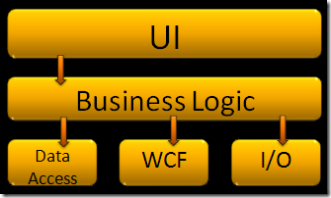 Let's review. Traditional layered architecture can look somewhat like the diagram depicted on the right. Each layer communicates with the layer below it. The UI talks to business logic, but it does not talk directly to data access, WCF, etc. The layering approach does call out the need to keep certain categories of code out of the UI. The big downfall is that business logic ends up coupled to infrastructure concerns. Data Access, I/O, and Web Services are all infrastructure. Infrastructure is any code that is a commodity and does not give your application a competitive advantage. This code is most likely to change frequently as the application goes through years of maintenance. Web services are still fairly new, and the first version in .Net, ASMX, is already deprecated in favor of WCF. We can be assured that WCF's days are numbered as well, so it is foolish to tightly couple the business logic to WCF. Data access changes every two years or so, so we definitely don't want to be tightly coupled to it. For long-life, we would want our business logic to be independent of these infrastructure concerns so that as infrastructure changes, the business logic doesn't have to.
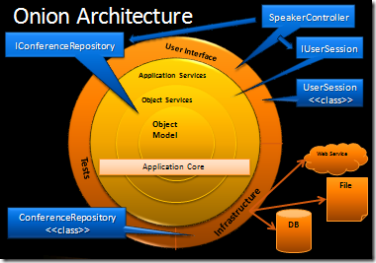 Let's review Onion Architecture. The object model is in the center with supporting business logic around it. The direction of coupling is toward the center. The big difference is that any outer layer can directly call any inner layer. With traditionally layered architecture, a layer can only call the layer directly beneath it. This is one of the key points that makes Onion Architecture different from traditional layered architecture. Infrastructure is pushed out to the edges where no business logic code couples to it. The code that interacts with the database will implement interfaces in the application core. The application core is coupled to those interfaces but not the actual data access code. In this way, we can change code in any outer layer without affecting the application core. We include tests because any long-lived application needs tests. Tests sit at the outskirts because the application core doesn't couple to them, but the tests are coupled to the application core. We could also have another layer of tests around the entire outside when we test the UI and infrastructure code.
This approach to application architecture ensures that the application core doesn't have to change as: the UI changes, data access changes, web service and messaging infrastructure changes, I/O techniques change.
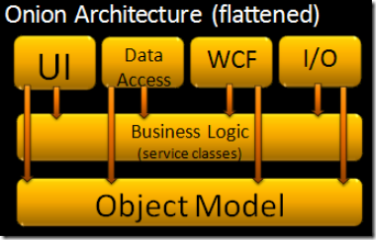 To the right, I have created a diagram which attempts to show what Onion Architecture would look like when represented as a traditionally layered architecture. The big difference is that Data Access is a top layer along with UI, I/O, etc. Another key difference is that the layers above can use any layer beneath them, not just the layer immediately beneath. Also, business logic is coupled to the object model but not to infrastructure.
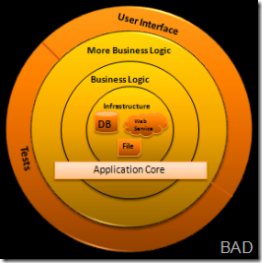
To the left here I have attempted to represent traditionally layered architecture using concentric circles. I have used black lines around the layers to denote that each outer layer only talks to the layer immediately toward the center. The big kicker here is that we clearly see the application is built around data access and other infrastructure. Because the application has this coupling, when data access, web services, etc. change, the business logic layer will have to change. The world view difference is how to handle infrastructure. Traditional layered architecture couples directly to it. Onion Architecture pushes it off to the side and defines abstractions (interfaces) to depend on. Then the infrastructure code also depends on these abstractions (interfaces). Depending on abstractions is an old principle, but the Onion Architecture puts that concepts right up front.
Key tenets of Onion Architecture:
- The application is built around an independent object model
- Inner layers define interfaces. Outer layers implement interfaces
- Direction of coupling is toward the center
- All application core code can be compiled and run separate from infrastructure
I encourage you to use the term "Onion Architecture" when speaking about architectures that adhere to the above four tenets. I believe that this approach to architecture leads to long-lived systems that are easy to maintain. Also, in my experience, this architecture yields dividends soon after a project starts since it makes the code a breeze to change.
Although I don't call out an IoC container as a key tenet, when using a mainstream language like Java or C#, an IoC container makes the code fit together very easily. Some languages have IoC features built-in, so this is not always necessary. If you are using C#, I highly recommend using Castle Windsor or StructureMap.
架构:The Onion Architecture : part 3(洋葱架构:第三篇)(转载)的更多相关文章
- 企业架构研究总结(38)——TOGAF架构能力框架之架构能力建设和架构治理
为了确保架构功能在企业中能够被成功地运用,企业需要通过建立适当的组织结构.流程.角色.责任和技能来实现其自身的企业架构能力,而这也正是TOGAF的架构能力框架(Architecture Capabil ...
- 架构:The Onion Architecture : part 2(洋葱架构:第二篇)(转载)
原位地址:http://jeffreypalermo.com/blog/the-onion-architecture-part-2/. In part 1, I introduced an archi ...
- 架构:The Onion Architecture : part 1(洋葱架构:第一篇)(转载)
原文地址:http://jeffreypalermo.com/blog/the-onion-architecture-part-1/. I've spoken several times about ...
- 干净的架构The Clean Architecture
干净的架构The Clean Architecture 这是著名软件大师Bob大叔提出的一种架构,也是当前各种语言开发架构.干净架构提出了一种单向依赖关系,从而从逻辑上形成一种向上的抽象系统. 我们经 ...
- 企业架构(Enterprise Architecture)
ylbtech-Miscellaneos: 企业架构(Enterprise Architecture) A,返回顶部 1, 简称EA.是指对企业事业信息管理系统中具有体系的.普遍性的问题而提供的通用解 ...
- [Architecture Design] 3-Layer基础架构
[Architecture Design] 3-Layer基础架构 三层式体系结构 只要是软件从业人员,不管是不是本科系出身的,相信对于三层式体系结构一定都不陌生.在三层式体系结构中,将软件开发所产出 ...
- 清晰架构(Clean Architecture)的Go微服务: 程序结构
我使用Go和gRPC创建了一个微服务,并试图找出最佳的程序结构,它可以用作我未来程序的模板. 我有Java背景,并发现自己在Java和Go之间挣扎,它们之间的编程理念完全不同.我写了一系列关于在项目工 ...
- 清晰架构(Clean Architecture)的Go微服务: 设计原则
我最近写了一个Go微服务应用程序,这个程序的设计来自三个灵感: 清晰架构"Clean Architecture"¹ and SOLID (面向对象设计)² 设计 原则³ Sprin ...
- 清晰架构(Clean Architecture)的Go微服务: 程序容器(Application Container)
清晰架构(Clean Architecture)的一个理念是隔离程序的框架,使框架不会接管你的应用程序,而是由你决定何时何地使用它们.在本程序中,我特意不在开始时使用任何框架,因此我可以更好地控制程序 ...
随机推荐
- 2011TG初赛
一.单项选择题(共20题,每题1.5分,共计30分,每题有且仅有一个正确选项.) 1. 在二进制下,1011001+( )=1100110. A.1011 B.1101 C.1010 D.1111 B ...
- Vue 虚拟Dom 及 部分生命周期初探
踏入前端,步入玄学 17年底至18年初附带做了vue的一些框架搭建,中途断断续续用了部分vue,时隔几个月后的工作又拾起vue,对于一些原理性的知识淡忘了,正值这段时间使用中遇到了一些坑,又拨了部分代 ...
- KnockoutJs学习笔记(十二)
value binding一般适用于input.select.textarea等form elements中,能够将view model中的属性和相关联的DOM element的值(value)连接起 ...
- [转]Kubernetes TLS bootstrapping 那点事
这个写得确实专业, 转一下收藏. https://mritd.me/2018/01/07/kubernetes-tls-bootstrapping-note/ 阅读本文章前,请先阅读一下本文参考的相关 ...
- Go语言 IDE之Gogland配置使用
Gogland 是 JetBrains 公司推出的 Go 语言集成开发环境.Gogland 同样基于 IntelliJ 平台开发,支持 JetBrains 的插件体系.目前正式版尚未发布.官方:htt ...
- kebab HDU2883
题意:现在有n个人要烤肉,有m个烤肉架,然后给出每个人的烤肉开始时间si,结束时间ei,以及要烤肉的串数num,还有拷一串的时间ti,然后问你能不能满足所有人的要求. 为3572的进阶题 每个人为一个 ...
- django model 条件过滤 queryset.filter(**condtions) 用法
1.下述代码查询model对应数据库中日期等于2018-05-22的数据: queryset = model.objects.all() condtions: {'date': '2018-05-22 ...
- PHP中使用OpenSSL生成RSA公钥私钥及进行加密解密示例(非对称加密)
php服务端与客户端交互.提供开放api时,通常需要对敏感的部分api数据传输进行数据加密,这时候rsa非对称加密就能派上用处了,下面通过一个例子来说明如何用php来实现数据的加密解密 先了解一下关于 ...
- 008.FTP单独虚拟用户
一 单独虚拟用户概念 给每个虚拟用户单独建立目录,并建立自己的配置文件,方便单独配置权限,并可以单独制定上传目录. 二 单独为虚拟用户设置权限 2.1 创建用户单独保存虚拟用户配置文件的目录 [roo ...
- Prettier来统一代码风格
prettier是一款解决代码风格问题的代码格式化工具,功能强大,简单易用,支持多语言,减少配置项. 前端开发过程中每个人写JavaScript的代码风格都不一样,又不能说别人写的代码有问题,这都是习 ...