
Paper Reading: Perceptual Generative Adversarial Networks for Small Object Detection
Perceptual Generative Adversarial Networks for Small Object Detection
2017-07-11 19:47:46 CVPR 2017
This paper use GAN to handle the issue of small object detection which is a very hard problem in general object detection. As shown in the following figures, small object and large objects usually shown different representations from the feature level.
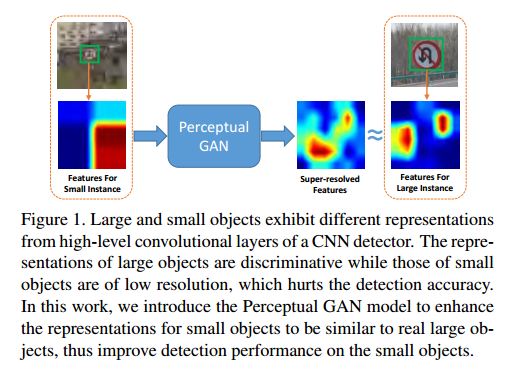
Thus, it is possbile to use Percetual GAN to super-resolution of feature maps of small objects to obtain better detection performance.
It consists of two subnetworks, i.e., a generator network and a perceptual discriminator network. Specifically, the generator is a deep residual based feature generative model which transforms the original poor features of small objects to highly discriminative ones by introducing fine-grained details from lower-level layers, achieving “super-resolution” on the intermediate representations.
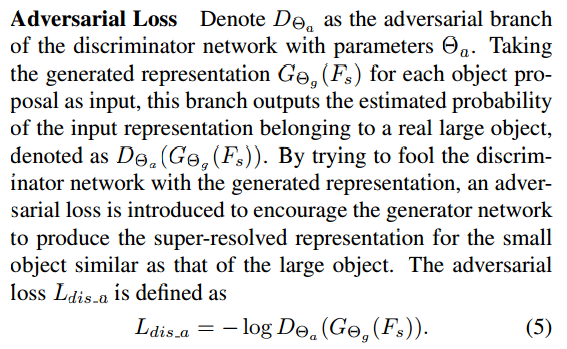
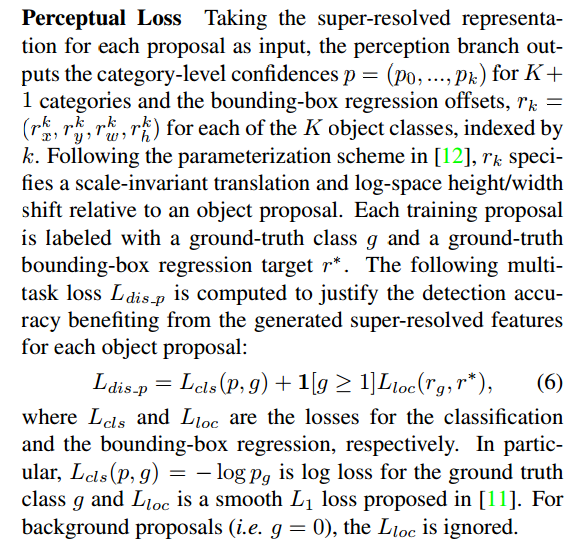
Different from normal GAN, this network also introduce a new perceptual loss tailored from the detection purpose. That is to say, the discriminator not only need to deal with the adversarial loss, but also need to justify the detection accuray benefiting from the generated super-resolved features with a perceptual loss.
The proposed contributions:
(1) We are the first to successfully apply GAN-alike models to solve the challenging small-scale object detection problems.
(2) We introduce a new conditional generator model that learns the additive residual representation between large and small objects, instead of generating the complete representations as before.
(3) We introduce a new perceptual discriminator that provides more comprehensive supervision beneficial for detections, instead of barely differentiating fake and real.
(4) Successful applications on traffic sign detection and pedestrian detection have been achieved with the state-of-the-art performance.

Figure 2. Training procedure of object detection network based on the Perceptual GAN.
As shown in Figure 2, the generator network aims to generate super-resoved representation for the small object.
The discriminator includes two branches, i.e.
1. the adversarial branch for differentiating between the generated superresolved representation.
2. the perception branch for justifying the detection accurcy benefiting from the generation representation. 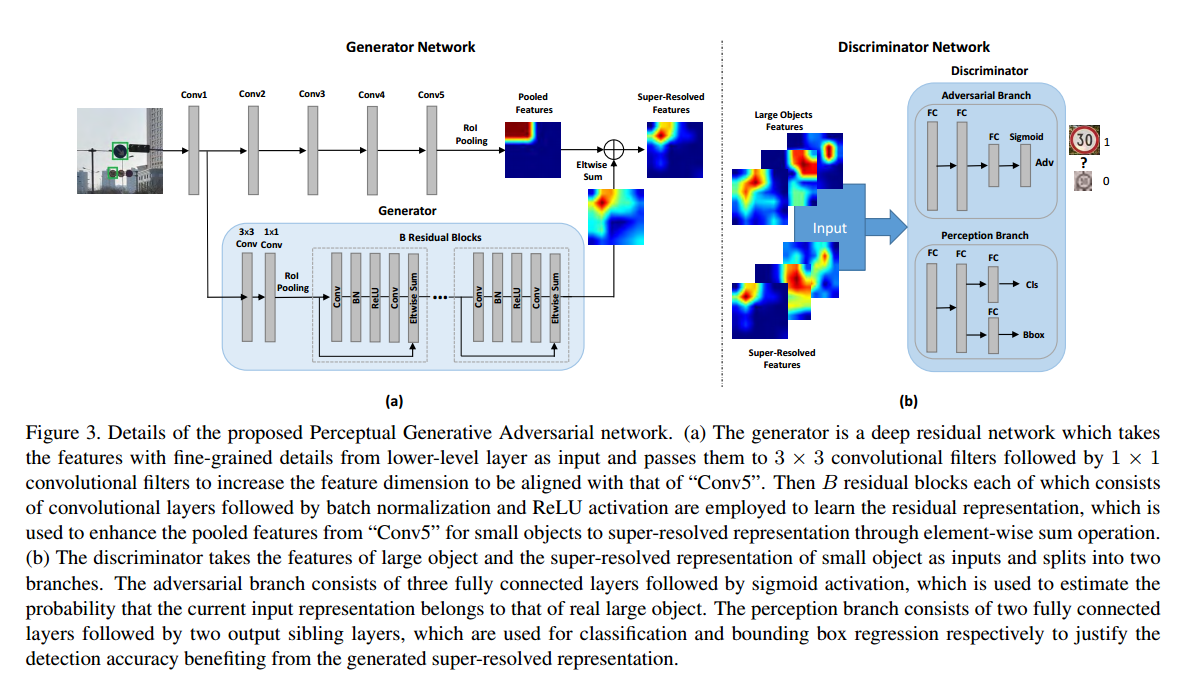
==>> Dicriminative Network Architecture:
The D network need to justify the dection accuracy benefiting from the generated super-resovled feature.
Given the adversarial loss $L_{dis_a}$ and the perceptual loss $L_{dis_p}$ , a final loss function Ldis can be produced as weighted sum of both individual loss components. Given weighting parameters w1 and w2, we define Ldis = w1 × Ldis_a + w2 × Ldis_p to encourage the generator network to generate super-resolved representation with high detection accuracy. Here we set both w1 and w2 to be one.
Paper Reading: Perceptual Generative Adversarial Networks for Small Object Detection的更多相关文章
- 【文献阅读】Perceptual Generative Adversarial Networks for Small Object Detection –CVPR-2017
Perceptual Generative Adversarial Networks for Small Object Detection 2017CVPR 新鲜出炉的paper,这是针对small ...
- Perceptual Generative Adversarial Networks for Small Object Detection
Perceptual Generative Adversarial Networks for Small Object Detection 感知生成对抗网络用于目标检测 论文链接:https://ar ...
- (转)Introductory guide to Generative Adversarial Networks (GANs) and their promise!
Introductory guide to Generative Adversarial Networks (GANs) and their promise! Introduction Neural ...
- 论文笔记之:UNSUPERVISED REPRESENTATION LEARNING WITH DEEP CONVOLUTIONAL GENERATIVE ADVERSARIAL NETWORKS
UNSUPERVISED REPRESENTATION LEARNING WITH DEEP CONVOLUTIONAL GENERATIVE ADVERSARIAL NETWORKS ICLR 2 ...
- Generative Adversarial Networks overview(2)
Libo1575899134@outlook.com Libo (原创文章,转发请注明作者) 本文章会先从Gan的简单应用示例讲起,从三个方面问题以及解决思路覆盖25篇GAN论文,第二个大部分会进一步 ...
- Generative Adversarial Networks overview(1)
Libo1575899134@outlook.com Libo (原创文章,转发请注明作者) 本文章会先从Gan的简单应用示例讲起,从三个方面问题以及解决思路覆盖25篇GAN论文,第二个大部分会进一步 ...
- GD-GAN: Generative Adversarial Networks for Trajectory Prediction and Group Detection in Crowds
GD-GAN: Generative Adversarial Networks for Trajectory Prediction and Group Detection in Crowds 2019 ...
- Social GAN: Socially Acceptable Trajectories with Generative Adversarial Networks
Social GAN: Socially Acceptable Trajectories with Generative Adversarial Networks 2019-06-01 09:52:4 ...
- 文献阅读报告 - Social GAN: Socially Acceptable Trajectories with Generative Adversarial Networks
paper:Gupta A , Johnson J , Fei-Fei L , et al. Social GAN: Socially Acceptable Trajectories with Gen ...
随机推荐
- MySql 应用语句
[1]MySQL基础语句 -- 查询mysql版本号 SELECT VERSION(); -- 创建数据库 DROP DATABASE IF EXISTS study; -- 如果存在先删除 CREA ...
- Hive静态分区和动态分区
一.静态分区 1.创建分区表 hive (default)> create table order_mulit_partition( > order_number string, > ...
- Thread(26)
1.进程:进程指正在运行的程序.确切的来说,当一个程序进入内存运行,即变成一个进程,进程是处于运行过程中的程序,并且具有一定独立功能. 2.线程:线程是进程中的一个执行单元,负责当前进程中程序的执行, ...
- [转载]String.Empty、string=”” 和null的区别
String.Empty是string类的一个静态常量: String.Empty和string=””区别不大,因为String.Empty的内部实现是: 1 2 3 4 5 6 7 8 9 10 1 ...
- SQL 语法笔记
➪SQL ➪基本类型 char / varchar / int / smallint / numeric / real, double precision / float ➪数据定义 create t ...
- python+selenium win32gui实现文件上传 enumerate()
upload = dr.find_element_by_id('exampleInputFile0') upload.click() time.sleep(1) # win32gui dialog = ...
- MySQL 主表与从表
通过上一篇随笔,笔者了解到,实体完整性是通过主键约束实现的,而参照完整性是通过外键约束实现的,两者都是为了保证数据的完整性和一致性. 主键约束比较好理解,就是主键值不能为空且不重复,已经强调好多次,所 ...
- Eclipse导入MyEclipse创建的WEB项目无法识别的解决方案
Eclipse导入MyEclipse创建的WEB项目无法识别的解决方案
- react将表格动态生成视频列表【代码】【案例】
只需要创建一个表格,id为videos,react就能将这个表格转换成视频列表,并点击自动播放 index.html <!DOCTYPE html> <html> <he ...
- Python cv2 OpenCV 中传统图片格式与 base64 转换
Base64是网络上最常见的用于传输8Bit字节码的编码方式之一,是一种基于64个可打印字符来表示二进制数据的方法.通过http传输图片常常将图片数据转换成base64之后再进行传输. Base64简 ...