
吴恩达-AI-机器学习课后习题解析-第三周
================================================= sigmod.m =========================================================================
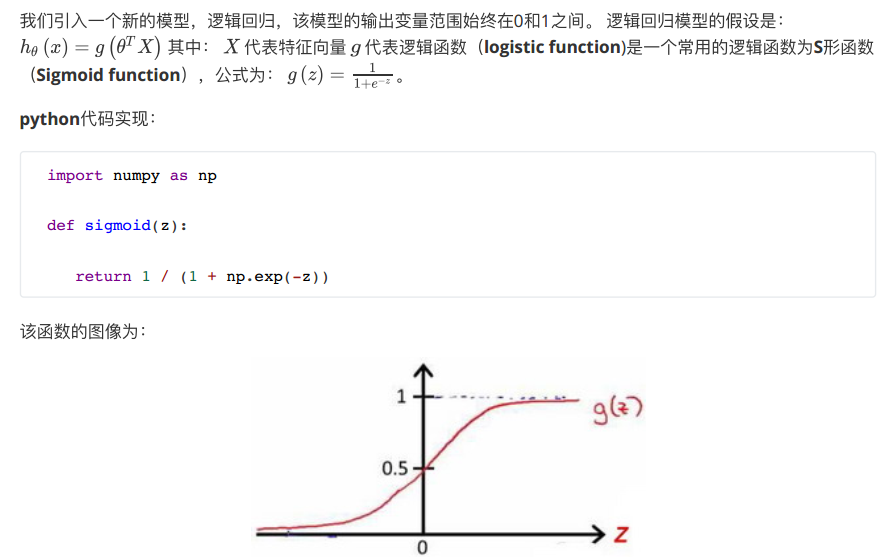
function g = sigmoid(z)
%SIGMOID Compute sigmoid function
% g = SIGMOID(z) computes the sigmoid of z.
% You need to return the following variables correctly
g = zeros(size(z));
% ====================== YOUR CODE HERE ======================
% Instructions: Compute the sigmoid of each value of z (z can be a matrix,
% vector or scalar).
g = 1 ./ (1+exp(-z))
% =============================================================
end
===================================================== predict.m =====================================================================
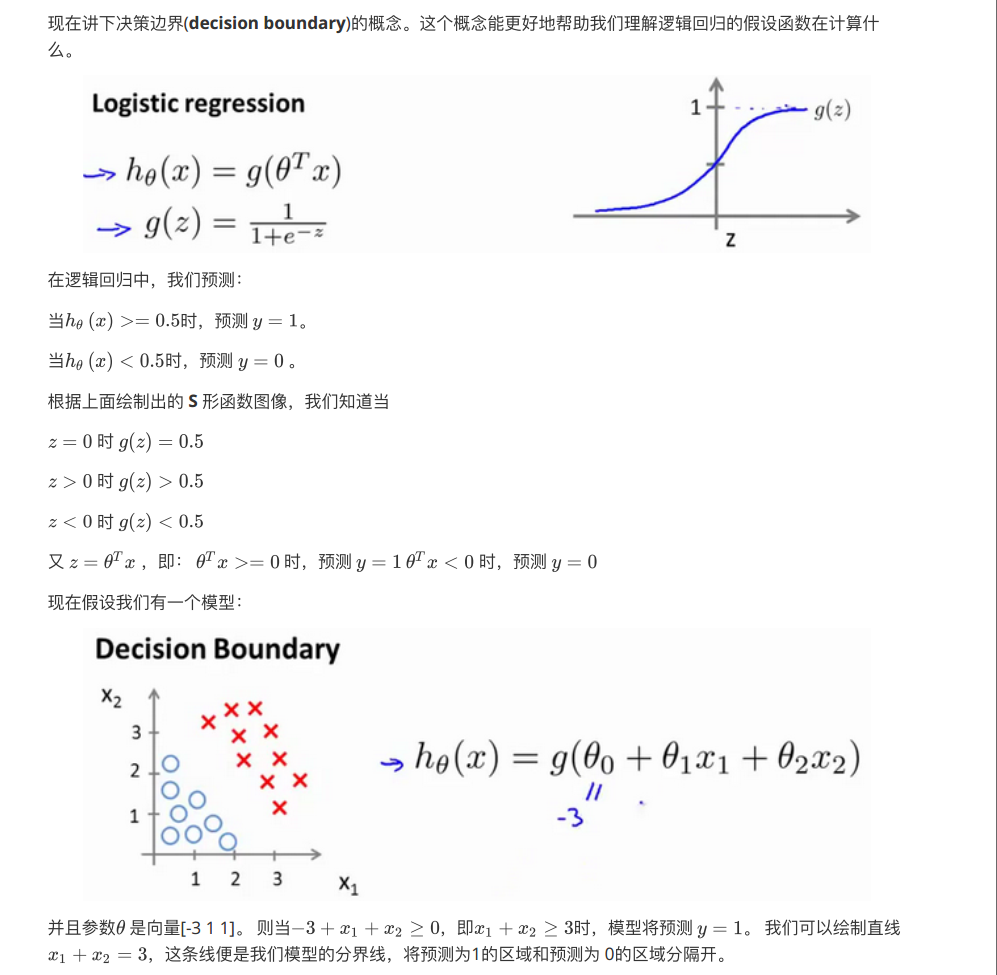
function p = predict(theta, X)
%PREDICT Predict whether the label is 0 or 1 using learned logistic
%regression parameters theta
% p = PREDICT(theta, X) computes the predictions for X using a
% threshold at 0.5 (i.e., if sigmoid(theta'*x) >= 0.5, predict 1)
m = size(X, 1); % Number of training examples
% You need to return the following variables correctly
p = zeros(m, 1);
% ====================== YOUR CODE HERE ======================
% Instructions: Complete the following code to make predictions using
% your learned logistic regression parameters.
% You should set p to a vector of 0's and 1's
%
p = round(sigmoid(X * theta)); % round(>= 0.5) = 1, round(< 0.5) = 0
% =========================================================================
end
================================================= costFunction.m =========================================================================
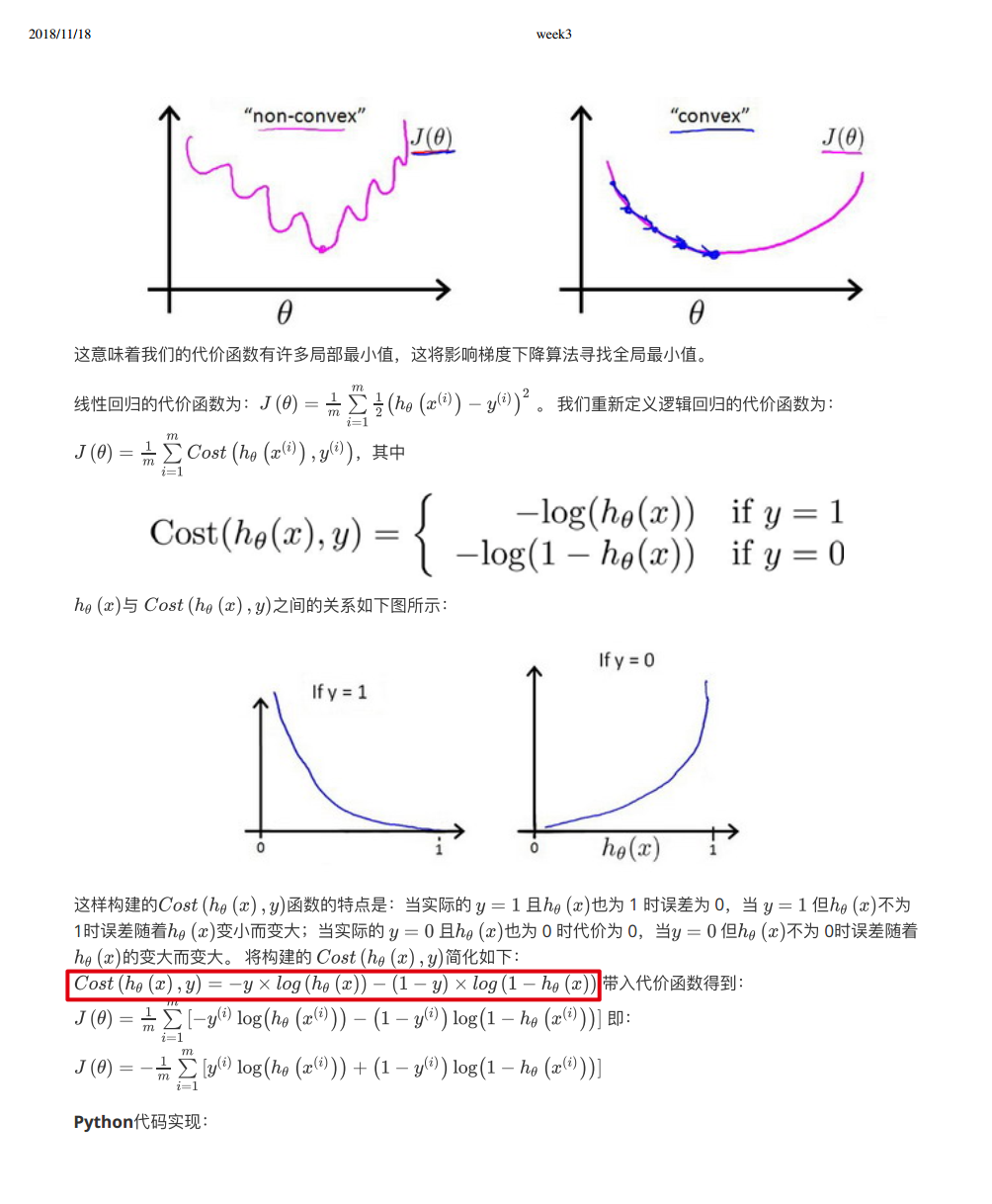
function [J, grad] = costFunction(theta, X, y)
%COSTFUNCTION Compute cost and gradient for logistic regression
% J = COSTFUNCTION(theta, X, y) computes the cost of using theta as the
% parameter for logistic regression and the gradient of the cost
% w.r.t. to the parameters.
% Initialize some useful values
m = length(y); % number of training examples
% You need to return the following variables correctly
J = 0;
grad = zeros(size(theta));
% ====================== YOUR CODE HERE ======================
% Instructions: Compute the cost of a particular choice of theta.
% You should set J to the cost.
% Compute the partial derivatives and set grad to the partial
% derivatives of the cost w.r.t. each parameter in theta
%
% Note: grad should have the same dimensions as theta
%
J = (-y' * log(sigmoid(X * theta)) - (1 - y)' * log(1 - sigmoid(X * theta))) / m;
grad = X' * (sigmoid(X * theta) - y) / m;
% =============================================================
end
吴恩达-AI-机器学习课后习题解析-第三周的更多相关文章
- 吴恩达深度学习课后习题第5课第1周第3小节: Jazz Improvisation with LSTM
目录 Improvise a Jazz Solo with an LSTM Network Packages 1 - Problem Statement 1.1 - Dataset What are ...
- 吴恩达深度学习第4课第3周编程作业 + PIL + Python3 + Anaconda环境 + Ubuntu + 导入PIL报错的解决
问题描述: 做吴恩达深度学习第4课第3周编程作业时导入PIL包报错. 我的环境: 已经安装了Tensorflow GPU 版本 Python3 Anaconda 解决办法: 安装pillow模块,而不 ...
- 吴恩达深度学习第2课第2周编程作业 的坑(Optimization Methods)
我python2.7, 做吴恩达深度学习第2课第2周编程作业 Optimization Methods 时有2个坑: 第一坑 需将辅助文件 opt_utils.py 的 nitialize_param ...
- 吴恩达《机器学习》课程笔记——第六章:Matlab/Octave教程
上一篇 ※※※※※※※※ [回到目录] ※※※※※※※※ 下一篇 这一章的内容比较简单,主要是MATLAB的一些基础教程,如果之前没有学过matlab建议直接找一本相关书籍,边做边学,matl ...
- 吴恩达《机器学习》课程总结(5)_logistic回归
Q1分类问题 回归问题的输出可能是很大的数,而在分类问题中,比如二分类,希望输出的值是0或1,如何将回归输出的值转换成分类的输出0,1成为关键.注意logistics回归又称 逻辑回归,但他是分类问题 ...
- 吴恩达深度学习第1课第4周-任意层人工神经网络(Artificial Neural Network,即ANN)(向量化)手写推导过程(我觉得已经很详细了)
学习了吴恩达老师深度学习工程师第一门课,受益匪浅,尤其是吴老师所用的符号系统,准确且易区分. 遵循吴老师的符号系统,我对任意层神经网络模型进行了详细的推导,形成笔记. 有人说推导任意层MLP很容易,我 ...
- 吴恩达《机器学习》编程作业——machine-learning-ex1:线性回归
❄❄❄❄❄❄❄❄[回到目录]❄❄❄❄❄❄❄❄ 本次编程作业中,需要完成的代码有如下几部分: [⋆] warmUpExercise.m - Simple example function in Octa ...
- 吴恩达《机器学习》课程笔记——第七章:Logistic回归
上一篇 ※※※※※※※※ [回到目录] ※※※※※※※※ 下一篇 7.1 分类问题 本节内容:什么是分类 之前的章节介绍的都是回归问题,接下来是分类问题.所谓的分类问题是指输出变量为有限个离散 ...
- 吴恩达j机器学习之过拟合
五.编程作业: 见:https://www.cnblogs.com/tommyngx/p/9933803.html
随机推荐
- ng 监听数据的变化
$scope.$watch('监听的变量的名称',func) 在angularJs之所以能够实现绑定,是因为angularJS框架在背后为每一个模型数据添加了一个监听,与$watch其实是一个道理. ...
- sublime 非常好用的注释工具
Sublime在进行前端开发时非常棒,当然也少不了众多的插件支持,DocBlocker是在Sublime平台上开发一款自动补全代码插件,支持JavaScript (including ES6), PH ...
- [转载] 使用FFmpeg捕获一帧摄像头图像
最近在研究FFmpeg,比较惊讶的是网上一大堆资料都是在说如何从已有的视频中截取一帧图像,却很少说到如何直接从摄像头中捕获一帧图像,其实我一直有个疑问,就是在Linux下,大家是用什么库来采集摄像头的 ...
- 数据分析笔试-sql
题目说明及要求: 以下是模似数据库里的表单信息,请根据要求写出SQL语句 表1:职工信息 表结构如下: 表名:Employee 职工ID 职工姓名 入职年份 部门ID A1 ...
- fn project hot functions 说明
1. 简单介绍 所谓 hot functions 实际上就是长时间运行的functions ,简单理解类似后台任务 2. fnproject 处理的方式 fnproject 使用 类似 http的 ...
- k8s api server ha 连接配置问题
常见的lb 负载有硬件的f5 big-ip ,同时对于互联网公司大家常用的是nginx haproxy 了解k8s 集群高可用的都知道 api server 是无状态的(etcd 解决了),但是 ...
- FastAdmin + uni-app
FastAdmin + uni-app FastAdmin https://www.FastAdmin.net uni-app http://uniapp.dcloud.io/ 自己先挖个坑.
- Linux环境抓包命令
有时候有些接口调用问题不好定位或者日志不够详细,那么我们往往会选择通过抓包来看详细的通讯过程.抓包有相关软件,这里说如何直接在环境里抓.假如现在我们在 Linux 下部署了 Tomcat 服务器,端口 ...
- Python学习笔记之selenium 定制启动 chrome 的选项
在自动化中,默认情况下我们打开的就是一个普通的纯净的chrome浏览器,而我们平时在使用浏览器时,经常就添加一些插件,扩展,代理之类的应用.所以使用 selenium 时,我们可能需要对 chrome ...
- MongoDB-WriteConcern
WriteConcern safe=false 非安全模式 很快