
NEURAL NETWORKS, PART 1: BACKGROUND
NEURAL NETWORKS, PART 1: BACKGROUND
Artificial neural networks (NN for short) are practical, elegant, and mathematically fascinating models for machine learning. They are inspired by the central nervous systems of humans and animals – smaller processing units (neurons) are connected together to form a complex network that is capable of learning and adapting.
The idea of such neural networks is not new. McCulloch-Pitts (1943) described binary threshold neurons already back in 1940’s. Rosenblatt (1958) popularised the use of perceptrons, a specific type of neurons, as very flexible tools for performing a variety of tasks. The rise of neural networks was halted after Minsky and Papert (1969) published a book about the capabilities of perceptrons, and mathematically proved that they can’t really do very much. This result was quickly generalised to all neural networks, whereas it actually applied only to a specific type of perceptrons, leading to neural networks being disregarded as a viable machine learning method.
In recent years, however, the neural network has made an impressive comeback. Research in the area has become much more active, and neural networks have been found to be more than capable learners, breaking state-of-the-art results on a wide variety of tasks. This has been substantially helped by developments in computing hardware, allowing us to train very large complex networks in reasonable time. In order to learn more about neural networks, we must first understand the concept of vector space, and this is where we’ll start.
A vector space is a space where we can represent the position of a specific point or object as a vector (a sequence of numbers). You’re probably familiar with 2 or 3-dimensional coordinate systems, but we can easily extend this to much higher dimensions (think hundreds or thousands). However, it’s quite difficult to imagine a 1000-dimensional space, so we’ll stick to 2-dimensional illustations.
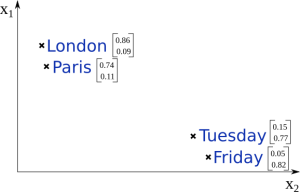
In the graph below, we have placed 4 objects in a 2-dimensional space, and each of them has a 2-dimensional vector that represents their position in this space. For machine learning and classification we make the assumption that similar objects have similar coordinates and are therefore positioned close to each other. This is true in our example, as cities are positioned in the upper left corner, and days-of-the-week are positioned a bit further in the lower right corner.
Let’s say we now get a new object (see image below) and all we know are its coordinates. What do you think, is this object a city or a day-of-the-week? It’s probably a city, because it is positioned much closer to other existing cities we already know about.
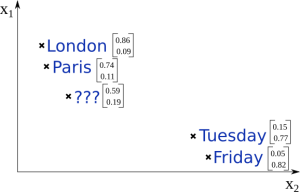
This is the kind of reasoning that machine learning tries to perform. Our example was very simple, but this problem gets more difficult when dealing with thousands of dimensions and millions of noisy datapoints.
In a traditional machine learning context these vectors are given as input to the classifier, both at training and testing time. However, there exist methods of representation learning where these vectors are learned automatically, together with the model.
Now that we know about vector spaces, it’s time to look at how the neuron works.
References
- McCulloch, Warren S., and Walter Pitts. “A logical calculus of the ideas immanent in nervous activity.” The Bulletin of Mathematical Biophysics 5.4 (1943): 115-133.
- Minsky, Marvin, and Papert Seymour. “Perceptrons.” (1969).
- Rosenblatt, Frank. “The perceptron: a probabilistic model for information storage and organization in the brain.” Psychological review 65.6 (1958): 386.
NEURAL NETWORKS, PART 1: BACKGROUND的更多相关文章
- 【转】Artificial Neurons and Single-Layer Neural Networks
原文:written by Sebastian Raschka on March 14, 2015 中文版译文:伯乐在线 - atmanic 翻译,toolate 校稿 This article of ...
- A Beginner's Guide To Understanding Convolutional Neural Networks(转)
A Beginner's Guide To Understanding Convolutional Neural Networks Introduction Convolutional neural ...
- Hacker's guide to Neural Networks
Hacker's guide to Neural Networks Hi there, I'm a CS PhD student at Stanford. I've worked on Deep Le ...
- 提高神经网络的学习方式Improving the way neural networks learn
When a golf player is first learning to play golf, they usually spend most of their time developing ...
- (转)A Beginner's Guide To Understanding Convolutional Neural Networks
Adit Deshpande CS Undergrad at UCLA ('19) Blog About A Beginner's Guide To Understanding Convolution ...
- 论文笔记之:Learning Multi-Domain Convolutional Neural Networks for Visual Tracking
Learning Multi-Domain Convolutional Neural Networks for Visual Tracking CVPR 2016 本文提出了一种新的CNN 框架来处理 ...
- 神经网络指南Hacker's guide to Neural Networks
Hi there, I'm a CS PhD student at Stanford. I've worked on Deep Learning for a few years as part of ...
- NEURAL NETWORKS, PART 2: THE NEURON
NEURAL NETWORKS, PART 2: THE NEURON A neuron is a very basic classifier. It takes a number of input ...
- [CVPR2015] Is object localization for free? – Weakly-supervised learning with convolutional neural networks论文笔记
p.p1 { margin: 0.0px 0.0px 0.0px 0.0px; font: 13.0px "Helvetica Neue"; color: #323333 } p. ...
随机推荐
- MFC 一个类訪问还有一个类成员对象的成员变量值
作者:卿笃军 原文地址:http://blog.csdn.net/qingdujun/article/details/35263857 MFC中一个类要訪问另外一个类的的对象的成员变量值,这就须要获得 ...
- java程序员从笨鸟到菜鸟系列
http://blog.csdn.net/csh624366188/article/category/888600
- JAVA对象之生
https://yq.aliyun.com/users/1556056716932876?spm=5176.100239.blogrightarea55811.3.6cvyJd
- Zookeeper3.4.6部署伪分布集群(Apache)
1.下载Zookeeper http://mirrors.cnnic.cn/apache/zookeeper/zookeeper-3.4.6/ 2.创建/usr/app/zookeeper目录,并切换 ...
- Android低功耗蓝牙(BLE)开发的一点感受
最近一段时间,因为产品的需要我做了一个基于低功耗蓝牙设备的Android应用,其中碰到了一些困难,使我深深体会到Android开发的难处:不同品牌,不同型号和不同版本之间的差异使得Android应用适 ...
- dll注册到GAC还是bin - sharepoint程序
通常来说程序在使用dll的时候,会先去GAC中查找是否有存在合适的dll,然后才会到应用程序下的bin目录去查找: 前几天遇到了一个奇葩问题,web项目工程添加了一个第三方dll的引用,然后把这个第三 ...
- SQL语句对应的LINQ和Lambda语句
1. 查询Student表中的所有记录的Sname.Ssex和Class列.select sname,ssex,class from studentLinq: from s in Student ...
- less编码规范
Less 编码规范 简介 因为自己最近写css用的比较多还是less,整理了一份less规范, 代码组织 代码按如下形式按顺序组织: @import 变量声明 样式声明 // ✓ @import &q ...
- PHP验证码的制作
<?phpsession_start(); //??session//?建随机?,并保存在session中for($i=0;$i<4;$i++){$_nmsg.=dechex(mt_r ...
- Sql Xml
/* sql xml 入门: --by jinjazz --http://blog.csdn.net/jinjazz 1.xml: 能认识元素.属性和值 2.xpath: 寻址语言,类似windows ...