
[Scikit-learn] 1.1 Generalized Linear Models - Neural network models
本章涉及到的若干知识点(红字);本章节是作为通往Tensorflow的前奏!
链接:https://www.zhihu.com/question/27823925/answer/38460833
首先,神经网络的最后一层,也就是输出层,是一个 Logistic Regression (或者 Softmax Regression ),也就是一个线性分类器。
那么,输入层和中间那些隐层又在干吗呢?你可以把它们看成一种特征提取的过程,就是把 Logistic Regression 的输出当作特征,然后再将它送入下一个 Logistic Regression,一层层变换。
神经网络的训练,实际上就是同时训练特征提取算法以及最后的 Logistic Regression的参数。
为什么要特征提取呢,因为 Logistic Regression 本身是一个线性分类器,所以,通过特征提取,我们可以把原本线性不可分的数据变得线性可分。
要如何训练呢,最简单的方法是(随机,Mini batch)梯度下降法(当然有更复杂的例如MATLAB里面用的是 BFGS),那要如何算梯度呢,我们通过导数的链式法则,得出一种称为 back-propagation 的方法(BP)。
最后,我们得到了一个比 Logistic Regression 复杂得多的模型,它的拟合能力很强,可以处理很多 Logistic Regression处理不了的数据,但是也更容易过拟合( VC inequality 告诉我们,能力越大责任越大),而且损失函数不是凸的,给优化带来一些困难。
所以我们无法回答什么是“优于”,就像我们无法回答“菜刀和火箭筒哪个更好”,使用者对机器学习的理解,以及具体数据的情况,参数的选择,以及训练的方法,都对模型的效果产生很大影响。
一个建议,普通问题还是用 SVM 吧,SVM 最好用了。
多层感知机
多层多分类
For classification, it minimizes the Cross-Entropy loss function, giving a vector of probability estimates  per sample
  .
.
其实就是softmax一样的道理!
举个栗子
1.17.2. Classification
"""

========================================================

Compare Stochastic learning strategies for MLPClassifier

========================================================

This example visualizes some training loss curves for different stochastic

learning strategies, including SGD and Adam. Because of time-constraints, we

use several small datasets, for which L-BFGS might be more suitable. The

general trend shown in these examples seems to carry over to larger datasets,

however.

Note that those results can be highly dependent on the value of

``learning_rate_init``.

"""

print(__doc__)

import matplotlib.pyplot as plt

from sklearn.neural_network import MLPClassifier

from sklearn.preprocessing import MinMaxScaler

from sklearn import datasets

# different learning rate schedules and momentum parameters

params = [{'solver': 'sgd', 'learning_rate': 'constant',   'momentum': 0,                               'learning_rate_init': 0.2},

          {'solver': 'sgd', 'learning_rate': 'constant',   'momentum': .9, 'nesterovs_momentum': False, 'learning_rate_init': 0.2},

          {'solver': 'sgd', 'learning_rate': 'constant',   'momentum': .9, 'nesterovs_momentum': True,  'learning_rate_init': 0.2},   # top one

          {'solver': 'sgd', 'learning_rate': 'invscaling', 'momentum': 0,                               'learning_rate_init': 0.2},

          {'solver': 'sgd', 'learning_rate': 'invscaling', 'momentum': .9, 'nesterovs_momentum': True,  'learning_rate_init': 0.2},

          {'solver': 'sgd', 'learning_rate': 'invscaling', 'momentum': .9, 'nesterovs_momentum': False, 'learning_rate_init': 0.2},

          {'solver': 'adam',                                                                            'learning_rate_init': 0.01}]  # top two


labels = ["constant learning-rate",
          "constant with momentum",

          "constant with Nesterov's momentum",

          "inv-scaling learning-rate",
          "inv-scaling with momentum",

          "inv-scaling with Nesterov's momentum",
          "adam"]

plot_args = [{'c': 'red',   'linestyle': '-'},

             {'c': 'green', 'linestyle': '-'},

             {'c': 'blue',  'linestyle': '-'},

             {'c': 'red',   'linestyle': '--'},

             {'c': 'green', 'linestyle': '--'},

             {'c': 'blue',  'linestyle': '--'},

             {'c': 'black', 'linestyle': '-'}]


# 重点

def plot_on_dataset(X, y, ax, name):

    # for each dataset, plot learning for each learning strategy

    print("\nlearning on dataset %s" % name)

    ax.set_title(name)

    X = MinMaxScaler().fit_transform(X)  # 区间缩放,返回值为缩放到[0,1]区间的数据

    mlps = []

    if name == "digits":

        # digits is larger but converges fairly quickly

        max_iter = 15

    else:

        max_iter = 400

    for label, param in zip(labels, params):

        print("training: %s" % label)

        mlp = MLPClassifier(verbose=0, random_state=0, max_iter=max_iter, **param)

        mlp.fit(X, y)

        mlps.append(mlp)

        print("Training set score: %f" % mlp.score(X, y))

        print("Training set loss: %f"  % mlp.loss_)

    for mlp, label, args in zip(mlps, labels, plot_args):

            ax.plot(mlp.loss_curve_, label=label, **args)

# Start from here.

fig, axes = plt.subplots(2, 2, figsize=(15, 10))

# load / generate some toy datasets

iris      = datasets.load_iris()

digits    = datasets.load_digits()

data_sets = [(iris.data, iris.target),

             (digits.data, digits.target),

             datasets.make_circles(noise=0.2, factor=0.5, random_state=1),  # 什么玩意?

             datasets.make_moons(noise=0.3, random_state=0)]

# 通过zip获取每一个小组的某一个名次的elem,构成一个处理集合

for ax, data, name in zip(axes.ravel(), data_sets, ['iris', 'digits', 'circles', 'moons']):

    plot_on_dataset(*data, ax=ax, name=name)

fig.legend(ax.get_lines(), labels=labels, ncol=3, loc="upper center")

plt.show()
Result:
Training set score: 0.980000

Training set loss: 0.096922

training: constant with momentum

Training set score: 0.980000

Training set loss: 0.050260

training: constant with Nesterov's momentum

Training set score: 0.980000

Training set loss: 0.050277

training: inv-scaling learning-rate

Training set score: 0.360000

Training set loss: 0.979983

training: inv-scaling with momentum

Training set score: 0.860000

Training set loss: 0.504017

training: inv-scaling with Nesterov's momentum

Training set score: 0.860000

Training set loss: 0.504760

training: adam

Training set score: 0.980000

Training set loss: 0.046248

learning on dataset digits

training: constant learning-rate

Training set score: 0.956038

Training set loss: 0.243802

training: constant with momentum

Training set score: 0.992766

Training set loss: 0.041297

training: constant with Nesterov's momentum

Training set score: 0.993879

Training set loss: 0.042898

training: inv-scaling learning-rate

Training set score: 0.638843

Training set loss: 1.855465

training: inv-scaling with momentum

Training set score: 0.912632

Training set loss: 0.290584

training: inv-scaling with Nesterov's momentum

Training set score: 0.909293

Training set loss: 0.318387

training: adam

Training set score: 0.991653

Training set loss: 0.045934

learning on dataset circles

training: constant learning-rate

Training set score: 0.830000

Training set loss: 0.681498

training: constant with momentum

Training set score: 0.940000

Training set loss: 0.163712

training: constant with Nesterov's momentum

Training set score: 0.940000

Training set loss: 0.163012

training: inv-scaling learning-rate

Training set score: 0.500000

Training set loss: 0.692855

training: inv-scaling with momentum

Training set score: 0.510000

Training set loss: 0.688376

training: inv-scaling with Nesterov's momentum

Training set score: 0.500000

Training set loss: 0.688593

training: adam

Training set score: 0.930000

Training set loss: 0.159988

learning on dataset moons

training: constant learning-rate

Training set score: 0.850000

Training set loss: 0.342245

training: constant with momentum

Training set score: 0.850000

Training set loss: 0.345580

training: constant with Nesterov's momentum

Training set score: 0.850000

Training set loss: 0.336284

training: inv-scaling learning-rate

Training set score: 0.500000

Training set loss: 0.689729

training: inv-scaling with momentum

Training set score: 0.830000

Training set loss: 0.512595

training: inv-scaling with Nesterov's momentum

Training set score: 0.830000

Training set loss: 0.513034

training: adam

Training set score: 0.850000

Training set loss: 0.334243
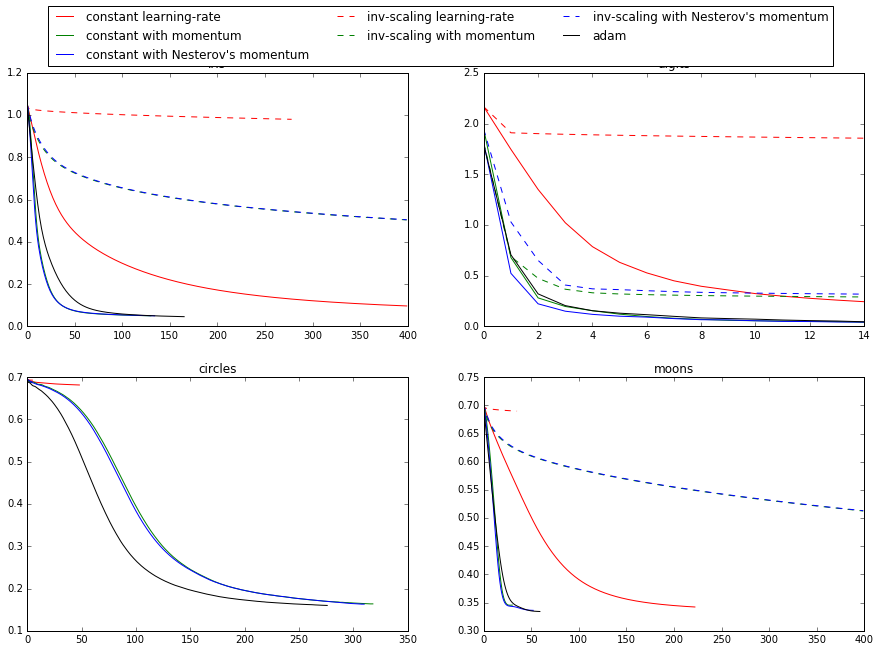
函数参数解析
多层感知机函数:
mlp = (verbose=0, random_state=0, max_iter=max_iter, **param)
【sklearn.neural_network.MLPClassifier】
| Parameters: |
hidden_layer_sizes : tuple, length = n_layers - 2, default (100,)
activation : {‘identity’, ‘logistic’, ‘tanh’, ‘relu’}, default ‘relu’
solver : {‘lbfgs’, ‘sgd’, ‘adam’}, default ‘adam’
alpha : float, optional, default 0.0001
batch_size : int, optional, default ‘auto’
learning_rate : {‘constant’, ‘invscaling’, ‘adaptive’}, default ‘constant’
max_iter : int, optional, default 200
random_state : int or RandomState, optional, default None
shuffle : bool, optional, default True 多则洗牌,少则不必
tol : float, optional, default 1e-4
learning_rate_init : double, optional, default 0.001
power_t : double, optional, default 0.5
verbose : bool, optional, default False
warm_start : bool, optional, default False
momentum : float, default 0.9
nesterovs_momentum : boolean, default True 这是什么好东东?
early_stopping : bool, default False
validation_fraction : float, optional, default 0.1
beta_1 : float, optional, default 0.9
beta_2 : float, optional, default 0.999
epsilon : float, optional, default 1e-8
|
|---|
参数的可视化
再来一盘例子:第一层 weight 的可视化
"""

=====================================

Visualization of MLP weights on MNIST

=====================================

Sometimes looking at the learned coefficients of a neural network can provide

insight into the learning behavior. For example if weights look unstructured,

maybe some were not used at all, or if very large coefficients exist, maybe

regularization was too low or the learning rate too high.

This example shows how to plot some of the first layer weights in a

MLPClassifier trained on the MNIST dataset.

The input data consists of 28x28 pixel handwritten digits, leading to 784

features in the dataset. Therefore the first layer weight matrix have the shape

(784, hidden_layer_sizes[0]).  We can therefore visualize a single column of

the weight matrix as a 28x28 pixel image.

To make the example run faster, we use very few hidden units, and train only

for a very short time. Training longer would result in weights with a much

smoother spatial appearance.

"""

print(__doc__)

import matplotlib.pyplot as plt

from sklearn.datasets import fetch_mldata

from sklearn.neural_network import MLPClassifier

mnist = fetch_mldata("MNIST original")

# rescale the data, use the traditional train/test split

X, y = mnist.data / 255., mnist.target

X_train, X_test = X[:60000], X[60000:]

y_train, y_test = y[:60000], y[60000:]

# mlp = MLPClassifier(hidden_layer_sizes=(100, 100), max_iter=400, alpha=1e-4,

#                     solver='sgd', verbose=10, tol=1e-4, random_state=1)

mlp = MLPClassifier(hidden_layer_sizes = (50,),
                    max_iter           = 10,
                    alpha              = 1e-4,

                    solver             = 'sgd',
                    verbose            = 10,
                    tol                = 1e-4,
                    random_state       = 1,

                    learning_rate_init = .1)

mlp.fit(X_train, y_train)

print("Training set score: %f" % mlp.score(X_train, y_train))

print("Test set score: %f" % mlp.score(X_test, y_test))

fig, axes = plt.subplots(4, 4)

# use global min / max to ensure all weights are shown on the same scale

vmin, vmax = mlp.coefs_[0].min(), mlp.coefs_[0].max()

# 根据 axes.ravel() 的大小,只画了16个

for coef, ax in zip(mlp.coefs_[0].T, axes.ravel()):

    ax.matshow(coef.reshape(28, 28), cmap=plt.cm.gray, vmin=.5 * vmin, vmax=.5 * vmax)

    ax.set_xticks(())

    ax.set_yticks(())

plt.show()
coefs的解释:
# Layer 1 --> Layer 2
len(mlp.coefs_[0])

Out[27]: 784

len(mlp.coefs_[0][0])

Out[28]: 50


784*50条边,每一条边代表一个权值。

# Layer 2 --> Layer 3

len(mlp.coefs_[1])

Out[29]: 50

len(mlp.coefs_[1][0])

Out[30]: 10
Result:

一个方块代表一个hiden node与28*28个input node的权重分布图
End.
[Scikit-learn] 1.1 Generalized Linear Models - Neural network models的更多相关文章
- Networks of Spiking Neurons: The Third Generation of Neural Network Models
郑重声明:原文参见标题,如有侵权,请联系作者,将会撤销发布! 顺便安利一下同组的大佬做的SNN教程:https://spikingflow.readthedocs.io/zh_CN/latest/Tu ...
- [Scikit-learn] 1.5 Generalized Linear Models - SGD for Regression
梯度下降 一.亲手实现“梯度下降” 以下内容其实就是<手动实现简单的梯度下降>. 神经网络的实践笔记,主要包括: Logistic分类函数 反向传播相关内容 Link: http://pe ...
- (转)How Transformers Work --- The Neural Network used by Open AI and DeepMind
How Transformers Work --- The Neural Network used by Open AI and DeepMind Original English Version l ...
- (zhuan) Recurrent Neural Network
Recurrent Neural Network 2016年07月01日 Deep learning Deep learning 字数:24235 this blog from: http:/ ...
- Regression:Generalized Linear Models
作者:桂. 时间:2017-05-22 15:28:43 链接:http://www.cnblogs.com/xingshansi/p/6890048.html 前言 本文主要是线性回归模型,包括: ...
- Generalized Linear Models
作者:桂. 时间:2017-05-22 15:28:43 链接:http://www.cnblogs.com/xingshansi/p/6890048.html 前言 主要记录python工具包:s ...
- 广义线性模型(Generalized Linear Models)
前面的文章已经介绍了一个回归和一个分类的例子.在逻辑回归模型中我们假设: 在分类问题中我们假设: 他们都是广义线性模型中的一个例子,在理解广义线性模型之前需要先理解指数分布族. 指数分布族(The E ...
- Andrew Ng机器学习公开课笔记 -- Generalized Linear Models
网易公开课,第4课 notes,http://cs229.stanford.edu/notes/cs229-notes1.pdf 前面介绍一个线性回归问题,符合高斯分布 一个分类问题,logstic回 ...
- [Scikit-learn] 1.1 Generalized Linear Models - from Linear Regression to L1&L2
Introduction 一.Scikit-learning 广义线性模型 From: http://sklearn.lzjqsdd.com/modules/linear_model.html#ord ...
随机推荐
- 库克谈新iPhone不支持5G的理由,学习一下如何高手怎么应答
库克谈新iPhone不支持5G的理由 投递人 itwriter 发布于 2019-09-12 08:41 评论(14) 有1623人阅读 原文链接 [收藏] « » 9 月 12 日消息,苹果公司 C ...
- PAT Basic 1074 宇宙无敌加法器 (20 分)
地球人习惯使用十进制数,并且默认一个数字的每一位都是十进制的.而在 PAT 星人开挂的世界里,每个数字的每一位都是不同进制的,这种神奇的数字称为“PAT数”.每个 PAT 星人都必须熟记各位数字的进制 ...
- Python基本语法变量
Python的语法和其它编程语言的语法有所不同,编写Paython程序之前需要对语法有所了解,才能编写规范的Python程序.本篇介绍Python标识符的同时,也讨论了Python变量的声明和赋值.通 ...
- [转载]Appium工作原理
[Appium]Appium工作原理 2017-09-13 15:28 sophia194910 阅读(7658) 评论(0) 编辑 收藏 参考:http://www.cnblogs.com/zhjs ...
- [译] 尤雨溪:Vue 3.0 计划
[译] 尤雨溪:Vue 3.0 计划 原文:Plans for the Next Iteration of Vue.js作者:Evan You 发表时间:Sep 30, 2018译者:西楼听雨 发表时 ...
- 又见回文 (SDUT 2560)
Problem Description "回文串"是一个正读和反读都一样的字符串,比如"level"或者"noon"等等就是回文串.现在呢, ...
- MySQL数据分析—(4)关系数据库的三个逻辑框架
(一)前面课程逻辑梳理 任何一门数据的软件也好,数据构架也好,或者说是数据学科也好,最终都是要解决实际问题的,大家说是不是? 前面jacky讲为什么要引入数据库的时候,举了一个案例,大家还记的吗?大家 ...
- c++ 容器切片反转次序(拷贝到新容器)
code: // rotate_copy algorithm example #include <iostream> // cout #include <algorithm> ...
- elasticsearch各种服务链接
查看elasticsearch信息http://localhost:9200/ 查看某个索引信息http://localhost:9200/index_name例如:http://localhost: ...
- iptables 查看对应规则及端口号
iptables -L -n --line-number