
第四周java实验
实验四 类与对象的定义及使用
实验时间 2018-9-20
1、实验目的与要求
(1) 理解用户自定义类的定义;
类是具有相同属性和行为的一组对象的集合。java中,用构造器构造并初始化对象。
类是构造对象的基本单元。
构造器是类中一个特殊的方法,其方法名与类名相同。
(2) 掌握对象的声明;
对象是客观事物的抽象,类是对对象的抽象。类是一种抽象的数据类型,其定义为:class 类名{ } 他们的关系是对象是类的实例,类是对象的模板。
对象的声明:
类名 对象名 = new 类名();
对象的调用
访问属性:对象名.属性名;
访问方法:对象名.方法名;
(3) 学会使用构造函数初始化对象;
构造函数的特点:构造函数名与类名相同;构造函数不返回任何值,也没有返回类型;每一类可以有零个或多个构造方法;构造方法在创建对象时自动执行,一般不用显示的直接调用。
2、实验内容和步骤
实验1 测试以下程序,掌握文件输入输出程序设计技术(文件输入输出,教材61-62).
import java.io.*;

import java.util.*;

public class FileWriteReadTest {

    public static void main(String[] args) throws IOException{

        //写入文件演示

        PrintWriter out = new PrintWriter("myfile.txt");

        out.println("姓名 高数 Java 数据结构 平均成绩 总成绩");

        out.println("张三 20 30 40 0 0");

        out.println("李四 50 60 70 0 0");

        out.close();//输出完毕,需要close

        //读入文件演示

        Scanner in = new Scanner(new File("myfile.txt"));//为myfile.txt这个File创建一个扫描器in

        int number = 1;//行号

        System.out.println(in.nextLine());

        while(in.hasNextLine()){//判断扫描器是否还有下一行未读取,该循环把文件的每一行都读出

            String line = in.nextLine();//读出myfile.txt的下一行

            System.out.print("第"+(++number)+"行的内容: ");

            Scanner linescanner = new Scanner(line);//行内容建立扫描器

            linescanner.useDelimiter(" ");//使用空格作为分隔符

            String name = linescanner.next();

            String math = linescanner.next();

            String java = linescanner.next();

            String ds = linescanner.next();

            String avg = linescanner.next();

            String total = linescanner.next();

            System.out.println("name="+name+"  math="+math+"  java="+java+"  ds="+ds+"  avg"+avg+"  total="+total);

        }

        in.close();//读入完毕,最后需要对其进行close。

    }

}
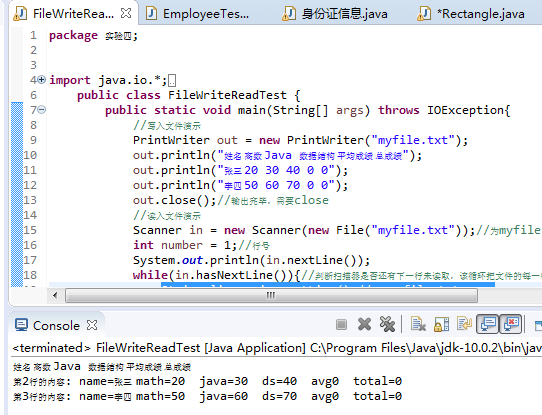
实验2 导入第4章示例程序并测试。
测试程序1:
l 编辑、编译、调试运行程序4-2(教材104页);
l 结合程序运行结果,掌握类的定义与类对象的用法,并在程序代码中添加类与对象知识应用的注释;
l 尝试在项目中编辑两个类文件(Employee.java、 EmployeeTest.java ),编译并运行程序。
import java.time.*;

/**

 * This program tests the Employee class.

 * @version 1.12 2015-05-08

 * @author Cay Horstmann

 */

public class EmployeeTest

{

   public static void main(String[] args)

   {

      // fill the staff array with three Employee objects

      Employee[] staff = new Employee[3];

    //构造一个数组,并填入如三个雇员对象。

      staff[0] = new Employee("Carl Cracker", 75000, 1987, 12, 15);

      staff[1] = new Employee("Harry Hacker", 50000, 1989, 10, 1);

      staff[2] = new Employee("Tony Tester", 40000, 1990, 3, 15);

      // raise everyone's salary by 5%

      for (Employee e : staff)

         e.raiseSalary(5);

      // print out information about all Employee objects

      for (Employee e : staff)

         System.out.println("name=" + e.getName() + ",salary=" + e.getSalary() + ",hireDay="

               + e.getHireDay());

   }

}

class Employee

{

   private String name;

   private double salary;

   private LocalDate hireDay;

   public Employee(String n, double s, int year, int month, int day)

   {

      name = n;

      salary = s;

      hireDay = LocalDate.of(year, month, day);

   }

   public String getName()

   {

      return name;

   }

   public double getSalary()

   {

      return salary;

   }

   public LocalDate getHireDay()

   {

      return hireDay;

   }

   public void raiseSalary(double byPercent)

   {

      double raise = salary * byPercent / 100;

      salary += raise;

   }

}
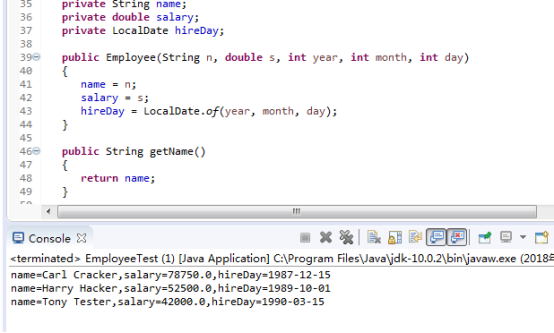
l 参考教材104页EmployeeTest.java,设计StudentTest.java,定义Student类,包含name(姓名)、sex(性别)、javascore(java成绩)三个字段,编写程序,从键盘输入学生人数,输入学生信息,并按以下表头输出学生信息表:
姓名 性别 java成绩
import java.util.ArrayList;

import java.util.Scanner;

public class StudentTest{

private int number;

private String name;

private String sex;

private int score;

public String getName() {

return name;

}

public void setName(String name) {

this.name = name;

}

public int getNumber() {

return number;

}

public void setNumber(int number) {

this.number = number;

}

public String getSex() {

return sex;

}

public void setSex(String sex) {

this.sex = sex;

}

public int getScore() {

return number;

}

public void setScore(int score) {

this.number = number;

}

public StudentTest(){}

public StudentTest(int number, String name) {

this.number = number;

this.name = name;

this.sex = sex;

}

public StudentTest writeInfo(){

    StudentTest st = new StudentTest();

Scanner in = new Scanner(System.in);

System.out.println("请输入学生的学号:");

number = in.nextInt();

st.setNumber(number);

System.out.println("请输入学生的姓名:");

String name = in.next();

st.setName(name);

System.out.println("请输入学生的性别:");

String sex = in.next();

st.setSex(sex);

System.out.println("请输入学生的Java成绩:");

score = in.nextInt();

st.setNumber(score);

return st;

}

public void readInfo(ArrayList list){

for(int i=0;i<=list.size()-1;i++){

    StudentTest st = new StudentTest();

st = (StudentTest) list.get(i);

System.out.println("第"+(i+1)+"位学生的学号:" + st.getNumber());

System.out.println("第"+(i+1)+"位学生的姓名:" + st.getName());

System.out.println("第"+(i+1)+"位学生的性别:" + st.getSex());

System.out.println("第"+(i+1)+"位学生的成绩:" + st.getScore());

}

}

public static void main(String[]args){ ArrayList<StudentTest> list = new ArrayList<StudentTest>();

StudentTest st = new StudentTest();

Scanner in = new Scanner(System.in);

while(true){

System.out.println("1、输入学生信息");

System.out.println("2、输出学生信息");

System.out.println("请选择:");

int option = in.nextInt();

switch (option) {

case 1:

list.add(st.writeInfo());

break;

case 2:

st.readInfo(list);

break;

default:

break;

}

}

}

}
程序运行结果为:
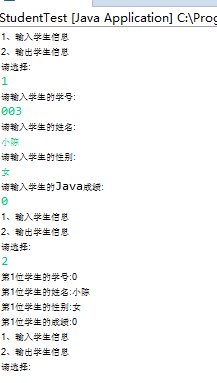
测试程序2:
l 编辑、编译、调试运行程序4-3(教材116);
l 结合程序运行结果,理解程序代码,掌握静态域(netxtId)与静态方法(getNextId)的用法,在相关代码后添加注释;
l 理解Java单元(类)测试的技巧。
/**

 * This program demonstrates static methods.

 * @version 1.01 2004-02-19

 * @author Cay Horstmann

 */

public class StaticTest

{

   public static void main(String[] args)

   {

      // fill the staff array with three Employee objects

      Employee[] staff = new Employee[3];

      staff[0] = new Employee("Tom", 40000);

      staff[1] = new Employee("Dick", 60000);

      staff[2] = new Employee("Harry", 65000);

      // print out information about all Employee objects

      for (Employee e : staff)

      {

         e.setId();

         System.out.println("name=" + e.getName() + ",id=" + e.getId() + ",salary="

               + e.getSalary());

      }

      int n = Employee.getNextId(); // calls static method

      System.out.println("Next available id=" + n);

   }

}

class Employee

{

   private static int nextId = 1;

   private String name;

   private double salary;

   private int id;

   public Employee(String n, double s)

   {

      name = n;

      salary = s;

      id = 0;

   }

   public String getName()

   {

      return name;

   }

   public double getSalary()

   {

      return salary;

   }

   public int getId()

   {

      return id;

   }

   public void setId()

   {

      id = nextId; // set id to next available id

      nextId++;

   }

   public static int getNextId()

   {

      return nextId; // returns static field

   }

   public static void main(String[] args) // unit test

   {

      Employee e = new Employee("Harry", 50000);

      System.out.println(e.getName() + " " + e.getSalary());

   }

}

测试程序3:
l 编辑、编译、调试运行程序4-4(教材121);
l 结合程序运行结果,理解程序代码,掌握掌握Java方法参数的用法,在相关代码后添加注释;
package 小陈1;
/**
* This program demonstrates parameter passing in Java.
* @version 1.00 2000-01-27
* @author Cay Horstmann
*/
public class ParamTest
{
public static void main(String[] args)
{
/*
* Test 1: Methods can't modify numeric parameters
*/
System.out.println("Testing tripleValue:");
double percent = 10;
System.out.println("Before: percent=" + percent);
tripleValue(percent);
System.out.println("After: percent=" + percent);
/*
* Test 2: Methods can change the state of object parameters
*/
System.out.println("\nTesting tripleSalary:");
Employee harry = new Employee("Harry", 50000);
System.out.println("Before: salary=" + harry.getSalary());
tripleSalary(harry);
System.out.println("After: salary=" + harry.getSalary());
/*
* Test 3: Methods can't attach new objects to object parameters
*/
System.out.println("\nTesting swap:");
Employee a = new Employee("Alice", 70000);
Employee b = new Employee("Bob", 60000);
System.out.println("Before: a=" + a.getName());
System.out.println("Before: b=" + b.getName());
swap(a, b);
System.out.println("After: a=" + a.getName());
System.out.println("After: b=" + b.getName());
}
public static void tripleValue(double x) // doesn't work
{
x = 3 * x;
System.out.println("End of method: x=" + x);
}
public static void tripleSalary(Employee x) // works
{
x.raiseSalary(200);
System.out.println("End of method: salary=" + x.getSalary());
}
public static void swap(Employee x, Employee y)
{
Employee temp = x;
x = y;
y = temp;
System.out.println("End of method: x=" + x.getName());
System.out.println("End of method: y=" + y.getName());
}
}
class Employee // simplified Employee class
{
private String name;
private double salary;
public Employee(String n, double s)
{
name = n;
salary = s;
}
public String getName()
{
return name;
}
public double getSalary()
{
return salary;
}
public void raiseSalary(double byPercent)
{
double raise = salary * byPercent / 100;
salary += raise;
}
}

测试程序5:
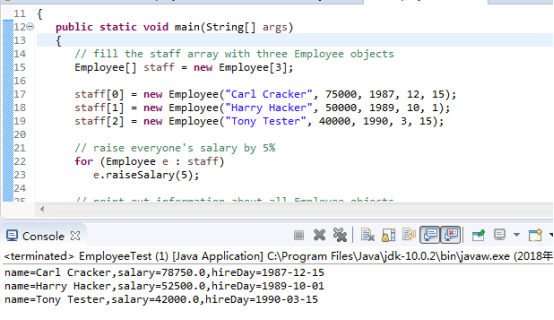
l 编辑、编译、调试运行程序4-6、4-7(教材135);
l 结合程序运行结果,理解程序代码,掌握Java包的定义及用法,在相关代码后添加注释;
import java.time.*;

/**

 * This program tests the Employee class.

 * @version 1.12 2015-05-08

 * @author Cay Horstmann

 */

public class EmployeeTest

{

   public static void main(String[] args)

   {

      // fill the staff array with three Employee objects

      Employee[] staff = new Employee[];

      staff[] = new Employee("Carl Cracker", , , , );

      staff[] = new Employee("Harry Hacker", , , , );

      staff[] = new Employee("Tony Tester", , , , );

      // raise everyone's salary by 5%

      for (Employee e : staff)

         e.raiseSalary();

      // print out information about all Employee objects

      for (Employee e : staff)

         System.out.println("name=" + e.getName() + ",salary=" + e.getSalary() + ",hireDay="

               + e.getHireDay());

   }

}

class Employee

{

   private String name;

   private double salary;

   private LocalDate hireDay;

   public Employee(String n, double s, int year, int month, int day)

   {

      name = n;

      salary = s;

      hireDay = LocalDate.of(year, month, day);

   }

   public String getName()

   {

      return name;

   }

   public double getSalary()

   {

      return salary;

   }

   public LocalDate getHireDay()

   {

      return hireDay;

   }

   public void raiseSalary(double byPercent)

   {

      double raise = salary * byPercent / ;

      salary += raise;

   }

}
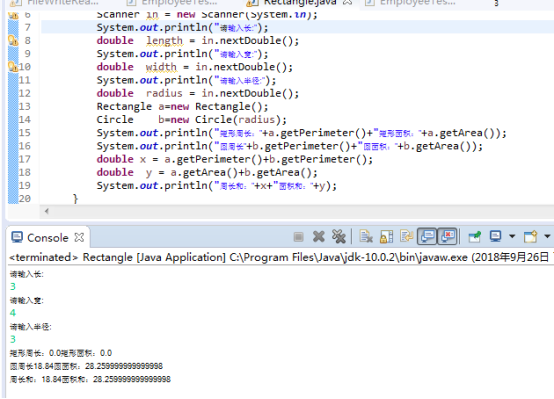
实验3 编写长方形类Rectangle与圆形类Circle,其中Rectangle类设置私有属性:width,length;Circle类设置私有属性radius。编写Rectangle类的带参构造函数Rectangle(int width,int length), Circle类的带参构造函数Circle(int radius),编写两个类的toString方法(Eclipse可自动生成)。上述2个类均定义以下方法:
求周长的方法public int getPerimeter()
求面积的方法public int getArea()
在main方法中完成以下任务:
(1) 输入1行长与宽,创建一个Rectangle对象;
(2) 输入1行半径,创建一个Circle对象;
(3) 将两个对象的周长加总输出,将两个对象的面积加总输出。
package 小陈4;

import java.util.*;

 public class Rectangle{

     public static void main(String[] args) {

         Scanner in = new Scanner(System.in);

         System.out.println("请输入长:");

         double  length = in.nextDouble();

         System.out.println("请输入宽:");

         double  width = in.nextDouble();

         System.out.println("请输入半径:");

         double  radius = in.nextDouble();

         Rectangle a=new Rectangle();

         Circle    b=new Circle(radius);

         System.out.println("矩形周长:"+a.getPerimeter()+"矩形面积:"+a.getArea());

         System.out.println("圆周长"+b.getPerimeter()+"圆面积:"+b.getArea());

         double x = a.getPerimeter()+b.getPerimeter();

         double  y = a.getArea()+b.getArea();

         System.out.println("周长和:"+x+"面积和:"+y);

     }

    private double getArea() {

        // TODO Auto-generated method stub

        return ;

    }

    private double getPerimeter() {

        // TODO Auto-generated method stub

        return ;

    }

  }

 class Rectangle1 {

     private double width;

     private double length;

     public Rectangle1(double w,double l)

     {

         width=w;

         length=l;

     }

     public double getPerimeter()

     {

        double Perimeter = (width+length)*;

        return Perimeter;

     }

     public double getArea()

     {

         double Area = width*length;

         return Area;

     }

 }

 class Circle {

     private double R;

     double PI = 3.14;

     public Circle(double r)

     {

         R=r;

     }

     public double getPerimeter()

     {

         double Perimeter = *PI*R;

         return Perimeter;

     }

     public double getArea()

     {

         double Area = PI*R*R;

         return Area;

     }

 }
第四周java实验的更多相关文章
- 第四周Java实验总结&学习总结
实验二 Java简单类与对象 实验目的 掌握类的定义,熟悉属性.构造函数.方法的作用,掌握用类作为类型声明变量和方法返回值: 理解类和对象的区别,掌握构造函数的使用,熟悉通过对象名引用实例的方法和属性 ...
- 第十四周java实验作业
实验十四 Swing图形界面组件 实验时间 20178-11-29 1.实验目的与要求 (1) 掌握GUI布局管理器用法: 在java中的GUI应用 程序界面设计中,布局控制通过为容器设置布局管理器 ...
- 第四周总结&实验报告二
第四周总结&实验报告二 课程总结 这周我们学习了string类,以及很多string类的很多操作方法,同时string也是一个对象,在用到它时我们首字母需要大写,这周我们还加深了对函数构造的理 ...
- Java实验五
20145113 Java实验五 网络编程及安全 实验内容 对于客户端与服务器端:修改原代码,使其可以实现连续的传消息,并且传送文件. 对于加解密部分: 对于原先的加密只加密"hello w ...
- Java实验四
20145113 Java实验四 快捷键 之前没怎么记ISDEA的快捷键,但是熟练使用快捷键可以带来很多的便利,于是先开始学习一些常用的快捷键,就采用它默认的快捷键,这样后期就不会出现冲突,一些and ...
- Java实验一
20145113 Java实验一 使用JDK编译.运行简单的Java程序 安装JDK并配置相关环境 安装JDK后配置环境变量 计算机→属性→高级系统设置→高级→环境变量 新建 JAVA_HOME 变量 ...
- Java实验二20135104
课程:Java程序设计 班级: 1351 姓名:刘帅 学号:20135104 成绩: 指导教师:娄嘉鹏 实验日期:2 ...
- Java实验报告五:Java网络编程及安全
Java实验报告五:Java网络编程及安全 ...
- Java实验报告二:Java面向对象程序设计
Java实验报告二:Java面向对象程序设计 ...
随机推荐
- Leetcode 412.FizzBuzz
题目描述 写一个程序,输出从 1 到 n 数字的字符串表示. 1. 如果 n 是3的倍数,输出"Fizz": 2. 如果 n 是5的倍数,输出"Buzz": 3 ...
- Promise 的含义
Promise 的含义 Promise 是异步编程的一种解决方案,比传统的解决方案——回调函数和事件——更合理和更强大.它由社区最早提出和实现,ES6 将其写进了语言标准,统一了用法,原生提供了Pro ...
- ant:如何用ant将web project打包成war包
说明:src中的文件将不会呈现出来,诸位可以自己写一个简单的web项目,然后依照我所提供的ant脚本配置来设置. 文件结构如图所示: 配置为下: build.xml < ...
- AWS CloudFront / 亚马逊CDN使用教程
步骤: 1. 打开CloudFront服务之后,首先需要选择分发类型.分发类型分为一般的静态文件分发和流媒体分发,即Web和RTMP,我的站点即选择Web类型. 2. CDN回源设定. a. 首先要填 ...
- 手术Robot能取代医生吗?
现在,机械自动化已经成为各领域为之神往的大趋势,从工业组装,到智能物流,再到餐饮.银行服务,以及娱乐等等,管理者无不处心积虑地降低成本.提高效率,其中,一个非常重要的手段就是利用机器取代人工.医院,作 ...
- ubuntu16.04安装mysql5.6
apt-get install software-properties-commonsudo add-apt-repository 'deb http://archive.ubuntu.com/ubu ...
- kettle_errot_karafLifecycleListenter
使用kettle 6.1 通过命令行批量执行作业的过程中,发现偶尔有作业执行时间会变慢几分钟,查看日志发现改作业开始就报了一个错 报错之后才会继续下面的作业,虽然不影响最终作业执行结果,但也延误了一些 ...
- 如何在NLP领域第一次做成一件事
作者简介 周明,微软亚洲研究院首席研究员.ACL候任主席(president).中国计算机学会中文信息技术专委会主任.中国中文信息学会常务理事.哈工大.天津大学.南开大学.山东大学等多所学校博士导师. ...
- Codeforces Round #612 (Div. 2)C. Garland
第四次写题解,请多指教! http://codeforces.com/contest/1287/problem/C题目链接 题目大意是有一个数字串挂有1-n n个数字,现在上面缺失了一些数字,让你找出 ...
- Go-数据类型以及变量,常量,函数,包的使用
Go-数据类型以及变量,常量,函数,包的使用 一.数据类型 1.字符串类型 string -双引号包裹的:"xxx" -反引号包裹,可以换行, 注意: 区别于python,是没有单 ...