
UNITY_MATRIX_IT_MV[Matrix] (转载)
转载 http://blog.csdn.net/cubesky/article/details/38682975
前面发了一篇关于unity Matrix的文章。
http://blog.csdn.net/cubesky/article/details/38664143
其中对于一般的Matrix可以说应该有一个清晰的了解了。但是对于UNITY_MATRIX_IT_MV这些matrix估计理解起来还是比较有问题。这里再重点描述一下UNITY_MATRIX_IT_MV。
首先,我们看一下unity中Doc中的描述:
| UNITY_MATRIX_IT_MV | float4x4 | Inverse transpose of model * view matrix. |
然后我们来看一下UNITY_MATRIX_IT_MV实际的变换意义
The transpose of World2Object is the transpose of the inverse of the Object2World matrix.
- MV transforms points from object to eye space
- IT_MV rotates normals from object to eye space
And similarly:
- Object2World transforms points from object to world space
- IT_Object2World (which, as you point out, is the transpose of World2Object) rotates normals from object to world space
If it is orthogonal, the upper-left 3x3 of Object2World will be equal to that of IT_Object2World, and so will also rotate normals from object to world space.
上面这里很好的描述了UNITY_MATRIX_IT_MV的使用场景,专门针对法线进行变换。但是为什么法线的变换和定点不一样呢?让我们来看一篇推导的文章。
The gl_NormalMatrix is present in many vertex shaders. In here some light is shed on what is this matrix and what is it for. This section was inspired by the excellent book by Eric Lengyel “Mathematics for 3D Game Programming and Computer Graphics”.
Many computations are done in eye space. This has to do with the fact that lighting is commonly performed in this space, otherwise eye position dependent effects, such as specular lights would be harder to implement.
Hence we need a way to transform the normal into eye space. To transform a vertex to eye space we can write:
vertexEyeSpace = gl_ModelViewMatrix * gl_Vertex;
So why can’t we just do the same with a normal vector? A normal is a vector of 3 floats and the modelview matrix is 4×4. Secondly, since the normal is a vector, we only want to transform its orientation. The region of the modelview matrix that contains the orientation is the top left 3×3 submatrix. So why not multiply the normal by this submatrix?
This could be easily achieved with the following code:
normalEyeSpace = vec3(gl_ModelViewMatrix * vec4(gl_Normal,0.0));
So, gl_NormalMatrix is just a shortcut to simplify code writing or to optimize it? No, not really. The above line of code will work in some circumstances but not all.
Lets have a look at a potential problem:
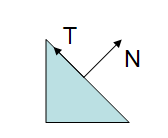
;
In the above figure we see a triangle, with a normal and a tangent vectors. The following figure shows what happens when the modelview matrix contains a non-uniform scale.
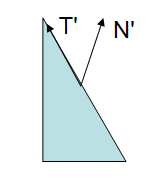
Note: if the scale was uniform, then the direction of the normal would have been preserved, The length would have been affected but this can be easily fixed with a normalization.
In the above figure the Modelview matrix was applied to all the vertices as well as to the normal and the result is clearly wrong: the transformed normal is no longer perpendicular to the surface.
We know that a vector can be expressed as the difference between two points. Considering the tangent vector, it can be computed as the difference between the two vertices of the triangle’s edge. If 


Considering that a vector can be written as a four component tuple with the last component set to zero, we can multiply both sides of the equality with the Modelview matrix

This results in


As 


Considering the same approach used for vector T, we can find two points 


The main issue is that the a vector defined through the transformed points, 
So now we know that we can’t apply the Modelview in all cases to transform the normal vector. The question is then, what matrix should we apply?
Consider a 3×3 matrix G, and lets see how this matrix could be computed to properly transform the normal vectors.
We know that, prior to the matrix transformation T.N = 0, since the vectors are by definition perpendicular. We also know that after the transformation N’.T’ must remain equal to zero, since they must remain perpendicular to each other. T can be multiplied safely by the upper left 3×3 submatrix of the modelview (T is a vector, hence the w component is zero), let’s call this submatrix M.
Let’s assume that the matrix G is the correct matrix to transform the normal vector. T. Hence the following equation:

The dot product can be transformed into a product of vectors, therefore:

Note that the transpose of the first vector must be considered since this is required to multiply the vectors. We also know that the transpose of a multiplication is the multiplication of the transposes, hence:

We started by stating that the dot product between N and T was zero, so if

then we have

Which is exactly what we want. So we can compute G based on M.

Therefore the correct matrix to transform the normal is the transpose of the inverse of the M matrix. OpenGL computes this for us in the gl_NormalMatrix.
In the beginning of this section it was stated that using the Modelview matrix would work in some cases. Whenever the 3×3 upper left submatrix of the Modelview is orthogonal we have:

This is because with an orthogonal matrix, the transpose is the same as the inverse. So what is an orthogonal matrix? An orthogonal matrix is a matrix where all columns/rows are unit length, and are mutually perpendicular. This implies that when two vectors are multiplied by such a matrix, the angle between them after transformation by an orthogonal matrix is the same as prior to that transformation. Simply put the transformation preserves the angle relation between vectors, hence transformed normals remain perpendicular to tangents! Furthermore it preserves the length of the vectors as well.
So when can we be sure that M is orthogonal? When we limit our geometric operations to rotations and translations, i.e. when in the OpenGL application we only use glRotate and glTranslate and not glScale. These operations guarantee that M is orthogonal. Note: gluLookAt also creates an orthogonal matrix!
注:之所以法线不能直接使用UNITY_MATRIX_MV进行变换,是因为法线是向量,具有方向,在进行空间变换的时候,如果发生非等比缩放,方向会发生偏移。为什么呢?拿上面的例子来说,我们可以简单的把法线和切线当成三角形的两条边,显然,三角形在空间变换的时候,不管是平移,还是旋转,或者是等比缩放,都不会变形,但是如果非等比缩放,就会发生拉伸。所以法线和切线的夹角也就会发生变化。(而切线在变换前后,方向总是正确的,所以法线方向就不正确了)。
参考:
http://www.lighthouse3d.com/tutorials/glsl-tutorial/the-normal-matrix/
http://forum.unity3d.com/threads/_object2world-or-unity_matrix_it_mv.112446/
http://www.cnblogs.com/kesalin/archive/2012/12/06/3D_math.html
UNITY_MATRIX_IT_MV[Matrix] (转载)的更多相关文章
- UNITY_MATRIX_IT_MV[Matrix]
http://blog.csdn.net/cubesky/article/details/38682975 前面发了一篇关于unity Matrix的文章. http://blog.csdn.NET/ ...
- 矩阵乘法C语言实现
/* 矩阵乘法C语言实现 Slyar 2009.3.20 */ #include <stdio.h> #include <stdlib.h> /* 给 int 类型定义 ...
- [转载]Matrix类的使用
2013-12-18 11:31:00 转载自: http://www.cnblogs.com/mmy0925/archive/2013/01/22/2871009.html 在Android中,对图 ...
- Android图片处理(Matrix,ColorMatrix) - 转载
Android图片处理(Matrix,ColorMatrix) 转载自:http://www.cnblogs.com/leon19870907/articles/1978065.html 在编程中有时 ...
- <转载> OpenGL Projection Matrix
原文 OpenGL Projection Matrix Related Topics: OpenGL Transformation Overview Perspective Projection Or ...
- Android中Matrix的pre post set方法理解(转载来源:Linux社区 作者:zjmdp)
虽说以前学习过线性代数和图形学原理,但是在实际中碰到matrix还是疑惑了好一阵子,今天通过向同事请教终于找到一点门路,特总结如下: Matrix主要用于对平面进行缩放,平移,旋转以及倾斜操作,为简化 ...
- Atitit Data Matrix dm码的原理与特点
Atitit Data Matrix dm码的原理与特点 Datamatrix原名Datacode,由美国国际资料公司(International Data Matrix, 简称ID Matrix)于 ...
- 【转】What is an SDET? Part 2 – Skill Matrix of SDET
What is an SDET? Part 2 ---- Skill Matrix of SDET (Instead of naming it as part 2 of What is an SDET ...
- paper 131:【图像算法】图像特征:GLCM【转载】
转载地址:http://www.cnblogs.com/skyseraph/archive/2011/08/27/2155776.html 一 原理 1 概念:GLCM,即灰度共生矩阵,GLCM是一个 ...
随机推荐
- .Net之美
第1章 C#类型基础 1.1 值类型和引用类型值类型和引用类型是以它们在计算机内存中是如何被分配的来划分的.值类型包括了结构和枚举,引用类型则包括了类. 接口. 委托等. 还有一种特殊的值类型,称为简 ...
- Keil(MDK-ARM)使用教程(三)_在线调试
Ⅰ.概述 该文章总结Keil(MDK-ARM)在线调试相关的内容,详情请往下看. 该文章是基于新建好软件工程来讲述,关于Keil的下载.安装和新建工程我已将在前面做了详细的总结,不懂的可以参看我博客里 ...
- char型变量理解
char c = 128; printf("%d", c); 问输出是多少? 正确答案应该是-128. 如下几种情况: char c=128;printf("%u\n& ...
- Linux 两个目录浅对比拷贝
对比两个目录内容,然后拷贝! #!/usr/bin/python# -*-coding:utf-8 -*-import osimport sysimport shutildef get_dir_con ...
- 扯一扯前端css的整体架构设计:(2)base基础类的那些事儿
周一下午在实验室写了第一篇博文,有几个人捧场,那咱就得接着下去啊.然后我觉得现在写的内容更多的偏向于谈一下我对于前端css架构的理解和前端经验的一个小总结,所以就把标题里原来的[项目总结]给删掉了.但 ...
- Microsoft SqlServer2008技术内幕:T-Sql语言基础-读书笔记-单表查询SELECT语句元素
1.select语句逻辑处理顺序: FORM WHERE GROUP BY HAVING SELECT OVER DISTINCT TOP ORDER BY 总结: 2.FORM子句的表名称应该带上数 ...
- EMVTag系列17《9F66 终端交易属性》
字节:1 8 1 – 支持非接触磁条 (MSD) 0– 不支持非接触磁条 (MSD) 7 1 – 支持非接触PBOC 0– 不支持非接触PBOC 6 1 – 支持非接触qPBOC 0 ...
- sqlserver中查找长时间未提交事务
无论是有意无意,如果事务在数据库中保持打开,则它会阻塞其他进程对修改后的数据进行操作.同样,对事务日志进行备份也只会截断不活动事务的那部分事务日志,所以打开的事务会导致日志变多(甚至达到物理限制),直 ...
- 如何从官网下载springframework和document
spring官网 http://spring.io/ --->spring project--->点击github图标 --->artifactory --->进入到了http ...
- Windows Phone Listbox虚拟化的问题
最近在项目里面碰到最头疼的一个难题就是Listbox虚拟化的问题,查阅很多文档其实Listbox本身是支持虚拟化的,那么在什么情况下会破坏Listbox的虚拟化呢?目前我接触到的主要有两个原因:一.是 ...