
UNITY_MATRIX_IT_MV[Matrix]
http://blog.csdn.net/cubesky/article/details/38682975
前面发了一篇关于unity Matrix的文章。
http://blog.csdn.NET/cubesky/article/details/38664143
其中对于一般的Matrix可以说应该有一个清晰的了解了。但是对于UNITY_MATRIX_IT_MV这些matrix估计理解起来还是比较有问题。这里再重点描述一下UNITY_MATRIX_IT_MV。
首先,我们看一下unity中Doc中的描述:
| UNITY_MATRIX_IT_MV | float4x4 | Inverse transpose of model * view matrix. |
然后我们来看一下UNITY_MATRIX_IT_MV实际的变换意义
The transpose of World2Object is the transpose of the inverse of the Object2World matrix.
- MV transforms points from object to eye space
- IT_MV rotates normals from object to eye space
And similarly:
- Object2World transforms points from object to world space
- IT_Object2World (which, as you point out, is the transpose of World2Object) rotates normals from object to world space
If it is orthogonal, the upper-left 3x3 of Object2World will be equal to that of IT_Object2World, and so will also rotate normals from object to world space.
上面这里很好的描述了UNITY_MATRIX_IT_MV的使用场景,专门针对法线进行变换。但是为什么法线的变换和定点不一样呢?让我们来看一篇推导的文章。
The gl_NormalMatrix is present in many vertex shaders. In here some light is shed on what is this matrix and what is it for. This section was inspired by the excellent book by Eric Lengyel “Mathematics for 3D Game Programming and Computer Graphics”.
Many computations are done in eye space. This has to do with the fact that lighting is commonly performed in this space, otherwise eye position dependent effects, such as specular lights would be harder to implement.
Hence we need a way to transform the normal into eye space. To transform a vertex to eye space we can write:
vertexEyeSpace = gl_ModelViewMatrix * gl_Vertex;
So why can’t we just do the same with a normal vector? A normal is a vector of 3 floats and the modelview matrix is 4×4. Secondly, since the normal is a vector, we only want to transform its orientation. The region of the modelview matrix that contains the orientation is the top left 3×3 submatrix. So why not multiply the normal by this submatrix?
This could be easily achieved with the following code:
normalEyeSpace = vec3(gl_ModelViewMatrix * vec4(gl_Normal,0.0));
So, gl_NormalMatrix is just a shortcut to simplify code writing or to optimize it? No, not really. The above line of code will work in some circumstances but not all.
Lets have a look at a potential problem:
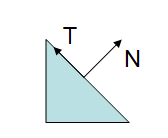
;
In the above figure we see a triangle, with a normal and a tangent vectors. The following figure shows what happens when the modelview matrix contains a non-uniform scale.
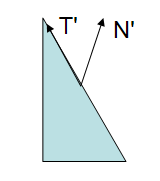
Note: if the scale was uniform, then the direction of the normal would have been preserved, The length would have been affected but this can be easily fixed with a normalization.
In the above figure the Modelview matrix was applied to all the vertices as well as to the normal and the result is clearly wrong: the transformed normal is no longer perpendicular to the surface.
We know that a vector can be expressed as the difference between two points. Considering the tangent vector, it can be computed as the difference between the two vertices of the triangle’s edge. If 


Considering that a vector can be written as a four component tuple with the last component set to zero, we can multiply both sides of the equality with the Modelview matrix

This results in


As 


Considering the same approach used for vector T, we can find two points 


The main issue is that the a vector defined through the transformed points, 
So now we know that we can’t apply the Modelview in all cases to transform the normal vector. The question is then, what matrix should we apply?
Consider a 3×3 matrix G, and lets see how this matrix could be computed to properly transform the normal vectors.
We know that, prior to the matrix transformation T.N = 0, since the vectors are by definition perpendicular. We also know that after the transformation N’.T’ must remain equal to zero, since they must remain perpendicular to each other. T can be multiplied safely by the upper left 3×3 submatrix of the modelview (T is a vector, hence the w component is zero), let’s call this submatrix M.
Let’s assume that the matrix G is the correct matrix to transform the normal vector. T. Hence the following equation:

The dot product can be transformed into a product of vectors, therefore:

Note that the transpose of the first vector must be considered since this is required to multiply the vectors. We also know that the transpose of a multiplication is the multiplication of the transposes, hence:

We started by stating that the dot product between N and T was zero, so if

then we have

Which is exactly what we want. So we can compute G based on M.

Therefore the correct matrix to transform the normal is the transpose of the inverse of the M matrix. OpenGL computes this for us in the gl_NormalMatrix.
In the beginning of this section it was stated that using the Modelview matrix would work in some cases. Whenever the 3×3 upper left submatrix of the Modelview is orthogonal we have:

This is because with an orthogonal matrix, the transpose is the same as the inverse. So what is an orthogonal matrix? An orthogonal matrix is a matrix where all columns/rows are unit length, and are mutually perpendicular. This implies that when two vectors are multiplied by such a matrix, the angle between them after transformation by an orthogonal matrix is the same as prior to that transformation. Simply put the transformation preserves the angle relation between vectors, hence transformed normals remain perpendicular to tangents! Furthermore it preserves the length of the vectors as well.
So when can we be sure that M is orthogonal? When we limit our geometric operations to rotations and translations, i.e. when in the OpenGL application we only use glRotate and glTranslate and not glScale. These operations guarantee that M is orthogonal. Note: gluLookAt also creates an orthogonal matrix!
注:之所以法线不能直接使用UNITY_MATRIX_MV进行变换,是因为法线是向量,具有方向,在进行空间变换的时候,如果发生非等比缩放,方向会发生偏移。为什么呢?拿上面的例子来说,我们可以简单的把法线和切线当成三角形的两条边,显然,三角形在空间变换的时候,不管是平移,还是旋转,或者是等比缩放,都不会变形,但是如果非等比缩放,就会发生拉伸。所以法线和切线的夹角也就会发生变化。(而切线在变换前后,方向总是正确的,所以法线方向就不正确了)。
参考:
http://www.lighthouse3d.com/tutorials/glsl-tutorial/the-normal-matrix/
http://forum.Unity3D.com/threads/_object2world-or-unity_matrix_it_mv.112446/
http://www.cnblogs.com/kesalin/archive/2012/12/06/3D_math.html
UNITY_MATRIX_IT_MV[Matrix]的更多相关文章
- UNITY_MATRIX_IT_MV[Matrix] (转载)
转载 http://blog.csdn.net/cubesky/article/details/38682975 前面发了一篇关于unity Matrix的文章. http://blog.csdn.n ...
- 旋转矩阵(Rotation Matrix)的推导及其应用
向量的平移,比较简单. 缩放也较为简单 矩阵如何进行计算呢?之前的文章中有简介一种方法,把行旋转一下,然后与右侧对应相乘.在谷歌图片搜索旋转矩阵时,看到这张动图,觉得表述的很清晰了. 稍微复杂一点的是 ...
- angular2系列教程(十一)路由嵌套、路由生命周期、matrix URL notation
今天我们要讲的是ng2的路由的第二部分,包括路由嵌套.路由生命周期等知识点. 例子 例子仍然是上节课的例子:
- Pramp mock interview (4th practice): Matrix Spiral Print
March 16, 2016 Problem statement:Given a 2D array (matrix) named M, print all items of M in a spiral ...
- Atitit Data Matrix dm码的原理与特点
Atitit Data Matrix dm码的原理与特点 Datamatrix原名Datacode,由美国国际资料公司(International Data Matrix, 简称ID Matrix)于 ...
- Android笔记——Matrix
转自:http://www.cnblogs.com/qiengo/archive/2012/06/30/2570874.html#translate Matrix的数学原理 在Android中,如果你 ...
- 通过Matrix进行二维图形仿射变换
Affine Transformation是一种二维坐标到二维坐标之间的线性变换,保持二维图形的"平直性"和"平行性".仿射变换可以通过一系列的原子变换的复合来 ...
- [LeetCode] Kth Smallest Element in a Sorted Matrix 有序矩阵中第K小的元素
Given a n x n matrix where each of the rows and columns are sorted in ascending order, find the kth ...
- [LeetCode] Longest Increasing Path in a Matrix 矩阵中的最长递增路径
Given an integer matrix, find the length of the longest increasing path. From each cell, you can eit ...
随机推荐
- php建立一个空类: stdClass
$pick = new stdClass; $pick->type = 'full'; ;
- [转载]Hibernate如何提升数据库查询的性能
目录(?)[-] 数据库查询性能的提升也是涉及到开发中的各个阶段在开发中选用正确的查询方法无疑是最基础也最简单的 SQL语句的优化 使用正确的查询方法 使用正确的抓取策略 Hibernate的性能优化 ...
- ALV 红绿灯编写
[转http://lz357502668.blog.163.com/blog/static/164967432012417102133216/]ALV 指示燈 編寫 1,在內表中申請一個字段. 該字段 ...
- LeetCode:用HashMap解决问题
LeetCode:用HashMap解决问题 Find Anagram Mappings class Solution { public int[] anagramMappings(int[] A, i ...
- js阻止a链接
<!DOCTYPE HTML> <html lang="en"> <head> <meta charset="UTF-8&quo ...
- Python程序打包成exe的一些坑
今天写了一个项目,Python项目,需要在win7上跑起来,我想,这不是简单的不行么,直接上Pyinstaller不就完了? 但是后来,我发觉我真是too young too simple. 为什么这 ...
- iOS JSON 和 Mode l转换
MJExtension 是我们项目开发常用的一个第三方框架 很好用. https://github.com/CoderMJLee/MJExtension 映射 json value key 直 ...
- maven导入项目时,缺少部分source folder
今天导入公司的maven项目时,少了一些source folder,运行启动正常,但是页面打不开,找不到对应的目录文件,使用maven更新项目,重启编辑器也无效. 问题描述如图所示,缺少了图中的2个目 ...
- 【Flask模板】宏的概念和基本使用
# 宏:模板中的宏跟python中的函数类似,可以传递参数,但是不能有返回值,可以将一些经常用到的代码片段放到宏中,然后把一些不固定的值抽取出来当成一个变量.使用宏的时候,参数可以为默认值.相关示例代 ...
- 20145229吴姗珊 《Java程序设计》第9周总结
20145229吴姗珊 <Java程序设计>第9周总结 教材学习内容总结 第十六章 整合数据库 JDBC入门 数据库本身是个独立运行的应用程序 撰写应用程序是利用通信协议对数据库进行指令交 ...