
字符串类——KMP算法的应用
1,字符串类中的新功能(本文代码已集成到字符串类——字符串类的创建(上)中,这里讲述函数实现原理):
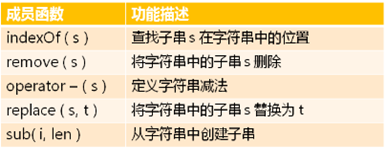
2,子串查找(KMP 算法直接运用):
1,int indexOf(const char* s) const;
2,int indexOf(const String& s) const;
3,子串查找成员函数的声明:
int indexOf(const char* ) const;
int indexOf(const String& s) const;
4,子串查找成员函数的定义:
 int String::indexOf(const char* s) const // 子串查找,返回下标

 {

     return kmp(m_str, s ? s : "");

 }

 int String::indexOf(const String &s) const

 {

     return kmp(m_str, s.m_str);

 }
3,在字符串中将指定的子串删除:
1,String& remove(const char* s);
2,String& remove(const String& s);
1,根据 kmp 在目标字符串中查找子串的位置;
2,通过子串位置和子串长度进行删除;
3,删除指定字符串成员函数的声明:
String& remove(int i, int len);
String& remove(const char* s);
String& remove(const String& s);
4,删除指定字符串成员函数的定义:
 /* 删除下标 i 处长度为 len 的字符串 */

 String& String::remove(int i, int len)   // 和 insert() 返回的是相同的函数,还可以以字符串类继续访问,如查看删除后的字符串等

 {

     if( ( <= i ) && (i < m_length) )

     {

         int n = i;

         int m = i + len; // 在 (n, m) 范围之内的字符都要删除掉

         while( (n < m) && (m < m_length) ) // 删除的字符串长度是不能大于当前的长度的,否则没有意义

         {

             m_str[n++] = m_str[m++];   // 这个赋值很经典

         }

         m_str[n] = '\0'; //这里为什么是 n,因为n是不断增加的,直到 m 为等于 length

         m_length = n;  // 不应该是 m_length - n 吗?

 }

     return *this;

 }

 String& String::remove(const char *s) // 删除子串

 {

     return remove(indexOf(s), s ? strlen(s) : );

 }

 String& String::remove(const String &s) // 删除子串

 {

     return remove(indexOf(s), s.length());

 }
4,字符串的减法操作定义(operator - ):
1,使用 remove 实现字符串间的减法操作;
1,字符串自身不被修改;
2,返回产生的新串;
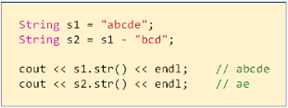
2,减法操作符重载的声明:
String operator - (const String& s) const;
String operator - (const char* s) const;
String& operator -= (const String& s);
String& operator -= (const char* s);
3,减法操作符重载的定义:
 String String::operator - (const String& s) const  // 字符串自身会被改变

 {

     return String(*this).remove(s);  // 直接调用构造函数产生一个新的临时字符串对象,值和当前字符串对象值相同,然后调用临时对象的remove() 函数将子串删除,最后将删除结果返回,但是当前的字符串没有被改变,因为是拷贝赋值

 }

 String String::operator - (const char* s) const  // 字符串自身会被改变

 {

     return String(*this).remove(s);

 }

 String& String::operator -= (const String& s) // 字符串自生不会被改变

 {

     return remove(s);

 }

 String& String::operator -= (const char* s)

 {

     return remove(s);

 }
5,字符串中的子串替换:
1,String& replace(const char* t, const char* s);
2,String& replace(const String& t, const char* s);
3,String& replace(cosnt char* t, const String& s);
4,String& replace(const String& t, const String& s);
5,子串替换成员函数的声明:
String& replace(const char* t, const char* s);
String& replace(const String& t, const char* s);
String& replace(const char* t, const String& s);
String& replace(const String& t, const String& s);
6,子串替换成员函数的定义:
 /* 用 s 替换字符串中的 t */

 String& String::replace(const char* t, const char* s)

 {

     int index = indexOf(t); // 查找 t 的位置

     if( index >=  ) // t 存在于当前的字符串中

     {

         remove(t);  // 不要复制粘贴代码,要复用

         insert(index, s);

    }

     return *this;

 }

 String& String::replace(const String& t, const char* s)

 {

     return replace(t.m_str, s);

 }

 String& String::replace(const char* t, const String& s)

 {

     return replace(t, s.m_str);

 }

 String& String::replace(const String& t, const String& s)

 {

     return replace(t.m_str, s.m_str);

 }
6,从字符串中创建子串:
1,String sub(int i, int len) const;
1,以 i 为起点去长度为 len 的子串;
2,子串提取不会改变字符串本身的状态;
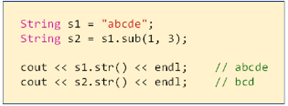
2,从字符串中创建子串成员函数的声明:
String sub(int i, int len) const; // 因为这里不会改变当前字符串状态,所以为 const 成员函数;
3,从字符串中创建子串成员函数的定义:
 String String::sub(int i, int len) const  // 查找当前字符串中第 i 个位置长度为 len 的字符串

 {

    String ret;

     if( ( <= i) && (i < m_length) )

     {

         if( len <  ) len = ; // 当小于零时候,不可能,要归一化到 0

         if(len+i > m_length) len = m_length - i; // 只能够提取这么长的长度

         char* str = reinterpret_cast<char*>(malloc(len + ));

         if( str != NULL )

         {

             strncpy(str, m_str + i, len); // 从 m_str + i 位置拷贝 len 长度的字符串,这里 m_str 是字符串起始位置

         }

         str[len] = '\0';

         ret = str;  // 返回子串

         free(str);

     }

     else

     {

         THROW_EXCEPTION(IndexOutOfBoundsException, "Parameter i is invaid ...");

    }

     return ret;

 }
7,本节课测试代码:
 #include <iostream>

 #include "DTString.h"

 #include "malloc.h"

 #include <cstring>

 using namespace std;

 using namespace DTLib;

 int main()

 {

     String s = "ababax";

    String s1 = s- "bax";

     cout << s.str() << endl;

15    cout << s1.str() << endl;

     s -= "ba";

    s -= s;

    cout << "[" << s.str() << "]" << endl;

     String s2 = "ababax";

    s2.replace("baba", "xyz");

    cout << s2.str() << endl;

     String s3 = "ababax";

    String s4 = s3.sub(, );

    cout << s4.str() << endl;

     return ;

 }
8,小结:
1,字符串类是工程开发中必不可少的组件;
2,字符串中应该包含常用字符串操作函数:
1,增:insert,operator +,...;
1,当前字符串增加;
2,删:remove,operator -,...;
1,当前字符串删除;
3,查: indexOf,...
1,当前字符串查找;
4,改:replace,...
1,当前字符串更改;
字符串类——KMP算法的应用的更多相关文章
- 字符串类——KMP子串查找算法
1, 如何在目标字符串 s 中,查找是否存在子串 p(本文代码已集成到字符串类——字符串类的创建(上)中,这里讲述KMP实现原理) ? 1,朴素算法: 2,朴素解法的问题: 1,问题:有时候右移一位是 ...
- [Algorithm] 字符串匹配算法——KMP算法
1 字符串匹配 字符串匹配是计算机的基本任务之一. 字符串匹配是什么?举例来说,有一个字符串"BBC ABCDAB ABCDABCDABDE",我想知道,里面是否包含另一个字符串& ...
- 字符串匹配算法——KMP算法
处理字符串的过程中,难免会遇到字符匹配的问题.常用的字符匹配方法 1. 朴素模式匹配算法(Brute-Force算法) 求子串位置的定位函数Index( S, T, pos). 模式匹配:子串的定位操 ...
- 查找字符串的 KMP 算法
查找字符串是我们平常编程过程中经常遇到的,现在介绍一种查找字符串算法,增加程序的执行速度. 通常我们是这么写的: /* content: search a string in a othor stri ...
- 字符串匹配算法——KMP算法学习
KMP算法是用来解决字符串的匹配问题的,即在字符串S中寻找字符串P.形式定义:假设存在长度为n的字符数组S[0...n-1],长度为m的字符数组P[0...m-1],是否存在i,使得SiSi+1... ...
- 字符串模式匹配KMP算法
一篇不错的博客:http://www.cnblogs.com/dolphin0520/archive/2011/08/24/2151846.html KMP字符串模式匹配通俗点说就是一种在一个字符串中 ...
- 字符串查找KMP算法(转)
如果你用过ctrl+F这个快捷键,那么你有很大的概率使用过这个算法,这就是在待查找字符串(可能有成千上万个字符)中找出模式串(比较小,可能有几个字符),可能找到大于或者等于1次的位置.例如,在abab ...
- 字符串查找KMP算法
如果你用过ctrl+F这个快捷键,那么你有很大的概率使用过这个算法,这就是在待查找字符串(可能有成千上万个字符)中找出模式串(比较小,可能有几个字符),可能找到大于或者等于1次的位置.例如,在abab ...
- c算法:字符串查找-KMP算法
/* *用KMP算法实现字符串匹配搜索方法 *该程序实现的功能是搜索本目录下的所有文件的内容是否与给定的 *字符串匹配,如果匹配,则输出文件名:包含该字符串的行 *待搜索的目标串搜索指针移动位数 = ...
随机推荐
- Node 12 值得关注的新特性
前言 时隔一年,Node.js 12 如约而至,正式发布第一个 Current 版本. 该版本带来了诸如: V8 更新带来好多不错的特性. HTTP 解析速度提升. 启动速度大幅提升. 更好的诊断报告 ...
- WPF绑定各种数据源之xml数据源
一.WPF绑定各种数据源索引 WPF 绑定各种数据源之Datatable WPF绑定各种数据源之object数据源 WPF绑定各种数据源之xml数据源 WPF绑定各种数据源之元素控件属性 Bindin ...
- Spark集成Kafka实时流计算Java案例
package com.test; import java.util.*; import org.apache.spark.SparkConf; import org.apache.spark.Tas ...
- CF9D How many trees? (dp)
这题我想了好久 设 \(f_{i,j}\) 为 \(i\) 结点 \(<=j\) 的方案数 固定根,枚举左右子树,就有: \[f_{i,j}=\sum_{k=0}^{n-1}f_{k,j-1}* ...
- kafka参数设置
一.broker参数 broker.id:kafka集群的唯一标识. log.dirs:kafka存储消息日志的目录,多个用逗号隔开,需要保证指定的目录有充足的磁盘空间. zookeeper.conn ...
- 2018-08-01-weekly
Algorithm 4. Median of Two Sorted Arrays What 两个排序数组的中位数 How 两个数组合并到同一个数组,然后进行排序取中间值即可 Key Codes cla ...
- python tkinter实时显示曲线
from tkinter import *from tkinter import ttkimport time#画窗口root = Tk()root.geometry('1000x500')root. ...
- rm 或者ls 报Argument list too long
一个文件夹下面碎文件太多,rm 或者 ls的时候报 Argument list too long 解决办法: find /tmp -type d -name "*-*-" -del ...
- 【leetcode】870. Advantage Shuffle
题目如下: 解题思路:几千年前,一个古人曾经解过这个题目,他的名字叫做田忌,后人称他的解题思想叫做“田忌赛马”.言归正传,本题就是一个田忌赛马的问题,先将A与B进行排序,然后判断A[0]与B[0]的大 ...
- 18 StringBuilder类型有何作用