
SegNet网络的Pytorch实现
1.文章原文地址
SegNet: A Deep Convolutional Encoder-Decoder Architecture for Image Segmentation
2.文章摘要
语义分割具有非常广泛的应用,从场景理解、目标相互关系推断到自动驾驶。早期依赖于低水平视觉线索的方法已经快速的被流行的机器学习算法所取代。特别是最近的深度学习在手写数字识别、语音、图像中的分类和目标检测上取得巨大成功。如今有一个活跃的领域是语义分割(对每个像素进行归类)。然而,最近有一些方法直接采用了为图像分类而设计的网络结构来进行语义分割任务。虽然结果十分鼓舞人心,但还是比较粗糙。这首要的原因是最大池化和下采样减小了特征图的分辨率。我们设计SegNet的动机来自于分割任务需要将低分辨率的特征图映射到输入的分辨率并进行像素级分类,这个映射必须产生对准确边界定位有用的特征。
3.网络结构
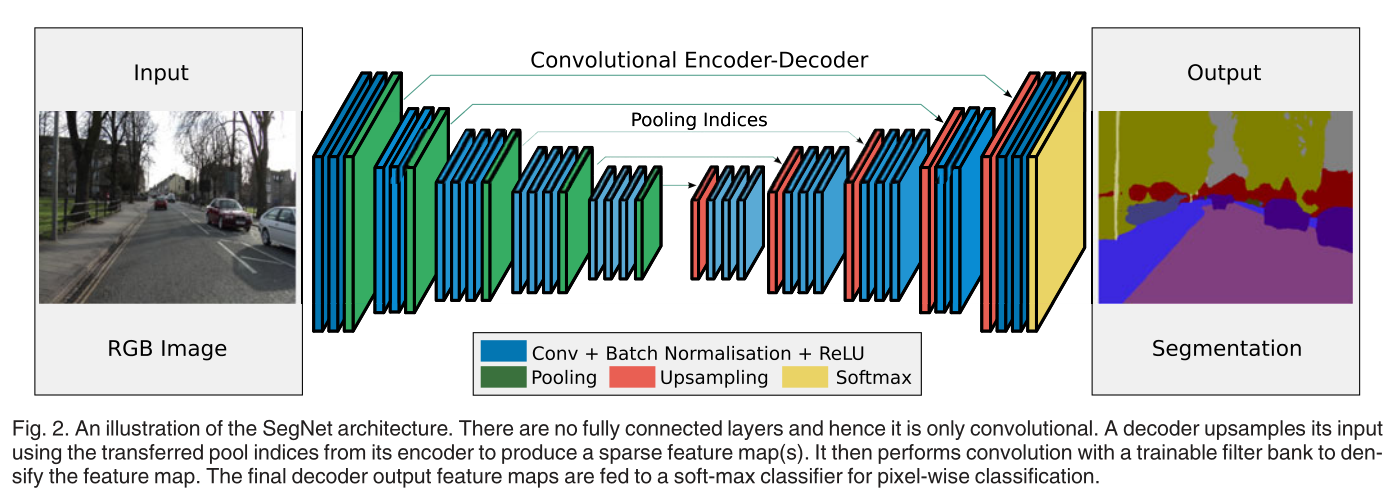
4.Pytorch实现
 import torch.nn as nn

 import torch

 class conv2DBatchNormRelu(nn.Module):

     def __init__(self,in_channels,out_channels,kernel_size,stride,padding,

                  bias=True,dilation=1,is_batchnorm=True):

         super(conv2DBatchNormRelu,self).__init__()

         if is_batchnorm:

             self.cbr_unit=nn.Sequential(

                 nn.Conv2d(in_channels,out_channels,kernel_size=kernel_size,stride=stride,padding=padding,

                           bias=bias,dilation=dilation),

                 nn.BatchNorm2d(out_channels),

                 nn.ReLU(inplace=True),

             )

         else:

             self.cbr_unit=nn.Sequential(

                 nn.Conv2d(in_channels, out_channels, kernel_size=kernel_size, stride=stride, padding=padding,

                           bias=bias, dilation=dilation),

                 nn.ReLU(inplace=True)

             )

     def forward(self,inputs):

         outputs=self.cbr_unit(inputs)

         return outputs

 class segnetDown2(nn.Module):

     def __init__(self,in_channels,out_channels):

         super(segnetDown2,self).__init__()

         self.conv1=conv2DBatchNormRelu(in_channels,out_channels,kernel_size=3,stride=1,padding=1)

         self.conv2=conv2DBatchNormRelu(out_channels,out_channels,kernel_size=3,stride=1,padding=1)

         self.maxpool_with_argmax=nn.MaxPool2d(kernel_size=2,stride=2,return_indices=True)

     def forward(self,inputs):

         outputs=self.conv1(inputs)

         outputs=self.conv2(outputs)

         unpooled_shape=outputs.size()

         outputs,indices=self.maxpool_with_argmax(outputs)

         return outputs,indices,unpooled_shape

 class segnetDown3(nn.Module):

     def __init__(self,in_channels,out_channels):

         super(segnetDown3,self).__init__()

         self.conv1=conv2DBatchNormRelu(in_channels,out_channels,kernel_size=3,stride=1,padding=1)

         self.conv2=conv2DBatchNormRelu(out_channels,out_channels,kernel_size=3,stride=1,padding=1)

         self.conv3=conv2DBatchNormRelu(out_channels,out_channels,kernel_size=3,stride=1,padding=1)

         self.maxpool_with_argmax=nn.MaxPool2d(kernel_size=2,stride=2,return_indices=True)

     def forward(self,inputs):

         outputs=self.conv1(inputs)

         outputs=self.conv2(outputs)

         outputs=self.conv3(outputs)

         unpooled_shape=outputs.size()

         outputs,indices=self.maxpool_with_argmax(outputs)

         return outputs,indices,unpooled_shape

 class segnetUp2(nn.Module):

     def __init__(self,in_channels,out_channels):

         super(segnetUp2,self).__init__()

         self.unpool=nn.MaxUnpool2d(2,2)

         self.conv1=conv2DBatchNormRelu(in_channels,out_channels,kernel_size=3,stride=1,padding=1)

         self.conv2=conv2DBatchNormRelu(out_channels,out_channels,kernel_size=3,stride=1,padding=1)

     def forward(self,inputs,indices,output_shape):

         outputs=self.unpool(inputs,indices=indices,output_size=output_shape)

         outputs=self.conv1(outputs)

         outputs=self.conv2(outputs)

         return outputs

 class segnetUp3(nn.Module):

     def __init__(self,in_channels,out_channels):

         super(segnetUp3,self).__init__()

         self.unpool=nn.MaxUnpool2d(2,2)

         self.conv1=conv2DBatchNormRelu(in_channels,out_channels,kernel_size=3,stride=1,padding=1)

         self.conv2=conv2DBatchNormRelu(out_channels,out_channels,kernel_size=3,stride=1,padding=1)

         self.conv3=conv2DBatchNormRelu(out_channels,out_channels,kernel_size=3,stride=1,padding=1)

     def forward(self,inputs,indices,output_shape):

         outputs=self.unpool(inputs,indices=indices,output_size=output_shape)

         outputs=self.conv1(outputs)

         outputs=self.conv2(outputs)

         outputs=self.conv3(outputs)

         return outputs

 class segnet(nn.Module):

     def __init__(self,in_channels=3,num_classes=21):

         super(segnet,self).__init__()

         self.down1=segnetDown2(in_channels=in_channels,out_channels=64)

         self.down2=segnetDown2(64,128)

         self.down3=segnetDown3(128,256)

         self.down4=segnetDown3(256,512)

         self.down5=segnetDown3(512,512)

         self.up5=segnetUp3(512,512)

         self.up4=segnetUp3(512,256)

         self.up3=segnetUp3(256,128)

         self.up2=segnetUp2(128,64)

         self.up1=segnetUp2(64,64)

         self.finconv=conv2DBatchNormRelu(64,num_classes,3,1,1)

     def forward(self,inputs):

         down1,indices_1,unpool_shape1=self.down1(inputs)

         down2,indices_2,unpool_shape2=self.down2(down1)

         down3,indices_3,unpool_shape3=self.down3(down2)

         down4,indices_4,unpool_shape4=self.down4(down3)

         down5,indices_5,unpool_shape5=self.down5(down4)

         up5=self.up5(down5,indices=indices_5,output_shape=unpool_shape5)

         up4=self.up4(up5,indices=indices_4,output_shape=unpool_shape4)

         up3=self.up3(up4,indices=indices_3,output_shape=unpool_shape3)

         up2=self.up2(up3,indices=indices_2,output_shape=unpool_shape2)

         up1=self.up1(up2,indices=indices_1,output_shape=unpool_shape1)

         outputs=self.finconv(up1)

         return outputs

 if __name__=="__main__":

     inputs=torch.ones(1,3,224,224)

     model=segnet()

     print(model(inputs).size())

     print(model)
参考
https://github.com/meetshah1995/pytorch-semseg
SegNet网络的Pytorch实现的更多相关文章
- 群等变网络的pytorch实现
CNN对于旋转不具有等变性,对于平移有等变性,data augmentation的提出就是为了解决这个问题,但是data augmentation需要很大的模型容量,更多的迭代次数才能够在训练数据集合 ...
- U-Net网络的Pytorch实现
1.文章原文地址 U-Net: Convolutional Networks for Biomedical Image Segmentation 2.文章摘要 普遍认为成功训练深度神经网络需要大量标注 ...
- ResNet网络的Pytorch实现
1.文章原文地址 Deep Residual Learning for Image Recognition 2.文章摘要 神经网络的层次越深越难训练.我们提出了一个残差学习框架来简化网络的训练,这些 ...
- GoogLeNet网络的Pytorch实现
1.文章原文地址 Going deeper with convolutions 2.文章摘要 我们提出了一种代号为Inception的深度卷积神经网络,它在ILSVRC2014的分类和检测任务上都取得 ...
- AlexNet网络的Pytorch实现
1.文章原文地址 ImageNet Classification with Deep Convolutional Neural Networks 2.文章摘要 我们训练了一个大型的深度卷积神经网络用于 ...
- VGG网络的Pytorch实现
1.文章原文地址 Very Deep Convolutional Networks for Large-Scale Image Recognition 2.文章摘要 在这项工作中,我们研究了在大规模的 ...
- 【转载】PyTorch系列 (二):pytorch数据读取
原文:https://likewind.top/2019/02/01/Pytorch-dataprocess/ Pytorch系列: PyTorch系列(一) - PyTorch使用总览 PyTorc ...
- pytorch预训练
Pytorch预训练模型以及修改 pytorch中自带几种常用的深度学习网络预训练模型,torchvision.models包中包含alexnet.densenet.inception.resnet. ...
- PyTorch使用总览
PyTorch使用总览 https://blog.csdn.net/u014380165/article/details/79222243 深度学习框架训练模型时的代码主要包含数据读取.网络构建和其他 ...
随机推荐
- xray写POC踩坑
错误记录 静态文件目录不一定是static. 只考虑了linux的情况,如果是 windows 呢,能读取某些应用自己的源码吗. 实际环境参数不一定是id,thinkphp 不适合使用 poc 来写 ...
- Django:使用模态框新增数据,成功后提示“提交成功”,并刷新表格bootstrap-table数据
废话不说先看图: 代码实现: 前台代码: {% load staticfiles %} <!DOCTYPE html> <html lang="en"> ...
- union all 关键字的应用(合并两个查询结果集到同一个结果集)
在此对于数据库中 union all 关键字的功能和用法进行简单的使用介绍. 这是我工作中的一个需求: 有两个 A表 和B表. A表的数据: B表的数据: 现在有这样一个需求,让他一次性的全部查出来. ...
- 2019.10.28 IDEA入门指南(很多人问补充一篇)
Idea快速入门指南 1.安装 1.1.安装 我们使用的是最新的2017.3.4版本: 双击打开, 选择一个目录,最好不要中文和空格: 然后选择桌面快捷方式,请选择64位: 然后选择安装: 开始安装: ...
- json数据的key的读取和替换
读取json的key: /** * @Description: 递归读取所有的key * @Param: * @return: * @throws Exception * @author: hw * ...
- ubuntu 安装 iperf
iperf的github https://github.com/esnet/iperf/releases 解压 sudo tar -zvxf iperf-3.6.tar.gz -C /usr/loca ...
- LeetCode 671. 二叉树中第二小的节点(Second Minimum Node In a Binary Tree) 9
671. 二叉树中第二小的节点 671. Second Minimum Node In a Binary Tree 题目描述 给定一个非空特殊的二叉树,每个节点都是正数,并且每个节点的子节点数量只能为 ...
- 原生js 实现better-scroll效果,饿了么菜单内容联动,即粘即用
<!DOCTYPE html> <html> <head> <meta http-equiv="Content-Type" content ...
- mogodb数据库简单的权限分配
mongdb数据库默认不需要权限认证,但为了安全起见,最好设置下需要权限认证,启动的时候设置auth=true即可. 推荐通过mongodb.conf配置文件的形式启动mongodb 进入mong ...
- git的快速入门
Git是目前世界上最先进的分布式版本控制系统(注意,仅仅是一个程序,而不是正真意义上的系统). Why为什么需要版本控制? 场景1:大学毕业前夕,你在完成毕业论文,初稿A写好了,找老师修改,老师提出意 ...