
[学习笔记] CS131 Computer Vision: Foundations and Applications:Lecture 9 深度学习
深度学习
So far this week
- Edge detection
- RANSAC
- SIFT
- K-Means
- Linear classifier
- Mean-shift
- PCA/Eigenfaces
- Image features
Current Research
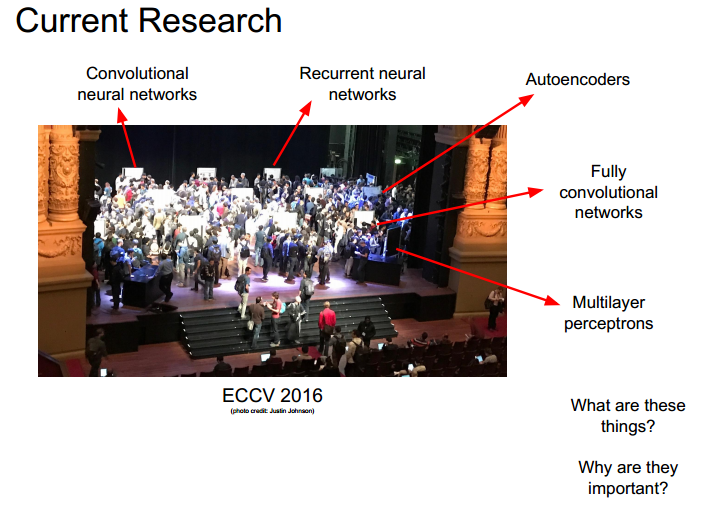
- Learning hierarchical representations from data
- End-to-end learning: raw inputs to predictions
- can use a small set of simple tools to solve many problems
- has led to rapid progress on many problems
- Inspired by the brain(very loosely!)
Deep learning for different problems
vision tasks
visual recognition

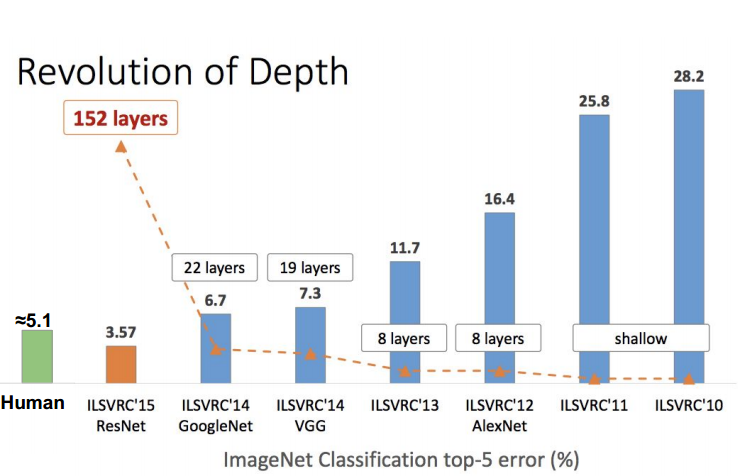
object detection: what and where

object segmentation
image caption
visual question answering
super resolution
image retrieval
style transfer
outside vision tasks
- Machine Translation
- Text Synthesis
- Speech Recognition
- Speech Synthesis
Motivation
Data-driven approach:
- collect a dataset of images and labels
- use machine learning to train an image calssifier
- evaluate the classifier on a withheld set of test images
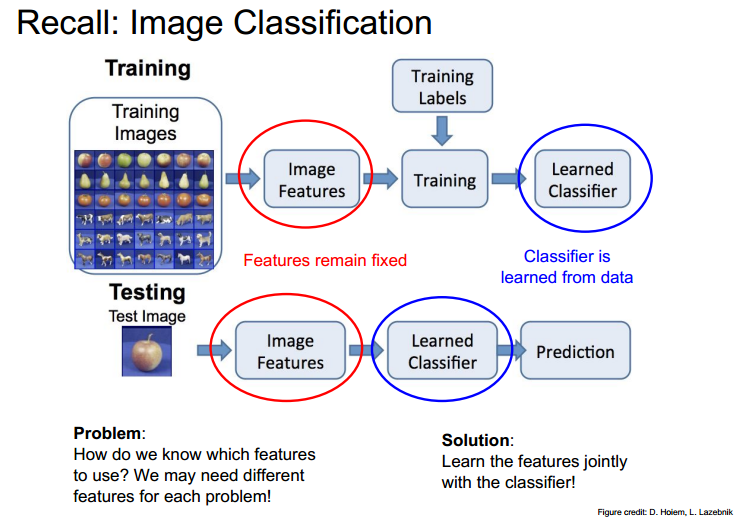
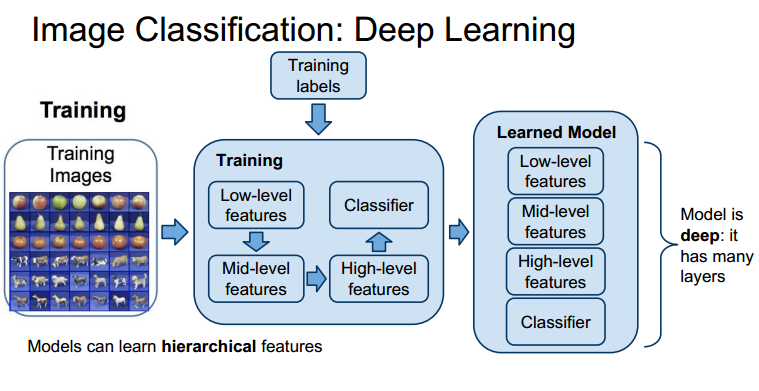
feature learning
what is feature learning?[^what is feature learning]
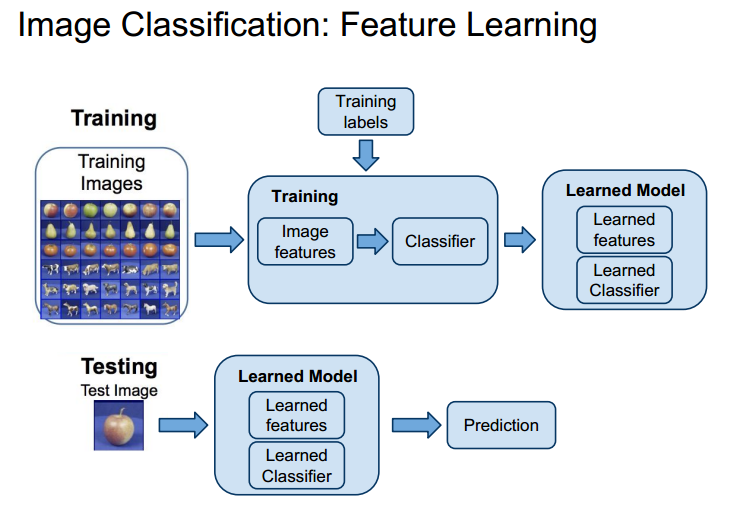
deep learning
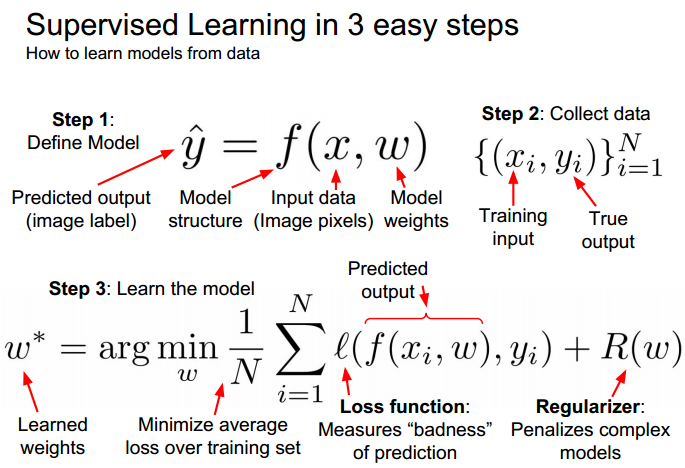
Supervised learning
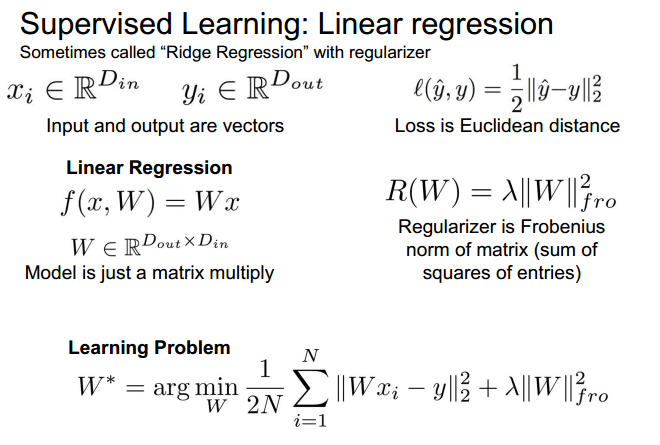
linear regression
neural network
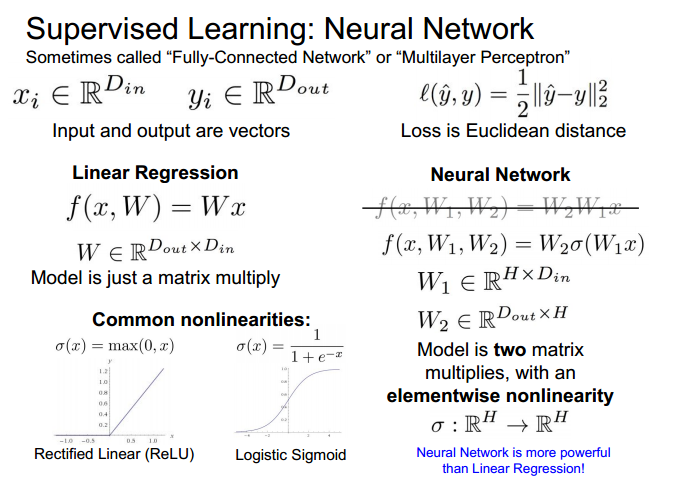
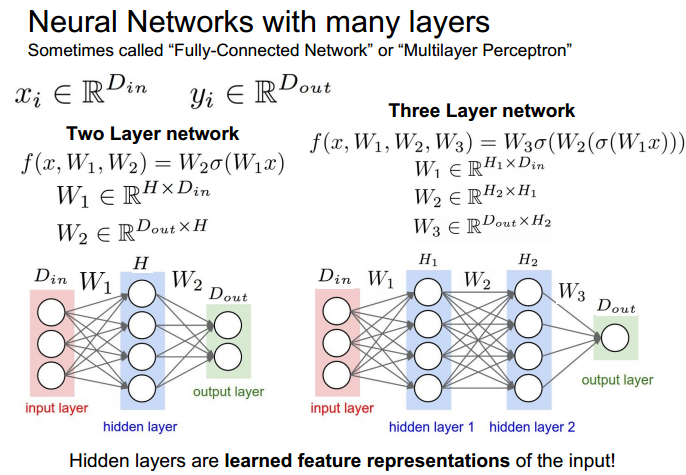
neural networks with many layers
Gradient descent
how to find the best weights \(w^T\)
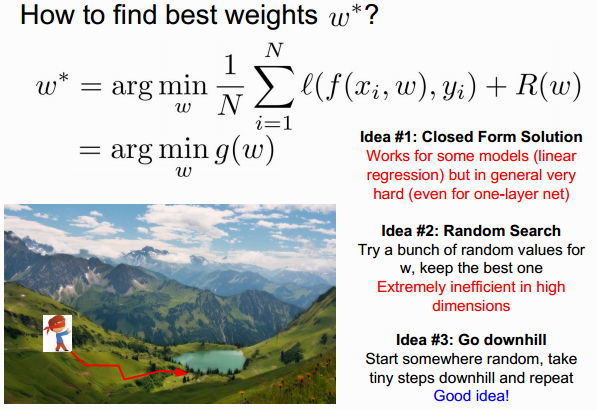
which way is down hill?

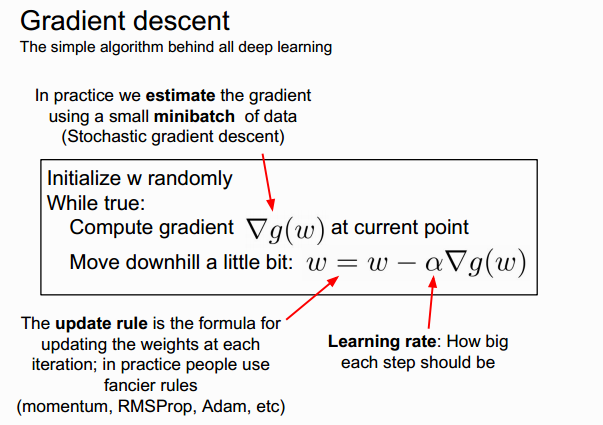
gradient descent
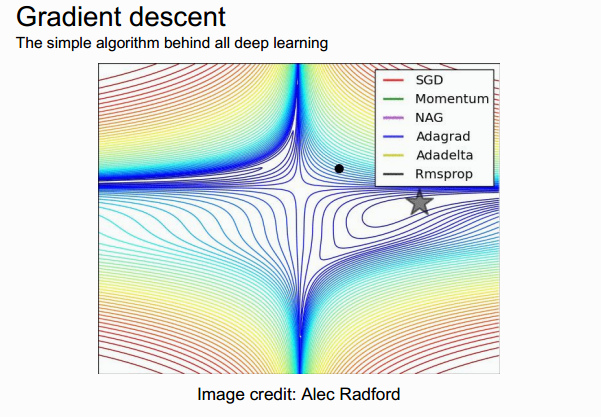
fancier rules:
- Momentum
- NAG
- Adagrad
- Adadelta
- Rmsprop
这里以后可以再 看看!
Backpropagation
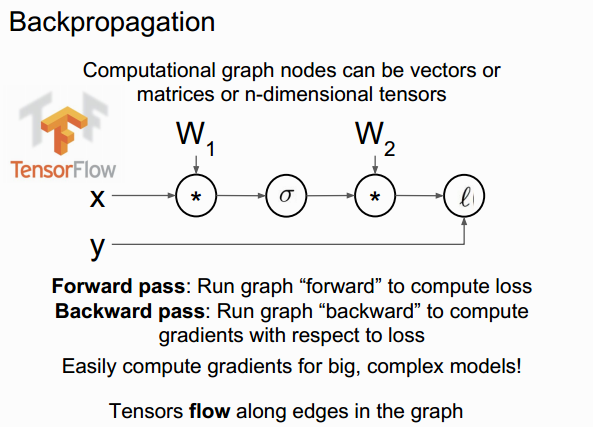
a two-layer neural network in 25 lines of code
import numpy as np

D,H,N = 8, 64,32

#randomly initialize weights

W1 = np.random.randn(D,H)

W2 = np.random.randn(H,D)

for t in xrange(10000):

	x = np.random.randn(N,D)

	y = np.sin(x)

	s = x.dot(W1)

	a = np.maxium(s,0)

	y_hat = a.dot(W2)

	loss = 0.5*np.sum((y_hat-y)**2.0)

	dy_hat = y_hat - y

	dW2 = a.T.dot(W2.T)

	da = dy_hat.dot(W2.T)

	ds = (s > 0)*da

	dW1 = x.T.dot(ds)

	W1 -= learning_rate*dW1

	W2 -= learning_rate*dW2
[^what is feature learning]:
In Machine Learning, feature learning or representation learningis a set of techniques that learn a feature: a transformation of raw data input to a representation that can be effectively exploited in machine learning tasks. This obviates manual feature engineering, which is otherwise necessary, and allows a machine to both learn at a specific task (using the features) and learn the features themselves.
Feature learning is motivated by the fact that machine learning tasks such as classification often require input that is mathematically and computationally convenient to process. However, real-world data such as images, video, and sensor measurement is usually complex, redundant, and highly variable. Thus, it is necessary to discover useful features or representations from raw data. Traditional hand-crafted features often require expensive human labor and often rely on expert knowledge. Also, they normally do not generalize well. This motivates the design of efficient feature learning techniques, to automate and generalize this.
Feature learning can be divided into two categories: supervised and unsupervised feature learning, analogous to these categories in machine learning generally.
In supervised feature learning, features are learned with labeled input data. Examples include Supervised Neural Networks, Multilayer Perceptron, and (supervised) dictionary Learning.
In unsupervised feature learning, features are learned with unlabeled input data. Examples include dictionary learning, independent component analysis, autoencoders, and various forms of clustering.
[学习笔记] CS131 Computer Vision: Foundations and Applications:Lecture 9 深度学习的更多相关文章
- [学习笔记] CS131 Computer Vision: Foundations and Applications:Lecture 1 课程介绍
课程大纲:http://vision.stanford.edu/teaching/cs131_fall1718/syllabus.html 课程定位: 课程交叉: what is (computer) ...
- [学习笔记] CS131 Computer Vision: Foundations and Applications:Lecture 2 颜色和数学基础
大纲 what is color? The result of interaction between physical light in the environment and our visual ...
- [学习笔记] CS131 Computer Vision: Foundations and Applications:Lecture 4 像素和滤波器
Background reading: Forsyth and Ponce, Computer Vision Chapter 7 Image sampling and quantization Typ ...
- [学习笔记] CS131 Computer Vision: Foundations and Applications:Lecture 3 线性代数初步
向量和矩阵 什么是矩阵/向量? Vectors and matrix are just collections of ordered numbers that represent something: ...
- Computer Vision: Algorithms and ApplicationsのImage processing
实在是太喜欢Richard Szeliski的这本书了.每一章节(after chapter3)都详述了该研究方向比較新的成果.还有很多很多的reference,假设你感兴趣.全然能够看那些參考论文 ...
- Deep Learning 10_深度学习UFLDL教程:Convolution and Pooling_exercise(斯坦福大学深度学习教程)
前言 理论知识:UFLDL教程和http://www.cnblogs.com/tornadomeet/archive/2013/04/09/3009830.html 实验环境:win7, matlab ...
- Sony深度学习框架 - Neural Network Console - 教程(1)- 原来深度学习可以如此简单
“什么情况!?居然不是黑色背景+白色文字的命令行.对,今天要介绍的是一个拥有白嫩的用户界面的深度学习框架.” 人工智能.神经网络.深度学习,这些概念近年已经涌入每个人的生活中,我想很多人早就按捺不住想 ...
- 百度DMLC分布式深度机器学习开源项目(简称“深盟”)上线了如xgboost(速度快效果好的Boosting模型)、CXXNET(极致的C++深度学习库)、Minerva(高效灵活的并行深度学习引擎)以及Parameter Server(一小时训练600T数据)等产品,在语音识别、OCR识别、人脸识别以及计算效率提升上发布了多个成熟产品。
百度为何开源深度机器学习平台? 有一系列领先优势的百度却选择开源其深度机器学习平台,为何交底自己的核心技术?深思之下,却是在面对业界无奈时的远见之举. 5月20日,百度在github上开源了其 ...
- Python入门学习笔记4:他人的博客及他人的学习思路
看其他人的学习笔记,可以保证自己不走弯路.并且一举两得,即学知识又学方法! 廖雪峰:https://www.liaoxuefeng.com/wiki/0014316089557264a6b348958 ...
随机推荐
- 30 包含min函数的栈(举例让抽象问题具体化)
题目描述: 定义栈的数据结构(push/pop),请在该类型中实现一个能够得到栈中所含最小元素的min函数(三者的时间复杂度都应为O(1)). 测试用例: 1)新压入栈的数字比之前的最小值大/小 2) ...
- /etc/default/useradd文件内容及对应功能
1.GROUP=100 #依赖于/etc/login.defs的USE RGRUUPS_ENAB参数,如果为no,则在此处控制 2.HOME=/home #把用户的家路径健在/home中 3.INAC ...
- Windows常用软件
目录 Uninstall Tool FACapture Unlocker Uninstall Tool Uninstall Tool 这是一款可以彻底删除应用的软件,能连通注册表内容一起删除. FAC ...
- 洛谷——P1802 5倍经验日
https://www.luogu.org/problem/show?pid=1802#sub 题目背景 现在乐斗有活动了!每打一个人可以获得5倍经验!absi2011却无奈的看着那一些比他等级高的好 ...
- HDU 5168
把边按权值排序后,就相当于求一个子序列以1开始和以n结束.由于边权递增,而且相差>=k,所以,边的顺序也必定是递增的.知道,当处理一条出边时,必定是从入边选择一条最优的边,考虑两个因素,入边的权 ...
- HDU 4354
思路是在看电视时突然想到的.枚举区间,然后按树形DP来选择最大值看是否满足条件.但枚举区间时的方法低效,看了题解,说枚举区间可以设两个指针逐步移动, 开始 l = r = 1, 记录已经出现的国家. ...
- cocos2D(六)----CCLayer
一个游戏中能够有非常多个场景,每一个场景里面又可能包括有多个图层,这里的图层一般就是CCLayer对象.CCLayer本身差点儿没什么功能.对照CCNode,CCLayer可用于接收触摸和加速计输入. ...
- ClassNotFoundException和NoClassDefFoundError的差别
正如它们的名字所说明的:NoClassDefFoundError是一个错误(Error),而ClassNOtFoundException是一个异常,在Java中错误和异常是有差别的,我们能够从异常中恢 ...
- 2015 Multi-University Training Contest 2 1006 Friends 壮压
题目链接 题意:t 组測试数据,每组測试数据有 n个人,m条关系 每条关系能够是 "线上关系" 或者 "线下关系". 要求每一个人的线上关系(条数) == 线下 ...
- springmvc+spring+jpa(hibernate)+redis+maven配置
废话不多少 项目结构 pom.xml配置例如以下 <project xmlns="http://maven.apache.org/POM/4.0.0" xmlns:xsi=& ...