
Laplace分布算子开发经验分享
摘要:Laplace 用于 Laplace 分布的概率统计与随机采样。
本文分享自华为云社区《Laplace分布算子开发经验分享》,作者:李长安。
1、任务解析
详细描述:
Laplace 用于 Laplace 分布的概率统计与随机采样, 此任务的目标是在 Paddle 框架中,基于现有概率分布方案进行扩展,新增 Laplace API,调用路径为:paddle.distribution.Laplace 。类签名及各个方法签名,请通过调研 Paddle 及业界实现惯例进行设计。要求代码风格及设计思路与已有概率分布保持一致。
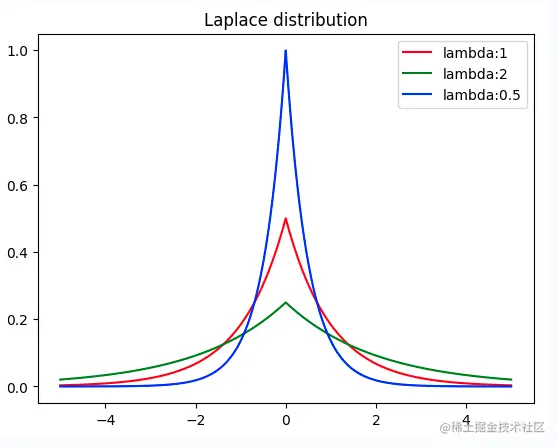
实际上说了一大堆,就是一件事:实现Laplace分布算子,那么首先我们需要知道什么是 Laplace 分布,在概率论和统计学中,拉普拉斯分布是一种连续概率分布。由于它可以看作是两个不同位置的指数分布背靠背拼在一起,所以它也叫双指数分布。与正态分布对比,正态分布是用相对于μ平均值的差的平方来表示,而拉普拉斯概率密度用相对于差的绝对值来表示。如下面的代码所示,Laplace 分布的图像和正态分布实际上是有点类似的,所以它的公式也与正态分布的公式类似的。
%matplotlib inline

import matplotlib.pyplot as plt

import numpy as np

def laplace_function(x, lambda_):

 return (1/(2*lambda_)) * np.e**(-1*(np.abs(x)/lambda_))

x = np.linspace(-5,5,10000)

y1 = [laplace_function(x_,1) for x_ in x]

y2 = [laplace_function(x_,2) for x_ in x]

y3 = [laplace_function(x_,0.5) for x_ in x]

plt.plot(x, y1, color='r', label="lambda:1")

plt.plot(x, y2, color='g', label="lambda:2")

plt.plot(x, y3, color='b', label="lambda:0.5")

plt.title("Laplace distribution")

plt.legend()

plt.show()
2、设计文档撰写
设计文档是我们API设计思路的体现,是整个开发工作中必要的部分。通过上述任务简介,我们可以知道此API的开发主要为Laplace分布的开发,需要包含一些相应的方法。首先我们需要弄清楚Laplace分布的数学原理,这里建议去维基百科查看Laplace分布的数学原理,弄明白数学原理。此外,我们可以参考Numpy、Scipy、Pytorch、Tensorflow的代码实现,进行设计文档的撰写。
首先,我们应该知道Laplace分布的概率密度函数公式、累积分布函数、逆累积分布函数,并且根据公式开发出代码,公式如下所示:

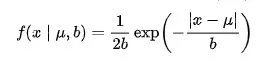
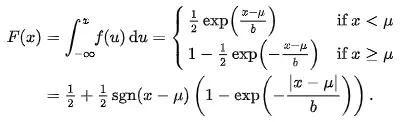
参考Numpy、Scipy、Pytorch、Tensorflow的代码实现,我们这里可以很容易的实现公式对应的代码,其实现方案如下3.1小节所示。
2.1 API 实现方案
该 API 实现于 paddle.distribution.Laplace。
基于paddle.distribution API基类进行开发。
class API 中的具体实现(部分方法已完成开发,故直接使用源代码),该api有两个参数:位置参数self.loc, 尺度参数self.scale。包含以下方法:
- mean 计算均值:
self.loc
- stddev 计算标准差:
(2 ** 0.5) * self.scale;
- variance 计算方差:
self.stddev.pow(2)
- sample 随机采样(参考pytorch复用重参数化采样结果):
self.rsample(shape)
- rsample 重参数化采样:
self.loc - self.scale * u.sign() * paddle.log1p(-u.abs())
其中 u = paddle.uniform(shape=shape, min=eps - 1, max=1); eps根据dtype决定;
- prob 概率密度(包含传参value):
self.log_prob(value).exp()
直接继承父类实现
- log_prob 对数概率密度(value):
-paddle.log(2 * self.scale) - paddle.abs(value - self.loc) / self.scale
- entropy 熵计算:
1 + paddle.log(2 * self.scale)
- cdf 累积分布函数(value):
0.5 - 0.5 * (value - self.loc).sign() * paddle.expm1(-(value - self.loc).abs() / self.scale)
- icdf 逆累积分布函数(value):
self.loc - self.scale * (value - 0.5).sign() * paddle.log1p(-2 * (value - 0.5).abs())
- kl_divergence 两个Laplace分布之间的kl散度(other–Laplace类的一个实例):
(self.scale * paddle.exp(paddle.abs(self.loc - other.loc) / self.scale) + paddle.abs(self.loc - other.loc)) / other.scale + paddle.log(other.scale / self.scale) - 1
同时在paddle/distribution/kl.py 中注册_kl_laplace_laplace函数,使用时可直接调用kl_divergence计算laplace分布之间的kl散度。
2.2 测试和验收的考量
在我们开发完对应的代码后,我们应该如何证明我们所开发出来的代码是正确的呢?这时候就需要单元测试的代码来证明我们的代码是正确的。那么什么是单元测试呢?单元测试的用例其实是一个“输入数据”和“预计输出”的集合。你需要跟你输入数据,根据逻辑功能给出预计输出,这里所说的根据逻辑功能是指,通过需求文档就能给出的预计输出。而非我们通过已经实现的代码去推导出的预计输出。这也是最容易被忽视的一点。你要去做单元测试,然后还要通过代码去推断出预计输出,如果你的代码逻辑本来就实现错了,给出的预计输出也是错的,那么你的单元测试将没有意义。实际上,这部分可以说是整个工作中最重要的部分也是比较难的部分,我们需要想出预计输出,并且如何通过已经实现的代码去推导出预计输出,只有单元测试通过了,我们的开发任务才算基本完成了。
根据api类各个方法及特性传参的不同,把单测分成三个部分:测试分布的特性(无需额外参数)、测试分布的概率密度函数(需要传值)以及测试KL散度(需要传入一个实例)。
1、测试Lapalce分布的特性
- 测试方法:该部分主要测试分布的均值、方差、熵等特征。类TestLaplace继承unittest.TestCase,分别实现方法setUp(初始化),test_mean(mean单测),test_variance(variance单测),test_stddev(stddev单测),test_entropy(entropy单测),test_sample(sample单测)。
- 均值、方差、标准差通过Numpy计算相应值,对比Laplace类中相应property的返回值,若一致即正确;
- 采样方法除验证其返回的数据类型及数据形状是否合法外,还需证明采样结果符合laplace分布。验证策略如下:随机采样30000个laplace分布下的样本值,计算采样样本的均值和方差,并比较同分布下scipy.stats.laplace返回的均值与方差,检查是否在合理误差范围内;同时通过Kolmogorov-Smirnov test进一步验证采样是否属于laplace分布,若计算所得ks值小于0.02,则拒绝不一致假设,两者属于同一分布;
- 熵计算通过对比scipy.stats.laplace.entropy的值是否与类方法返回值一致验证结果的正确性。
- 测试用例:单测需要覆盖单一维度的Laplace分布和多维度分布情况,因此使用两种初始化参数
- ‘one-dim’: loc=parameterize.xrand((2, )), scale=parameterize.xrand((2, ));
- ‘multi-dim’: loc=parameterize.xrand((5, 5)), scale=parameterize.xrand((5, 5))。
2、测试Lapalce分布的概率密度函数
- 测试方法:该部分主要测试分布各种概率密度函数。类TestLaplacePDF继承unittest.TestCase,分别实现方法setUp(初始化),test_prob(prob单测),test_log_prob(log_prob单测),test_cdf(cdf单测),test_icdf(icdf)。以上分布在scipy.stats.laplace中均有实现,因此给定某个输入value,对比相同参数下Laplace分布的scipy实现以及paddle实现的结果,若误差在容忍度范围内则证明实现正确。
- 测试用例:为不失一般性,测试使用多维位置参数和尺度参数初始化Laplace类,并覆盖int型输入及float型输入。
- ‘value-float’: loc=np.array([0.2, 0.3]), scale=np.array([2, 3]), value=np.array([2., 5.]); * ‘value-int’: loc=np.array([0.2, 0.3]), scale=np.array([2, 3]), value=np.array([2, 5]);
- ‘value-multi-dim’: loc=np.array([0.2, 0.3]), scale=np.array([2, 3]), value=np.array([[4., 6], [8, 2]])。
3、测试Lapalce分布之间的KL散度
- 测试方法:该部分测试两个Laplace分布之间的KL散度。类TestLaplaceAndLaplaceKL继承unittest.TestCase,分别实现setUp(初始化),test_kl_divergence(kl_divergence)。在scipy中scipy.stats.entropy可用来计算两个分布之间的散度。因此对比两个Laplace分布在paddle.distribution.kl_divergence下和在scipy.stats.laplace下计算的散度,若结果在误差范围内,则证明该方法实现正确。
- 测试用例:分布1:loc=np.array([0.0]), scale=np.array([1.0]), 分布2: loc=np.array([1.0]), scale=np.array([0.5])
3、代码开发
代码的开发主要参考Pytorch,此处涉及到单元测试代码的开发,kl散度注册等代码,需要仔细阅读PaddlePaddle中其他分布代码的实现形式。
import numbers

import numpy as np

import paddle

from paddle.distribution import distribution

from paddle.fluid import framework as framework

class Laplace(distribution.Distribution):

    r"""

    Creates a Laplace distribution parameterized by :attr:`loc` and :attr:`scale`.

    Mathematical details

    The probability density function (pdf) is

 .. math::

 pdf(x; \mu, \sigma) = \frac{1}{2 * \sigma} * e^{\frac {-|x - \mu|}{\sigma}}

    In the above equation:

 * :math:`loc = \mu`: is the location parameter.

 * :math:`scale = \sigma`: is the scale parameter.

 Args:

 loc (scalar|Tensor): The mean of the distribution.

 scale (scalar|Tensor): The scale of the distribution.

 name(str, optional): Name for the operation (optional, default is None). For more information, please refer to :ref:`api_guide_Name`.

    Examples:

 .. code-block:: python

 import paddle

                        m = paddle.distribution.Laplace(paddle.to_tensor([0.0]), paddle.to_tensor([1.0]))

 m.sample()  # Laplace distributed with loc=0, scale=1

                        # Tensor(shape=[1], dtype=float32, place=Place(cpu), stop_gradient=True,

                        # [3.68546247])

 """

    def __init__(self, loc, scale):

 if not isinstance(loc, (numbers.Real, framework.Variable)):

            raise TypeError(

 f"Expected type of loc is Real|Variable, but got {type(loc)}")

 if not isinstance(scale, (numbers.Real, framework.Variable)):

            raise TypeError(

 f"Expected type of scale is Real|Variable, but got {type(scale)}"

 )

 if isinstance(loc, numbers.Real):

            loc = paddle.full(shape=(), fill_value=loc)

 if isinstance(scale, numbers.Real):

            scale = paddle.full(shape=(), fill_value=scale)

 if (len(scale.shape) > 0 or len(loc.shape) > 0) and (loc.dtype

 == scale.dtype):

 self.loc, self.scale = paddle.broadcast_tensors([loc, scale])

 else:

 self.loc, self.scale = loc, scale

 super(Laplace, self).__init__(self.loc.shape)

    @property

    def mean(self):

 """Mean of distribution.

        Returns:

            Tensor: The mean value.

 """

 return self.loc

    @property

    def stddev(self):

 """Standard deviation.

        The stddev is

 .. math::

 stddev = \sqrt{2} * \sigma

        In the above equation:

 * :math:`scale = \sigma`: is the scale parameter.

        Returns:

            Tensor: The std value.

 """

 return (2**0.5) * self.scale

    @property

    def variance(self):

 """Variance of distribution.

        The variance is

 .. math::

            variance = 2 * \sigma^2

        In the above equation:

 * :math:`scale = \sigma`: is the scale parameter.

        Returns:

            Tensor: The variance value.

 """

 return self.stddev.pow(2)

    def _validate_value(self, value):

 """Argument dimension check for distribution methods such as `log_prob`,

 `cdf` and `icdf`.

 Args:

 value (Tensor|Scalar): The input value, which can be a scalar or a tensor.

        Returns:

          loc, scale, value: The broadcasted loc, scale and value, with the same dimension and data type.

 """

 if isinstance(value, numbers.Real):

            value = paddle.full(shape=(), fill_value=value)

 if value.dtype != self.scale.dtype:

            value = paddle.cast(value, self.scale.dtype)

 if len(self.scale.shape) > 0 or len(self.loc.shape) > 0 or len(

 value.shape) > 0:

            loc, scale, value = paddle.broadcast_tensors(

 [self.loc, self.scale, value])

 else:

            loc, scale = self.loc, self.scale

 return loc, scale, value

    def log_prob(self, value):

 """Log probability density/mass function.

        The log_prob is

 .. math::

            log\_prob(value) = \frac{-log(2 * \sigma) - |value - \mu|}{\sigma}

        In the above equation:

 * :math:`loc = \mu`: is the location parameter.

 * :math:`scale = \sigma`: is the scale parameter.

 Args:

 value (Tensor|Scalar): The input value, can be a scalar or a tensor.

        Returns:

          Tensor: The log probability, whose data type is same with value.

        Examples:

 .. code-block:: python

 import paddle

                            m = paddle.distribution.Laplace(paddle.to_tensor([0.0]), paddle.to_tensor([1.0]))

                            value = paddle.to_tensor([0.1])

 m.log_prob(value)

                            # Tensor(shape=[1], dtype=float32, place=Place(cpu), stop_gradient=True,

                            # [-0.79314721])

 """

        loc, scale, value = self._validate_value(value)

 log_scale = -paddle.log(2 * scale)

 return (log_scale - paddle.abs(value - loc) / scale)

    def entropy(self):

 """Entropy of Laplace distribution.

        The entropy is:

 .. math::

 entropy() = 1 + log(2 * \sigma)

        In the above equation:

 * :math:`scale = \sigma`: is the scale parameter.

        Returns:

            The entropy of distribution.

        Examples:

 .. code-block:: python

 import paddle

                            m = paddle.distribution.Laplace(paddle.to_tensor([0.0]), paddle.to_tensor([1.0]))

 m.entropy()

                            # Tensor(shape=[1], dtype=float32, place=Place(cpu), stop_gradient=True,

                            # [1.69314718])

 """

 return 1 + paddle.log(2 * self.scale)

    def cdf(self, value):

 """Cumulative distribution function.

        The cdf is

 .. math::

 cdf(value) = 0.5 - 0.5 * sign(value - \mu) * e^\frac{-|(\mu - \sigma)|}{\sigma}

        In the above equation:

 * :math:`loc = \mu`: is the location parameter.

 * :math:`scale = \sigma`: is the scale parameter.

 Args:

 value (Tensor): The value to be evaluated.

        Returns:

            Tensor: The cumulative probability of value.

        Examples:

 .. code-block:: python

 import paddle

                            m = paddle.distribution.Laplace(paddle.to_tensor([0.0]), paddle.to_tensor([1.0]))

                            value = paddle.to_tensor([0.1])

 m.cdf(value)

                            # Tensor(shape=[1], dtype=float32, place=Place(cpu), stop_gradient=True,

                            # [0.54758132])

 """

        loc, scale, value = self._validate_value(value)

 iterm = (0.5 * (value - loc).sign() *

 paddle.expm1(-(value - loc).abs() / scale))

 return 0.5 - iterm

    def icdf(self, value):

 """Inverse Cumulative distribution function.

        The icdf is

 .. math::

 cdf^{-1}(value)= \mu - \sigma * sign(value - 0.5) * ln(1 - 2 * |value-0.5|)

        In the above equation:

 * :math:`loc = \mu`: is the location parameter.

 * :math:`scale = \sigma`: is the scale parameter.

 Args:

 value (Tensor): The value to be evaluated.

        Returns:

            Tensor: The cumulative probability of value.

        Examples:

 .. code-block:: python

 import paddle

                            m = paddle.distribution.Laplace(paddle.to_tensor([0.0]), paddle.to_tensor([1.0]))

                            value = paddle.to_tensor([0.1])

 m.icdf(value)

                            # Tensor(shape=[1], dtype=float32, place=Place(cpu), stop_gradient=True,

                            # [-1.60943794])

 """

        loc, scale, value = self._validate_value(value)

        term = value - 0.5

 return (loc - scale * (term).sign() * paddle.log1p(-2 * term.abs()))

    def sample(self, shape=()):

 """Generate samples of the specified shape.

 Args:

 shape(tuple[int]): The shape of generated samples.

        Returns:

            Tensor: A sample tensor that fits the Laplace distribution.

        Examples:

 .. code-block:: python

 import paddle

                            m = paddle.distribution.Laplace(paddle.to_tensor([0.0]), paddle.to_tensor([1.0]))

 m.sample()  # Laplace distributed with loc=0, scale=1

                            # Tensor(shape=[1], dtype=float32, place=Place(cpu), stop_gradient=True,

                            # [3.68546247])

 """

 if not isinstance(shape, tuple):

            raise TypeError(

 f'Expected shape should be tuple[int], but got {type(shape)}')

 with paddle.no_grad():

 return self.rsample(shape)

    def rsample(self, shape):

 """Reparameterized sample.

 Args:

 shape(tuple[int]): The shape of generated samples.

        Returns:

            Tensor: A sample tensor that fits the Laplace distribution.

        Examples:

 .. code-block:: python

 import paddle

                            m = paddle.distribution.Laplace(paddle.to_tensor([0.0]), paddle.to_tensor([1.0]))

 m.rsample((1,))  # Laplace distributed with loc=0, scale=1

                            # Tensor(shape=[1, 1], dtype=float32, place=Place(cpu), stop_gradient=True,

                            # [[0.04337667]])

 """

        eps = self._get_eps()

        shape = self._extend_shape(shape) or (1, )

        uniform = paddle.uniform(shape=shape,

                                 min=float(np.nextafter(-1, 1)) + eps / 2,

                                 max=1. - eps / 2,

 dtype=self.loc.dtype)

 if len(self.scale.shape) == 0 and len(self.loc.shape) == 0:

            loc, scale, uniform = paddle.broadcast_tensors(

 [self.loc, self.scale, uniform])

 else:

            loc, scale = self.loc, self.scale

 return (loc - scale * uniform.sign() * paddle.log1p(-uniform.abs()))

    def _get_eps(self):

 """

        Get the eps of certain data type.

        Note:

            Since paddle.finfo is temporarily unavailable, we

            use hard-coding style to get eps value.

        Returns:

            Float: An eps value by different data types.

 """

        eps = 1.19209e-07

 if (self.loc.dtype == paddle.float64

                or self.loc.dtype == paddle.complex128):

            eps = 2.22045e-16

 return eps

    def kl_divergence(self, other):

 """Calculate the KL divergence KL(self || other) with two Laplace instances.

        The kl_divergence between two Laplace distribution is

 .. math::

 KL\_divergence(\mu_0, \sigma_0; \mu_1, \sigma_1) = 0.5 (ratio^2 + (\frac{diff}{\sigma_1})^2 - 1 - 2 \ln {ratio})

 .. math::

            ratio = \frac{\sigma_0}{\sigma_1}

 .. math::

            diff = \mu_1 - \mu_0

        In the above equation:

 * :math:`loc = \mu`: is the location parameter of self.

 * :math:`scale = \sigma`: is the scale parameter of self.

 * :math:`loc = \mu_1`: is the location parameter of the reference Laplace distribution.

 * :math:`scale = \sigma_1`: is the scale parameter of the reference Laplace distribution.

 * :math:`ratio`: is the ratio between the two distribution.

 * :math:`diff`: is the difference between the two distribution.

 Args:

 other (Laplace): An instance of Laplace.

        Returns:

            Tensor: The kl-divergence between two laplace distributions.

        Examples:

 .. code-block:: python

 import paddle

                            m1 = paddle.distribution.Laplace(paddle.to_tensor([0.0]), paddle.to_tensor([1.0]))

                            m2 = paddle.distribution.Laplace(paddle.to_tensor([1.0]), paddle.to_tensor([0.5]))

                            m1.kl_divergence(m2)

                            # Tensor(shape=[1], dtype=float32, place=Place(cpu), stop_gradient=True,

                            # [1.04261160])

 """

 var_ratio = other.scale / self.scale

        t = paddle.abs(self.loc - other.loc)

        term1 = ((self.scale * paddle.exp(-t / self.scale) + t) / other.scale)

        term2 = paddle.log(var_ratio)

 return term1 + term2 - 1
4、总结
目前,该API已经锁定贡献。回顾API的开发过程,实际上该API的开发并不难,主要的问题在于如何进行单元测试,证明开发的API是正确的,并且还有一些相关的细节点,比如KL散度的注册等。还有就是最开始走了弯路,参照了Normal的开发风格,将API写成了2.0风格的,影响了一些时间,并且在最后的单测中,发现了Uniform实现方式的一些Bug,此处Debug花费了一些时间,整体来看,花时间的部分是在单测部分。
Laplace分布算子开发经验分享的更多相关文章
- 【Meetup回顾】Apache DolphinScheduler在联通的实践和二次开发经验分享
在由 openLooKeng 社区主办,Apahce DolphinScheduler社区.Apache Pulsar 社区.示说网协办的联合 Meetup 上,来自联通数字科技的王兴杰老师分享了Do ...
- Nuxt开发经验分享
Nuxt开发经验分享 本文章基于starter-template模板进行讲解,面向有vue-cli开发经验的宝宝 vue init nuxt-community/starter-template ...
- 钱包开发经验分享:ETH篇
# 钱包开发经验分享:ETH篇 [TOC] ## 开发前的准备 > 工欲善其事,必先利其器 一路开发过来,积累了一些钱包的开发利器和网站,与大家分享一下.这些东西在这行开发过的人都知道,只是给行 ...
- Laplace(拉普拉斯)算子
[摘要] Laplace算子作为边缘检测之一,和Sobel算子一样也是工程数学中常用的一种积分变换,属于空间锐化滤波操作.拉普拉斯算子(Laplace Operator)是n维欧几里德空间中的一个二阶 ...
- 安卓开发经验分享:资源、UI、函数库、测试、构建一个都不能少(转)
除了高超的武艺,每位黑忍者还需要装备最好的武器.在软件开发的世界里,好的工具能让我们的生活变得更轻松,在更短的时间里写出更棒的代码. 时光回到2008年,那时安卓还很年轻.只有几个相关的博客和谷歌官方 ...
- java开发经验分享(三)
三. 项目开发 1. 需求: 1) 需求最终需要开发人员在产品中实现,开发不合理的设计会浪费时间,开发技术无法实现的设计带来最大的痛苦:失败.所以,开发人员要重视需求以及需求评审,提出自己能够想到的所 ...
- TCP/IP和Socket开发经验分享
当前与网络相关的业务主要是基于tcp/ip或http,熟悉j2ee的同学一定会对http场景下的开发比较了解.但是,精通tcp/ip以及如何构建一个直接基于tcp/ip层通讯的知识却不太多见.恰巧,最 ...
- 【转】安卓开发经验分享:资源、UI、函数库、测试、构建一个都不能少
本文由 ImportNew - 唐尤华 翻译自 gigavoice.如需转载本文,请先参见文章末尾处的转载要求. 除了高超的武艺,每位黑忍者还需要装备最好的武器.在软件开发的世界里,好的工具能让我们的 ...
- uni-app开发经验分享二十一: 图片滑动解锁插件制作解析
在开发用户模块的时候,相信大家都碰到过一个功能,图片滑动解锁后发送验证码,这里分享我用uni-app制作的一个小控件 效果如下: 需要如下图片资源 template <template> ...
- uni-app开发经验分享十九: uni-app对接微信小程序直播
uni-app对接微信小程序直播 1.登录微信小程序后台-点击>设置->第三方设置->添加直播插件 2.添加直播组件后->点击<详情> 记录这两个参数直播 ...
随机推荐
- vite+vue3批量导入静态资源图片;动态绑定大量图片
vite版本:vite3:vue版本:vue3 打包上线后发现,动态绑定的图片皆失效. 单图可用 import 导入解决,但是若有大量图片,一一导入则耗时耗力. vue2+webpack 可用 req ...
- JS Math与一些原始类型
镇楼图 Pixiv:DSマイル 一.值属性.函数 globalThis JS有全局对象,但是在不同环境中全局对象均不同.在Web环境中,window.self.frames取得全局对象,在Web Wo ...
- ubuntu安装软件报依赖关系错误
1.环境 Distributor ID: UbuntuDescription: Ubuntu 20.04.1 LTSRelease: 20.04Codename: focal 2.安装 报错 3.解决 ...
- 小白开始成长了+洛谷1488与CF629A Far Relative’s Birthday Cake题解
终于开始我的博客生活了,希望博客可以让我记住学了什么,错了什么,接下来会有什么将出现. 记录写ACM生涯中的一些经验和网工经验吧,如果有人看我博客的话,希望可以留言给我提提意见,指导指导我啦~~~ 正 ...
- 第七章 狄克斯特拉算法 (Dijkstra's algorithm)
步骤 找出最便宜的节点,即可在最短时间内前往的节点 对于该节点的的邻居,检查是否有前往他们的更短路径,如果有,就更新其开销 重复这个过程,知道对图中的每个节点都这样做了 计算最终路径 条件 只适用于有 ...
- [C#] Func及Action的快速Demo
参考代码1: using System;using System.Collections.Generic;using System.Linq;namespace FuncActionDemo{ ...
- pod控制器
Pod控制器介绍 Pod是kubernetes的最小管理单元,在kubernetes中,按照pod的创建方式可以将其分为两类: 自主式pod:kubernetes直接创建出来的Pod,这种pod删除后 ...
- OpenStack组件说明
1.版本对应组件 2.Juno版本的核心组件
- 联想拯救者R9000P风扇拉满加强散热的方法
管软可以开野兽模式,但是风扇还不是最猛的.锻炼的时候为了保护硬件,牺牲风扇和噪音吧,方法如下:下载 RWEverything运行RW.exe点击笔记本图标+EC文字的图案 修改:B0+0D对应的数据, ...
- Conda 创建、激活、克隆、删除虚拟环境 - 搬运
Conda 创建.激活.克隆.删除虚拟环境 转自 :https://zhuanlan.zhihu.com/p/547724114 风影忍着 通常来说,对于每一个新的项目,我们都需要创建一个新的环境 ...