
Paper Reading - Learning to Evaluate Image Captioning ( CVPR 2018 ) ★
Link of the Paper: https://arxiv.org/abs/1806.06422
Innovations:
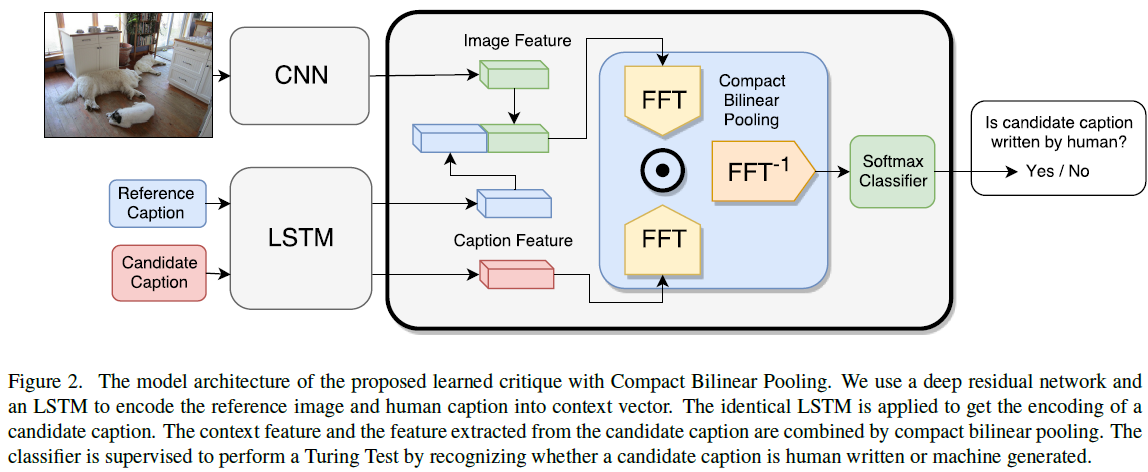
- The authors propose a novel learning based discriminative evaluation metric that is directly trained to distinguish between human and machine-generated captions. They train an automatic critique to distinguish generated captions from human-written ones, and then score candidate captions by how successful they are in fooling the critique. Formally, given a critique parametrized by Θ, a reference image i, and a generated caption c, the score is defined as the probability for the caption of being human-written, as assigned by the critique: scoreΘ(c, i) = P(c is human written | i, Θ). More generally, the reference image represents the context in which the generated caption is evaluated. To provide further information about the relevance and salience of the image content, a reference caption can additionally be supplied to the context. Let C(i) denotes the context of image i, then reference caption c could be included as part of context, i.e. c∈C(i). The score with context becomes scoreΘ(c, i) = P(c is human written | C(i), Θ).
- To systematically create pathological sentences, the authors define several transformations to generate unnatural sentences that might get high scores in an evaluation metric. Their proposed data augmentation scheme uses these transformations to generate large number of negative examples. Formally, a transformation Τ takes an image-caption dataset and generates a new one: Τ({(c, i) ∈ D}; γ) = {(c1', i1'), ..., (cn', in')}, where i, ii' are images, c, ci' are captions, D is a list of caption-image tuples representing the original dataset, and γ is a hyper-parameter that controls the strength of the transformation. Specifically, authors define following three transformations to generate pathological image-captions pairs:
- Random Captions ( RC ): To ensure the metric pays attention to the image content, they randomly sample human written captions from other images in the training set: TRC(D; γ) = {(c', i) | (c, i), (c', i') ∈ D, i'∈Nγ(i)}, where Nγ(i) represents the set of images that are top γ percent nearest neighbors to image i.
- Word Permutation ( WP ): To make sure that their metric pays attention to sentence structure, authors randomly permute at least 2 words in the reference caption: TWP(D; γ) = {(c', i) | (c, i) ∈ D, c' ∈ Pγ(c) \ {c}}, where Pγ(c) represents all sentences generated by permuting γ percent of words in caption c.
- Random Word ( RW ): To explore rare words authors replace from 2 to all words of the reference caption with random words from the vocabulary: TRW(D; γ) = {(c', i) | (c, i) ∈ D, c' ∈ Wγ(c) \ {c}}, where Wγ(c) represents all sentences generated by randomly replacing γ percent words from caption c.
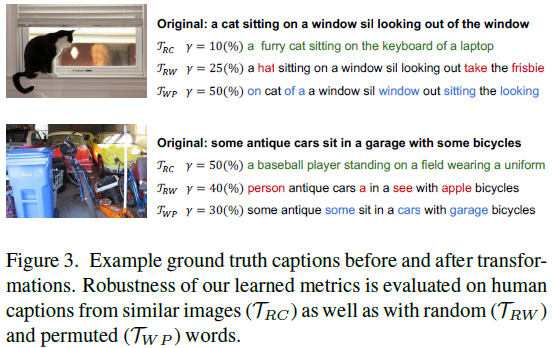
- The authors propose a systematic approach to measure the robustness of an evaluation metric to a given pathological transformation.
General Points:
- Commonly used evaluation metrics for Image Captioning: BLEU, METEOR, ROUGE, CIDEr, SPICE. These metrics face two challenges. Firstly, many metrics fail to correlate well with human judgments. Metrics based on measuring word overlap between candidate and reference captions find it difficult to capture semantic meaning of a sentence, therefore often lead to bad correlation with human judgments. Secondly, each evaluation metric has its well-known blind spot, and rule-based metrics are often inflexible to be responsive to new pathological cases.
- Compact Bilinear Pooling ( CBP ) has been demonstrated in Multimodal compact bilinear pooling for visual question answering and visual grounding to be very effective in combining heterogeneous information of image and text.
Paper Reading - Learning to Evaluate Image Captioning ( CVPR 2018 ) ★的更多相关文章
- Paper Reading - Convolutional Image Captioning ( CVPR 2018 )
Link of the Paper: https://arxiv.org/abs/1711.09151 Motivation: LSTM units are complex and inherentl ...
- Paper Reading - Learning like a Child: Fast Novel Visual Concept Learning from Sentence Descriptions of Images ( ICCV 2015 )
Link of the Paper: https://arxiv.org/pdf/1504.06692.pdf Innovations: The authors propose the Novel V ...
- Paper Reading: Stereo DSO
开篇第一篇就写一个paper reading吧,用markdown+vim写东西切换中英文挺麻烦的,有些就偷懒都用英文写了. Stereo DSO: Large-Scale Direct Sparse ...
- 读paper笔记[Learning to rank]
读paper笔记[Learning to rank] by Jiawang 选读paper: [1] Ranking by calibrated AdaBoost, R. Busa-Fekete, B ...
- 在矩池云上复现 CVPR 2018 LearningToCompare_FSL 环境
这是 CVPR 2018 的一篇少样本学习论文:Learning to Compare: Relation Network for Few-Shot Learning 源码地址:https://git ...
- 爬取CVPR 2018过程中遇到的坑
爬取 CVPR 2018 过程中遇到的坑 使用语言及模块 语言: Python 3.6.6 模块: re requests lxml bs4 过程 一开始都挺顺利的,先获取到所有文章的链接再逐个爬取获 ...
- Paper Reading - Convolutional Sequence to Sequence Learning ( CoRR 2017 ) ★
Link of the Paper: https://arxiv.org/abs/1705.03122 Motivation: Compared to recurrent layers, convol ...
- Paper Reading - Deep Captioning with Multimodal Recurrent Neural Networks ( m-RNN ) ( ICLR 2015 ) ★
Link of the Paper: https://arxiv.org/pdf/1412.6632.pdf Main Points: The authors propose a multimodal ...
- Paper Reading - Deep Visual-Semantic Alignments for Generating Image Descriptions ( CVPR 2015 )
Link of the Paper: https://arxiv.org/abs/1412.2306 Main Points: An Alignment Model: Convolutional Ne ...
随机推荐
- Nlog日志出坑合集
.net core框架下nlog不记录: 1.安装NLog.Web.AspNetCore 2.在Startup.cs文件的方法public void Configure(IApplicationBui ...
- 常见的springmvc、SpringBoot的注解
springMvc的常用注解 : @Controller :用于标记在一个类上,使用它标记的类就是一个springmcv Controller对象,分发处理器将会扫描使用了该注解 的类的方法,并检测该 ...
- 安装oracle11g时遇到环境不满足最低要求
在安装oracle11g时出现问题:INS-13001环境不满足最低要求 解决方法:找到下载解压后的文件,依次打开以下文件路径:Oracle11g\database\stage\cvu, 在cvu文件 ...
- WebPack系列之Proxy
背景 当我们直接去访问https://m.weibo.cn/api/config/list时由于端口.域名的不同产生了跨域,无法请求到资源数据. 分析 WebPack中devServer的proxy代 ...
- Mac连接Linux服务器
1.终端命令 a).打开Mac的命令终端 b).输入ssh -p 22 root@101.200.86.233 它会提示你输入密码,输入正确的密码之后,你就发现已经登陆成功了.(22: 端口号 roo ...
- Win10英文系统 JDK1.8安装及环境变量配置
前提 今天换新电脑了,需要重新安装一遍JDK.写个随笔记录一下整个过程. 下载 官网上JDK已经出到10了,但是回忆起JDK9都有各种坑(不支持一些软件),决定还是用JDK8. 下载地址: http: ...
- node 版本升级,版本管理,版本切换
查看node版本 node -v 升级步骤 1,清除node缓存 sudo npm cache clean -f 2,安装n模块 sudo npm install -g n 3,升级到稳定版本 sud ...
- windows service 2012:搭建FTP服务器
最近公司将服务器从线上移植到线下每次上传项目都要进入服务器感觉好麻烦, 所以就想搭建一个FTP的站点来管理项目,弄这个之前首先要关闭我们的windows service 2012 服务器的防火墙,只有 ...
- CI框架视图继承
CI(CodeIgniter)框架 视图继承 这个代码不是我撸的 ... 当时在哪儿找的忘了 ... 如果有侵权什么的 ... 联系我删了 ... 需要去core里面创建一个MY_loader.php ...
- php的基础知识(一)
php(超文本预处理器)定义: php(外文名:php:Hertext Preprocessor,中文名:“超文本预处理器”)是一种通用的开源脚本语言.语法吸收了C语言.Java和Perl的特点,利于 ...