
理解 LinkedList
java -version :jdk 1.8.0_191
构造
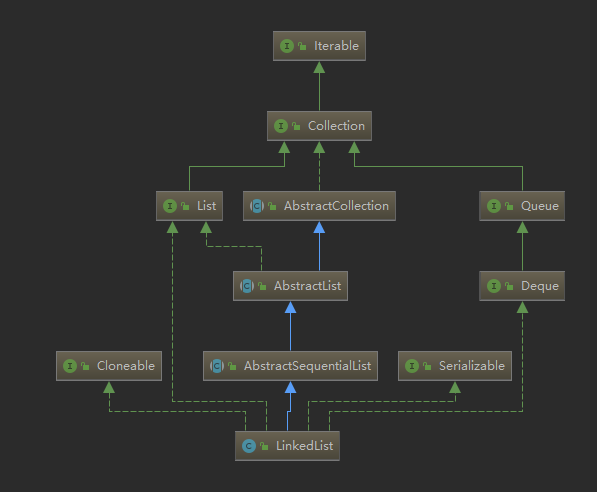
类内参数,方法
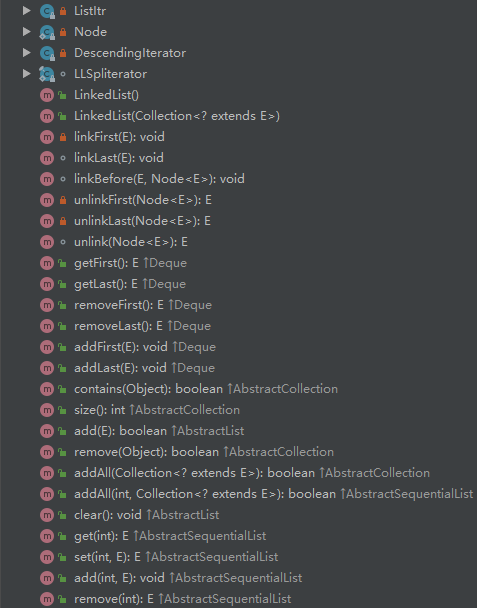
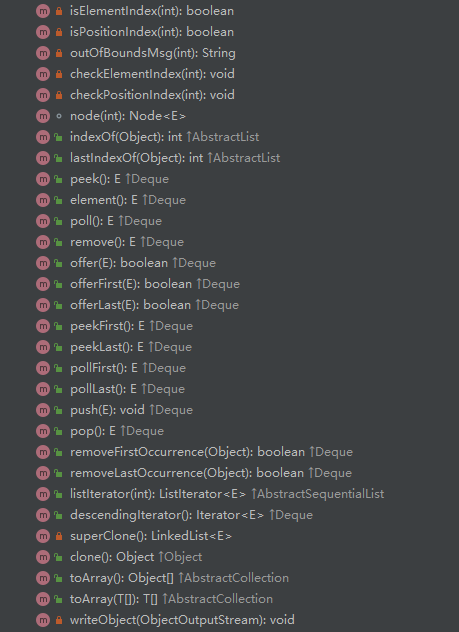
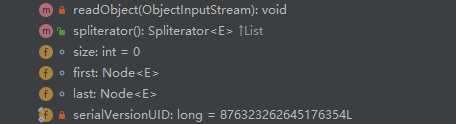
实现
基于双向链表实现。
插入时间复杂度 O(1)
查找时间复杂度 O(n)
删除时间复杂度 O(1)
修改时间复杂度 O(n)
链表不存在扩容的问题。
静态参数
1

2

3

4

5

6

7

8

9

10

11

12

13

14

15


    /**

     * Pointer to first node.

     * Invariant: (first == null && last == null) ||

     *            (first.prev == null && first.item != null)

     */

    transient Node<E> first;

    链表的第一个,不能被序列化

    /**

     * Pointer to last node.

     * Invariant: (first == null && last == null) ||

     *            (last.next == null && last.item != null)

     */

    transient Node<E> last;

    链表的最后一个,不能被序列化
节点参数
1

2

3

4

5

6

7

8

9

10

11

12

13

14


    private static class Node<E> {

        //数据

        E item;

        //下一个节点

        Node<E> next;

        //上一个节点

        Node<E> prev;

        Node(Node<E> prev, E element, Node<E> next) {

            this.item = element;

            this.next = next;

            this.prev = prev;

        }

    }
add方法
public boolean add(E e)
1

2

3

4

5

6

7

8

9

10

11

12

13

14

15

16

17

18

19

20

21

22

23

24

25

26

27

28


    /**

     * Appends the specified element to the end of this list.

     *

     * <p>This method is equivalent to {@link #addLast}.

     *

     * @param e element to be appended to this list

     * @return {@code true} (as specified by {@link Collection#add})

     */

    public boolean add(E e) {

        //插入到链表的尾端

        linkLast(e);

        return true;

    }

    /**

     * Links e as last element.

     */

    void linkLast(E e) {

        final Node<E> l = last;

        final Node<E> newNode = new Node<>(l, e, null);

        last = newNode;

        if (l == null)

            first = newNode;

        else

            l.next = newNode;

        size++;

        modCount++;

    }
public void add(int index, E element)
将 e 添加到指定位置
1

2

3

4

5

6

7

8

9

10

11

12

13

14

15

16

17

18

19


    /**

     * Inserts the specified element at the specified position in this list.

     * Shifts the element currently at that position (if any) and any

     * subsequent elements to the right (adds one to their indices).

     *

     * @param index index at which the specified element is to be inserted

     * @param element element to be inserted

     * @throws IndexOutOfBoundsException {@inheritDoc}

     */

    public void add(int index, E element) {

        //先判断是否会越界

        checkPositionIndex(index);

        //刚好是最后一个

        if (index == size)

            linkLast(element);

        else

            linkBefore(element, node(index));

    }
get方法
1

2

3

4

5

6

7

8

9

10

11

12

13

14

15

16

17

18

19

20

21

22

23

24

25

26

27

28

29

30

31

32

33


    /**

     * Returns the element at the specified position in this list.

     *

     * @param index index of the element to return

     * @return the element at the specified position in this list

     * @throws IndexOutOfBoundsException {@inheritDoc}

     */

    public E get(int index) {

        checkElementIndex(index);

        return node(index).item;

    }

    for 循环遍历下标,找到对应的节点,根据下标的大小判断是从头遍历还是从尾部遍历

    /**

     * Returns the (non-null) Node at the specified element index.

     */

    Node<E> node(int index) {

        // assert isEle 大专栏  理解 LinkedListmentIndex(index);

        从头遍历

        if (index < (size >> 1)) {

            Node<E> x = first;

            for (int i = 0; i < index; i++)

                x = x.next;

            return x;

        } else {

            从尾部遍历

            Node<E> x = last;

            for (int i = size - 1; i > index; i--)

                x = x.prev;

            return x;

        }

    }
remove方法
循环遍历找到对应的节点,然后将上一个节点的next指向该节点的下一个节点。
1
2
3
4
5
6
7
8
9
10
11
12
13
14
15
16
17
18
19
20
21
22
23
24
25
26
27
28
29
30
31
/**
* Removes the first occurrence of the specified element from this list,
* if it is present. If this list does not contain the element, it is
* unchanged. More formally, removes the element with the lowest index
* {@code i} such that
* <tt>(o==null ? get(i)==null : o.equals(get(i)))</tt>
* (if such an element exists). Returns {@code true} if this list
* contained the specified element (or equivalently, if this list
* changed as a result of the call).
*
* @param o element to be removed from this list, if present
* @return {@code true} if this list contained the specified element
*/
public boolean remove(Object o) {
if (o == null) {
for (Node<E> x = first; x != null; x = x.next) {
if (x.item == null) {
unlink(x);
return true;
}
}
} else {
for (Node<E> x = first; x != null; x = x.next) {
if (o.equals(x.item)) {
unlink(x);
return true;
}
}
}
return false;
}
序列化
LinkedList 和 ArrayList 一样,不能通过一般方式的序列化
序列化writeObject(java.io.ObjectOutputStream s)
1

2

3

4

5

6

7

8

9

10

11

12

13

14

15

16

17

18

19

20


    /**

     * Saves the state of this {@code LinkedList} instance to a stream

     * (that is, serializes it).

     *

     * @serialData The size of the list (the number of elements it

     *             contains) is emitted (int), followed by all of its

     *             elements (each an Object) in the proper order.

     */

    private void writeObject(java.io.ObjectOutputStream s)

        throws java.io.IOException {

        // Write out any hidden serialization magic

        s.defaultWriteObject();

        // Write out size

        s.writeInt(size);

        // Write out all elements in the proper order.

        for (Node<E> x = first; x != null; x = x.next)

            s.writeObject(x.item);

    }
反序列化readObject(java.io.ObjectInputStream s)
1

2

3

4

5

6

7

8

9

10

11

12

13

14

15

16

17


    /**

     * Reconstitutes this {@code LinkedList} instance from a stream

     * (that is, deserializes it).

     */

    @SuppressWarnings("unchecked")

    private void readObject(java.io.ObjectInputStream s)

        throws java.io.IOException, ClassNotFoundException {

        // Read in any hidden serialization magic

        s.defaultReadObject();

        // Read in size

        int size = s.readInt();

        // Read in all elements in the proper order.

        for (int i = 0; i < size; i++)

            linkLast((E)s.readObject());

    }
其他
LinkedList 和 ArrayList 一样,都不是线程安全的数据结构。
理解 LinkedList的更多相关文章
- 理解ArrayList与LinkedList的区别
一.先来看看ArrayList与LinkedList 在JDK中所在的位置 从图中可以看出,ArrayList与LinkedList都是List接口的实现类,因此都实现了List的所有未实现的方法,只 ...
- 深入理解ArrayList与LinkedList的区别
一.先来看看ArrayList与LinkedList 在JDK中所在的位置 从图中可以看出,ArrayList与LinkedList都是List接口的实现类,因此都实现了List的所有未实现的方法,只 ...
- 理解java容器底层原理--手动实现LinkedList
Node java 中的 LIinkedList 的数据结构是链表,而链表中每一个元素是节点. 我们先定义一下节点: package com.xzlf.collection; public class ...
- 容器--LinkedList
一.前言 上一篇我们介绍了List的重要实现之一ArrayList, 在大多数情况下,我们写代码时会直接使用到ArrayList,因为其在随机访问的优势是其它List无法比拟的.除了ArrayLis ...
- LinkedList源码分析
LinkedList也和ArrayList一样实现了List接口,但是它执行插入和删除操作时比ArrayList更加高效,因为它是基于链表的.基于链表也决定了它在随机访问方面要比ArrayList逊色 ...
- Java 集合深入理解(8):AbstractSequentialList
点击查看 Java 集合框架深入理解 系列, - ( ゜- ゜)つロ 乾杯~ 今天有点无聊,来学学 AbstractSequentialList 解解闷 吧! AbstractSequentialLi ...
- LinkedList源码浅析(jdk1.8)
LinkedList由双向链表实现的集合,因此可以从头或尾部双向循环遍历. LinkedList的操作都是对双向链表的操作,理解双向链表的数据结构就很容易理解LinkedList的实现. 双向链表由带 ...
- LinkedList 源码分析(JDK 1.8)
1.概述 LinkedList 是 Java 集合框架中一个重要的实现,其底层采用的双向链表结构.和 ArrayList 一样,LinkedList 也支持空值和重复值.由于 LinkedList 基 ...
- Java集合框架之二:LinkedList源码解析
版权声明:本文为博主原创文章,转载请注明出处,欢迎交流学习! LinkedList底层是通过双向循环链表来实现的,其结构如下图所示: 链表的组成元素我们称之为节点,节点由三部分组成:前一个节点的引用地 ...
随机推荐
- java类为什么要实现Serializable接口
什么是Serializable接口? 一个对象序列化的接口.一个类只有实现了Serializable接口,它的对象才能被序列化. 什么是序列化? 将对象的状态信息转换为可以存储或传输的形式的过程. 在 ...
- TOJ-3474 The Big Dance(递归二分)
链接:https://ac.nowcoder.com/acm/contest/1077/L 题目描述 Bessie and the herd, N (1 <= N <= 2,200) co ...
- iTOP-4412开发板qt4文件的移植和修改
在 7.4 小节介绍配置文件的时候,提到迅为制作的触摸库文件“/usr/local/tslib”,迅为 已经将触摸功能编译到 Qt/E4.7.1 的库文件中,开发板可以支持触摸和鼠标功能. 用户在前面 ...
- Linux基础篇三:文件系统
/bin 实际上是 /usr/bin /sbin 实际上是 /usr/sbin /usr/bin 里面的命令其实是依赖 /lib64 或者 /lib32 ldd /us ...
- idea整合mybatis逆向工程
--pom.xml添加插件 <build> <finalName>hnapi</finalName> <plugins> <plugin> ...
- mui折叠面板的使用
折叠面板从二级列表中演化而来,dom结构和二级列表类似,如下: <div class="mui-content"> <div class="mui-ca ...
- C#面向对象---对象成员、方法加载、引用类库
一.方法重载: 1.两个函数同名,就互相构成方法的重载关系 2.重载的函数,必须跟其他函数之间具有不同的参数类型或参数个数 二.字段与属性 类的字段: 类里面是可以直接定义变量的,这些变量就叫类的字段 ...
- day15-接口类
# 一.接口类的作用是规范它的子类,跟后面学习的接口没关系. from abc import abstractmethod,ABCMeta class Pay(metaclass=ABCMeta): ...
- Mysql Sql 语句练习题 (50道)
MySql 语句练习50题 表名和字段 –1.学生表 Student(s_id,s_name,s_birth,s_sex) –学生编号,学生姓名, 出生年月,学生性别 –2.课程表 Course(c_ ...
- 《C程序设计语言》练习 1-6,1-7
#include<stdio.h> /*验证表达式getchar()!=EOF的值是0还是1*/ main () { int c; c=getchar()!=EOF; printf(&qu ...