
Neural Network模型复杂度之Batch Normalization - Python实现
背景介绍
Neural Network之模型复杂度主要取决于优化参数个数与参数变化范围. 优化参数个数可手动调节, 参数变化范围可通过正则化技术加以限制. 本文从参数变化范围出发, 以Batch Normalization技术为例, 简要演示Batch Normalization批归一化对Neural Network模型复杂度的影响.算法特征
①. 重整批特征之均值与方差; ②. 以批特征均值与方差之凸组合估计整体特征均值与方差算法推导
以批数据集\(X_B = \{x^{(1)}, x^{(2)}, \cdots, x^{(n)}\}\)为例, 重整前均值与标准偏差分别如下\[\begin{align*}
\mu_B &= \frac{1}{n}\sum_i x^{(i)} \\
\sigma_B &= \sqrt{\frac{1}{n}\sum_i (x^{(i)} - \mu_B)^2 + \epsilon}
\end{align*}
\]其中, \(\epsilon\)代表足够小正数, 确保标准偏差非零.
对此批数据集进行如下重整,\[x_{\mathrm{new}}^{(i)} = \sigma_{B, \mathrm{new}}\frac{x^{(i)} - \mu_B}{\sigma_B} + \mu_{B, \mathrm{new}}
\]其中, \(\mu_{B,\mathrm{new}}\)与\(\sigma_{B, \mathrm{new}}\)为待优化参数, 分别代表批数据集重整后均值与标准偏差. 以此手段构建线性层, 重置了数据特征之分布范围, 调整了模型复杂度.
在训练过程中, 采用如下凸组合估计整体特征重整前均值与标准偏差,\[\begin{align*}
\mu &= \lambda\mu + (1 - \lambda)\mu_{B} \\
\sigma &= \lambda\sigma + (1-\lambda)\sigma_{B}
\end{align*}
\]其中, \(\lambda\)代表权重参数. 在测试过程中, 此\(\mu\)与\(\sigma\)用于替代\(\mu_B\)与\(\sigma_B\).
数据、模型与损失函数
此处采用与Neural Network模型复杂度之Dropout - Python实现相同的数据、模型与损失函数, 并在隐藏层取激活函数tanh之前引入Batch Normalization层.代码实现
本文拟将中间隐藏层节点数设置为300, 使模型具备较高复杂度. 通过添加Batch Normalization层与否, 观察Batch Normalization对模型收敛的影响.code
import numpy

import torch

from torch import nn

from torch import optim

from torch.utils import data

from matplotlib import pyplot as plt

numpy.random.seed(0)

torch.random.manual_seed(0)

# 获取数据与封装数据

def xFunc(r, g, b):

    x = r + 2 * g + 3 * b

    return x

def yFunc(r, g, b):

    y = r ** 2 + 2 * g ** 2 + 3 * b ** 2

    return y

def lvFunc(r, g, b):

    lv = -3 * r - 4 * g - 5 * b

    return lv

class GeneDataset(data.Dataset):

    def __init__(self, rRange=[-1, 1], gRange=[-1, 1], bRange=[-1, 1], num=100,\

                transform=None, target_transform=None):

        self.__rRange = rRange

        self.__gRange = gRange

        self.__bRange = bRange

        self.__num = num

        self.__transform = transform

        self.__target_transform = target_transform

        self.__X = self.__build_X()

        self.__Y_ = self.__build_Y_()

    def __build_X(self):

        rArr = numpy.random.uniform(*self.__rRange, (self.__num, 1))

        gArr = numpy.random.uniform(*self.__gRange, (self.__num, 1))

        bArr = numpy.random.uniform(*self.__bRange, (self.__num, 1))

        X = numpy.hstack((rArr, gArr, bArr))

        return X

    def __build_Y_(self):

        rArr = self.__X[:, 0:1]

        gArr = self.__X[:, 1:2]

        bArr = self.__X[:, 2:3]

        xArr = xFunc(rArr, gArr, bArr)

        yArr = yFunc(rArr, gArr, bArr)

        lvArr = lvFunc(rArr, gArr, bArr)

        Y_ = numpy.hstack((xArr, yArr, lvArr))

        return Y_

    def __len__(self):

        return self.__num

    def __getitem__(self, idx):

        x = self.__X[idx]

        y_ = self.__Y_[idx]

        if self.__transform:

            x = self.__transform(x)

        if self.__target_transform:

            y_ = self.__target_transform(y_)

        return x, y_

# 构建模型

class Linear(nn.Module):

    def __init__(self, in_features, out_features, bias=True):

        super(Linear, self).__init__()

        self.__in_features = in_features

        self.__out_features = out_features

        self.__bias = bias

        self.weight = nn.Parameter(torch.randn((in_features, out_features), dtype=torch.float64))

        self.bias = nn.Parameter(torch.randn((out_features,), dtype=torch.float64))

    def forward(self, X):

        X = torch.matmul(X, self.weight)

        if self.__bias:

            X += self.bias

        return X

class Tanh(nn.Module):

    def __init__(self):

        super(Tanh, self).__init__()

    def forward(self, X):

        X = torch.tanh(X)

        return X

class BatchNorm(nn.Module):

    def __init__(self, num_features, lamda=0.9, epsilon=1.e-6):

        super(BatchNorm, self).__init__()

        self.__num_features = num_features

        self.__lamda = lamda

        self.__epsilon = epsilon

        self.training = True

        self.__mu_new = nn.parameter.Parameter(torch.zeros((num_features,)))

        self.__sigma_new = nn.parameter.Parameter(torch.ones((num_features,)))

        self.__mu = torch.zeros((num_features,))

        self.__sigma = torch.ones((num_features,))

    def forward(self, X):

        if self.training:

            mu_B = torch.mean(X, axis=0)

            sigma_B = torch.sqrt(torch.var(X, axis=0) + self.__epsilon)

            X = (X - mu_B) / sigma_B

            X = X * self.__sigma_new + self.__mu_new

            self.__mu = self.__lamda * self.__mu + (1 - self.__lamda) * mu_B.data

            self.__sigma = self.__lamda * self.__sigma + (1 - self.__lamda) * sigma_B.data

            return X

        else:

            X = (X - self.__mu) / self.__sigma

            X = X * self.__sigma_new + self.__mu_new

            return X

class MLP(nn.Module):

    def __init__(self, hidden_features=50, is_batch_norm=True):

        super(MLP, self).__init__()

        self.__hidden_features = hidden_features

        self.__is_batch_norm = is_batch_norm

        self.__in_features = 3

        self.__out_features = 3

        self.lin1 = Linear(self.__in_features, self.__hidden_features)

        if self.__is_batch_norm:

            self.bn1 = BatchNorm(self.__hidden_features)

        self.tanh = Tanh()

        self.lin2 = Linear(self.__hidden_features, self.__out_features)

    def forward(self, X):

        X = self.lin1(X)

        if self.__is_batch_norm:

            X = self.bn1(X)

        X = self.tanh(X)

        X = self.lin2(X)

        return X

# 构建损失函数

class MSE(nn.Module):

    def forward(self, Y, Y_):

        loss = torch.sum((Y - Y_) ** 2)

        return loss

# 训练单元与测试单元

def train_epoch(trainLoader, model, loss_fn, optimizer):

    model.train(True)

    loss = 0

    with torch.enable_grad():

        for X, Y_ in trainLoader:

            optimizer.zero_grad()

            Y = model(X)

            lossVal = loss_fn(Y, Y_)

            lossVal.backward()

            optimizer.step()

            loss += lossVal.item()

    loss /= len(trainLoader.dataset)

    return loss

def test_epoch(testLoader, model, loss_fn):

    model.train(False)

    loss = 0

    with torch.no_grad():

        for X, Y_ in testLoader:

            Y = model(X)

            lossVal = loss_fn(Y, Y_)

            loss += lossVal.item()

    loss /= len(testLoader.dataset)

    return loss

# 进行训练与测试

class BatchNormShow(object):

    def __init__(self, trainLoader, testLoader):

        self.__trainLoader = trainLoader

        self.__testLoader = testLoader

    def train(self, epochs=100):

        torch.random.manual_seed(0)

        model_BN = MLP(300, True)

        loss_BN = MSE()

        optimizer_BN = optim.Adam(model_BN.parameters(), 0.001)

        torch.random.manual_seed(0)

        model_NoBN = MLP(300, False)

        loss_NoBN = MSE()

        optimizer_NoBN = optim.Adam(model_NoBN.parameters(), 0.001)

        trainLoss_BN, testLoss_BN = self.__train_model(self.__trainLoader, self.__testLoader, \

            model_BN, loss_BN, optimizer_BN, epochs)

        trainLoss_NoBN, testLoss_NoBN = self.__train_model(self.__trainLoader, self.__testLoader, \

            model_NoBN, loss_NoBN, optimizer_NoBN, epochs)

        fig = plt.figure(figsize=(5, 4))

        ax1 = fig.add_subplot()

        ax1.plot(range(epochs), trainLoss_BN, "r-", lw=1, label="train with BN")

        ax1.plot(range(epochs), testLoss_BN, "r--", lw=1, label="test with BN")

        ax1.plot(range(epochs), trainLoss_NoBN, "b-", lw=1, label="train without BN")

        ax1.plot(range(epochs), testLoss_NoBN, "b--", lw=1, label="test without BN")

        ax1.legend()

        ax1.set(xlabel="epoch", ylabel="loss", yscale="log")

        fig.tight_layout()

        fig.savefig("batch_norm.png", dpi=100)

        plt.show()

    def __train_model(self, trainLoader, testLoader, model, loss_fn, optimizer, epochs):

        trainLossList = list()

        testLossList = list()

        for epoch in range(epochs):

            trainLoss = train_epoch(trainLoader, model, loss_fn, optimizer)

            testLoss = test_epoch(testLoader, model, loss_fn)

            trainLossList.append(trainLoss)

            testLossList.append(testLoss)

            print(epoch, trainLoss, testLoss)

        return trainLossList, testLossList

if __name__ == "__main__":

    trainData = GeneDataset([-1, 1], [-1, 1], [-1, 1], num=1000, \

        transform=torch.tensor, target_transform=torch.tensor)

    testData = GeneDataset([-1, 1], [-1, 1], [-1, 1], num=300, \

        transform=torch.tensor, target_transform=torch.tensor)

    trainLoader = data.DataLoader(trainData, batch_size=len(trainData), shuffle=False)

    testLoader = data.DataLoader(testData, batch_size=len(testData), shuffle=False)

    bnsObj = BatchNormShow(trainLoader, testLoader)

    epochs = 10000

    bnsObj.train(epochs)
结果展示
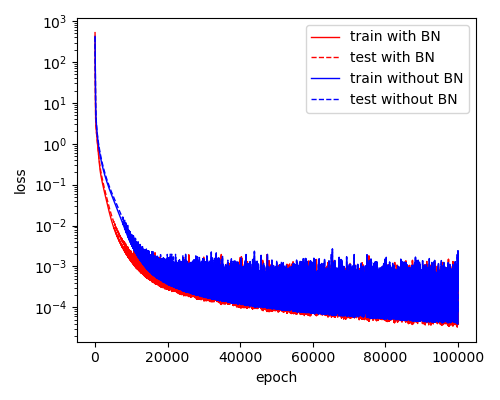
可以看到, Batch Normalization使得模型具备更快的收敛速度, 不过对最终收敛值影响不大, 即在上述重整手段下模型复杂度变化不大.
使用建议
①. Batch Normalization改变了特征分布, 具备调整模型复杂度的能力;
②. Batch Normalization使特征分布在原点附近, 不容易出现梯度消失或梯度爆炸;
③. Batch Normalization适用于神经网络全连接层与卷积层.参考文档
①. 动手学深度学习 - 李牧
Neural Network模型复杂度之Batch Normalization - Python实现的更多相关文章
- 吴恩达深度学习笔记(十二)—— Batch Normalization
主要内容: 一.Normalizing activations in a network 二.Fitting Batch Norm in a neural network 三.Why does ...
- Batch Normalization详解
目录 动机 单层视角 多层视角 什么是Batch Normalization Batch Normalization的反向传播 Batch Normalization的预测阶段 Batch Norma ...
- [CS231n-CNN] Training Neural Networks Part 1 : activation functions, weight initialization, gradient flow, batch normalization | babysitting the learning process, hyperparameter optimization
课程主页:http://cs231n.stanford.edu/ Introduction to neural networks -Training Neural Network ________ ...
- [C2W3] Improving Deep Neural Networks : Hyperparameter tuning, Batch Normalization and Programming Frameworks
第三周:Hyperparameter tuning, Batch Normalization and Programming Frameworks 调试处理(Tuning process) 目前为止, ...
- 图像分类(二)GoogLenet Inception_v2:Batch Normalization: Accelerating Deep Network Training by Reducing Internal Covariate Shift
Inception V2网络中的代表是加入了BN(Batch Normalization)层,并且使用 2个 3*3卷积替代 1个5*5卷积的改进版,如下图所示: 其特点如下: 学习VGG用2个 3* ...
- 课程二(Improving Deep Neural Networks: Hyperparameter tuning, Regularization and Optimization),第三周(Hyperparameter tuning, Batch Normalization and Programming Frameworks) —— 2.Programming assignments
Tensorflow Welcome to the Tensorflow Tutorial! In this notebook you will learn all the basics of Ten ...
- Batch normalization:accelerating deep network training by reducing internal covariate shift的笔记
说实话,这篇paper看了很久,,到现在对里面的一些东西还不是很好的理解. 下面是我的理解,当同行看到的话,留言交流交流啊!!!!! 这篇文章的中心点:围绕着如何降低 internal covari ...
- Deep Learning 27:Batch normalization理解——读论文“Batch normalization: Accelerating deep network training by reducing internal covariate shift ”——ICML 2015
这篇经典论文,甚至可以说是2015年最牛的一篇论文,早就有很多人解读,不需要自己着摸,但是看了论文原文Batch normalization: Accelerating deep network tr ...
- 论文笔记:Person Re-identification with Deep Similarity-Guided Graph Neural Network
Person Re-identification with Deep Similarity-Guided Graph Neural Network 2018-07-27 17:41:45 Paper: ...
- 论文翻译:2020_WaveCRN: An efficient convolutional recurrent neural network for end-to-end speech enhancement
论文地址:用于端到端语音增强的卷积递归神经网络 论文代码:https://github.com/aleXiehta/WaveCRN 引用格式:Hsieh T A, Wang H M, Lu X, et ...
随机推荐
- python导入和导出excel,以文件流形式返回前端
一.导入excel 1. 安装依赖包 pip install xlrd 2. 读取excel getColIndex(colList:list,colName:str): try: return co ...
- 【ccc】为了ds的ccc
补一下之前的笔记: 今日:str!!~~~ 然后还有gets 和 puts 和一些基础的东西 strlen:统计字符串长度 strcpy:将某个字符串赋值到字符数组中 strcat:拼接字符 ...
- el-transfer 数据量过大加载慢卡顿解决办法:el-transfer虚拟滚动懒加载的实现
参考链接 1)https://github.com/GreenHandLittleWhite/blog/issues/152)https://github.com/GreenHandLittleWhi ...
- 使用花生壳进行内网穿透实验SQLserver
在一次编写软件的过程中,想让远在河南的同学对试一试,但是他的电脑上没有与之对应的SQL数据库不能便不能够运行软件.于是我想到了远程连接.在使用花生壳的时候,遇到了一些问题,然而网络上并没有与之对应的解 ...
- vue3和vue2的区别
一.Vue3介绍 Vue 新版本的理念成型于 2018 年末,当时 Vue 2 的代码库已经有两岁半了.比起通用软件的生命周期来这好像也没那么久,但在这段时期,前端世界已经今昔非比了 在更新(和重写) ...
- Cesium中各种坐标以及相互转换(七)
2023-01-11 1.坐标系 Cartesian3 笛卡尔坐标,又叫世界坐标,是一个三维空间中的点 ,具有xyz,类似:(-1314910.6675027965, 5328726.84641194 ...
- JZOJ 1038. 【SCOI2009】游戏
题目 自己找 思路 大致过程见 JZOJ 3232. [佛山市选2013]排列 而本题改成种类数 那么我们不需要 \(ln\) 这个东东 直接转移 \(f\) 改成种类数 对于可能转移过来的状态,直接 ...
- 操作系统复习(updating)
操作系统复习(updating) 1.进程和线程的区别是什么? 1)调度:进程是操作系统资源分配的基本单位,而线程是处理器任务调度和执行的基本单位 2)拥有资源:不论是传统操作系统还是设有线程的操作系 ...
- NameError: name '_name_' is not defined
if _name_ == '_main_': 错误的原因可能是name是双下划线.(明显下面的下划线要长一点) if __name_ == '_main__':
- PostGIS之空间连接
1. 概述 PostGIS 是PostgreSQL数据库一个空间数据库扩展,它添加了对地理对象的支持,允许在 SQL 中运行空间查询 PostGIS官网:About PostGIS | PostGIS ...