
poj 1486 Sorting Slides
| Time Limit: 1000MS | Memory Limit: 10000K | |
| Total Submissions: 4469 | Accepted: 1766 |
Description
The situation is like this. The slides all have numbers written on them according to their order in the talk. Since the slides lie on each other and are transparent, one cannot see on which slide each number is written. 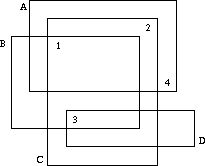
Well, one cannot see on which slide a number is written, but one may deduce which numbers are written on which slides. If we label the slides which characters A, B, C, ... as in the figure above, it is obvious that D has number 3, B has number 1, C number 2 and A number 4.
Your task, should you choose to accept it, is to write a program that automates this process.
Input
This is followed by n lines containing two integers each, the x- and y-coordinates of the n numbers printed on the slides. The first coordinate pair will be for number 1, the next pair for 2, etc. No number will lie on a slide boundary.
The input is terminated by a heap description starting with n = 0, which should not be processed.
Output
If no matchings can be determined from the input, just print the word none on a line by itself.
Output a blank line after each test case.
Sample Input
4

6 22 10 20

4 18 6 16

8 20 2 18

10 24 4 8

9 15

19 17

11 7

21 11

2

0 2 0 2

0 2 0 2

1 1

1 1

0
Sample Output
Heap 1

(A,4) (B,1) (C,2) (D,3)

Heap 2

none

题意:有n张幻灯片重叠在了一起,并且每张幻灯片上都标记了一个数字,只是重叠之后不知道相应的数字是哪张幻灯片上的,你需要判断那几张幻灯片可以确定出它们上面标记的数字。
思路:每张幻灯片抽象为一个结点,每个数字也抽象为一个结点,并且每个数字出现在了某张幻灯片的内部,幻灯片就向该数字连一条边,这样建立了匹配图,之后就是二分匹配问题。先求一次该图最大匹配,求得的匹配数设为N;
要确定出每张幻灯片a是不是对应了某个数字b,可以先把a,b对应的边从图中删除,删除后再求该图最大匹配,若最大匹配变为了N-1,说明这条边是必须边,即确定了a,b的对应关系;反之,这条边删除后,a还可以和其他的数字对应,b还可和其他幻灯片对应,那么关系就不唯一了,无法确定。操作完成,把这条边再加进图中
把所有边都删除一次,即可确定哪些边是必须的。
AC代码:
#define _CRT_SECURE_NO_DEPRECATE

#include<iostream>

#include<algorithm>

#include<queue>

#include<set>

#include<vector>

#include<cstring>

#include<string>

using namespace std;

#define INF 0x3f3f3f3f

const int N_MAX =;

int V;//点的个数

vector<int>G[N_MAX];

int match[N_MAX];

bool used[N_MAX];

void add_edge(int u, int v) {

    G[u].push_back(v);

    G[v].push_back(u);

}

bool dfs(int v) {

    used[v] = true;

    for (int i = ; i < G[v].size(); i++) {

        int u = G[v][i], w = match[u];

        if (w <  || !used[w] && dfs(w)) {

            match[v] = u;

            match[u] = v;

            return true;

        }

    }

    return false;

}

int bipartite_matching() {

    int res = ;

    memset(match, -, sizeof(match));

    for (int v = ; v < V; v++) {

        if (match[v] < ) {

            memset(used, , sizeof(used));

            if (dfs(v))

                res++;

        }

    }

    return res;

}

struct Area {

    int x_min, x_max, y_min, y_max;

}area[N_MAX];

struct Cor {

    int x, y;

}cor[N_MAX];

int n,s,t,COr[N_MAX];

char ARea[N_MAX];

int main() {

    int Case = ;

    while (scanf("%d",&n)&&n) {

        Case++;

        //0~n-1:区域

        //n~2n-1:记号

        V =  * n;

        for (int i = ; i < n; i++)

            scanf("%d%d%d%d",&area[i].x_min,&area[i].x_max,&area[i].y_min,&area[i].y_max);

        for (int i = ; i < n;i++) {

            scanf("%d%d",&cor[i].x,&cor[i].y);

            for (int j = ; j < n;j++) {

                if (area[j].x_min<cor[i].x&&area[j].x_max>cor[i].x&&area[j].y_min<cor[i].y&&area[j].y_max>cor[i].y)

                add_edge(j, i + n);

            }

        }

        int N = bipartite_matching();//一开始匹配数

        int num = ;

        for (int i = ; i < n;i++) {//对于每一块区域

            for (int j = ; j < n;j++) {//对于每一个坐标点

                if (area[i].x_min<cor[j].x&&area[i].x_max>cor[j].x&&area[i].y_min<cor[j].y&&area[i].y_max>cor[j].y) {

                    vector<int>::iterator it1 = find(G[i].begin(),G[i].end(),j+n);

                    vector<int>::iterator it2 = find(G[j + n].begin(), G[j + n].end(), i);

                    G[i].erase(it1);

                    G[j + n].erase(it2);

                    if (bipartite_matching() < N) {//说明是必须边

                        ARea[num] = i+;

                        COr[num] = j+;

                            num++;

                    }

                    add_edge(i, j + n);//复原

                }

            }

        }

        if (!num)printf("Heap %d\nnone\n",Case);

        else {

            printf("Heap %d\n", Case);

            for (int i = ; i < num;i++) {

                printf("(%c,%d) ",ARea[i],COr[i]);

            }

            puts("");

        }

        puts("");

    for (int i = ; i < V;i++) {

            G[i].clear();

        }

    }

    return ;

}
poj 1486 Sorting Slides的更多相关文章
- POJ 1486 Sorting Slides (KM)
Sorting Slides Time Limit: 1000MS Memory Limit: 10000K Total Submissions: 2831 Accepted: 1076 De ...
- POJ 1486 Sorting Slides(二分图匹配)
[题目链接] http://poj.org/problem?id=1486 [题目大意] 给出每张幻灯片的上下左右坐标,每张幻灯片的页码一定标在这张幻灯片上, 现在问你有没有办法唯一鉴别出一些幻灯片 ...
- poj 1486 Sorting Slides(二分图匹配的查找应用)
Description Professor Clumsey is going to give an important talk this afternoon. Unfortunately, he i ...
- POJ 1486 Sorting Slides(寻找必须边)
题意:找出幻灯片与编号唯一对应的情况 思路: 1:求最大匹配,若小于n,则答案为none,否则转2 (不过我代码没有事先判断一开始的最大匹配数是否<n,但这样也过了,估计给的数据最大匹配数一定为 ...
- POJ 1486 Sorting Slides (二分图关键匹配边)
题意 给你n个幻灯片,每个幻灯片有个数字编号1~n,现在给每个幻灯片用A~Z进行编号,在该幻灯片范围内的数字都可能是该幻灯片的数字编号.问有多少个幻灯片的数字和字母确定的. 思路 确定幻灯片的数字就是 ...
- POJ 1486 Sorting Slides(二分图完全匹配必须边)题解
题意:给你n张照片的范围,n个点的坐标,问你能唯一确定那几个点属于那几张照片,例如样例中4唯一属于A,2唯一属于C,1唯一属于B,3唯一属于C 思路:进行二分图完全匹配,怎么判断唯一属于?匹配完之后删 ...
- POJ 1486 Sorting Slides【二分图匹配】
题目大意:有n张幻灯片和n个数字,幻灯片放置有重叠,每个数字隶属于一个幻灯片,现在问你能够确定多少数字一定属于某个幻灯片 思路:上次刷过二分图的必须点后这题思路就显然了 做一次二分匹配后将当前匹配的边 ...
- 【POJ】1486:Sorting Slides【二分图关键边判定】
Sorting Slides Time Limit: 1000MS Memory Limit: 10000K Total Submissions: 5390 Accepted: 2095 De ...
- ACM: poj 1094 Sorting It All Out - 拓扑排序
poj 1094 Sorting It All Out Time Limit:1000MS Memory Limit:10000KB 64bit IO Format:%lld & ...
随机推荐
- Stream.iterate方法与UnaryOperator
前提:本人在翻看<Java核心技术II>的时候在p17的时候发现一段代码不是很明白.不知道为什么就输出了1,2,3,4,5,6,7,8,9,10,...也不知道n-n.add(BigInt ...
- Robot Framework(十三) 执行测试用例——创建输出
3.5创建输出 执行测试时会创建几个输出文件,并且所有这些文件都与测试结果有某种关联.本节讨论创建的输出,如何配置它们的创建位置以及如何微调其内容. 3.5.1不同的输出文件 输出目录 输出文件 日志 ...
- hibernate的注解
1.many-to-one @ManyToOne @JoinColumn(name = "user_id") 2.many-to-many /** * 双向关联关系中,有且仅有一端 ...
- Bootstrap 基本按钮
本章将通过实例讲解如何使用Bootstrap按钮,任何带有class.btn的元素都会继承圆角灰色默认按钮样式,但Bootstrap提供了一些选项来定义按钮的样式. 实例 <!DOCTYPE h ...
- XDB基于Library的备份及恢复
基于standalone全备份 语句: xdb backup --federation xhive://localhost:1235 --standalone --file E:\xdbData\xD ...
- 746. Min Cost Climbing Stairs@python
On a staircase, the i-th step has some non-negative cost cost[i] assigned (0 indexed). Once you pay ...
- Codeforces Round #477滚粗记&&祭第一次div2场
4.29 - 23:58:现在似乎在ST的样子……先等一波 Day4.29 prescript : 难得遇上一场9:00开始的div2,看了看大家都打,索性也当一回神仙吧. 晚上出去吃饭,匆匆赶回家, ...
- 八:SQL之DQL数据查询语言单表操作
前言: DQL数据库查询语言是我们在开发中最常使用的SQL,这一章总结了单表操作部分的常用查询方式 主要操作有:查询所有字段.查询指定字段.查询指定记录.带IN的关键字查询,范围查询,陪查询.查询空值 ...
- 蓝牙学习 (8)配对raspberryPi和SensorTag CC2650
在上一篇中,用raspberryPi能够扫描到Ti SensorTag. 但是没有获得更多的数据,并且发现sensor Tag并没有回复scan request. https://blog.csdn. ...
- 【mysql】返回非空值 COALESCE 用法
在mysql中,其实有不少方法和函数是很有用的,这次介绍一个叫coalesce的,拼写十分麻烦,但其实作用是将返回传入的参数中第一个非null的值,比如 SELECT COALESCE(NULL, N ...